![]() |
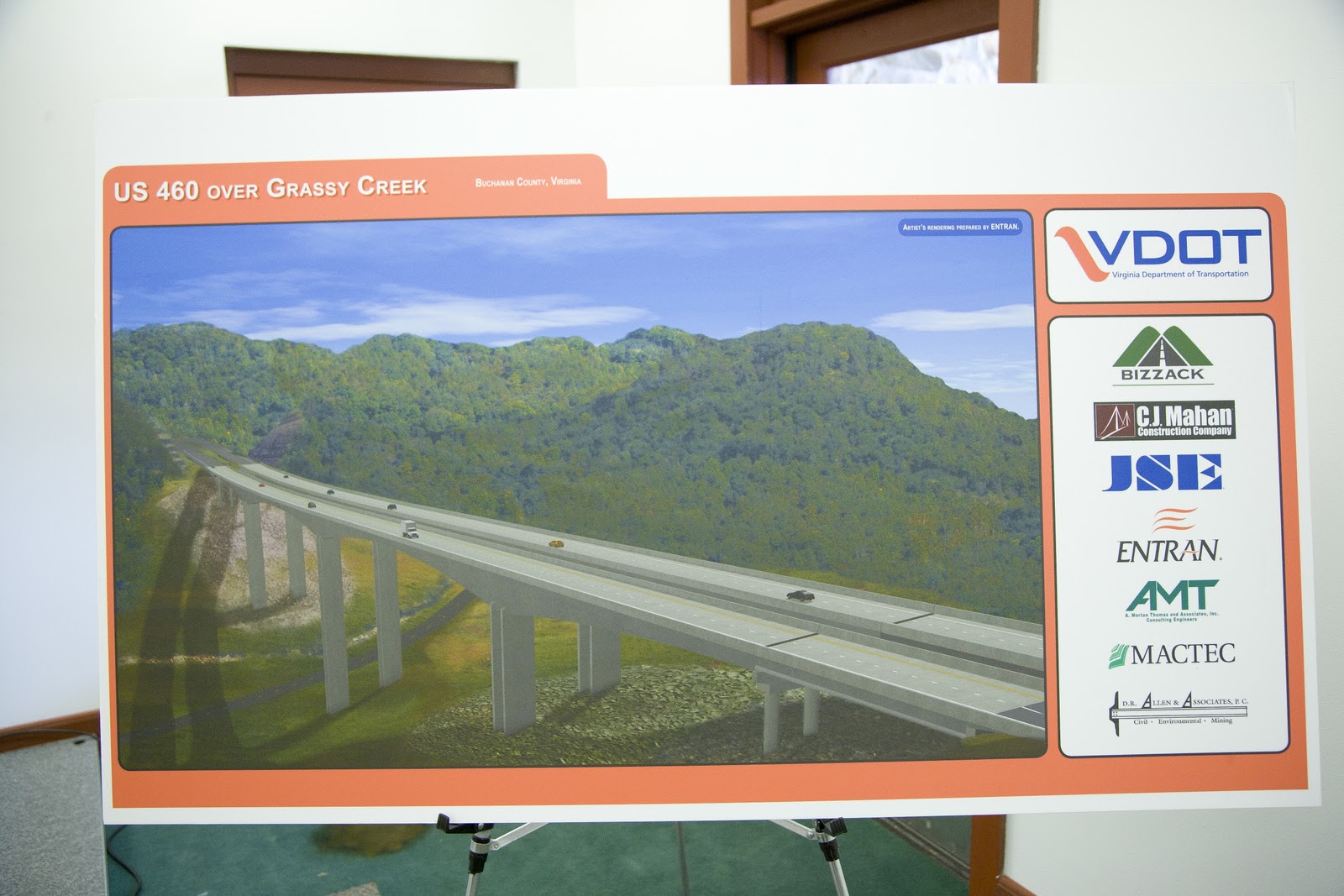
| Route 460 Connector Phase 1 Ceremonial Groundbreaking Breaks Interstate Park (Photo by Trevor Wrayton, VDOT) |
![]() |
| Route 460 Connector Phase 1 Ceremonial Groundbreaking Breaks Interstate Park (Photo by Trevor Wrayton, VDOT) |
![]() |
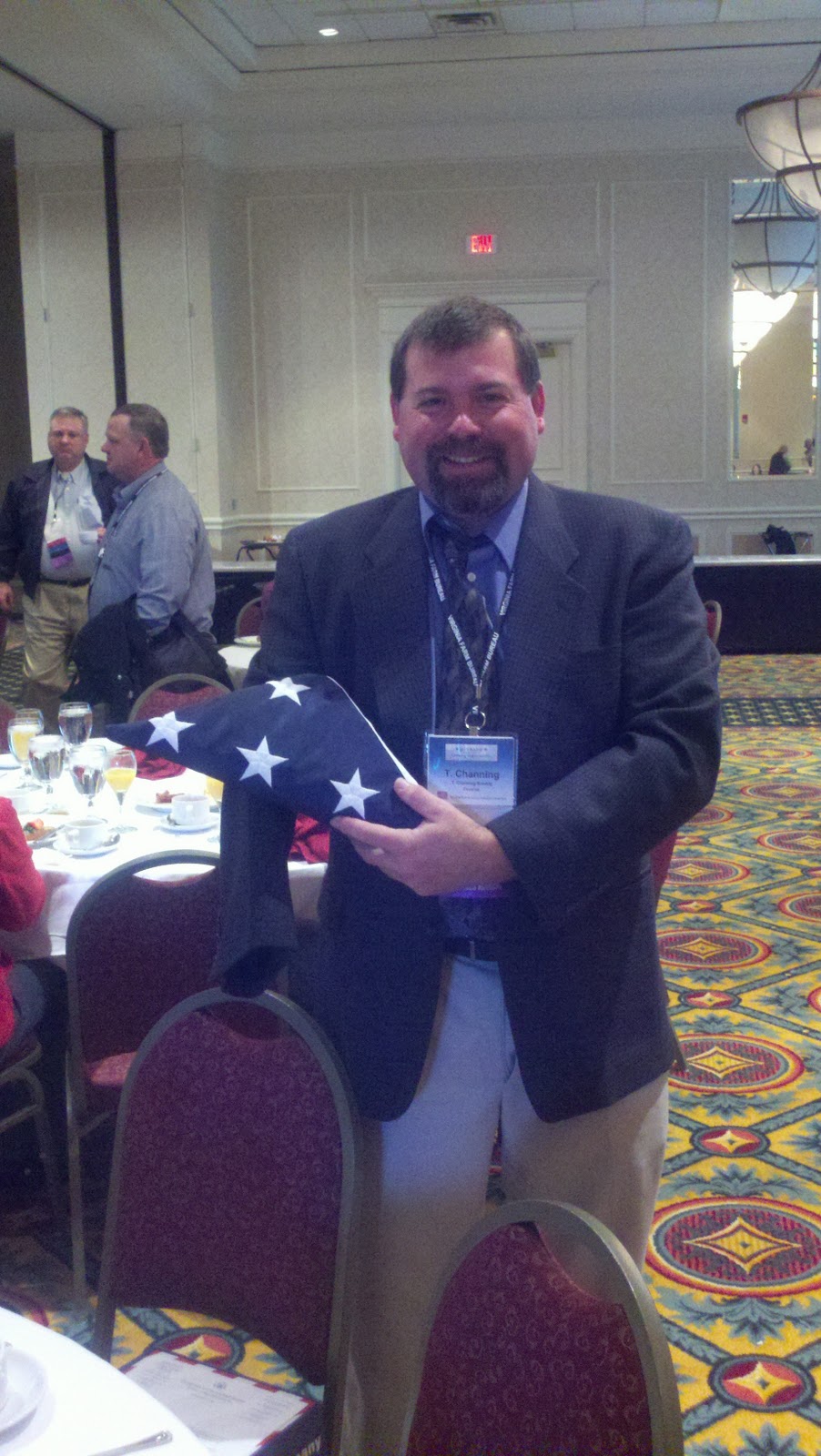
| Channing Snoddy, president of Fluvanna County Farm Bureau, received an American flag from the U.S. Capital on behalf of his county reaching the goal for the Stand Our Ground: Critical Issues campaign. |
In 2010, Farm Bureau members responded to Action Alerts regarding federal legislation that would unfairly blame farmers and overestimate their impact on the Chesapeake Bay. Their efforts resulted in 28,000 contacts made to U.S. Sens. Warner and Web and Virginia’s delegation in the House of Representatives, including personal visits, emails, phone calls and more than 18,000 letters. These contacts played a huge role in the defeat of the legislation
With the success of our Stand Our Ground: Chesapeake Bay campaign in 2010, we wanted to keep the momentum going in 2011 with other critical federal issues. We began the Stand Our Ground: Critical Issues campaign in July, and challenged county Farm Bureaus to make as many legislative contacts as possible on these four of our federal critical issues with Virginia’s congressional delegation by November 15, 2011. Those four issues were the 2012 Farm Bill, ag labor, air quality and water quality.
These issues along with a specific contact goal were recommended by the VFBF Legislative and National Affairs Advisory Committees and approved by the VFBF Board. These issues are aligned with American Farm Bureau priority issues.
The goal for each county Farm Bureau was to get a minimum of 2 percent of its producer membership to make contacts for each issue. Members from counties that achieved this goal were recognized at the Virginia Farm Bureau Federation Annual Convention last week by wearing purple ribbons. We had 75 counties reach and exceed their 2 percent goal, which is wonderful accomplishment! The county that made the lost contacts in each district received an American flag from the U.S. Capital, and were recognized at the Leadership Breakfast during the convention. Click below to see what counties reached their goal.
Below are the counties that reached their campaign goal. Counties noted in red are the district winners.
Accomack
Albemarle
Alleghany
Amelia
Amherst
Augusta
Bedford
Bland
Botetourt
Brunswick
Buckingham
Caroline
Carroll
CC-JC-NK-Y
Charlotte
Chesapeake
Chesterfield
Clarke
Craig
Culpeper
Dinwiddie
Essex
Fauquier
Floyd
Fluvanna
Franklin
Giles
Gloucester-Mathews
Goochland
Grayson
Greene
Greensville
Hanover
Henrico
Henry
Highland-Bath
Isle of Wight
King William
Lee
Lunenburg
Mecklenburg
Middlesex
Montgomery
Nansemond
Nelson
Northampton
Northumberland-Lancaster
Nottoway
Page
Patrick
Pittsylvania
Powhatan
Prince George
Prince Edward
Pulaski
Rappahannock
Roanoke
Rockbridge
Rockingham
Russell
Scott
Shenandoah
Smyth
Southampton
Stafford
Surry
Sussex
Tazewell
Virginia Beach
Warren
Washington
Westmoreland
Wise – Dickenson
Wythe
Virginia Farm Bureau members from across the state are meeting in Norfolk this week for the organization’s annual convention. Along with attending workshops and other programs, members will discuss and set policy for the upcoming year.
On Tuesday, members stopped by the Governmental Relations booth in the convention’s exhibit hall to learn about five of Farm Bureau’s critical issues: animal care, property rights, Virginia Cooperative Extension funding, water quality and game laws. They also learned about receiving Capital Connections Action Alerts from the GR Department, as well as how to sign up to receive e-mail alerts on new posts on the Plows and Politics blog (hint: enter your e-mail address under FOLLOW BY E-MAIL in the top left of this page). Both are very important tools to keep members updated and active during the General Assembly and Congress on issues that may need legislative contacts.
On Wednesday, members heard from Secretary of Agriculture Todd Haymore at breakfast. Afterwards, members entered General Session where they heard from updates from the insurance company and participated in policy discussions.
During the remainder of the convention, members will set policy, determine what county representatives will attend the American Farm Bureau Federation’s annual meeting in January, and hold elections for the VFB Board of Directors.
As many as 900 farmers and others with an interest in agriculture and agribusiness will gather next week for the Virginia Farm Bureau Federation’s annual convention at the Norfolk Waterside Marriott.
This is a very important step in Farm Bureau’s legislative process. During general sessions of the convention, voting delegates from each of Virginia’s 88 county Farm Bureaus will discuss and cote on the organization’s state and federal legislative policies for the coming year. They also will elect members of the VFBF board of directors to represent Districts 1, 4, 7, 10 and 13.
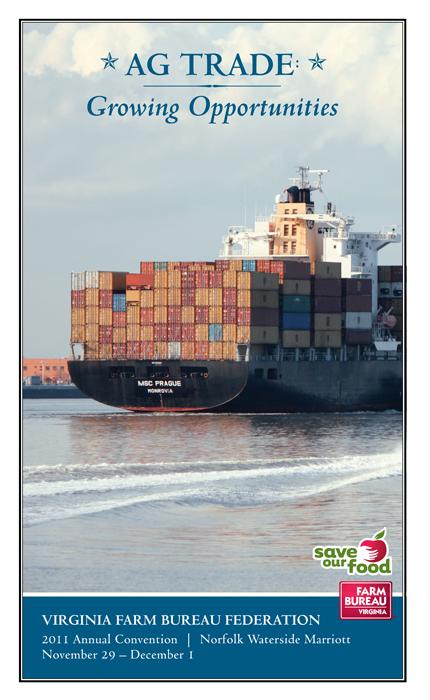
With the theme “Ag Trade: Growing Opportunities,” this year’s Virginia Farm Bureau Federation Annual Convention will focus on how farmers can increase their profitability through trade.
Topping the conference is a keynote speech by J.J. Keever, senior deputy executive director of external affairs for the Virginia Port Authority, titled “Agriculture & Maritime: Partnering for a Brighter Future.” Keever will talk about how farmers can take advantage of the Port of Virginia to increase agricultural exports.
Participants also will have the opportunity to attend two educational conferences: “Port of Virginia: Proximity & Potential Profit” and “Conservation Easements: The Right Fit for Your Farm?”
Greg Edwards, director of external affairs for the Virginia Port Authority, will piggyback on Keever’s keynote speech and offer farmers tangible ways to get involved in exporting their products through the Port of Virginia.
Lisa Anne Hawkins, Kevin Schmidt and Laura Thurman will participate in a panel discussion on conservation easements and how farmers can benefit from them. Hawkins is a founding partner of the law firm Lenhart Obenshain PC and has worked on easements to preserve thousands of acres of land in Virginia. Schmidt is the coordinator of the Virginia Department of Agriculture and Consumer Services’ Office of Farmland Preservation. Thurman is the easement project manager for the Shenandoah Valley region of the Virginia Outdoors Foundation.
Stay tuned to the blog for live updates from convention next week. And if you’re a producer member attending the convention, stop by the Governmental Relations booth in the exhibit hall to learn more about our 2012 critical issues.
Happy Thanksgiving!
Over the past two years, Governor McDonnell has made the preservation of working lands a priority for his administration. The Virginia Department of Agriculture and Consumer Services (VDACS) has recently posted the online registration for the next two “Conservation Easement Workshop for Working Lands” sessions. These workshops, led by Secretary Todd Haymore and Commissioner Matthew Lohr, are a great opportunity for farm and forest landowners in Virginia to learn more about conservation easements and see if it is a good idea for their farm and get questions answered. This past spring the first one was held in Rockbridge County, and we had good attendance from actual farmers in that section of the Valley. The next two sessions are as follows:
December 13, 2011: Pittsylvania County at Olde Dominion Agricultural Complex in Chatham
January 5, 2012: Dinwiddie County at Eastside Community Enhancement Center in Petersburg
For more information, visit www.vdacs.virginia.gov/preservation/workshop.shtml
![]() |
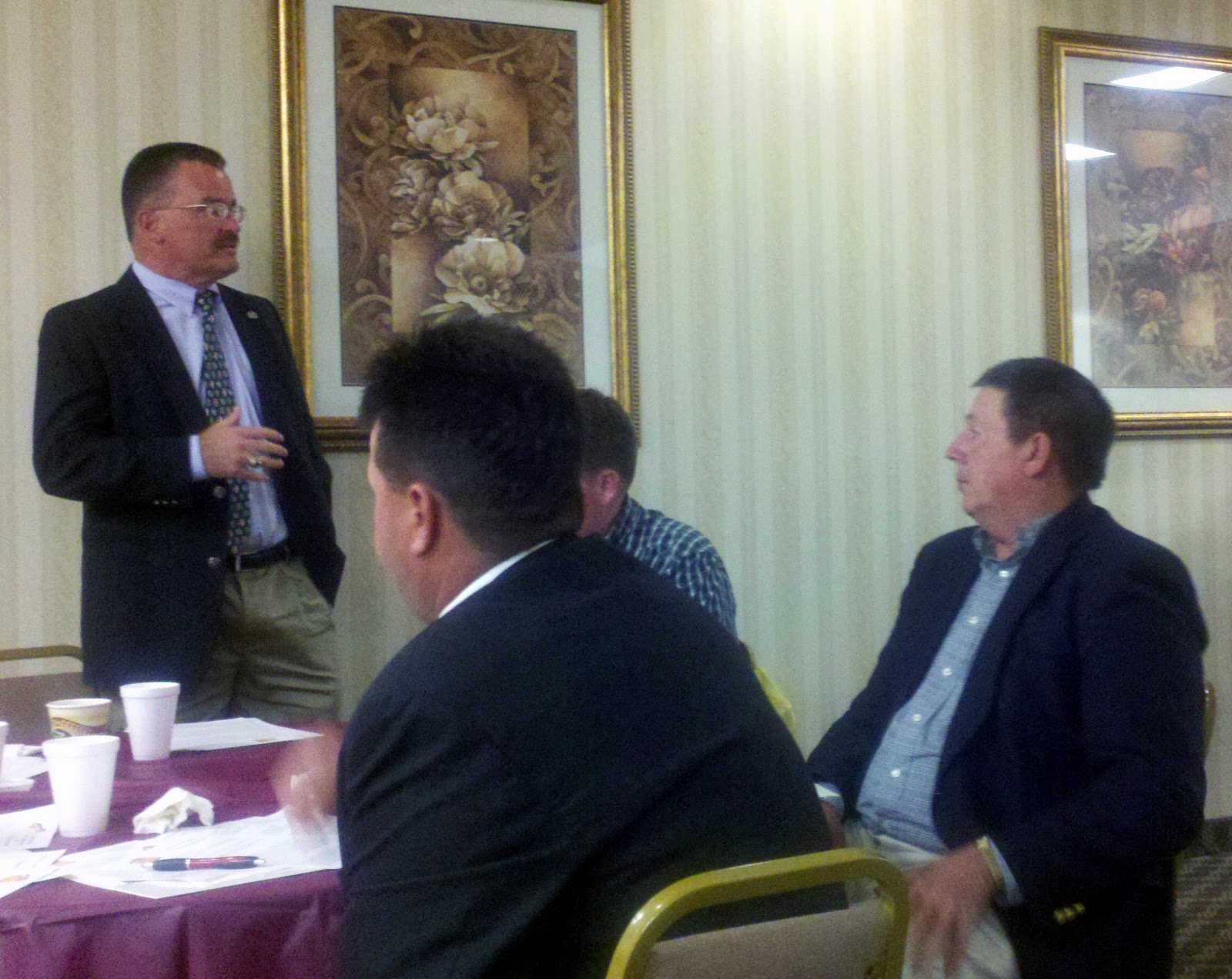
| Del. Ed Scott discusses the legislative issues with Farm Bureau members at a Senatorial District meeting in Zion Crossroads Tuesday night. |
Farm Bureau began its annual senatorial district meetings this week in Zion Crossroads. Farm Bureau members from Augusta, Fluvanna, Orange, Greene Spotsylvania, Albemarle and Madison counties were in attendance as well as Delegate Ed Scott and Sens. Emmett Hangar and Tom Garrett.
Each year before the General Assembly starts, producer members meet with their legislators to discuss the issues most important to them for the upcoming session. This year water quality, property rights, animal care, funding for Virginia Cooperative Extension and game laws were the topics of discussion.
Senatorial District meetings are a great way to connect with your legislators and educate them on some of our critical issues. You will also hear how your legislators feel about these issues which helps us gauge where they stand on an issue.
Having producer members attend these meetings is critical to our legislators understanding more about Virginia agriculture so they can make more informed decisions that affect our livelihood.
Senatorial District meetings run through December. If you are a producer member and interested in attending, please contact your Field Services director or County Farm Bureau office.
The Stand Our Ground: Property Rights postcard campaign has technically come to end, and we have received more than 13,500 signed postcards. Many thanks to the county Farm Bureaus for their participation!At county Farm Bureau annual meetings this summer and fall, Virginia Farm Bureau asked its members to sign postcards in support of the second passage of a constitutional amendment to protect property rights in the upcoming General Assembly. Each county was asked to sign “112 for 2012,” which equals almost 10,000 cards. As you can see, we surpassed that goal!
The top three counties to collect signed postcards are:
1. Page County- 1,509
2. August- 448
3. Bedford- 354
The postcards will be delivered to legislators at a crucial time next year.
The 2011 Virginia General Assembly passed a resolution to amend the state constitution to further protect your property rights. This has been a long-term priority goal for Virginia Farm Bureau since 2008.
HJR 693, patroned by Delegate Johnny Joannou, D-Portsmouth, was intended to prevent eminent domain abuse by the condemning authorities. The proposed amendment would tighten up the state’s definition of “public use” with regard to eminent domain and ensure that your land can not be taken and given to another private entity. It also would ensure that private property cannot be taken without just compensation to the owner and that no more property is taken than necessary.
To amend the state constitution, the General Assembly must pass a resolution in two consecutive years, and the wording of the resolution in the second year must be exactly the same as the wording in the first year. If this second amendment is passed by the legislature in 2012, it will go before Virginia voters next November.
Even though the campaign has technically ended, we are still collecting signed postcards! So please send them to Kelly Pruitt, Governmental Relations. The more postcards we get, the bigger the impact we will make on our legislators.
The Virginia Farm Bureau recently joined the U.S. Farmers and Ranchers Alliance, a newly formed alliance consisting of a wide range of prominent farmer- and rancher-led organizations and agricultural partners. This marks the first time agricultural groups at the national, regional and state levels have collaborated to lead the dialogue and answer Americans’ questions about how we raise our food – while being stewards of the environment, responsibly caring for our animals and maintaining strong businesses and communities.
USFRA recently held town hall meetings across the country to discuss concerns uncovered by surveys commissioned by USFRA, and answered questions from audience members and online participants.
The surveys found that Americans think about food production a lot, yet 72 percent of consumers say they know nothing or very little about farming or ranching. Many consumers think the United States is on the wrong track with regard to the way the nation produces food.
Consumers surveyed said some of the agricultural topics with the most confusing information include the use of pesticides and antibiotics and genetic engineering in crops. Seventy-nine percent of those surveyed said that producing healthy choices for all consumers is very important for farmers to consider when planning farming practices.
For more information, visit http://www.usfraonline.org/
**Farm Bureau is offering a USFRA message training program on the morning of Legislative Day, January 24, 2012, for County Farm Bureau leaders. At this message training program, you will
Seats for this program are limited. Please register as soon as you can if you are a County Farm Bureau leader. Contact your Field Services Director for details.
*News Leads are the weekly top agriculture stories written by Farm Bureau’s Communications Department and sent to local newspapers and TV stations around the state as a news release. This story was released on Oct. 13.
Virginia farmers in six soil and water conservation districts are being urged to participate in a pilot program to collect information about conservation practices they’ve implemented.“Farmers need to know what’s going on, and they should participate,” said Wilmer Stoneman, Virginia Farm Bureau Federation associate director of governmental relations. “This is a program that is valuable to them. It’s a direct response to Farm Bureau’s complaints that incomplete data is being used by the Environmental Protection Agency to draw up mandatory conservation programs to improve water quality in the Chesapeake Bay watershed.”
Best management practices are changes farmers and other landowners make to their property to reduce or eliminate soil erosion or contamination of water. They include switching to no-till planting methods, fencing livestock out of waterways, using nutrient-management planning for crop production, and covering manure storage facilities.
The Virginia Department of Conservation and Recreation has records only of practices installed using cost-share funds from federal and state conservation programs. Those were the records the EPA used for its Chesapeake Bay computer model in recent years.
“We know that a lot more conservation practices have been installed or are in use on Virginia farms than are on record,” Stoneman said. “They have to be, since there has never been enough cost-share funding to meet the demand for financial assistance. So many farmers paid for these practices out of their own pockets, but they are not being credited in the EPA model.”
In response to that complaint, the 2010 Virginia General Assembly passed a bill requiring the secretary of natural resources to establish a data collection program for voluntarily implemented agriculture and forestry BMPs. Virginia’s 47 soil and water conservation districts are the primary collection agents, and six pilot districts started that work this summer.
The pilot districts are located in and around Bristol, Roanoke, Harrisonburg, Charlottesville, the Northern Neck, Virginia Beach and Chesapeake. For more information, visit vaswcd.org.
The Virginia Department of Forestry has received several reports of a man posing as a representative of the state agency who is approaching elderly and widowed landowners in Central Virginia trying to buy the timber on their property. This is a scam that could cost the landowners tens of thousands of dollars.
VDOF Assistant Regional Forester Robbie Talbert said, “We have an individual who has been contacting landowners in Goochland and Fluvanna counties telling them that ‘Forestry’ has asked him to contact them regarding selling their timber. While he doesn’t explicitly mention the VDOF, by invoking ‘Forestry’ he is trying to associate himself with the Virginia Department of Forestry. VDOF does not have any employee or contractor contacting landowners for the purpose of selling their timber.
“While some landowners have contacted our Goochland office asking whether this person works for us, it’s quite possible that other landowners are being scammed – an action that can cost them thousands of dollars. We want citizens to know that this individual does not work for the Virginia Department of Forestry, and that the VDOF does not purchase timber. Anyone making such a sales pitch to landowners is trying to scam these citizens. We urge landowners who may be contacted by someone claiming that ‘Forestry’ sent him to purchase their timber to contact their local sheriff’s office and report the incident immediately,” Talbert said.
Before landowners consider selling their trees, the Virginia Department of Forestry has a few tips that may enable them to attain – and retain – the maximum value from their timber sale while minimizing the overall impact to their land; protecting the water resources that either originate or pass through their property, and keeping them on the right side of the law.
First, have a plan!
Chuck Wright, VDOF area forester for Goochland and Fluvanna counties, said, “Most forest landowners harvest timber only once or twice during their lifetimes. It’s extremely important to have a good plan for overall management of their timber resources as well as a specific timetable when that timber is going to be harvested.”
A sound timber sale is the result of careful planning, management and marketing, and each of these variables can make a tremendous difference in the amount of money that their timber sale will bring.
Things to consider in a timber sale are:
• Volume and species of timber to be sold
• Statement of purchase price and method of payment
• Length of time allowed for cutting
• Boundary line location and CLEAR marking of those boundaries
• Restrictions on logging, such as designated places for skid trails, haul roads, logging decks and stream crossings
• Required use of Best Management Practices, or BMPs, for watershed protection
• Responsibilities of the logging contractor at the completion of the harvest to repair any damages caused by his activity and to stabilize any erosion that has occurred as the result of the harvest
Although professionals who work with the Virginia Department of Forestry can provide landowners with recommendations on how to manage their timberland, including when to harvest, VDOF employees do not provide landowners with a value associated with the sale of their timber.
Wright said, “As a state agency, the VDOF does not sell timber, nor do we ask individuals to solicit timber sales on our behalf. It is solely a private enterprise, and it is a landowner’s individual decision as to whether he or she would like to sell timber.”
Landowners should also keep in mind that timber markets tend to fluctuate, and it is often best to solicit the services of a private consulting forester to handle a potential harvest and provide them with information regarding the value of their timber. Upon request, the VDOF can provide landowners with a list of private forestry consultants who work in their area.
Second, know the Law!
In Virginia, water quality protection from timber harvesting is the responsibility of not only the logging contractor and the timber owner, but also the landowner.
The Virginia Department of Forestry oversees the enforcement of the Silvicultural Water Quality Law. This law mandates the protection of the Commonwealth’s streams and rivers from any negative effects, mainly sedimentation, caused by timber harvesting. The law allows for the issuance of civil penalties of up to $5,000 per day for failure to correct problems due to sedimentation caused by the logging activity.
Wright said, “The important thing to note here is that the penalty is placed on ALL owners and operators, which includes the landowner. So it’s vital for you to be involved with your timber sale to the extent possible, or have a professional forester who is looking out for your interests on your timber sale.”
The Virginia Department of Forestry is available to provide landowners with assistance in planning their timber harvest. Please call the VDOF regional office in Charlottesville at 434-977-5193 and ask to be put in touch with the appropriate field personnel for your area.