VALOR Class II Fellows Announced

Andrew Smith
Sr. Assistant Director
On July 19, 2014 the Inaugural Class of VALOR, including myself, graduated at the Hotel Roanoke. The weekend was not only one of celebration but one of volunteering and evaluation of the program itself.

We started with the Southwest Virginia Feeding America then wrapped up classes on Saturday with a facilitated evaluation process to aid in the future development of the program to serve classes for years to come.

Fellows experience an amazing journey that take them through our industry and venture into self-realization. I highly recommend you to follow the next class via Facebook and their blog over the next two years.

Class II starts the weekend of September 5-7. I am happy to share the names of the new class here! I wish them luck!

·         Mr. Albert Reid of Petersburg, VA; 4-H Specialist and Aquaculture Agent at Virginia State University
·         Mr. Adam Shiflett of Harrisonburg, VA; Lending Team Leader with Farm Credit of the Virginias
·         Mr. Cliff Williamson of Culpeper, VA; Animal Export Consultant with TK Exports
·         Mr. Josh Stephens of Quicksburg, VA; General Manager with Southern States Cooperative
·         Mr. Joe Wilkerson of South Boston, VA; Owner of Southside Nursery and Landscape
·         Ms. Jennifer Leech of Lexington, VA; Dairy Farmer with Ingleside Dairy Farm
·         Ms. Marilyn Adams of Purcellville, VA; Branch Manager with Farm Credit of the Virginias
·         Dr. Basil Gooden of Henrico, VA; Director of Virginia Rural Development with USDAMs.
·         Shelley Barlow of Suffolk, VA; Vice-President of Cotton Plains Farm
·         Mr. Kevin Beamer of Hillsville, VA; CEO of Virginia Produce Company
·         Dr. Timothy Durham of Callaway, VA; Assistant Professor of Agronomy and Agricultural Science Program Coordinator at Ferrum College
·         Ms. Lauren Arbogast of Harrisonburg, VA; Extension Program Coordinator, Community Viability
·         Mr. M. James Faison of Richmond, VA; President of Milton’s Local Harvest
·         Mr. Melvin Atkinson of Windsor, VA; Director of Airfield 4-H Center with Virginia Cooperative Extension

Governor McAuliffe Announces Creation of Virginia Oyster Trail

Governor Terry McAuliffe today announced the creation of the Virginia Oyster Trail, a major tourism development project connecting travelers to Virginia oyster purveyors, raw bars and restaurants, and the watermen culture throughout Coastal Virginia, the Northern Neck, Middle Peninsula and Virginia’s Eastern Shore.
“Virginia produces the best oysters in the world and as the oyster industry continues to grow, we want to let it be known that Virginia is also the Oyster Capital of the East Coast,” said Governor McAuliffe.  “In addition to growing, harvesting and selling the best oysters, our watermen are providing good jobs in their communities, generating revenue and tax dollars throughout their region, and helping improve the environment of the Chesapeake Bay as their oysters filter millions of gallons of water each day.”
“As my team and I work to build a new Virginia economy, I want to make sure that our tourism and agricultural industries, including our outstanding and diverse marine products sector, can and will play a significant role in that effort.” 

This year, a public-private partnership of stakeholders began working together to brand the Virginia oyster travel experience to show the world that Virginia is for Oyster Lovers.  The trail offers visitors a way to enjoy Virginia’s seven different oyster regions, as well as experience the unique culture of watermen in the Chesapeake Bay.   As a result of these exciting developments with the Virginia oyster, Governor McAuliffe officially declared November as Virginia Oyster Month and named Virginia the “Oyster Capital of the East Coast.”
“The Virginia oyster pairs perfectly with another widely recognized Virginia product – wine – and some of Virginia’s oyster regions share watersheds with a number of Virginia’s outstanding wineries,” said First Lady Dorothy McAuliffe. “I believe this goes a long way to proving the old saying of “what grows together, goes together.”  Indeed, we have two world-class products – oysters and wine – right here in Virginia and I know that the Virginia Oyster Trail will provide new economic opportunities for both those sectors and many other businesses as we work to create a new Virginia economy.”
Virginia’s oyster harvest increased by 25 percent from 2012 to 2013, with more than 500,000 bushels – the most in nearly a generation.  Over the past 12 years, the oyster harvest in Virginia has increased from approximately 23,000 bushels in 2001 to last year’s level of just over 500,000.  This is the highest level since 1987.  The dockside value alone of the oyster harvest in 2013 was more than $22 million, up from approximately $16 million in 2012.
“In addition to being the nation’s third largest producer of marine products, Virginia is the leading East Coast seafood production state and the oyster industry plays a significant role in those both of these high rankings,” said Todd Haymore, Secretary of Agriculture and Forestry, noting that the Commonwealth had more than 400 million pounds in landings last year placing it behind only Alaska and Louisiana.  “We’re proud to promote Virginia oysters here and on international trade missions, where we’ve generated new export sales to China, Hong Kong, and Canada.  As we answer the Governor’s call to build a new Virginia economy, we must take an inclusive approach by working with some of our oldest businesses, such as our seafood industries, as they continue to provide good jobs and outstanding products.  With today’s announcement of the Virginia Oyster Trail, we’re hoping to spur more growth and opportunities for our watermen, the marine product sector, and other businesses along the trail.”
Virginia’s seven different oyster regions produce the largest quantity of fresh wild-caught and farm-raised oysters in the United States and each region produces oysters with distinct flavors, offering an oyster for every palate.  The Virginia oyster industry is one of the longest-standing industries in the state, providing bountiful meals for Virginia’s first inhabitants.
“The continued growth of the oyster industry and our fisheries management programs, combined with private sector investment, positively impacts the Chesapeake Bay and Virginia’s economy, particularly with respect to tourism,” said Maurice Jones, Secretary of Commerce and Trade. “Tourism is an instant revenue generator for Virginia, accounting for over $21.2 billion in revenue and supporting 210,000 jobs in 2012.  The Virginia Oyster Trail is sure to continue this growth in tourism around the Commonwealth.”

“Virginia is in the oyster business in a major way,” said Rita McClenny, President and CEO of Virginia Tourism Corporation. “With seven different oyster regions, we are unlike any other state in the nation.  The development of the Virginia Oyster Trail will allow travelers to experience the state with taste by pairing the Virginia oyster with other quality products made in Virginia, including wine, craft beer, cider and spirits.”

The Virginia Tourism Corporation partnered with the Virginia Department of Agriculture and Consumer Services, the Virginia Department of Housing and Community Development, Shellfish Growers of Virginia, the Virginia Seafood Council, the Virginia Marine Products Board, and the Artisans Center of Virginia, in addition to local tourism offices and planning district committees, to make this project a reality.  For more information on the Virginia Oyster Trail, visit virginiaoystertrail.com.  Learn more about the various tourism economic efforts of the Virginia Tourism Corporation by visiting vatc.org/PAM.

Provide Your Input for Virginia’s Future Transportation Needs

The Virginia Farm Bureau Federation has been asked to provide input to the Multimodal Advisory Committee on Virginia’s long-range transportation needs. The Multimodal Advisory Committee (MAC) was appointed by the Deputy Secretary of Transportation. It includes representatives of agencies that will be closely involved in implementing VTrans2040. Members include representatives from MPOs, Rural Transportation Planning Organizations (RTPOs), local governments, transit providers, and state agencies. 

Complementing the MMWG’s technical oversight, the MAC plays a supportive role on all aspects of the project, with a strong focus on policy and engagement.

As part of the process, we’ve been asked to share a survey with our stakeholders for input from a broad cross-section of travelers. We hope you will take a few minutes to complete this survey. Your feedback is important to this process and appreciated.

A direct link to the survey is here: https://www.research.net/s/vtrans
Virginia’s Office of Intermodal Planning and Investment (OIPI) will lead the development of the Commonwealth’s long-range multimodal transportation plan – VTrans2040. The plan will be developed in two phases and will result in the production of two companion documents: the VTrans2040 Vision and the VTrans2040 Multimodal Transportation Plan.

VTrans2040 will identify multimodal needs across the Commonwealth. Moving forward, only projects that help address a need identified in VTrans2040 will be considered for funding under the statewide prioritization process from House Bill 2. The plan will focus on the needs of the Commonwealth’s statewide network of Corridors of Statewide Significance, the multimodal regional networks that support travel within metropolitan regions, and improvements to promote locally designated Urban Development Areas (UDAs).

VTrans2040 Vision: The VTrans2040Vision will lay out Virginia’s Guiding Principles, Vision, Goals, and Objectives in a policy framework to guide partner agency investment decisions over the next 25 years. It will be informed by detailed trend analyses and stakeholder input regarding transportation-related issues and opportunities associated with potential changes in catalytic factors such as major economic generators, freight movement, household characteristics, land development patterns, transportation technology, and the natural environment.

The purpose of the MAC is two-fold:
•        Provide practical feedback and guidance from various agency perspectives, and
•        Foster buy-in and consensus among partner agencies and organizations that play an active role in implementing VTrans2040 policies and recommendations.

We hope you will take time to complete the survey!

From the Field: Barbecue And Red, White & Blue

From the Field is a bi-monthly column written by Mark Campbell, Farm Bureau Field Services Director for the Central District. He writes about Farm Bureau member benefits and County Farm Bureau activities.

Buckingham County Farm Bureau Annual Meeting
Farm Bureau meeting season officially started this week for District Field Services Directors with a couple of county Farm Bureau annual membership meetings across the state.  For me, Albemarle was last night and Greene County is tomorrow. 
The main purpose of the annual membership meetings is to conduct the business of the membership by electing directors to represent them, discuss resolutions and policy and elect voting delegates to the state convention.  Many of these meetings will have speakers about certain topics.  In central Virginia, the most requested topics have been the Waters of the U.S. Proposed Rule by EPA and the Army Corps of Engineers and Frequently Asked Questions About Farm Vehicles. 
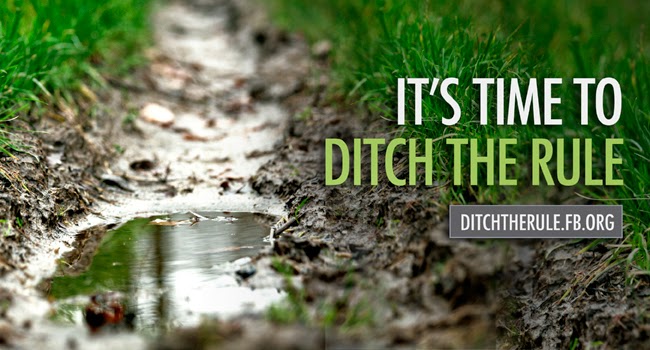
The Governmental Relations department has two excellent brochures that you should have.  They are Ditch the Rule and Resource Management Planning.  Everyone needs to be involved on Ditch the Rule.  This is a movement of Farm Bureau and other agricultural groups to oppose Waters of the U.S., expansive regulations by EPA and Army Corps of Engineers to claim jurisdiction over all water; not just navigable waters as defined in the Clean Water Act and upheld in the courts.  This is not just an issue for farmers and ranchers.  Plus, the brochure lays out in steps as simple as 1,2,3 how you can act. 

J.D. Alexander, former president of National Cattlemen’s Beef Association, once said that “If you’re not at the table, you risk being on the menu”.  Well folks, we are on EPA’s menu and we need to step it up even more.  I hear time and time again from members of their frustration and anger about EPA running roughshod over everyone, including Congress.  The House of Representatives has proposed some legislation to prevent some actions of EPA on the citizenry.  But just on that statement’s face, isn’t it sad that our elected representatives actually have to propose legislation to prevent a government agency from being too burdensome and creating hardships on the citizens?  I digress, but this style of rules and regulations is eerily similar to what Thomas Jefferson and other patriots described of the relationship between England and the colonies with legalistic rules that were difficult to understand or to fulfill.
The other part of county Farm Bureau annual membership meetings is the food and patriotism.  While not the menu item for every meeting, BBQ is popular.  After 16 years with Farm Bureau I have refined my palate sampling many styles of BBQ.  I do like the Carolina style best.  One other menu item that many in the district tease me about is cheesy potatoes.  Fluvanna FB always makes sure they have it and even saved me some one year when I couldn’t attend their meeting.  How cool is that?  Most county Farm Bureaus have realized that a good meal brings a good crowd.  Having some entertainment or an interesting speaker is also a draw. 
The other thing that can be said is interwoven in the Farm Bureau fabric is patriotism.  Most, if not all, annual membership meetings begin with the Pledge of Allegiance to the Flag of the United States of America. 
So while I have one down and nine more county annual meetings to go, I enjoy it because it is a small piece of Americana: representative democracy in action, patriotism, and good country food.  I encourage you to attend your county Farm Bureau meeting.  The more participation, the better.  Make sure that you are at the table and not on the menu. 
Until next time,

Mark

AgCache: An Innovative Marketing Tool for your Agribusiness

Thinking of adding an agritourism aspect to your farm this fall? Try AgCaching.
What is an AgCache?
An AgCache is a unique spin on a popular outdoor past time called GeoCaching. GeoCaching is a high tech treasure-hunting experience using GPS where seekers use GPS coordinates to find hidden caches. Once they have found the caches they post pictures and comments about their experience online.
AgCache uses the geocaching network to allow visitors to experience the real treasure: agriculture.
AgCache visitors have the opportunity to learn the importance and history of agriculture by visiting operating agricultural businesses and farms. Not only do AgCaches educate visitors, but they also bring traffic and business to the AgCache hosts.
AgCache is a fun, exciting way to turn your business into an agritourism destination.

How can hosting AgCache benefit you?
1. AgCache connects you to your customers at your farm and allows you to build customer relationships.
2. AgCache allows you to tap into a new audience and expose your business to new partners and customers.
3. AgCache visitors give you instant feedback on what appeals most to your customers.
4. AgCache hosting provides an added product line to your product mix, i.e. agritourism activity during non-production seasons.
5. AgCache hosting gives you an opportunity to educate people about agricultural production realities.
6. AgCache requires very little time or money – select your site, choose your box (be creative!), include the log sheet, and check in every week to track your visitors!
Preliminary steps prior to hosting an AgCache
Before deciding to host an AgCache, there are specific considerations to address with your farm family and employees.
Must Like People
Agritourism invites the public onto your agribusiness and encourages curiosity. AgCache hosts should be prepared for curious visitors and their questions. Hosting an AgCache requires friendly interactions and knowledgeable responses to the inquisitive public. An AgCache is a form of agritourism that does not demand your physical presence, however, setting the stage to provide responses to the wide range of questions from the public help visitors get the most out of the experience.
Know Caching Rules
When it comes to choosing the location and disguise of your AgCache box, the choice is all yours. Most cache boxes include a journal to allow seekers to note their name and visit date, and visitors often include a small memento, such as a sticker, toy car or animal, keychain, and other assorted items. There are a few rules that keep the experience fair, fun, and safe for everyone involved.
• All caches must be at least 0.1 miles apart. This is mandated by the Geocache organization. The organization holds various running competitions and if the density of caches is too high, it
gives some GeoCachers an unfair advantage.
• No visitors after dark. This ensures the safety of all participants especially on agriculture operations where accidents can occur very easily even in the daylight.
• Cannot charge fee where the cache is located. For example, a cache can be placed next to a for-fee corn maze, but cannot be inside a for-fee corn maze. AgCache is an opportunity that can be experienced by everyone, whether they brought their wallet with them or not.
• AgCache must be accessible 365 days a year, regardless of the operating schedule of the site. For example, a cache cannot be placed at a seasonable produce stand.
Invest in insurance liability policy
An agriculture operation can be a dangerous place to those unfamiliar with production, harvesting and processing activities. An insurance liability policy protects your agribusiness should an accident occur during an AgCache visit. These policies may provide additional protection beyond the Code of Virginia Title 3.2 Chapter 64 – Agritourism Activity Liability legislation. The Virginia Farmers Direct Marketing Association offers an Agritourism Liability Signage Order Form, and potential AgCache hosts are encouraged to purchase and post these warning signs on their premises.
Add signage
Many AgCache visitors may have never even seen an operating farm before and are unaware of the unspoken rules, such as “always close a gate if you open it.” Before inviting visitors to your agribusiness, ensure that appropriate signage has been placed. Examples can include “Please close gate behind you”, “Keep off grass”, etc. Also be sure to rope off any restricted areas that you would not be comfortable with visitors exploring. Establishing these measures will make hosting an AgCache an easier and more enjoyable experience for you.
Contact AgCache Creators
Once you have completed this checklist and chosen the design and location of your AgCache, the next step is to contact the creators of AgCache, Chris and Jennie Simms at 804-731-5236.
The Simms will schedule a farm visit and provide confirmation that the proposed AgCache site meets the requirements. Once the Simms approve your AgCache site, your farm will be added as an official host of an AgCache in Virginia.
If you are interested in learning more about Virginia agritourism opportunities or adding value to your agribusiness by hosting an AgCache, please contact Dr. Kimberly Morgan at KLMorgan@vt.edu.

VSU to Hold 29th Annual Ag Field Day Aug. 28


Come learn about the ongoing research at Virginia State University Randolph Farm located in Petersburg, VA.  Research and Extension presentations will raise small farm producer awareness about small farm production and marketing.
29th Annual Agriculture Field Day
Randolph Farm
4415 River Road
Petersburg, VA 23806
Thursday August 28, 2014
8:30 AM – 12:00 PM
RAIN OR SHINE
Field Presentations Include:
· Small Ruminants
· Specialty Crop Research at VSU
· Horticulture Crops
· Cover Crops for Soil Health
· Bee Keeping
This is a FREE event & open to the public! Register online by: August 26, 2014

Virginia on List of States with Most Farmers Markets

From WTOP:

The mantra, “buy local” is catching on as farmers markets become more abundant nationwide and Virginia is among the states experiencing the most growth.

Farmers markets are being celebrated as part of National Farmers Market Week, which goes from Aug. 3-9.

The number of farmers markets nationwide has increased a whopping 76 percent since 2008, according to the U.S. Department of Agriculture. There are more than 8,200 farmers markets around the country, according to the department.

Virginia is seeing big growth in the number of farmers markets, too. The commonwealth ranked ninth in the U.S. for its number of farmers markets, according to rankings released by the U.S. Department of Agriculture.

There are about 250 farmers markets in Virginia, but that number continues to grow, says Elaine Lidholm, director of communications for the Virginia Agriculture and Consumer Services Department.

It’s ahead of Missouri at No. 10 and trailing Wisconsin. The top three states are California, New York and Michigan. They are followed by Ohio, Illinois, Massachusetts and Pennsylvania.

“We are always happy to be in the top 10 and this year we’re No. 9,” says Lidholm.
Last year, Virginia came in at No. 9, too.

Considering the size of Virginia compared to some of the other big agricultural states, she says it makes the commonwealth’s ranking an even bigger deal.

Virginians are latching on to the mantra, “buy fresh, buy local,” says Lidholm. She says one reason behind the growth is that Virginians love their farmers markets.

“It says how much Virginians support farmers markets. Because we wouldn’t have them if they weren’t viable,” she says.

Other reasons for the success behind the large number of farmers markets in the commonwealth, she says is the diversity of products in Virginia from peaches to seafood and of course, the all-important direct farmer-to-consumer relationship.

Lidholm says while the ranking is great news for Virginia, the biggest winners are the customers who have more and more access to farm fresh products.

“The consumers are buying it literally hours after it’s been picked.”

Looking to start selling your products at a farmers’ market? Go here for some helpful advice from Modern Farmer: http://modernfarmer.com/2014/07/dos-donts-marketing-farmers-markets/