AFBF: In Failing to Move Voluntary GMO Labeling Measure, Senators Abandon Farmers, Consumers
This Week’s Commodity Comments: March 16, 2016
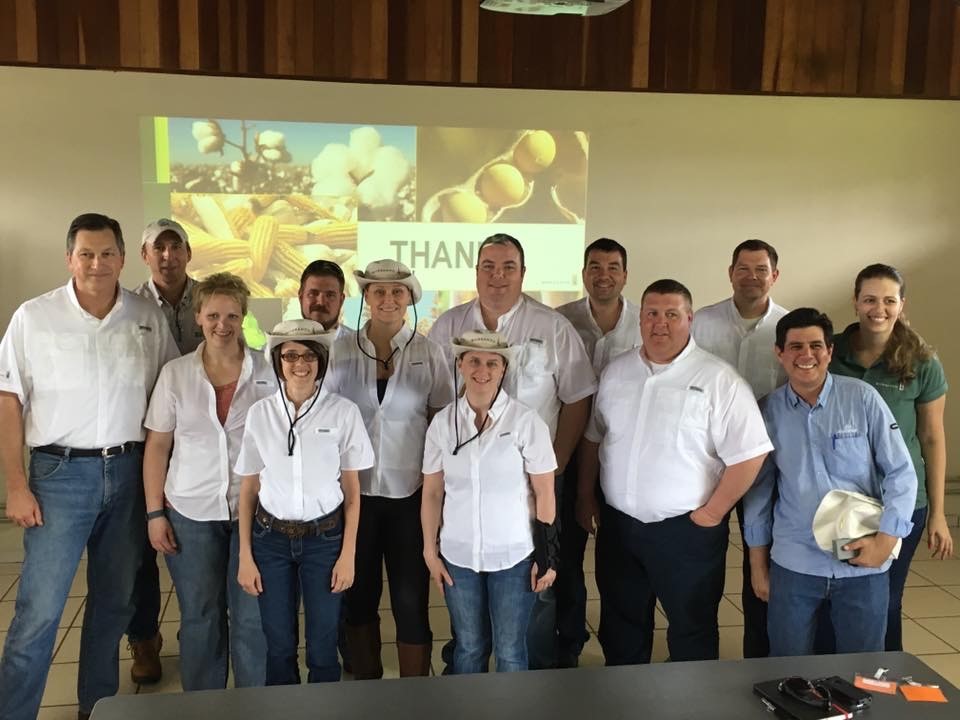
VFBF Vice President Visits Brazil As Part of PAL Program
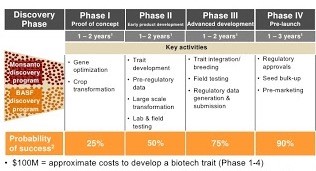
The process starts with discovery on the farm. Monsanto works directly with local farmers to understand changes in their climate, environment and production practices. The discovery process is the identification of traits needed to help farmers meet these challenges. This process takes 2-4 years while exploring hundreds of millions of traits which are selected and tested for suitability and proof of concept, this process takes an additional 2-4 years.
Farm Bureau Applauds Governor, Legislature for Ag Budget
Most notably, Gov. Terry McAuliffe and the Virginia General Assembly allocated a record amount of money for cost-share assistance in implementing agricultural best management practices. Included was $54.39 million for cost-share money in fiscal year 2017 and $8.8 million for fiscal year 2018.
“These funds are critical to helping Virginia farmers work cooperatively with the state to help achieve its water quality goals,” said Martha Moore, vice president of governmental relations.
Of the $54.39 million, $19.6 million is for farmers who have signed up and been waiting for cost-share money to install stream exclusion fencing. The practice protects waterways and reduces erosion of stream banks by keeping livestock out of creeks and rivers.
Legislators also included money for local soil and water conservation districts, which provide technical assistance to farmers implementing BMPs. They allocated $7.4 million for FY2017 and $1.2 million for FY2018.
The state budget also included an additional $345,701 for FY2017 and $197,101 for FY2018 to fund two additional Virginia Department of Agriculture and Consumer Services weights and measures staff who would focus on keeping farm scales in compliance. Those funds also would pay for replacing some needed equipment for the program.
Also incorporated was $1.8 million for full funding of the Reforestation of Timberland program. “This is the first time since the Gilmore administration the industry severance tax will be fully matched by the commonwealth to provide funding for a cost-share program with landowners to incentivize the replanting of pine trees,” Moore said.
Other ag-related budget items include bond money for replacing and renovating some of the livestock and poultry facilities at Virginia Tech. Those facilities provide research that translates into applied technologies that help farmers be more profitable and sustainable.
“Funding for BMPs helps farmers and the environment, and funding for research helps farmers’ long-term bottom lines” Moore said. “We are thrilled that the governor and the General Assembly are able to support the state’s largest economic industry by giving agriculture and forestry a boost in the budget.”
$390,000 in USDA Specialty Crop Block Grants Available for Virginia Agricultural Interests Announced
This Week’s Commodity Comments: March 9, 2016
Trade Speakers Touched on Factors that can Enhance, Block Exports
The conference was held March 7 and 8.
Ambassador Darci Vetter, chief agricultural negotiator in the Office of the U.S. Trade Representative, outlined benefits of U.S. participation in the Trans-Pacific Partnership.
The TPP is an agreement among the U.S. and Australia, Brunei, Canada, Chile, Japan, Malaysia, Mexico, New Zealand, Peru, Singapore and Vietnam. Its implementation has been a goal of the Obama administration.
Vetter said the TPP will foster “unprecedented access to the region that will support two-thirds of the world’s middle class by 2030.” That’s important from an agricultural standpoint, she noted, because “when people enter the middle class they change the way they eat,” purchasing more fresh fruits and vegetables and more proteins.
Vetter said TPP participation will afford U.S. exporters “trade liberalization for every agricultural product, without exception.” For example, she said, Brunei, Japan, Malaysia, New Zealand and Vietnam would eliminate duties on 93 percent of all ag tariff lines, and 70 percent of those tariff lines would be eliminated immediately.
The American Farm Bureau Federation has estimated that net exports of U.S. soybeans and grain products will increase in value by $297 million when the TPP is fully implemented, and net dairy exports will increase by $131 million.
The agreement also stands to raise trade standards related to sanitary and phytosanitary issues, intellectual property, labor and human rights and environmental issues.
Failure by Congress to approve TPP participation presents a significant risk, Vetter said. “The rest of the world is continuing to move. These countries will continue to negotiate preferential agreements with each other.”
Ray Owens, senior economist and research advisor for the Federal Reserve Bank of Richmond, called the U.S. economy “relatively solid” but noted that in election-year rhetoric “we continually hear there’s something really broken in our economy.”
All things considered, “we at the Federal Reserve think this is about as fast as the economy can grow,” he said. The Richmond Fed serves the Fifth Federal Reserve District, which consists of Maryland, the District of Columbia, Virginia, North Carolina, South Carolina and most of West Virginia.
If globalization yields rising incomes, and if global economic policy is well-run, Owens said, the U.S. stands to benefit. But it is important to adapt quickly to rapid international developments. “We have to keep a much sharper eye, be much more agile, be quicker on our feet.”
Dr. John Clifford, deputy administrator and chief veterinary officer for the U.S. Department of Agriculture’s Animal & Plant Health Inspection Service, told conference participants that trade interruptions related to animal health issues can be lasting ones.
In 2003, he reminded them, officials confirmed a single case of bovine spongiform encephalopathy in a cow of Canadian origin that was in the United States. It resulted in numerous bans on U.S. beef, and “we are still, today, trying to gain some of those markets back,” Clifford said.
An outbreak in 2014 and 2015 of avian influenza in commercial turkey flocks in the Midwest had a similar result on poultry and egg exports. Jim Sumner, president of the USA Poultry and Egg Export Council, said the outbreak and unrelated economic conditions formed the “perfect storm” for exports.
“About 18 countries banned U.S. poultry,” he said. “Fortunately some of those have lifted their restrictions,” though challenges still remain in major markets like China, South Korea, Mexico and Russia.
Virginia’s 2015 Agricultural Exports Valued at $3.19 Billion
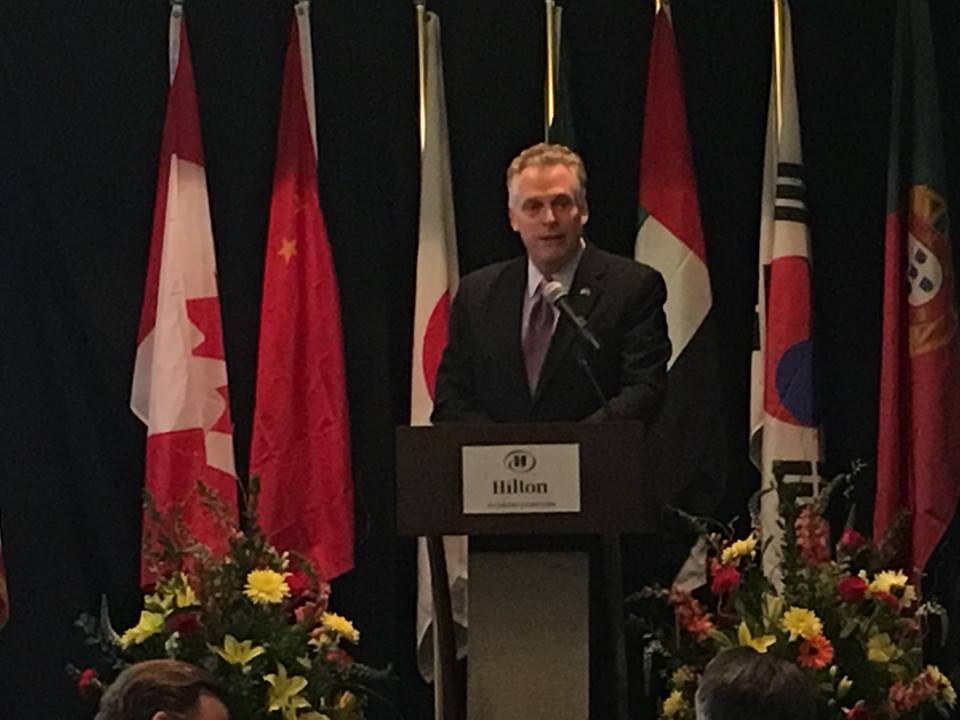
Gov. Terry McAuliffe noted on March 7 that the decrease “is in (market) value, not in volume” and noted that the value of ag exports to Virginia’s top trading partners increased last year.
McAuliffe spoke at the opening luncheon of the eighth annual Governor’s Conference on Agricultural Trade, announcing that Virginia has strengthened its position as the second-largest exporter of agricultural goods on the East Coast and narrowed the gap between the commonwealth and first-ranked Georgia.
Virginia agricultural exports reached an all-time high of $3.35 billion in 2014, the fourth consecutive year in which those exports set a record. Nationwide, ag exports were affected last year by depressed commodity prices; decreased shipments to certain regions due to prohibitive shipping costs; new trade bans; and various geopolitical challenges.
“Despite the global headwinds we faced this year, we will continue building the infrastructure to increase exports, and the new resources for that effort that I placed in my proposed budget … will help the cause,” McAuliffe said.
The governor told conference participants that he and his staff took part in 13 trade missions last year. “Ninety-five percent of the world’s customers live outside of America. So you have to go where the customers are.”
In spite of a challenging global marketplace, “Virginia continues to be a leader in promoting agricultural exports, which have grown in value by 42 percent since 2010 when we launched a strategic initiative to increase shipments of these products,” said Todd Haymore, secretary of agriculture and forestry.
The top three export markets for Virginia in 2015 were China, Canada and Switzerland; all have held those spots since 2013. China imported more than $694 million in agricultural purchases, while Canada imported just over $291 million and Switzerland took in about $204 million. The value of exports to China and Canada increased by 1.4 and 4.3 percent, respectively, over 2014 levels, while those to Switzerland increased by 17 percent.
The remainder of Virginia’s top 10 export markets, along with the values shipped, are Mexico, $179 million; Japan, $175 million; United Kingdom, $134 million; Morocco, $103 million; Republic of Korea, $94 million; Taiwan, $90 million; and Indonesia, $70 million. All countries saw increases in value since 2014 except Indonesia.
Top agricultural and forestry exports from Virginia in 2015 included soybeans; pork; lumber and logs; soybean meal; leaf tobacco; processed foods and beverages, including wine, craft beer and distilled spirits; wood pellets and chips; poultry; soybean oil; wheat; animal feed; corn; raw peanuts; seafood and other marine products; and cotton.
The Governor’s Conference on Agricultural Trade was co-hosted by the Virginia Farm Bureau Federation, the Virginia Department of Agriculture and Consumer Services, the Virginia Port Authority and Virginia Tech’s Department of Agricultural and Applied Economics.
Save RFD-TV!
Click on the link below to submit comments to the FCC urging Verizon to bring back RFD-TV to their channel line-up.
http://www.rfdtv.com/story/31286442/submit-your-comments-to-the-fcc