Virginia’s 2015 Agricultural Exports Valued at $3.19 Billion

Farm and forestry exports from Virginia in 2015 were valued at $3.19 billion, 4.7 percent less than in 2014.

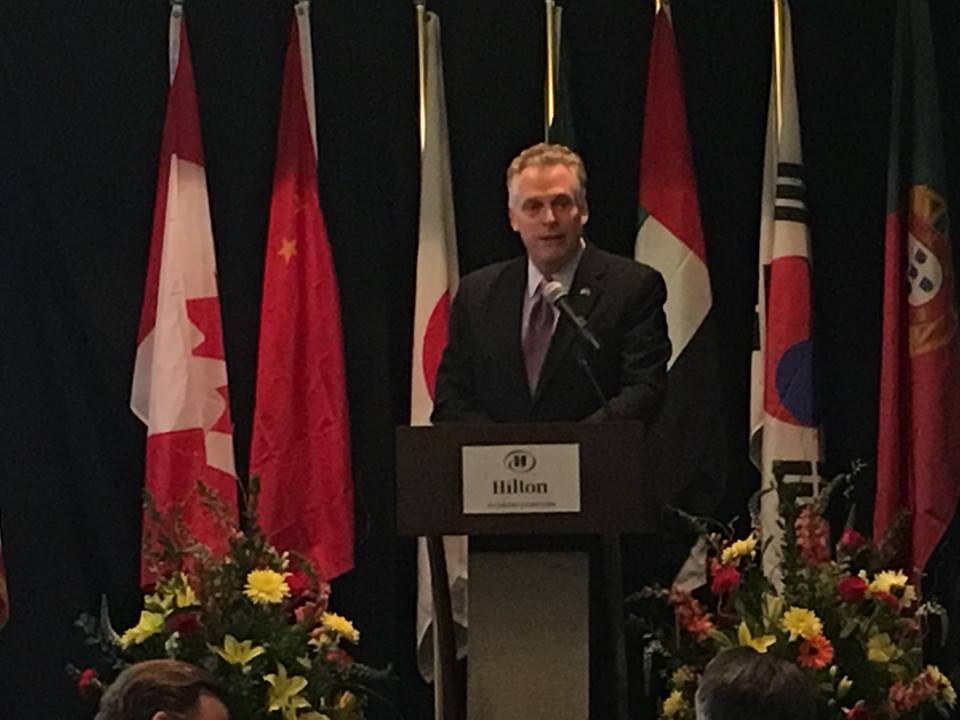
Gov. Terry McAuliffe noted on March 7 that the decrease “is in (market) value, not in volume” and noted that the value of ag exports to Virginia’s top trading partners increased last year.

McAuliffe spoke at the opening luncheon of the eighth annual Governor’s Conference on Agricultural Trade, announcing that Virginia has strengthened its position as the second-largest exporter of agricultural goods on the East Coast and narrowed the gap between the commonwealth and first-ranked Georgia.

Virginia agricultural exports reached an all-time high of $3.35 billion in 2014, the fourth consecutive year in which those exports set a record. Nationwide, ag exports were affected last year by depressed commodity prices; decreased shipments to certain regions due to prohibitive shipping costs; new trade bans; and various geopolitical challenges.

“Despite the global headwinds we faced this year, we will continue building the infrastructure to increase exports, and the new resources for that effort that I placed in my proposed budget … will help the cause,” McAuliffe said.


The governor told conference participants that he and his staff took part in 13 trade missions last year. “Ninety-five percent of the world’s customers live outside of America. So you have to go where the customers are.”

In spite of a challenging global marketplace, “Virginia continues to be a leader in promoting agricultural exports, which have grown in value by 42 percent since 2010 when we launched a strategic initiative to increase shipments of these products,” said Todd Haymore, secretary of agriculture and forestry.

The top three export markets for Virginia in 2015 were China, Canada and Switzerland; all have held those spots since 2013. China imported more than $694 million in agricultural purchases, while Canada imported just over $291 million and Switzerland took in about $204 million. The value of exports to China and Canada increased by 1.4 and 4.3 percent, respectively, over 2014 levels, while those to Switzerland increased by 17 percent.

The remainder of Virginia’s top 10 export markets, along with the values shipped, are Mexico, $179 million; Japan, $175 million; United Kingdom, $134 million; Morocco, $103 million; Republic of Korea, $94 million; Taiwan, $90 million; and Indonesia, $70 million. All countries saw increases in value since 2014 except Indonesia.

Top agricultural and forestry exports from Virginia in 2015 included soybeans; pork; lumber and logs; soybean meal; leaf tobacco; processed foods and beverages, including wine, craft beer and distilled spirits; wood pellets and chips; poultry; soybean oil; wheat; animal feed; corn; raw peanuts; seafood and other marine products; and cotton.

The Governor’s Conference on Agricultural Trade was co-hosted by the Virginia Farm Bureau Federation, the Virginia Department of Agriculture and Consumer Services, the Virginia Port Authority and Virginia Tech’s Department of Agricultural and Applied Economics.


Save RFD-TV!

RFD-TV, is a rural cable and satellite station, which carries Virginia Farm Bureau’s “Real Virginia” and other Farm Bureau programming from around the country. Verizon has pulled it from their cable offerings. We are trying to get the network back on this nationwide cable company. It’s very important for Virginia Farm Bureau to continue to receive this exposure as we are the highest rated Farm Bureau program on RFD.

Click on the link below to submit comments to the FCC urging Verizon to bring back RFD-TV to their channel line-up.

http://www.rfdtv.com/story/31286442/submit-your-comments-to-the-fcc

Supreme Court Will Not Examine Lawfulness of EPA’s Bay ‘Blueprint’

On Monday, the Supreme Court announced it will not examine the lawfulness of the Environmental Protection Agency’s Chesapeake Bay “Blueprint.” AFBF President Zippy Duvall expressed Farm Bureau’s disappointment in the decision in a statement.

“EPA has asserted the power to sit as a federal zoning board, dictating which land can be farmed and where homes, roads and schools can be built,” Duvall said. “We remain firm in opposing this unlawful expansion of EPA’s power.” Duvall said Farm Bureau will closely monitor the agency’s actions in connection with the Bay blueprint, as well as any efforts to impose similar mandates in other areas.

“This lawsuit has ended, but the larger battle over the scope of EPA’s power is not over,” Duvall said.

Farmers to Learn about Communicating at Inaugural Farming Leaders Conference

Consumers are asking questions about farms and food, and sometimes the farmer’s voice isn’t heard.

To better prepare farmers to communicate with the public, several organizations will host a Farming Leaders Conference March 19 at Blue Ridge Community College. The conference is sponsored by the Farm Credit Knowledge Center, Farm Credit of the Virginias, Rockingham County Farm Bureau and the Rockingham Farm Bureau Young Farmers and Ranchers Committee.

The agenda will cover communication styles, modern communication issues and positive media interaction. “The goal of the conference is to prepare those involved in the agriculture community for formal and informal interactions with consumers regarding food and farming,” said Jesse Martin, producer of On the Farm Radio and an organizer of the event.

Presenters include Martin; Dr. Alex White, a dairy science professor at Virginia Tech; Lauren Arbogast, an agriculture lifestyle blogger; Matt Lohr, director of the Farm Credit Knowledge Center; and a team of communicators from the Virginia Farm Bureau Federation.

The conference is open to anyone. Registration is $15, and space is limited. Register online at farmingleaders.com.

Virginia is Top State for Agricultural Exports to Cuba

Governor Terry McAuliffe has announced that Virginia is now the top state in the nation for agricultural and forestry exports to Cuba.  With a total of $41.6 million, Virginia agricultural exports to Cuba increased by more than 67 percent last year surpassing Louisiana, Georgia, Florida and Alabama for the top position.  Virginia exports, mostly soybeans and soybean meal, represent 28 percent of Cuba’s total agricultural imports from the U.S., which totaled $148.5 million in 2015.  Virginia was the only state to see an increase in exports to Cuba in 2015. 
Speaking about the announcement, Governor McAuliffe stated, “Virginia has been a leader in the development of relations with Cuba since federal law allowed for the export of foods and agricultural commodities to the country.  I am pleased that our efforts to foster mutually beneficial exchange with Cuba have led to increased agricultural exports for our Virginia producers.  During the mission in January, we continued these efforts to expand current agricultural export business, achieve new agricultural exports, and open the doors to future collaboration between Virginia Commonwealth University, the Port of Virginia and their Cuban counterparts.” 

During January’s historic marketing and collaboration mission to Cuba, Governor McAuliffe had several discussions with senior government officials, including a meeting with His Excellency Rodrigo Malmierca Díaz, Minister of the Ministry for Foreign Trade and Investment (MINCEX).  MINCEX is the Cuban agency responsible for promoting foreign trade and commercial transactions between Cuban enterprises and business entities in other countries.  The agency develops and proposes policies, conducts trade negotiations with other countries and signs agreements to further economic development.  Following the Governor’s invitation, Minister Malmierca agreed to visit Virginia, the first visit to the Commonwealth by a Cuban government official of his ranking in more than 50 years.
“Today’s announcement is a big win for Virginia’s agribusinesses and producers doing business with Cuba, which has led to more than $423 million in agricultural exports to the country over the past decade,” commented Secretary Haymore.  “Minister Malmierca’s visit represents another historic moment for Virginia – Cuba relations and we are honored to host him in the Commonwealth to highlight the great assets we talk about every time we travel to Havana.  Like the Governor, I’m hopeful that Virginia agribusiness will continue to serve as a catalyst for more positive change and create new opportunities for other sectors of the Virginia economy as the relationship between the U.S. and Cuba evolves to normalization.”
Since the Trade Sanctions Reform and Export Enhancement Act of 2000 (TSRA) was passed, limited sales of food and agricultural products have been allowed to Cuba.  Recently, the U.S. reestablished official diplomatic ties with Cuba.  As bilateral relations continue to improve, Governor McAuliffe tasked Virginia state agencies to explore new commercial opportunities with Cuba, covering a variety of sectors in preparation for the embargo to be fully lifted.
Following his election in November 2013, Governor McAuliffe has worked to expand Virginia’s relationship with Cuba and to promote ending the U.S. embargo against Cuba.  In January 2015, Cuba’s top diplomat in the U.S., then Chief of Mission, José R. Cabañas, was invited to be the keynote speaker at the Governor’s Conference on Agricultural Trade during a day-long visit to Richmond arranged by the McAuliffe administration; the visit was Cabañas’ first U.S. visit beyond Washington, D.C.  Cabañas was named formally as Cuban Ambassador to the United States in September 2015. 
Although U.S. food and agriculture companies can legally export to Cuba under current sanctions, financing restrictions imposed by the embargo, which went into effect in 1962, still limit the ability of Virginia companies to competitively serve the Cuban market to the fullest extent possible.  Travel restrictions also constrain Americans’ ability to freely travel to Cuba and business collaboration in certain sectors, such as tourism and basic infrastructure investment, remain illegal.  There are currently several bills in Congress which would eliminate or further ease embargo restrictions against Cuba. 
During the visit to Havana, Governor McAuliffe reiterated his position that Congress should take action to address these impediments to business.  Governor McAuliffe commented, “Ending the embargo will create jobs here at home.  From rural Virginia to our world-class ports, lifting these arcane trade and travel restrictions will create new employment and economic opportunities for Virginia companies.  It will also open new opportunities for Cuban products to be imported to the United States.  If we can do business with other countries from around the world, we ought to be able to freely conduct business with a country that’s our next door neighbor”.
In October 2015, Governor McAuliffe was joined by eight other governors in a bi-partisan letterto the leaders of Congress calling for an end to the remaining trade and travel restrictions.  Governor McAuliffe reiterated that his administration will continue to press for changes to federal law which will allow for free and open bilateral trade and travel between the U.S. and Cuba.

Farmers’ Input Sought for Survey on USDA Programs

The American Farm Bureau Federation is encouraging farmers and ranchers to complete a short online survey about 10 Agriculture Department programs. All farmers – whether they are long-time food producers or just beginning their careers – are encouraged to complete the survey.  

“If you have ever found it confusing or complex to apply for USDA programs, this is your opportunity to provide feedback on how to improve the process,” said AFBF President Zippy Duvall. “We know USDA staff are concerned that farmers and ranchers who could benefit from agency programs frequently do not apply,” he added. “Our goal is to help turn that around.”

AFBF will use feedback from the survey to develop recommendations on how USDA can enhance its programs and make them more useful.    

The survey focuses on the following programs housed in three USDA agencies – Farm Service Agency, Natural Resources Conservation Service, and Rural Development:
•        Environmental Quality Incentives Program;
•        Conservation Stewardship Program;
•        Conservation Reserve Program;
•        Conservation Reserve Enhancement Program;
•        Value Added Producer Grants;
•        Rural Energy for America Program;
•        Farmers Market and Local Food Promotion Program;
•        Direct Farm Ownership Loans;
•        Direct Farm Operating Loans; and
•        Guaranteed Farm Loans (farm operating and farm ownership).

Membership in Farm Bureau is not required for the survey, which takes fewer than 10 minutes to complete.

Take the survey online through March 15 at http://usdaprograms.questionpro.com/

Young Farmers Gather in Richmond to Meet with Legislators

Members of the Virginia Farm Bureau Young Farmers and Growing Leaders programs met with members of the Virginia General Assembly on Feb. 8. 

In their meetings with state legislators, they discussed important agriculture issues such as funding for Virginia’s Agriculture Best Management Practices Cost-Share Program, property rights, and assistance for farmers dealing with wildlife predation. 
 The group also attended the House Finance Committee meeting at which the committee passed a bill creating an income tax credit for farmers who make food crop donations to a food bank. The bill was heavily supported by Virginia’s first lady, Dorothy McAuliffe, who met with the farmers later that afternoon. VFBF Young Farmers have been partnering with local food banks since 2010 to make fresh produce available to Virginians in need.