Breaking News: Public Meetings Announced On The Role Of The Soil And Water Conservation Districts

House Bill 2048 and Senate Bill 1279 of the 2013 General Assembly Session directed the Directors of the Departments of Environmental Quality (DEQ) and Conservation and Recreation (DCR); the Commissioner of Agriculture and Consumer Services (VDACS); members of the Senate Committee on Agriculture, Conservation and Natural Resources; and members of the House Committee on Agriculture, Chesapeake and Natural Resources, to convene public meetings throughout the Commonwealth to evaluate the role of Soil and Water Conservation Districts (Districts) in providing effective delivery of water quality services and technical assistance.

Six public meetings are being held from 6:30 pm until 9:00 p.m. in locations convenient to the Commonwealth’s six Soil and Water Conservation District Areas:

Area I – Augusta County Government Center, October 1;
Area II – Culpeper County Reva Fire and Rescue, October 28;
Area III – Henrico County Government Center, October 3;
Area IV – Emory and Henry College, October 24;
Area V – Chatham, Olde Dominion Agricultural Complex, October 30; and
Area VI – Chesapeake, Hampton Roads Planning District Offices, October 8.

Each meeting will include a roundtable discussion of the topics from Enactment Clause 12 of House Bill 2048 and Senate Bill 1279.  In addition to the Legislators, the roundtable will consist of representatives from the following areas:

  • DCR, DEQ and VDACS agency heads
  • One representative from each District in the area
  • The Virginia Association of Soil and Water Conservation District’s area chairperson
  • Representatives of agriculture
  • Representatives of environmental groups

AGENDA
  • Introduction of Roundtable Participants
  • Meeting Purpose
  • Meeting Process
  • Review of House Bill 2048 and Senate Bill 1279 and Actions to Date
  • Roundtable Discussion Topics
  • The role of soil and water conservation districts in providing effective delivery of water quality services and technical assistance
  • Implications of the 2013 Legislation
  • The extent of the role the districts should play in providing technical assistance for such programs as erosion and sediment control and stormwater management
  • The organizational location for district support that would provide the most effective and efficient delivery of district services
  • Public Comment

MEETING DIRECTIONS
All meetings are scheduled from 6:30 PM until 9:00 PM

Area I – October 1, 2013 – Augusta County Government Center Complex
South Board Room, 18 Government Center Lane, Verona, VA 24482
From the North Take Exit 227 on Interstate 81 Merge onto Laurel Hill Road Route 612 turn Left at the second light Turn left on to Route 11 then a left onto the Government Center Complex.  From the South take exit 225 off Interstate 81 turn left onto Woodrow Wilson Parkway Route 275, turn right at first light onto Route 11 and the second right into the Government Center Complex.

Area II – October 28, 2013 – Culpeper County Reva Volunteer Fire & Rescue
18230 Birmingham Road, Culpeper, VA 22701-6902
Reva Volunteer Fire and Rescue is located off of Route 29 halfway between Culpeper and Madison VA.  If traveling from the north or from Route 3 (Warrenton, Fredericksburg…): Take 29 South approximately 7 miles south of Culpeper VA.  Go past the Shell/7-11 station and several car dealers approximately 2.5 miles and RVFD will be located on the right.  If traveling from the south (Charlottesville): Follow 29 north approximately 10 miles north of Madison VA.  Go past the Reva Market about 1.5 miles and the RVFD will be on the left.

Area III – October 3, 2013 – Henrico County Human Services Board Room
8600 Dixon Powers Drive, Henrico, VA 23228.
From Interstate 64 take exit 185 Staples Mill Road West turn left on Parham Road and then left on Dixon Powers Road.  From Interstate 95 take Exit 83B onto Parham Road take Parham past Staples Mill and then turn left on Dixon Powers Drive.

Area IV – October 24, 2013 – Emory and Henry College
Board of Visitor’s Lounge, Van Dyke Center, 30461 Garnand Drive, Emory, VA 24327
Parking will be in the lot behind Hillman Hall (#13 on the map located adjacent to the Van Dyke Center which is #34 on the map). http://www.ehc.edu/about/emory-southwest-virginia/campus-map  From Interstate 81 take Exit 26 and follow the signs to the campus.

Area V – October 30, 2013 – Olde Dominion Agricultural Complex
19783 US Highway 29 South, Chatham, VA 24531

Area VI – October 8, 2013 – Chesapeake Hampton Roads Planning District Office
The Regional Building, 723 Woodlake Drive, Chesapeake, VA 23320
Take Interstate 64 to Exit 289A onto Greenbrier Parkway North then take a right onto Woodlake Drive.

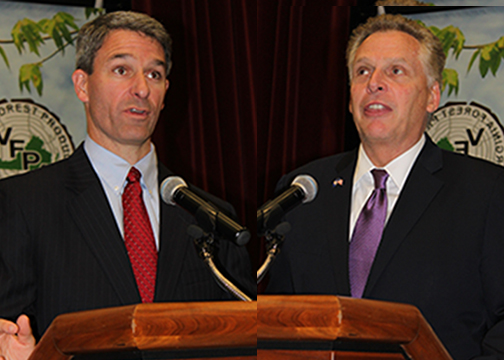
Cuccinelli, McAuliffe Address Virginia Farming and Forestry at Forum

Cuccinelli (left) and McAuliffe (right)
Photos by Pam Wiley

Gubernatorial candidates Ken Cuccinelli and Terry McAuliffe shared their thoughts on the future of farming and forestry in Virginia Aug. 2 at a forum at Wytheville Community College.

The event was sponsored by Virginia Farm Bureau Federation, the Virginia Agribusiness Council, the Virginia Forest Products Association and the Virginia Forestry Association and was open to those organizations’ members.

The candidates spoke separately, answering questions submitted by farmers and forestland owners.

McAuliffe said one of his major goals if elected will be to broaden markets for agricultural and forestry exports. While Virginia exports significant amounts of farm and forest products, “in some countries we are just scratching the surface,” he said.


McAuliffe said he would work toward $1 billion in annual farm and forestry exports to China and to make “as many trade missions as I can possibly get done” to market Virginia-grown products.

When asked for his thoughts on regulating farms to protect natural resources, McAuliffe said, “I want everybody to be at the table” for “a constant interaction between us as we move forward on regulations, and maybe on regulations we no longer need.”

Asked how he might lessen negative effects of the Patient Protection and Affordable Care Act on the state’s farms, McAuliffe noted that federal health care reform is now “the law of the land. We’ve got to work with it to find out what works for us” while ensuring that it does not hinder economic growth.

He said Virginia needs to take the federal Medicaid expansion rather than lose $26 billion it has paid into the system. “Why in green acres would we not want to bring that back? … I am not going to leave that money in Washington” to be spent on other states.

Cuccinelli questioned the affordability of the Affordable Care Act, calling it “an assault on the middle class.” If elected, “I will do everything I can to keep us unentangled with this new law as it unfolds,” he said.

As a state government, he said, “we have to obey the law of the land. We might not like it. It might be difficult. They’re making it more difficult.”

With regard to regulations proposed by the U.S. Environmental Protection Agency for Virginia farms and other businesses, Cuccinelli cited his track record for pushing back against EPA mandates and pledged to keep pushing back. He also said Virginia faces ongoing challenges to property rights, even after enactment of the constitutional amendment voters approved last fall.

The amendment’s opponents “want us all to say, ‘OK, we’re done!’” he said. “Well, we’re not done.”

The ability to take land using “quick take” procedures needs to be “reined in,” he said, and takings such as those by the Virginia Department of Transportation should be examined by state government “so we get consistency and what I expect to be better treatment of our citizens.”

Both candidates said they would ensure that 100 percent of state funds earmarked for transportation improvements would be spent on transportation.

From the Field: Award Time Begins Way Before Convention

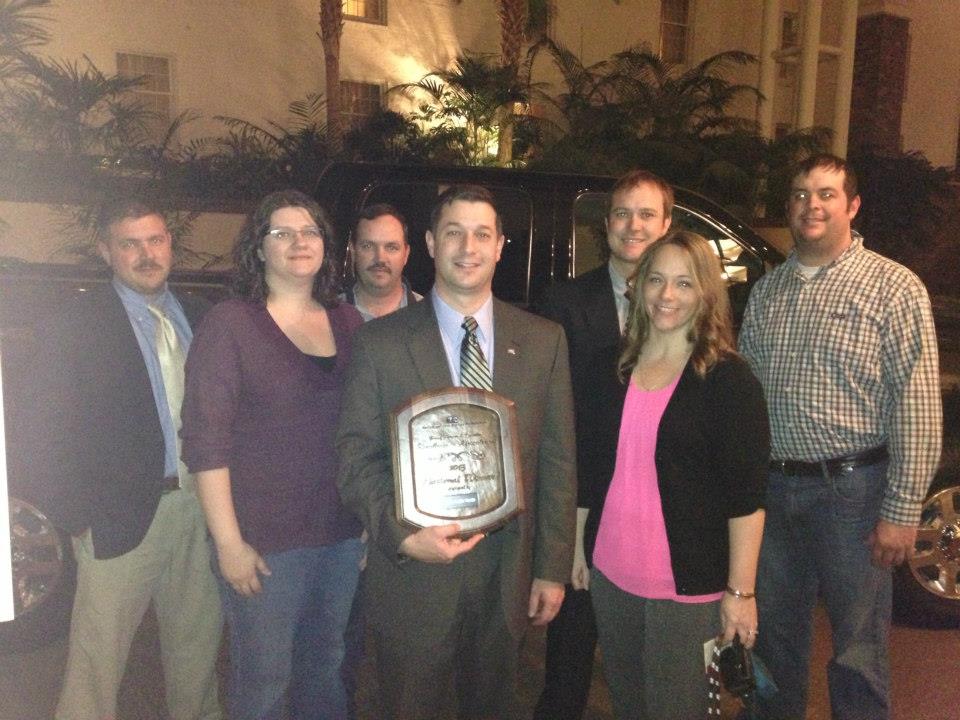
Dana Fisher, a young farmer from Shenandoah County, won
 the 2013 American Farm Bureau Excellence in Agriculture Award
at the AFBF Annual Meeting in Nashville. 
From the Field is a bi-monthly column written by Mark Campbell, Farm Bureau Field Services Director for the Central District. He writes about Farm Bureau member benefits and County Farm Bureau activities.
Even though Farm Bureau conventions, state and national, are in the winter months, now is the time for county Farm Bureaus to apply for awards that are presented at those conventions.  I know from experience that any activities that you have conducted within Farm Bureau have had a main purpose to educate the public about agriculture or share your knowledge of Farm Bureau and encourage people to become members.  The awards are a way we can show recognition and appreciation for all of your hard work.  Plus everyone likes to share ideas and learn about new successful activities.
The Best in State Award is presented to one county Farm Bureau that had the best activity in one of four categories.  The categories are membership acquisition, member involvement and/or retention, ag promotion or education aimed at the general public, and government relations.  Winners of this award receive $1,000 in credit to the VFB Company Store, special recognition at the Virginia Farm Bureau (VFB) Convention, and recognition in the Farm Bureau News- January issue.  If your county doesn’t win the Best in State, they can still qualify for best in district, which comes with a $100 credit to the VFB Company Store. 

The Women’s Program also has some awards to recognize outstanding activities.  These awards are presented at the State Women’s Conference in March.  Most of the Young Farmer awards are focused toward individual and family agriculture accomplishments.  But remember, all of these committees fall under the county Farm Bureau structure.  So an activity that a county Farm Bureau women’s committee conducted could qualify for both awards programs.  Ron Saacke, Director of women and Young Farmers Programs and Agriculture in the Classroom, said that the Farm Woman of the Year and VFB Ambassador applications are due by mid October.
American Farm Bureau Federation (AFBF) has a neat award that county Farm Bureaus can apply for.  It is called the County Activities of Excellence (CAE).  “The CAE showcases up to 24 of the top county Farm Bureau programs in the nation. These county Farm Bureaus and their award-winning programs serve as models of innovation for local program development, and display the amazing ability of local Farm Bureau volunteers working together to strengthen the lives of rural Americans and build strong, prosperous agricultural communities”.
If selected as a winner, your prize includes showcasing your activity or event in the exhibit hall at the AFBF Convention, four free registrations to the AFBF Convention and a $2,500 stipend to offset travel and exhibition expenses.  Oh, did I mention that the AFBF Convention is in San Antonio, TX?  San Antonio, The River Walk, and the Alamo.  Sound appealing?  We have had some Virginia counties that have won in previous years.  The deadline is August 30th.
I know that I have listed a lot of awards and you are probably thinking it is just too much to keep up with.  Don’t worry.  Your District Field Services Director (DFSD) can assist you and your county Farm Bureau.  We can even help guide you for those awards that have a more individual focus.  Furthermore, these awards are equal opportunity.  You don’t have to be a large county Farm Bureau to win.  I have seen some small county Farm Bureaus with some energetic volunteers do some amazing projects and win at the state and national levels.  So if you have an activity or an individual award that you want to apply for, just let your DFSD know.  We don’t mind reminders either.
Until next time,

Mark

Virginia Farm Bureau Members Appointed to VDACS Board of Directors

Governor McDonnell has announced the following appointments to the Board of Agriculture and Consumer Services:
  • Shelley S. Butler Barlow of Suffolk, Assistant Farm Manager of Cotton Plains Farm, Inc.
  • L. Wayne Kirby of Mechanicsville, self-employed Grain Producer
  • John R. Marker of Winchester, Orchardist at Marker-Miller Orchards
  • Mark A. McCann of Newport, Professor of Animal and Poultry Sciences at Virginia Tech
  • Robert J. Mills, Jr.* of Callands, Managing Partner of M-C Cattle Company
  • Steve W. Sturgis* of Eastville, Farmer and Owner of Tri-S Farms, Inc.
  • Luther Kirk Wiles, III* of Clifton, Founder and Owner of Paradise Springs Winery

* denotes reappointment

All of the above are Virginia Farm Bureau Federation members.

The Board of Agriculture and Consumer Services has fifteen members. The Board consists of one member from each of the 11 congressional district, at least eight of whom are currently working farmers, and two at-large members, one of whom is a structural commercial applicator of pesticides and one of whom is engaged in the commercial sale or application of agricultural pesticides. The presidents of the Virginia Polytechnic Institute and State University and Virginia State University or their designees are ex officio members of the Board with voting privileges. A full term of appointment is four years. Except for those who are initially appointed to fill an un-expired term, each citizen member is eligible to serve no more than two successive terms. In addition to its other duties, the Board now promulgates regulations to certify pesticide applicators, register pesticide products and issue pesticide business licenses in order to protect individuals and the environment through the safe and effective control of pests that adversely affect health, crops, structures and domestic animals.
The Board:
  • Promotes the agricultural interest of Virginia,
  • Has the power to receive and hold in trust donations made for the advancement of agricultural interests and to administer such trusts,
  • Advises the governor on the state of the industry of agriculture and offers the governor recommendations on actions to be taken to promote the industry’s development,
  • Works with members of the agricultural community and with federal and state agencies to develop and implement programs that will provide for a strong and viable Virginia agriculture,
  • Receives annual reports from the state’s commodity boards concerning their progress in promoting the industry,
  • Has the authority to prescribe, adopt and promulgate rules and regulations necessary to administer and enforce laws relating to agriculture, commerce and the consumer,
  • Is called upon by the commissioner from time to time to give advice and support concerning the development of new agency programs, organizational changes and other administrative matters,
  • Represents the broad interests of the public for the development of a strong industry of agriculture and efficient and responsive programs for serving and protecting the consumer.

The board holds four to five regular business meetings a year. With the exception of the July meeting, which is usually held in a different area of the state each year, the board meetings are conducted in the Richmond offices of the Virginia Department of Agriculture and Consumer Services. Additional meetings required for public hearings, planning, and new member orientation are held as needed. Public hearings are normally held in conjunction with regular business meetings. (Please note that you must select Department of Agriculture and Consumer Services on the Commonwealth Regulatory Town Hall in order to view Board meeting notices and minutes on that web site. See meetings for schedules and locations).

Breaking News: Expanded Livestock Protection Services Available in Eastern Virginia

Beginning in August, farmers in eastern Virginia will have a new resource for protecting their animals from predation by coyotes and other predators.  The Virginia General Assembly increased funding for livestock protection activities, allowing state and federal agencies to add a livestock protection specialist position to a program that has been successful in western parts of the commonwealth.  Administered by the Virginia Department of Agriculture and Consumer Services and USDA Wildlife Services, this program provided assistance to 150 livestock producers in 2012 who reported livestock losses, including 86 sheep farms, 61 cattle farms, and 3 goat farms.

Wildlife specialists assist livestock producers by providing information and training on husbandry practices and other non-lethal methods to help reduce predation, evaluating predator-killed livestock to identify the predator, and in some cases removing them locally. The program also conducted 17 educational programs during 2012 for livestock producers and the public about coyote ecology and coyote damage management. 

Livestock producers experiencing damage from predators should contact the USDA Wildlife Services Program at 804-739-7739 or 1-866-4USDA-WS (1-866-487-3297).

AFBF, 400 Others Call for House Immigration Reform

The American Farm Bureau Federation and more than 400 leading U.S. businesses and advocacy organizations called on the House to enact immigration reform legislation. The letter, sent today, was signed by a broad cross section of industries that includes agriculture, housing, retail, tourism, hospitality, technology, engineering, manufacturing, finance, venture capital, consumer electronics and others with a combined presence in every state in the United States.
The letter and all the groups signing on can be found at: http://bit.ly/18OVlYP.
Following is the text of the letter that was sent to U.S. House Speaker John Boehner and House Minority Leader Nancy Pelosi:

 “The undersigned organizations urge the United States Congress to enact legislation that would bring meaningful reforms to critical components of our nation’s immigration system. Reform of an outdated, broken immigration system is essential if we are to achieve a fully revitalized economy that provides rewarding and lasting jobs and opportunities for all Americans.

“Thought leaders from across the ideological spectrum agree that enacting immigration reform now will accelerate U.S. economic growth at a critical time when it has struggled to recover, and will help to enable sustained growth for decades to come. Done right, reform will also serve to protect and complement our U.S. workforce, generating greater productivity and economic activity that will lead to new innovations, products, businesses and jobs in communities across the U.S.
“We deal with an immigration system that is now in its third decade and completely incapable of being responsive to an ever-changing national economy and hypercompetitive global marketplace. Today, the problems with our immigration system have grown and multiplied to become an emerging threat to the current and future productivity, ingenuity and competitiveness of key sectors of our economy, including agriculture, housing, manufacturing, retail, hospitality, tourism, engineering and technology.
“We are united in the belief that we can and must do better for our economy and country by modernizing our immigration system. We already have been engaged with many members of CongressRepublicans and Democratson numerous components of a modern immigration system, and we urge that you not let this momentum slip and progress vanish.

“Failure to act is not an option. We can’t afford to be content and watch a generation-old immigration system work more and more against our overall national interest.  Instead, we urge Congress to remain mindful of the clear benefits to our economy if we succeed, and work together and with us to achieve real, pro-growth immigration reform.”

New Bill Protects Farmers’ Personal Information

Senators Joe Donnelly (D-IN) and Chuck Grassley (R-IA) have introduced the Farmer Identity Protection Act, legislation that would protect farmers and ranchers by prohibiting the Environmental Protection Agency (EPA) from disclosing their private and confidential information to the public.
Earlier this year, the Environmental Protection Agency (EPA) released the personal and private information of many livestock and poultry owners from across the nation. Sensitive information including names, phone numbers, and email addresses of the farmers and ranchers, their spouses, and employees on these farms or ranches was made available to the public.
Donnelly said, “I am proud to join Senator Grassley in introducing legislation that would protect livestock and poultry farmers from having their personal information released by the EPA.  It is unacceptable that earlier this year, the EPA released the personal contact information of over 80,000 livestock and poultry owners from across the nation, including many from Indiana. This blatant violation of privacy must not happen again, which is why I urge my colleagues on both sides of the aisle to support this common sense legislation.”
Grassley said, “Transparency is good for accountability, but putting the personal information of tens of thousands of farmers in the hands of environmental activists makes no sense.  It’s par for the course at the EPA, and by the looks of the agency’s response, they aren’t going to end this reckless behavior.  It’s time for Congress to step in and fix the problem.”
While the EPA has attempted to correct the error, this bill would provide clear protections moving forward for farmers and ranchers across the country.  It would limit the EPA to disclosing information about farming operations only when all personally identifiable information is removed to prevent the identification of farmers and ranchers and their families and employees.

Farm Bureau and several other farm and agricultural organizations recently sent a letter to Grassley expressing support for the legislation. 

Comment on Newest Version of the Chesapeake Bay Agreement

The Chesapeake Bay Program has accomplished a great deal since the signing of the first Chesapeake Bay Agreement in 1983, but there is still much left to be done. Three decades later, Bay Program partners are working to guide the continued evolution of the Bay ecosystem restoration and stewardship effort with the creation of a new Chesapeake Bay Watershed Agreement.

This new plan for collaboration across the Bay’s political boundaries will clarify our vision, mission and values and establish shared goals and outcomes for the protection, restoration and stewardship of the Bay, its tributaries and the lands that surround them. The agreement, now being drafted, is intended to encourage a forward-looking approach to conservation and restoration, focusing on immediate results and recognizing our long-term effort must be sustained by and for future generations.
Current version of the agreement, abridged for early stakeholder input: Draft Chesapeake Bay Watershed Agreement (pdf)
Provide Feedback:
Bay Program partners welcome stakeholder input between July 10 and August 15, 2013, on an abridged version of the Agreement, which includes our best thinking to date on how to create this new voluntary partnership plan.
Interested parties can offer input in two ways:
Submitting an online comment here(up to 750 words)
Submitting an email to: agreement@chesapeakebay.net

Please note: all comments, emails and letters submitted to the Bay Program in regards to the Chesapeake Bay Watershed Agreement will be posted on this webpage.

Southern States will Close Some Retail Stores

From the Richmond Times-Dispatch: 
By Randy Hallman

Focusing on its agriculture industry and wholesale business, Southern States Cooperative Inc. will close or consolidate about two dozen of its 1,244 retail stores in 17 states by the end of this month.
Only one of the company’s nearly 100 Virginia locations will be affected. A Southern States operation in Tappahannock will continue its industrial and wholesale services for farmers but will close its retail showroom.
The change will mean that three of the store’s 15 employees will be laid off, said Steve Patterson, Southern States vice president of marketing and communications.

Companywide, the closings will result in about 120 layoffs, he said.
Patterson said the store closings, most of which will be in northern Georgia and northern Alabama, will “free up some capital to serve our core customers.”
Southern States, based in western Henrico County, had the equivalent of 594 full-time employees as of Jan. 1.

In the Richmond area, the company has stores at 8718 W. Broad St. in western Henrico, 1200 Alverser Drive in Chesterfield County, 3119 Williamsburg Road in eastern Henrico and 1961 Sandy Hook Road in Goochland County.

The company supplies the independently owned Ashland Feed store and has a fuel service center at 11023 Washington Highway in Hanover County.
Southern States announced the changes Monday. A release said the company has established an agronomy business unit “to better serve the needs of core agricultural customers.”
Tom Scribner, Southern States’ president and CEO, said the changes are a growth strategy enabling the company “to be more streamlined and efficient from sourcing products to application in our farmers’ fields.”
Patterson said the company plans to add retail stores “in better locations.” He said the new stores will serve rural customers in high-growth markets, rather than urban and suburban locations.
A year ago, the company laid off about 150 workers companywide. Those job cuts included seasonal and part-time workers as well as employees in the corporate offices and stores.
Southern States has about 200,000 members and offers a range of products and services to help farmers.
One of the nation’s largest agriculture cooperatives, the company sells fertilizer, seed, feed, livestock and pet feed and other items for the farm and home. The company also offers farm equipment and crop-management services.

From the Field: How I Spent My Summer "Farmcation"


From the Field is a bi-monthly column written by Mark Campbell, Farm Bureau Field Services Director for the Central District. He writes about Farm Bureau member benefits and County Farm Bureau activities.

What is a “farmcation” you may ask?  Well, for some of us, it is taking in some type of agriculture while on vacation.  My family and I went to Florida last week for our vacation.  We drove.  It’s too expensive to fly a family of four, and I don’t mind driving.  We spent two days at Disney World and six days at the beach.  Our beach destination, Sanibel, was three hours southwest of Disney World. 
On the way to the beach, we stopped to see my friend from Florida Farm Bureau who lives in southwest Florida.  He also happens to be a District Field Services Director like myself. 

One comment before describing the farmcation:  Disney has the logistics of moving lots of people in the most efficient manner down to a science.  My wife had an app on her phone that even reported wait times at rides and best times to check back at certain rides.  That app worked great.  We didn’t have to wait for many rides or shows at all.  It was impressive.  I thought of Temple Grandin as we made our way through the lines and on to trams.

O.K.  Back to the rest of the story.  My farmcation mainly involved driving through the rural parts of the state and taking pictures and paying particular attention to what was growing or grazing on either side of the roads.  There are definitely rural areas.  On one piece of road that I was on, there wasn’t a convenience store, gas station or hardly a house to be seen for quite a while.  This was actually the best part.  It was just big pastures and cattle for as far as the eye could see scattered with Palm and Live Oak trees; such a beautiful sight. 

I especially enjoyed the drive from Kissimmee to Ft. Myers.  This was major citrus and cattle country.  In fact, the further south I drove, the larger the cattle herds.  The pastures were huge.  Most of the cattle, as to be expected, had Brahman influence for the heat and insect tolerance.  The cattle were grazing in the middle of the afternoon thanks to that Brahman influence. 

Florida cattle used to be known years ago as being a Heinz 57 mix of about every breed under the sun.  Today, Florida cattle enjoy a good reputation in the beef cattle industry as the ranches have really improved their genetics and health programs.  The most prominent breeds are Angus, Brangus, Braford, Charolais, and SimAngus.  Florida is the 10th largest state in the USA for beef cows. 

I also noticed in the southwestern part of the state that there were a fair amount of melon and blueberry growers.  I always thought of blueberry production mainly in the mid-Atlantic to northern states, like Michigan.  But blueberry production in Florida seemed pretty big.  Of course the orange and grapefruit trees were plentiful. 
On our way back home, in the central area of Florida from about Ocala to Jacksonville, the main types of agriculture were produce, cattle and horses.  In the Ocala area, there are some very impressive horse farms with big barns.  I saw so many horses, I thought I was in Lexington, Kentucky instead of Florida.  There were lots of black board fences, manicured pastures, and nice barns. 

My family and I enjoyed Disney World and our “farmcation,” but, just like Dorothy says, there’s no place like home.
Until next time,

Mark