Issues and Trends for Food and Agriculture in an Election Year

In an election year, especially a presidential election year, congressional and executive branch activity slows down and often comes nearly to a complete stop. This year will be no different, although there are several important food, agriculture, trade and environmental issues that will likely receive significant attention before activity wanes after Memorial Day. These issues include normalizing relations with Cuba, approval of the Trans-Pacific Partnership trade agreement, labeling of GMO food products, precision agriculture, use of drones and implementation of the Food Safety Modernization Act.

AFBF President Responds to Consumer Reports Column

AFBF President
Zippy Duvall
Our nation’s food system starts with America’s farm and ranch families, who own and operate 97 percent of the farms in our country. We enjoy a food supply that is among the world’s best, one that delivers a diverse bounty of affordable, nutritious and delicious food options—a horn o’ plenty that our ancestors could only dream about. But a recent Consumer Reports column (Eric Schlosser, “A Safer Food Future, Now,” May 2016), with its numerous, random gripes lodged against today’s food system, is a little like the story of the ungrateful son who turns away from his father, even though he showers the son with riches.

Our food riches include choice. Whether America’s eaters want grassfed or grainfed beef, freerange or sheltered poultry and pork, or tofu and sprouts, America’s farmers and ranchers work to provide it all. They harness a team of workhorses that includes everything from time-honored methods used by our grandparents to new crop and data technologies that would spin the brightest heads in Silicon Valley. We can apply nutrients and crop protection products precisely when and where needed, reducing impacts to our environment and to the farmer’s balance sheet. According to the Field to Market Alliance for Sustainable Agriculture, farmers are growing more with less—less land use, less labor, less water, less soil erosion, less energy use, less greenhouse gas emissions—but with more safety.

These achievements are driven by scientific advancements, but they have their roots in the farmer’s personal values—the desire to serve and a commitment to constantly improve. While others merely talk, farmers are producing plentiful, healthy food, caring for their animals and conserving natural resources. That’s a triple bottom line our society can be proud of, and I would put their performance up for comparison with anyone’s, anywhere.

So when it comes to our food system, I take issue with the naysayers. Today’s tools, seeds and methods, and the men and women who use them, make our food system healthier, safer and more affordable than it has ever been. The key to that success is our farm and ranch families, who uphold a tradition and a pledge to sustain our nation and nourish its citizens—season in and season out, all year long.

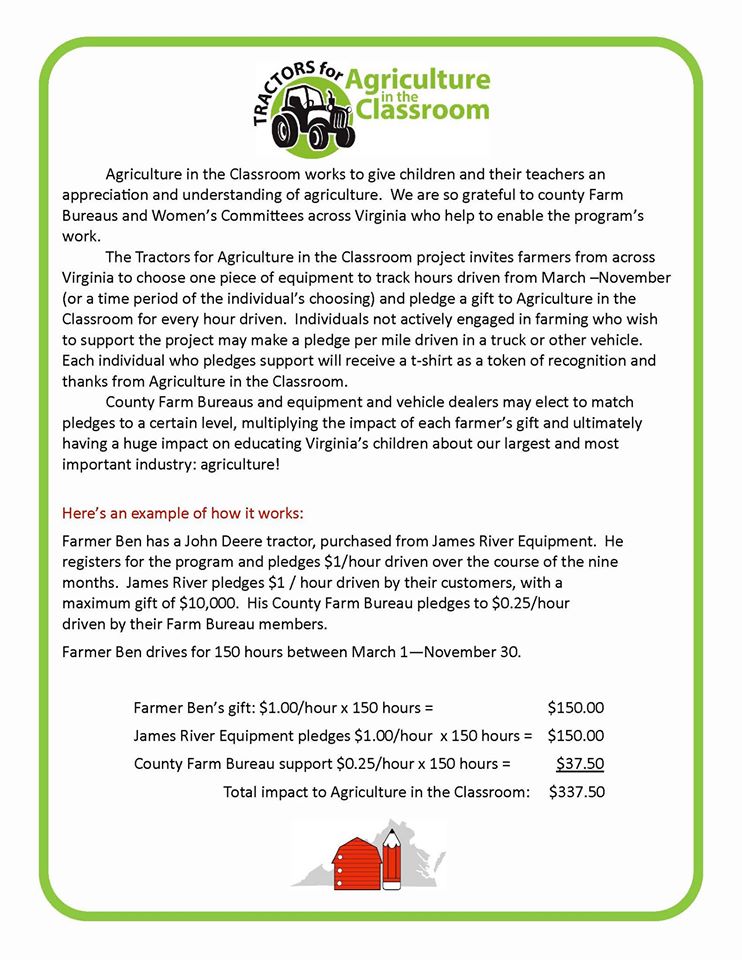
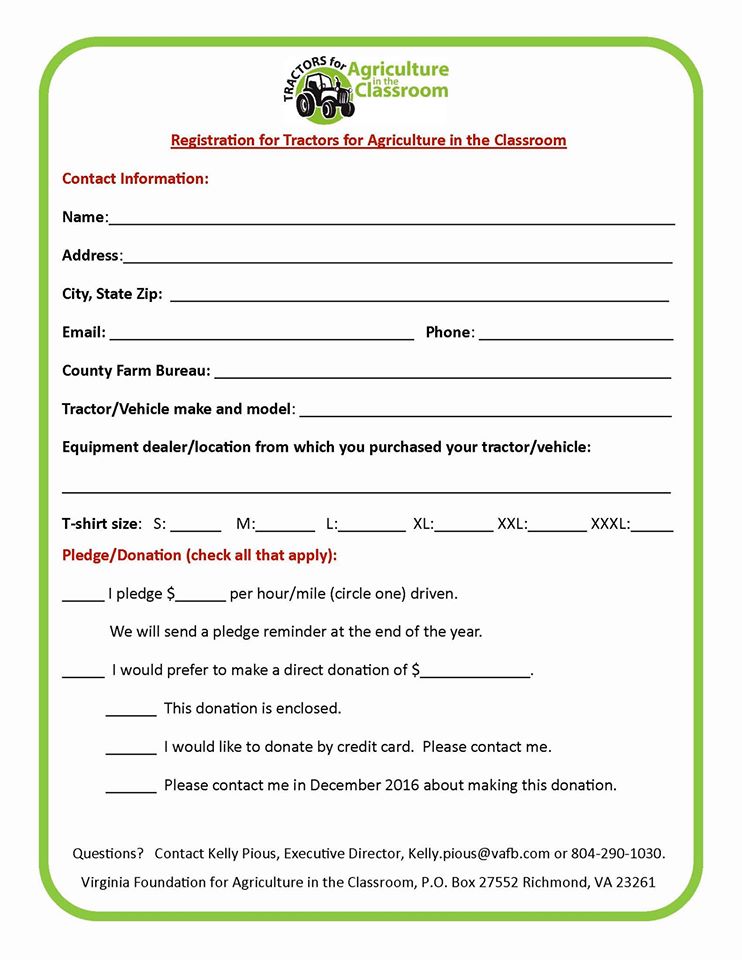
Track your Tractor Usage and Raise Money for Agriculture in the Classroom

Spring is here and supporting Agriculture in the Classroom is as easy as operating a tractor on your farm! Just choose one piece of equipment (or a vehicle) to track hours of use from March through November (or a time period that fits you best) and pledge a gift to Agriculture in the Classroom for every hour of operation. If you are interested in participating, have questions or need a pledge form, please contact Agriculture in the Classroom at 804-290-1034.

What Virginia Farmers are Planting in 2016


The Virginia Department of Agriculture and Consumer Services today announced the planting intentions of Virginia farmers as of March 1 surveys by the USDA’s National Agricultural Statistics Service. 
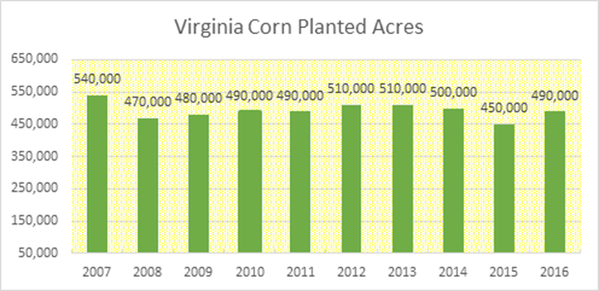
Farmers in Virginia intend to plant 490,000 acres of corn, 40,000 higher than 2015. U.S. corn growers intend to plant 93.6 million acres for all purposes in 2016, up 6 percent from last year and 3 percent higher than 2014. 
Soybean acreage in Virginia is expected to total 630,000 acres, unchanged from the previous year’s acres. U.S. soybean planted area for 2016 is estimated at 82.2 million acres, down 1 percent from last year. 
Upland cotton acreage to be planted in Virginia is forecast at 80,000, down 5,000 acres from 2015. The U.S. total upland cotton acreage is estimated at 9.35 million acres, up 11 percent from the previous year. 

Peanut acreage in Virginia is expected to total 19,000 acres, unchanged from the previous year’s acres. U.S. peanut planted area for 2016 is estimated at 1.48 million acres, down 9 percent from last year. 
Flue-cured tobacco growers in Virginia intend to harvest 21,000 acres, down 500 acres from 2015. For flue-cured producing states, growers intend to harvest 209,000 acres, 4 percent below last year. 
Producers intend to harvest 250 acres of dark-fired tobacco in Virginia, unchanged acres from the previous year. Burley tobacco was estimated at 1,200 acres, down 100 acres from 2015. 
Barley seeded by Virginia farmers in the fall of 2015 totaled 44,000 acres, down 2,000 acres from previous year. U.S. seeded acreage was 3.14 million acres, down 12 percent from the previous year. 
Winter wheat seeded by Virginia farmers in the fall of 2015 totaled 240,000 acres, down 20,000 acres from previous year. Seeded acreage for the nation was 36.2 million acres, down 8 percent from the previous year. 

Farmers in the state intend to harvest 1.18 million acres of all hay, up 5,000 from 2015. U.S. farmers intend on harvesting 54.3 million acres of hay in 2016, down slightly from last year.

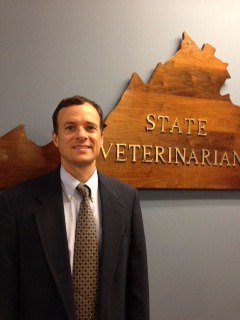
VDACS Names Dr. Charles Broaddus as New State Vetrinatian

The Virginia Department of Agriculture and Consumer Services (VDACS) recently selected Dr. Charles C. Broaddus as State Veterinarian and Director of the Division of Animal and Food Industry Services (AFIS).  He will begin his new duties May 11.
Dr. Broaddus came to VDACS in 2009 as Program Manager of the Office of Veterinary Services. Prior to joining the Agency, he worked in private practice and in academia. His undergraduate degree is in Economics from the University of Virginia, and he holds a Doctor of Veterinary Medicine (D.V.M) degree from Auburn University, where he also completed a dairy internship. He also holds a PhD in veterinary clinical sciences from Oklahoma State University, where he completed a theriogenology residency (animal reproduction).


Broaddus is a member of the American Veterinary Medical Association’s Council on Public Health and Veterinary Regulatory Medicine, the Virginia Veterinary Medical Association, the Virginia Academy of Food Animal Practitioners, and is a member of several committees of the United States Animal Health Association. He currently serves in the Army Reserves, Veterinary Corps.
 “I am delighted to welcome Dr. Broaddus to his new position within the Agency,” said Sandra J. Adams, Commissioner. “His practical hands-on experience in working with agriculture clients, his background in all aspects of animal health, his experience with animal-disease response and his enthusiastic commitment to Virginia agriculture will be a tremendous asset as State Veterinarian.”
The Division of Animal and Food Industry Services is comprised of the State Veterinarian’s Office and specialized programs in Laboratory Services, Veterinary Services, Meat and Poultry Services, Dairy and Foods, and Animal Care and Emergency Response.  The Division oversees such diverse functions as meat inspection, animal health and welfare, food inspection, livestock disease prevention and eradication, emergency planning and food security.

Dr. Broaddus lives in Hanover County with his wife, Dr. Kristy Broaddus, a veterinary surgeon, and their three children.

From the Field: VFB Staff Strengthening Partnerships on Member Benefits

The General Motors (GM) $500 discount with Farm Bureau was introduced in Virginia in 2012.  Shortly after the program introduction, the district field services directors (DFSDs) visited with all of the dealerships’ sales managers to introduce ourselves and Farm Bureau to them. 
Since that time, the GM discount program has been very successful.  In the first three quarters of 2015, Farm Bureau members saved almost $500,000 with the purchase of 992 vehicles.  That is certainly a good return on the $40 membership dues investment. 
In an effort to further enhance this benefit, our DFSDs have been visiting every GM dealer in the state this month and in April.  At these visits, we are meeting again with the sales managers and providing them promotional materials to use in their dealerships such as large window clings that say “Member Discount Available Here”, and table top displays.  During the meetings, we are asking dealers to partner with us by having a vehicle on display at some county Farm Bureau events and meetings.  At least one dealer is going to do a “Farm Bureau Day” at their dealership as a promotion.

At the same time, we are cross promoting Member Deals Plus and membership.  We are asking them and their salesman to become members and participate in Member Deals Plus.  Some dealerships are now offering discounts on service and free, state inspections through Member Deals Plus. 
Feedback that we have received all over the state is that the GM salesmen state how easy the program is to use and they use it to sell vehicles on a regular basis.  Many of the salesman stated that they ask customers if they are Farm Bureau members.
We are actively promoting and enhancing our member benefits package.  One of the best methods of advertisement is verbal.  So, if you have used one of the Farm Bureau member benefits, tell a family member or friend and encourage them to join if they aren’t Farm Bureau members.  We can save members a significant amount of money.  Help us spread the word about Farm Bureau’s member benefits. 
Until next time,

Mark

AFBF: In Failing to Move Voluntary GMO Labeling Measure, Senators Abandon Farmers, Consumers

On Wednesday, The Senate rejected a bill that would have prevented any state from requiring GMO labels on food.

Calling the Senate’s failure to move forward with debate on a voluntary GMO labeling bill “inexcusable,” American Farm Bureau Federation President Zippy Duvall said farmers will continue their fight to secure a law that supports consumers, America’s farmers and ranchers and our nation’s system of affordable, productive agriculture.

“To say we are angry with those senators who abandoned farmers and ranchers and turned their backs on rural America on this vote is an understatement. Their votes opposing this measure ignored science, threw our nation’s food system into disarray and undermined the public’s understanding of the many benefits of biotechnology in feeding a growing and hungry population,” Duvall said in a statement.

With a July 1 start-date set for a mandatory GM labeling law in Vermont, passage of a national voluntary GMO labeling bill is needed immediately. The measure Farm Bureau was anxious for the Senate to take up this week was offered by Sen. Pat Roberts (R-Kan.).
Duvall said farmers are willing to give senators a second chance.

“We remain hopeful they will have a chance at redemption by correcting this situation that will otherwise lead to increased food costs for consumers and stifle agricultural innovation, which remains a strength of our nation. We must not let anyone forget that rural America and our farmers and ranchers do matter,” he said.