 The Organic Livestock and Poultry Practices Rule (OLR) allows for animal welfare standards and metrics to become part of the organic label. AFBF opposed this on the basis that the original intent of the Organic Food Production Act was never intended to include standards on animal welfare issues. The OLR also contradicts recommendations for biosecurity, as it would create environmental compliance issues and does not follow recommended protocols for food safety. The economic burden of compliance is significant enough to force many organic livestock producers out of organic production or out of business entirely.
Author: VFB Governmental Relations
Farm Women Will Focus on ‘Agvocacy’ at Conference
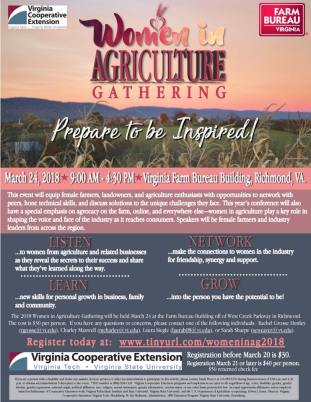 “Agvocacy” is the focus of the Virginia Women in Agriculture Gathering, which will be held from 9 a.m. to 4:30 p.m. March 24 at the Virginia Farm Bureau Federation headquarters in Goochland County.
The keynote speaker will be Lauren Arbogast, who is involved in her family’s Rockingham County farm and is one of five U.S. Farmers & Ranchers Alliance Faces of Farming & Ranching. Arbogast will speak about social media, advocating for agriculture and the key role women play in shaping the voice and face of the industry.
Presented by Virginia Cooperative Extension, the event is supported by the VFBF Women’s Committee.
Va. Educator Receives National Honor for Agriculture-based Lessons
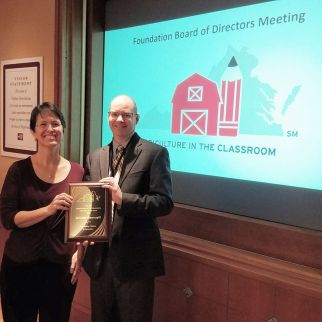 Jennifer Massengill, a science and technology teacher at Hampton Roads Academy in Newport News, is one of eight 2018 Excellence in Teaching about Agriculture Award recipients.
The awards recognize innovative efforts by teachers of kindergarten through 12th grade to use agricultural concepts when teaching core curricula. They are presented by the National Agriculture in the Classroom Organization, the U.S. Department of Agriculture and Farm Credit.
Agritourism Conference Helps Important Farm Sector
 Whether it’s selling pumpkins at a roadside stand or hosting weddings in a winery, agritourism is a $2.2 billion business in Virginia. Agritourism operators have the opportunity to attend the 2018 Virginia Agritourism Conference March 21-22 at the Great Wolf Lodge.
Participants will learn from experts how to grow or improve their agritourism businesses.
Trade Conference Speakers: Free and Fair Trade Crucial for Va. Farmers
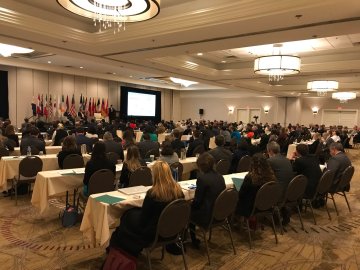 Breaking down trade barriers to achieve free and fair trade is critical for Virginia—and U.S.—agriculture.
That’s what several speakers told nearly 300 participants at the 10th annual Governor’s Conference on Agricultural Trade March 5.
The U.S. has focused internally and taken its eye off the global market, said American Farm Bureau Federation President Zippy Duvall. He told conference-goers that the U.S. share of global exports has dropped from 65 percent in the 1970s to 28 percent in 2017. “We need to turn our eyes back to the global markets and write new trade agreements,” Duvall noted. “Trade is one of those issues we’ve got to give it all we’ve got.”
Farmers Call for Swift Action on Emissions Reporting Bill
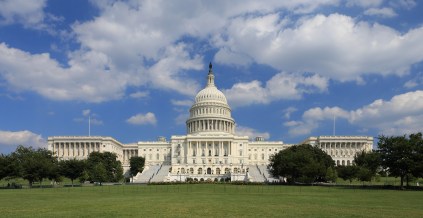 Unless Congress acts quickly on a Senate bill to exempt most farms from unnecessary reporting of routine air emissions from animals and their manure, nearly 200,000 farms and ranches across the country could face the threat of activist lawsuits, the American Farm Bureau Federation is warning.
The Fair Agricultural Reporting Method (FARM) Act (S. 2421) would clarify that normal emissions from farm animals and their manure are not reportable under the Comprehensive Environmental Response, Compensation, and Liability Act (CERCLA), which requires facilities to report releases of hazardous substances that exceed certain threshold quantities within a 24-hour period.
FMCSA Addresses ELD Concerns
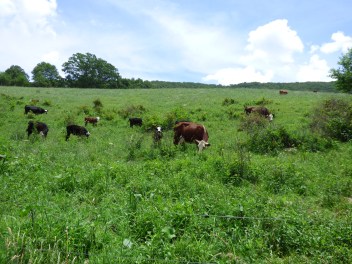 Recently, the Federal Motor Carrier Safety Administration (FMCSA) updated their website to address questions concerning existing agricultural exemptions and exceptions for agriculture along with those hauling horses or show animals. The updated website is here.
At the Senate EPW hearing last week, Senators Ernst (R-IA) and Moran (R-KS) pressed Secretary of Transportation Chao about the challenges around ELD’s and the lack of the agency’s response to our petition for a longer term exemption from ELD’s. Secretary Chao responded by saying: “If we do anything, it will be another waiver, but that is not a long-term solution,” Chao told the committee. “A decision will have to come up before March 18.”
Still Time to be Counted in the 2017 Census of Agriculture
 Farmers still have time to be counted in the 2017 Census of Agriculture, according to the U.S. Department of Agriculture’s (USDA) National Agricultural StatisticsService (NASS). Although the first deadline has just passed, NASS will continue to accept Census information through the spring to get a complete and accurate picture of American agriculture that represents all farmers.
“We thank everyone who has completed their Census to date. We currently have a return rate of just over 40 percent of the 3 million Census questionnaires mailed last fall,” said NASS Administrator Hubert Hamer. “A lot is at stake if producers are not represented in this data. Census data have and will continue to influence important decisions for American agriculture. The data will affect every operation and every farming community at some point, whether it be through farm policy, disaster relief, insurance or loan programs, infrastructure improvements, or agribusiness setup. There is accuracy and strength in numbers, which is why NASS is committed to giving producers every opportunity to respond.”
Farm Bureau Calls for Clarity on Exemptions for Agricultural Haulers
 While again urging the Department of Transportation to grant agricultural haulers a waiver and limited exemption from the electronic logging device mandate, Farm Bureau in recent comments responded to the department’s efforts to provide clarity to the 150-air mile agricultural commodity exemption and the hours of service regulations.
Until recently, very few Farm Bureau members or agricultural haulers were aware of their ability to use the newly interpreted 150-air mile agricultural commodity exemption, which provides exceptions from the HOS rules for the transportation of agricultural commodities within a 150-air mile radius from the source of the commodities. Enforcement officials, too, likely have very little knowledge about this exemption. This lack of awareness, combined with the unforgiving realities of ELD technology, makes the need for clarity all the more pressing, Farm Bureau emphasized.
RFD-TV Explores How ELD Mandate Would Affect Agriculture
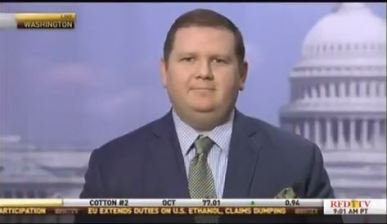 AFBF’s Andrew Walmsley, director of congressional relations, explained the intent of the electronic logging device mandate and what it means for agriculture in a recent RFD-TV segment. Most farmers and ranchers should be exempt from the ELD mandate because they can claim covered farm vehicle status, but drivers who haul livestock, live fish and insects are likely to fall under the requirements.
The Transportation Department’s “one-size-fits-all approach” to implementing the regulation is of great concern, Walmsley noted.
Drivers who have to use ELDs would be limited to current hours of service rules, which restrict a driver to only 14 “on duty” hours, with no more than 11 active driving hours. Once a driver hits those maximum hour allotments, he must stop and rest for 10 consecutive hours, which would be problematic when transporting livestock and other live animals. DOT’s 90-day waiver from the requirement that agricultural and livestock haulers install ELDs in their vehicles expires March 18. AFBF remains in contact with the agency regarding agriculture’s concerns and continues to urge lawmakers to come up with a legislative solution.
Watch the RFD-TV clip.

