2014 VFBF Critical Legislative Issue #1: Funding for Ag BMPs and Soil and Water Conservation Districts

Earlier this month, the Virginia Farm Bureau Federation announced its critical legislative issues for 2014. These are the issues Governmental Relations staff believe will be at the forefront during the next year’s General Assembly.  These issues are also discussed at Senatorial District meetings, regional legislative briefings for legislators held across the state during November and December. Each critical issue will be highlighted on Plows and Politics every day this week. If you are a producer member and would like to attend your region’s Senatorial District Meeting, please contact your Field Services Director for dates and locations. 

Virginia Farm Bureau is urging legislators to:
  • Adequately fund the Agriculture Best Management Practices Cost-Share Program in order for farmers to meet Virginia’s Watershed Implementation Plan goals by 2017 to avoid mandatory agriculture best management practices requirements
  • Adequately fund operational support and technical assistance for Soil and Water Conservation Districts to:
    • Administer Agriculture Best Management Practices Cost-Share Program
    • Assist farmers in developing Resource Management Plans
    • Track voluntary agriculture best management practices to help document water quality improvements for input into the Chesapeake Bay computer simulation model

In total, the General Assembly directed evaluation concluded that $51. 7 million is needed in FY15 and $72.6 million in FY16.
Why is it so important to fund Agriculture Best Management Practices and local Soil and Water Conservation Districts?

 On October 4, 2013, Virginia Farm Bureau along with other agriculture and forestry groups in Virginia made a direct plea to Governor McDonnell to fully fund the agriculture best management practices cost share program as well as the operational and technical assistance support for the 47 Soil and Water Conservation Districts.  Governor McDonnell will unveil the budget for the two years on December 16, 2013.  He will need to include $51.7 million for fiscal year 2015 which begins on July 1, 2014 and $72.6 million for fiscal year 2016. 
Where might the money come from?

The Commonwealth ended the 2013 fiscal year with $585 million.  Most of these dollars are already designated for specific purposes in the Appropriations Act that the Governor signed last spring.  Some of the funding obligations include $313.9 million for the Commonwealth’s Rainy Day Fund, $21.7 million to the transportation trust fund as repayment, $34.5 million to cover the state’s obligation resulting from some natural disasters, $22.5 million for the fund to help the Commonwealth deal with federal downsizing.  In the designated amounts, the Water Quality Improvement Fund will be given $31.5 million.  Because the General Assembly passed a bond measure to assist the waste water treatment plants with their funding last year, the majority of these funds is expected to be allocated to Agriculture Best Management Practices Cost Share.  In addition, $9.1 million is anticipated from the fee on the recordation tax that Governor Kaine included in his outgoing budget that remains as a source of funding.  It is anticipated that the Agriculture Best Management Practices may get around $35 million from these sources of funding for FY 2015 – it could be more or less depending on the Governor’s actions.  While this keeps stability in the program, it falls short of fully funding these needs identified of $51.7 million. We may or may not have a surplus at the end of FY 2014 in order to fund the FY 2016 need other than the $9.1 million in the fee on recordation tax.

 If you wonder why it is so important to fund the needed amount?  


The reason is that under the Commonwealth’s water quality commitments in the Chesapeake Bay region that it must achieve a 60% reduction in nutrients overall by 2017 or federal sanctions or additional state regulations may need to be enacted as a penalty.  Farmers already feel over regulated.  The system of the public private incentive based conservation practices can work if the funding is provided.  This is why is so important for farmers to continue educating their legislators as to how this program helps them and the Commonwealth achieve its water quality goals.

Breaking News: FSA Advises Producers to Anticipate Payment Reductions Due to Mandated Sequester

USDA’s Farm Service Agency (FSA) is reminding farmers and ranchers who participate in FSA programs to plan accordingly in FY2014 for automatic spending reductions known as sequestration.  The Budget Control Act of 2011 (BCA) mandates that federal agencies implement automatic, annual reductions to discretionary and mandatory spending limits.  For mandatory programs, the sequestration rate for FY2014 is 7.2%. 
Accordingly, FSA is implementing sequestration for the following programs:
·                  Dairy Indemnity Payment Program;
·                  Marketing Assistance Loans;
·                  Loan Deficiency Payments;
·                  Sugar Loans;
·                  Noninsured Crop Disaster Assistance Program;
·                  Tobacco Transition Payment Program;
·                  2013 Direct and Counter-Cyclical Payments;
·                  2013 Average Crop Revenue Election Program;
·                  2011 & 2012 Supplemental Revenue Assistance Program;
·                  Storage, handling; and
·                  Economic Adjustment Assistance for Upland Cotton.
 Conservation Reserve Program payments are specifically exempt by statute from sequestration, thus these payments will not be reduced.

 “These sequester percentages reflect current law estimates; however with the continuing budget uncertainty, Congress still may adjust the exact percentage reduction. Today’s announcement intends to help producers plan for the impact of sequestration cuts in FY2014,” said FSA Administrator Juan M. Garcia.  “At this time, FSA is required to implement the sequester reductions. Due to the expiration of the Farm Bill on September 30, FSA does not have the flexibility to cover these payment reductions in the same manner as in FY13. FSA will provide notification as early as practicable on the specific payment reductions. ”

For information about FSA programs, visit your county USDA Service Center or go to www.fsa.usda.gov/.

USDA Threatens to Cut Private Commodity Payments

USDA is considering withholding millions in PRIVATE DOLLARS owed to Virginians as part of the landmark tobacco buyout settlement. USDA has wrongly identified the Tobacco Transition Payment Program (TTPP), a temporary, contractual program, as a direct payment program and thus subject to FY2014 federal budget sequestration. The analogy to this action for nontobacco farmers is if USDA cut funding paid by producers into national check-off programs by reclassifying the funding as part of USDA’s budget.  Therefore, this action could be precedent setting as it applies to other commodities in the future.

The American Jobs Creation Act contained the Fair and Equitable Tobacco Reform Act of 2004 (Act) which ended federal production, marketing and pricing restrictions and price support loans for tobacco in exchange for 10 annual payments to producers from 2005-2014. The Act established the Tobacco Transition Payment Program (TTPP) to help tobacco producers transition to the free market.

The Act eliminated the tobacco quota and price support system. The “assets” once held by farmers and quota holders were replaced by legally binding contracts with USDA, which manages the collection and distribution of TTPP funds. Unlike direct payments provided for other crops, tobacco producers and quota holders enrolled in the TTPP in exchange for a concession, the transition of tobacco into the free market. Where TTPP payments differ from most other federal programs appropriate for sequestration is that:

    • These payments are not taxpayer funded; rather, they are funded through fees that are assessed to tobacco companies.
    • USDA’s only role is to pass along the fees collected from tobacco companies and distribute them to contract holders.
    • Unlike direct payments, TTPP payment recipients were eligible to receive a lump sum payment from a private third party in exchange for TTPP payment assignment or successor-in-interest contracts. Only the 2014 payment is outstanding for completion of TTPP contracts. This could hurt rural lending institutions such as Farm Credits because they would have to take this as a loss.

USDA’s FY2014 budget includes a mandatory appropriation of $960 million for TTPP nationwide.  The proposed 7.2% cut would reduce TTPP payments by $69 million.  In Virginia the FY2014 TTPP payments should total nearly $51 million.  The proposed sequester cuts would reduce TTPP payments in Virginia by an estimated $3.7 million.

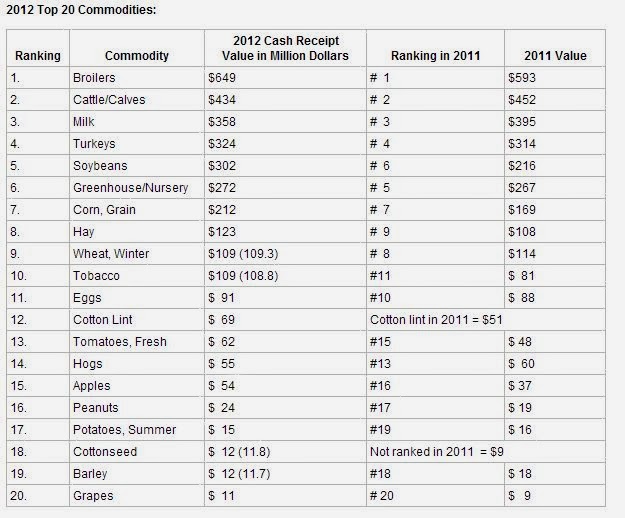
Virginia produced 53.6 million pounds of tobacco in 2012 (NASS) valued at nearly $109 million.


These cuts will affect payments scheduled for January 2014!

Virginia Farm Bureau has asked its producer members to send letters to the Virginia members of the House of Representatives, Senators and U.S. Secretary of Agriculture Tom Vilsack asking them to oppose TTPP payments as a sequestration cut. 

If you’re a producer member and interested in receiving Action Alerts, please contact Kelly Pruitt at kprui@vafb.com or 804-290-1293. 

Many Veterans Turn to Farming Post Duty

Vocational training programs have sprung up across the country for post-9/11 veterans, and some of them focus on agriculture as a way to help them re-adjust to civilian life. Veterans learn farm skills as they discover ways to get past the battlefield’s aftermath.

In honor of Veteran’s Day yesterday, below is a video news story Virginia Farm Bureau Communications Department’s Norm Hyde did on veteran farmers in Virginia Beach in May 2012. Thank you to all who have served and sacrificed for our beautiful country!


GMO Labeling Measure Fails in Washington

From FarmFutures.com:

Washington voters in all but four of the state’s counties Tuesday rejected a measure to label genetically modified foods and foods made with GM material.
According to the Washington Secretary of State, 986,806 of the state’s nearly 4 million voters turned out to cast their ballots, with 45% entering a yes vote and 54% voting no.

The measure, which would have made Washington the first state to implement GM labeling, sparked a heated debate in the state, garnering huge campaign contributions on both sides of the discussion. Nearly $30 million was spent advertising and other public messages between the two campaigns, according to an Oct. 30 analysis by Maplight.
Yes on 522, a group that collected nearly $8 million to support the initiative, Tuesday said the race was too close to call.

“Due to Washington State’s vote-by-mail system, we don’t have a final tally of the votes,” Delana Jones, campaign manager for Yes on 522 said in a statement. “Please stay tuned for more information in the following days.”

The group, which argued that consumers had a right to know what is in their food, said the initiative originated from a petition that more than 300,000 Washington residents signed. Key donors included Dr. Bronner’s Magic Soaps, Center for Food Safety Action Fund, and Mercola.com.

On the other side of the argument, No on 522, supported by top contributors Monsanto, DuPont Pioneer and PepsiCo, said the labeling measure would have significant costs to industry and agriculture, as well as consumers.

“This is a clear victory for Washington consumers, taxpayers and family farmers,” Dana Bieber, spokesperson for No on 522 said in a statment. “Washington voters have soundly rejected this badly written and deceptive initiative.”

The No campaign took issue specifically with exemptions that appeared in the initiative. For example, foods purchased at restaurants and meat and dairy products from animals fed GE grains were not required to be labeled.

The campaign did face a misstep earlier in the year as one of the lead sponsors, the Grocery Manufacturers Association, was hit with a money laundering lawsuit by the Washington State Attorney General.

The suit alleged that GMA – which represents more than 300 food and beverage companies – had collected and spent more than $7 million on the campaign while shielding the identity of its contributors.

Despite the setbacks, and no vote on the measure, it’s likely that the fight is not over. Similar measures have been introduced in several state legislatures and a ballot initiative for labeling was narrowly defeated last year in California.

Now, groups in Oregon are preparing for a similar battle in the next election cycle, according to U.S. Sen. Peter DeFazio, D-Ore., backing up a campaign that has in previous years been introduced nationally but failed to materialize.

Tech Student Chosen as 2013-2014 FFA President

Brian Walsh, an agribusiness major at Virginia Tech, was elected 2013-2014 National FFA President at the 86th National FFA Convention in Louisville, Ky. last week. The Woodstock native and FFA, 4-H member grew up raising and showing hogs and lambs. He also sells show hogs and lambs to 4-H and FFA members throughout Virginia.
It was eventually that enterprise that Walsh adopted as his FFA supervised agricultural experience.

“That tie to production agriculture is one that’s very valuable to me and one that I continue to use and expand on in the future,” said Walsh.

Each year at the National FFA Convention & Expo, six students are elected by delegates to represent the organization as National FFA officers. Delegates elect a president, secretary and vice presidents representing the central, southern, eastern and western regions of the country.
National officers commit to a year of service to the National FFA Organization. Each travels more than 100,000 national and international miles to interact with business and industry leaders, thousands of FFA members and teachers, corporate sponsors, government and education officials, state FFA leaders, the general public and more. The team will lead personal growth and leadership training seminars for FFA members throughout the country and help set policies that will guide the future of FFA and promote agricultural literacy. 

“For this new national officer team, it will be a year of hard work, long hours, lots of travel and major advocacy for FFA and agricultural education,” said 2012-13 National FFA President Clay Sapp, who delivered his retiring address today before the new team was named. “It is a year of profound experiences that will change their lives and thousands of lives their service will touch.”

The National FFA Organization provides leadership, personal growth and career success training through agricultural education to 579,678 student members in grades seven through 12 who belong to one of 7,570 local FFA chapters throughout the U.S., Puerto Rico and the Virgin Islands.

Candidates Share Final Thoughts on Ag and Forestry Before Election

The Virginia Prosperity Project (VA P2), a cooperative effort of Virginia employers to help educate employees and associates about important economic issues and engage them in the political process, recently released a series of candidate questionnaire videos featuring all the candidates running for statewide office discussing the major sectors of Virginia’s economy.

The last set of videos reveal how the candidates plan to support the major sectors of Virginia’s economy such as tourism, agriculture and forestry.

Key takeaways from the videos include:

Ken Cuccinelli – “I’ll continue as Governor to fight federal overreach that invades the agriculture and forestry ability…to do business.”

Terry McAuliffe – “As Governor my primary responsibility to Agriculture and forestry is to help open markets on a global basis.”

Robert Sarvis – “I trust the Virginia farmers, not the state or federal government, to decide how best to run their lives and their business.”

To see the videos in their entirety, visit http://www.virginiap2.com/

And don’t forget to vote on Tuesday, Nov. 5!

From the Field: Soil and Water Conservation Districts Important to Farmers

From the Field is a bi-monthly column written by Mark Campbell, Farm Bureau Field Services Director for the Central District. He writes about Farm Bureau member benefits and County Farm Bureau activities.

Soil and Water Conservation Districts (SWCD) have long partnered with farmers in addressing soil conservation and water quality.  In fact, they date back to the 1930s.  The agriculture programs provide funding to exclude livestock from streams, provide alternative watering systems, plant cover crops, convert cropland to grass, and convert to continuous no-till. There are 47 SWCDs in Virginia, and they are funded through local government appropriations and state and federal grants.  The board of directors of each district are volunteers that are locally elected, and many Farm Bureau members comprise these boards.  The boards set priorities and guide the activities and programs. While farmers are most familiar with agriculture programs, the SWCDs are involved in urban projects as well. 

Assistance from SWCDs is technical and financial.  All SWCDs have staff that can visit with you at your farm to talk about ideas for potential conservation practices.  This does not commit the landowner to anything.  The programs are voluntary.  Since more and more regulations are written every year about water; many farmers have been proactive, and have taken advantage of the cost share conservation programs.  The cost share programs are a blending of public and private money.  The percentage of cost share money varies by conservation program and budget allocations depending upon the year.  In some cases, the conservation program installed can be a combination of federal assistance from USDA and state assistance through the local SWCD.  New this year and continuing through June 2015 is 100% cost share on programs that include stream exclusion of livestock with a fence providing a 35 foot buffer.  Tree planting is not required with this program as it is with the Conservation Reserve Enhancement Program (CREP) with USDA, NRCS.  This state funding is in an effort to get ahead of the curve of more federal regulations with the Chesapeake Bay TMDL and show the federal government that Virginia can manage its own waters under the Watershed Implementation Plan (WIP).
These voluntary programs for livestock farms have helped not only provide alternative water sources, but have been conducive for rotational grazing.  I am a firm believer in management intensive grazing, and having strategically located water tanks makes it easier to operate.  Anyone that uses some form of managed grazing will notice improved forage production, healthier stands of grass, more drought tolerance, and the ability to increase stocking capacity.
One issue related to SWCDs that attracted a lot of attention from farmers this year was what agency would oversee the SWCDs and agriculture water quality programs.  Right now oversight is provided by Virginia Department of Conservation and Recreation (DCR).  There has been debate in the General Assembly about consolidating agencies and placing SWCDs in the Department of Environmental Quality (DEQ).  This generated lots of discussion at the Virginia Farm Bureau Conventionlast fall.  Several public meetings were held this summer and early fall to seek public input on this issue.  The Farm Bureau producer members developed policy that states “We support maintaining the agriculture water quality and Soil and Water District programs at the Department of Conservation and Recreation.  However, if DCR is unable to retain those programs, we believe VDACS is the best suited to serve those functions and programs.”
Many Farm Bureau members that I have talked to are opposed to a move to DEQ and attended the public meetings to voice their concerns.  As for now the SWCDs still remains with DCR.
You may want to check with your local SWCD and see if there are any programs that might work for you.  I know some people have considerable challenges in implementing programs due to topography and locations of streams, especially in the more mountainous areas.  But it doesn’t commit you to anything to check your options.  I will end by saying that I do not foresee less regulations related to water quality.  In fact, water availability, access, and quality will likely be regulated more as the human population increases. 
Until next time,

Mark

Commissioner of Agriculture and Consumer Services Leaving for Farm Credit Position

Matthew J. Lohr, 14th Commissioner of the Virginia Department of Agriculture and Consumer Services (VDACS), announced today that he will be leaving the agency in early December to begin a new position as Director of the Farm Credit of the Virginias Knowledge Center in Harrisonburg, Virginia. Lohr has been VDACS Commissioner since his appointment by Governor Robert F. McDonnell in May 2010. He currently serves as the President of the Southern Association of State Departments of Agriculture, a post he will leave upon his departure from VDACS.
“Serving as the Commissioner of VDACS has been an amazing honor and opportunity,” Lohr said. “I have enjoyed assisting Governor McDonnell and Agriculture and Forestry Secretary Todd Haymore in strengthening our Commonwealth’s number one industry. We have worked tirelessly to assist producers, promote agriculture and increase its importance and visibility all across the state.  It has been a wonderful experience championing an industry I care about so passionately.”    

The mission of the Farm Credit Knowledge Center is to facilitate the sharing of knowledge and resources for the betterment of all farmers through customer-focused programs that increase and advance the knowledge base of the agricultural community. “Here I will have the opportunity to build relationships and serve as a resource for young, beginning, small, minority and veteran farmers, as well as the established full-time producers,” Lohr said. “It’s a very exciting opportunity and one that will allow me to work from Harrisonburg and be at home much more for my two young children.”
“Matt has led VDACS with distinction and honor over the last three and one-half years and the agency is a better place for his service,” said Secretary Haymore. “He’s been a great partner in implementing the strategic plan behind the Governor’s decision to integrate fully agriculture and forestry into the administration’s overall economic development agenda.  Our work with the private sector on the Governor’s agenda has yielded much success and Matt deserves credit for achieving those accomplishments. Indeed, his passion for the promotion and betterment of Virginia agriculture is unmatched and I know that he’ll bring the same passion to his new role with Farm Credit.”
Haymore noted that Governor McDonnell will announce soon a VDACS leadership transition plan for the remaining months of the administration.
Prior to coming to VDACS, Lohr represented the 26th House District in the Virginia state legislature from 2005 to 2010. A lifelong farmer, Lohr and his family currently operate a 250 acre farm that includes commercial poultry, beef, row crops and sweet corn.    
A graduate of Virginia Tech, Lohr was very involved in the Virginia Farm Bureau Federation, winning the American Farm Bureau “Excellence in Agriculture Award” in 2003.  He also served several years as his county Farm Bureau president and chaired both the Rockingham County Planning Commission and School Board.

As a youth, Lohr was very active in the FFA organization where he served as state president and national vice president in the early 1990s.

Public Invited to Provide Input on Future Road, Rail, Transit Projects at Meetings

Governor Bob McDonnell has invited Virginia residents to attend the public meetings to be held across the state this fall so they can learn more about transportation projects funded in the current Six-Year Improvement Program (SYIP) and to provide comments for transportation improvements in the upcoming SYIP for fiscal years 2015-2020.
The Commonwealth Transportation Board (CTB) approves a SYIP for road, rail, and transit projects each June.
Speaking about the public meetings, Governor McDonnell said, “For the first time in 27 years, transportation in Virginia received a major boost, thanks to bipartisan cooperation in the General Assembly that allowed passage of legislation to provide much-needed, long-term sustainable funding for roads, bridges, and transit. Now I am looking to Virginians to provide their input on potential projects that will improve transportation.”

CTB Chairman and Secretary of Transportation Sean T. Connaughton added, “The new transportation investment will support better roads and stimulate job and economic growth as well.  The state’s transportation program is $17.6 billion for the next six years, including $15.7 billion for highway, rail and public transportation projects in the current SYIP and $1.9 billion in new funding sources for Northern Virginia.  Much of the funding is going toward rehabilitating aging highways and bridges, improving safety and operations as well as increasing capacity to reduce congestion.  Already, VDOT has advertised more than $2 billion in projects during this year alone.” 
“The new transportation funding will help each motorist in Virginia reach their destination quicker and more safely,” said Virginia Department of Transportation (VDOT) Commissioner Greg Whirley. “I am asking for your ideas, suggestions and input on how we can improve roads and bridges. You can do this by meeting with your regional transportation representatives during these fall planning meetings.”
“Due to the historic transportation funding bill signed into law this year,  the Commonwealth continues to provide for and grow its regional intercity passenger rail service and provide  for more public transportation choices, while reducing the amount of single-occupancy vehicles and maximizing the existing transportation infrastructure,” said Thelma Drake, director of the Department of Rail and Public Transportation.
Projects include interstate, road, rail, bicycle, pedestrian and public transportation initiatives. They emphasize bridge and pavement projects along with those to improve safety and reduce congestion throughout the transportation network. All SYIP projects eligible for federal funding will be included in the Statewide Transportation Improvement Program (STIP), which documents how Virginia will obligate its federal money.
Representatives from the CTB, VDOT, Virginia Department of Rail and Public Transportation (DRPT), metropolitan planning organizations (MPOs), and planning district commissions (PDCs) will be at the meetings to discuss their respective projects and programs.
If you cannot attend, information about the meeting will be available Oct. 22 at www.virginiadot.org/2013fallmeetings.  Send comments on rail, public transportation, and transportation demand-management projects to: Public Information Officer, DRPT, 600 East Main Street, Suite 2102, Richmond, Va., 23219 or DRPTPR@drpt.Virginia.gov.  Send comments on highway projects to: Programming Director, VDOT, 1401 East Broad Street, Richmond, Va., 23219 or SixYearProgram@VDOT.Virginia.gov.  Comments will be accepted until Dec. 6, 2013.
Meeting schedule at each location*:
6 p.m.-7 p.m. – Open house displays and general discussion
7 p.m. – Moderated public meeting
Wednesday, October 30, 2013
Northside High School
6758 Northside High School Road
Roanoke, VA 24019
Wednesday, November 6, 2013
VDOT Central Office Auditorium
1221 East Broad Street
Richmond, VA 23219
Wednesday, November 13, 2013
University of Mary Washington
Stafford Campus – University Hall (North Building)
125 University Boulevard
Fredericksburg, VA 22406
Thursday, November 14, 2013
Holiday Inn Staunton
Conference Center
152 Fairway Lane
Staunton, VA 24401
Monday, November 18, 2013
Germanna Community College
Daniel Technology Center
18121 Technology Drive
Culpeper, VA 22701
Tuesday, November 19, 2013
Holiday Inn and Suites
Bristol Convention Center
3005 Linden Drive
Bristol, VA 24202
Thursday, November 21, 2013
Kirkley Hotel and Conference Center
2900 Candler’s Mountain Road
Lynchburg, VA 24502

* You can find the localities that make up each district at www.virginiadot.org or by calling 800-367-7623.