Farm Bureau focuses on Farm Bill, Estate Tax during Lame Duck Session

http://c.brightcove.com/services/viewer/federated_f9?isVid=1

During its upcoming lame-duck session, Congress has some big policy moves to make. At the top of lawmakers’ to-do list, farmers and ranchers say, should be the farm bill and estate and capital gains taxes.

Many of the provisions of the 2008 farm bill expired on Sept. 30. Most farmers are okay for now because the 2008 bill covers the 2012 crops, not just fiscal 2012. However, dairy farmers are struggling without a Milk Income Loss Contract program, which expired at the end of September.

And even growers who are currently feeling few effects of not having a farm policy in place are at a loss in terms of planning for the future.

Just before Congress adjourned in October, hundreds of Americans, including farmers, congressional members and leaders from agriculture, conservation, energy, consumer and nutrition organizations, gathered on Capitol Hill at the Farm Bill Now rally. They called on lawmakers to pass a new, comprehensive, five-year farm bill. Such a bill, Farm Bureau says, is necessary to ensure stability for growers and allow them to plan for the future.

The Senate passed its version of the farm bill in June and the House Agriculture Committee approved its own legislation the following month. Farmers and ranchers had hoped to see Congress compromise on the two measures before heading home in the run-up to the election.

“Now it’s a lame duck must-do,” said Dale Moore, American Farm Bureau Federation policy specialist.

Sen. Debbie Stabenow (D-Mich.), chairman of the Senate Agriculture Committee, said she thinks there’s a good chance Congress will get the farm bill done, after House Majority Leader Eric Cantor (R-Va.) said in late October that the House would vote on a measure after the election.

Farmers and ranchers are also anxious for Congress to act on estate and capital gains taxes. On Jan.1, the estate tax exemption is slated to drop from the current $5 million to $1 million per person and the top tax rate will climb from the 35 percent in place now to 55 percent. The spousal transfer for the exemption will also disappear.

As part of an ongoing AFBF campaign, farmers and ranchers are e-mailing and calling their lawmakers to let them know how important estate tax reform is to keep family operations going and ease the transition following the death of a family member. Until estate taxes are permanently eliminated, farmers want Congress to keep or improve the current exemption, indexed for inflation, maintain spousal transfer and continue the top tax rate.

“If Congress doesn’t act on estate taxes, many more surviving farm family members could be faced with making critical decisions to sell land, buildings or equipment to generate enough money to pay the tax,” said Pat Wolff, AFBF tax specialist.

As with estate taxes, farmers are disproportionately affected by capital gains taxes. And, as with estate taxes, without congressional action, the capital gains tax rate will go up on Jan. 1, 2013.

With the new year, the top long-term capital gains tax rate will rise from the current 15 percent to 20 percent, and the dividends tax rate will more than double to 39.6 percent. Nationwide, 40 percent of all agricultural producers report some capital gains, nearly double the share for all taxpayers. And the average amount of capital gains reported by farmers is about 50 percent higher than the average capital gains reported by other taxpayers, according to AFBF.

USFRA responds to consumers concerns about GMOs

The U.S. Farmers and Ranchers Alliance, agricultural groups at the national, regional and state levels (including Virginia Farm Bureau) that are answering Americans’ questions about agriculture, recently responded on their Web site, http://www.fooddialogues.com, to some concerns about GMOs and biotechnology. After Proposition 37 failed in California, this is a very timely discussion.

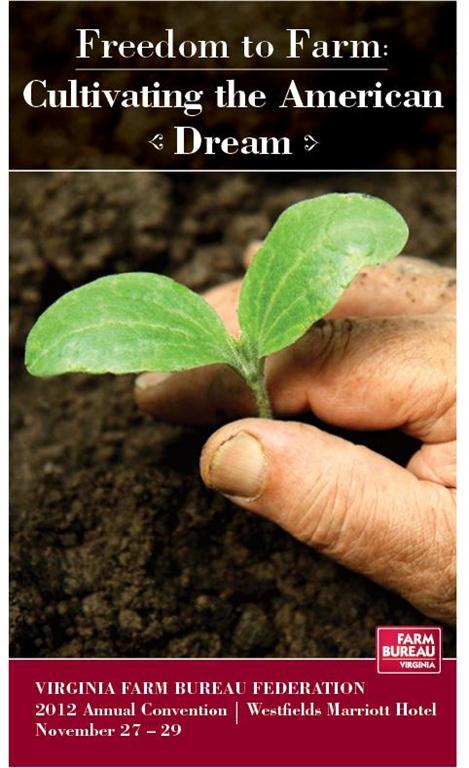
If you’re interested in learning more about USFRA and are a producer member attending the 2012 Virginia Farm Bureau Annual Convention in Chantilly, please contact your county Farm Bureau about attending the USFRA workshop on Tuesday, Nov. 27

USFRA’s View:

Consumers have a number of questions concerning the use of biotechnology in crops. Combining science with food raises many concerns and questions and during the New York Food Dialogues, the USFRA panel discussion with tackle a number of these questions. As the event takes place, you may be challenged to provide some answers as well from your followers and consumer audience. Here’s some background on this topic from the USFRA overview of biotechnology:


USFRA supports farmers’ choices to plant and grow conventional crops, biotech crops, organic crops or a combination. Similarly, USFRA supports consumers’ choices to purchase foods they prefer. Many of our farmers plant biotech seeds for reasons such as protecting their crops from adverse weather. Some of our farmers choose organic production. All of these methods of production contribute to meeting consumer demands for food products as well as producing healthy choices for everyone and protecting the environment.

Farmers also use biotech seeds for a number of reasons – to reduce crop damage from weeds, diseases and insects as well as from adverse weather conditions such as drought or flooding. Biotech seeds often allow farmers to be more precise about their use of inputs like nutrients, pesticides and water needed to grow crops.

Safety and FDA Review

“FDA has no basis for concluding that bioengineered foods differ from other foods in any meaningful or uniform way, or that, as a class, foods developed by the new techniques present any different or greater safety concern than foods developed by traditional plant breeding.”

Since 1995, food from biotech seeds has been commercially available and has been proven safe for human and animal consumption. No other crops have been more studied or subject to greater scientific review. Biotech seeds undergo testing for safety, health and nutritional value – and regulation is overseen by The Food and Drug Administration (FDA), The U.S. Department of Agriculture (USDA), Animal and Plant Health Inspection Service and the Environmental Protection Agency (EPA).

Research shows that the current commercial crops from biotech seeds have the same nutritional properties as non-biotech seed crops and are not harmful for humans and animals to consume. In the years that farmers have grown crops from biotech seeds (since 1995), there has not been a single instance of harm to human health.

For roughly 10,000 years, farmers have been genetically altering plants and seeds through selective breeding to improve characteristics such as hardiness, yield, taste and nutrition. Today’s biotech seeds are part of this evolution – their development is sped up and more precise by inserting the genes from one plant into another in a laboratory setting.

For more information on USFRA’s view on biotechnology, visit http://www.fooddialogues.com/foodsource/topics/biotech-seeds

Ballot Initiaive on GMOs fails in California

Lindsay Reames
Assistant Director
Governmental Relations

The property rights constitutional amendment wasn’t the only ballot initiative we were watching on Nov. 6.

Californians rejected Proposition 37, which would have mandated genetically modified foods (GMO) to be labeled as such and was opposed by agriculture groups.

Supporters of the measure argued that consumers have a right to know what’s in their food and that information should be made available on labels. About 60 countries around the world already require such labels, proponents stressed.

Opponents countered that labeling foods would cost families hundreds of dollars a year in higher grocery bills. They also accused the initiative of sowing fear that genetically-engineered foods are unsafe.

The proposition lost steam when local California writers such as The Los Angeles Times Alexandra Le Tellier questioned the science behind some anti-GMO research. “Is it (research) credible?” she asked. “Or is it science for the sake of fulfilling an agenda?” After noting that much of the criticism of GMO foods centered around pesticides, Le Tellier asked, “If the problem is the pesticides, then why isn’t the Proposition 37 labeling initiative about that?” Proposition 37 was defeated 53 percent to 47 percent.

This ballot intitiave was interesting to Farm Bureau because legislation calling for GMO food labeling was introduced and failed in Virginia last year, and we’re sure it will be coming back in the 2013 Virginia General Assembly.

Stay tuned to Plows and Politics and if you havent, please join the Capitol Connections Action Center (contact Kelly Pruitt at kelly.pruitt@vafb.com) for updates on this and other legislative issues.

Statement by Bob Stallman, President, AFBF, Regarding Election and Lame Duck Session

Bob Stallman, president of American Farm Bureau Federation released a statement on Wednesday regarding the 2012 Presidential Election and the Lame Duck Session. Read it below:

“The American Farm Bureau Federation congratulates President Barack Obama on his re-election, as well as those candidates elected to serve during the 113th session of Congress. A number of important issues lie ahead of us, both for our nation, and for American agriculture. It is vital that, under the president’s leadership, all our elected officials come together in a bipartisan fashion to resolve the challenges we face.

“Farmers and ranchers, like all Americans, have a list of issues that they are relying on the administration and Congress to address. But we cannot wait until 2013 for the action to start. Serious work on the farm bill, the fiscal cliff and critical tax policy fixes all must start during the lame duck session of the 112th Congress.

“Farm Bureau also looks forward to working in a cooperative and positive manner with the Obama administration and the new Congress on issues such as turning around our economy, ensuring agriculture an adequate labor supply, pursuing a trade agenda focused on reducing barriers and expanding exports and the continued fiscal challenges we face as a nation. There are many points of view on these issues, but we also know that our elected leaders have one thing in common: each ran on a platform to make America better and improve this country for all Americans.

“We will do our part to help identify opportunities for cooperation, not only to improve the lives of Farm Bureau members and their rural communities, but for all Americans proudly served by our farm and ranch families.”

From the Field: County Farm Bureaus Have Programs to Help Members and Communities

From the Field is a bi-monthly column written by Mark Campbell, Farm Bureau Field Services Director for the Central District. He writes about Farm Bureau member benefits and County Farm Bureau activities.

Earlier this year, you may remember me informing you about Louisa County Farm Bureau providing a poultry litter spreader for rent as a service to the farmers in the county. Well, this is just one county of several that have looked at discount programs and community services at the local level. American Farm Bureau and Virginia Farm Bureau have several member discount programs that certainly are available to all counties. But, in some cases, county Farm Bureaus have carved out niches to further expand the membership advantage in their county.

While not specific to just Farm Bureau members, Tazewell County Farm Bureau in cooperation with local veterinarians and the county government sponsor a free rabies clinic every November that is available to all county citizens, and there is no limit to the number of pets. This one-day clinic is a cooperative effort in that all three parties chip in money to cover the costs of the rabies vaccination and share the workload. Two veterinarians cover eight locations across the county. The Tazewell County Farm Bureau Women’s Committee helps staff the locations and prepares the certificates. It has been going on for about five years, and turnout has been great.

A few other county Farm Bureaus such as Bland, Franklin, Montgomery, Pulaski, and Prince George offer member programs with discounts to Texas Roadhouse (yummy- my favorite!), O’Charley’s, Advance Auto Parts, Gardner’s Frozen Treats, Anderson Animal Extractions, tax preparation service, Sam’s Club and vendor fee at the farmers market. The local discount programs have been well received in those counties. The reciprocal part of the agreement is that the county Farm Bureaus promote the businesses and the discount to their respective members.

Farm Bureaus time and time again to meet their purpose and fulfill their mission that is described in the bylaws as “…working to achieve educational improvements, economic opportunity (like the examples anove), social advancement, and thereby promote the national welfare…” A big thank you goes out to all of the Farm Bureau volunteer leaders and county Farm Bureaus that worked tirelessly to get the constitutional amendment on eminent domain passed by a huge majority. If you are not actively involved in your county Farm Bureau, I encourage you to do so. New ideas are always welcome and an extra helping hand with activities is certainly welcomed. Your District Field Services Director is your local liaison to Virginia and American Farm Bureau and always ready to assist you and your county Farm Bureau.

Until next time,
Mark

BREAKING NEWS: Property Rights Constitutional Amendment Passes!

We did it!!!! Thank you, Virginia Farm Bureau producer members! Without your grassroots support, the property rights constitutional amendment wouldn’t have been a reality!

Once the votes are certified, the amendment will go into affect Jan. 1, 2013. 
From the Richmond Times-Dispatch:

Virginians overwhelmingly approved a constitutional amendment on Tuesday night that will restrict the state’s ability to take private property for commercial purposes.

The amendment – backed by almost 80 percent of voters — requires that private property be taken by the government only for a true “public use” and not given to another private landowner, such as a developer, even in the case of job creation. Exceptions would include utilities or the elimination of a public nuisance. 

The amendment ensures that property owners who have their land taken are properly compensated, including lost profits to businesses.

Governor McDonnell Announces Agriculture and Forestry Industries Development Fund Now Open to Applicants

Governor Bob McDonnell has announced  that guidelines for the newly created Agriculture and Forestry Industries Development (AFID) Fund have been finalized and localities are now able to apply for AFID grants that will enable them to support economic development and job creation efforts. With the release of these guidelines, Virginia, for the first time, has an economic development grant program designed specifically to support agriculture and forestry development projects.

“Agriculture and forestry are Virginia’s largest industries, but we learned that too often economic development projects within these important business sectors didn’t meet the necessary criteria for the Commonwealth’s major incentive programs,” said Governor McDonnell, who has made agriculture and forestry key components of his overall economic development and jobs creation agenda. “That’s an omission that we’ve addressed as the AFID clearly recognizes the sometimes unique aspects of agriculture and forestry projects. We hope this program will encourage local governments to work closely with these important industries to create new jobs and increased economic opportunity in communities throughout the Commonwealth.”

The creation of the AFID was part of Governor McDonnell’s jobs creation and economic development agenda during the 2012 session of the General Assembly. The Governor signed the AFID bill into law on May 9 at Cave View Farm in Weyers Cave. Senator Bill Stanley (R – Glade Hill) and Delegate Steve Landes (R – Augusta) sponsored the AFID legislation, which is funded at $1 million in each year of the biennium. AFID funds are broken into two categories with $750,000 going to large grants to assist local efforts in expanding current or attracting new agriculture and forestry processing/value-added facilities using Virginia grown products and $250,000 dedicated to small grants to assist localities in improving local economic development efforts relating to agribusiness. The guidelines being released today are for applicants seeking an AFID grant for a processing or value-added facility. Guidelines for the assistance to localities will be released later this year.

“The AFID is a powerful new tool in Virginia’s already impressive economic development and jobs creation portfolio of incentive options and will further enhance our ‘best for business’ reputation,” said Lieutenant Governor Bill Bolling. “The fund is particularly important to rural areas, regions of the state where the Governor and I pledged to focus significant attention and job creation efforts after we were elected in 2009. Agriculture and forestry typically are significant economic drivers in rural Virginia, so new investments in these industries will help to build on these region’s existing strengths.”

Under the processing/valued-added guidelines, program funds are now available to local governments and other political subdivisions as one to one matching grants of up to $250,000 to attract economic development prospects involving agriculture and forestry operations to locate or expand in Virginia. In order to qualify, a minimum of 30 percent of the agricultural or forestry products to which the facility is adding value must be grown or produced in the Commonwealth. Grant awards will be determined based on such factors as amount of private capital invested, projected state and local tax revenue generated as a result of capital investment and jobs created, anticipated amount of Virginia-grown product used by the project, projected impact on agricultural and forestal producers, a total return on investment analysis and an analysis of the impact on competing businesses in the area.

“The AFID’s ‘buy local’ provisions will encourage agricultural and forestry operations receiving grant funds to explore all the ways they can source a significant portion of their inputs from within the Commonwealth,” said Todd Haymore, Virginia’s Secretary of Agriculture and Forestry. “In addition to allowing investing companies to utilize and enjoy the benefits of Virginia’s high quality agricultural and forestry products, this provision expands existing markets or opens new ones for Virginia producers, helps preserve working farmland, and encourages investments in our rural communities.”

Businesses interested in an AFID grant should first contact their local economic development professional or other appropriate representative of the political subdivision to discuss the proposed project. If the political subdivision is interested in applying for the grant and providing the required local match, they should contact Stephen Versen, AFID program contact at the Virginia Department of Agriculture and Consumer Services (VDACS) at stephen.versen@vdacs.virginia.gov or 804.786.6911 to discuss the program and share initial project details. AFID Guidelines may be obtained on the VDACS website at http://www.vdacs.virginia.gov/agribusiness/afid.shtml.  Applications will be taken on a rolling basis. The AFID program will be administered by the Secretary of Agriculture and Forestry with assistance from VDACS and Virginia Department of Forestry staff.

Agriculture and forestry are Virginia’s largest industries, with a combined economic impact of $79 billion annually: $55 billion from agriculture and $24 billion from forestry. The industries also provide approximately 500,000 jobs in the Commonwealth according to the Weldon Cooper Center for Public Service at the University of Virginia.

Got Feral Hogs? VDGIF Sets Public Discussions for August

The Virginia Department of Game and Inland Fisheries is holding public discussions on feral hogs in Virginia, their impacts, and what other states are now doing to control them in August. They will be held:

August 15, 6:30 PM
Germanna Community College,
Locust Grove Campus
For more information, contact VDGIF at 540-295-7590

August 20, 6:30 PM
Halifax County – Scottsburg Vol. Fire Dept.
For more information, contact VDGIF at 434-525-7522

A third meeting is planned in the Southwest region of the state. Date and location to be determined.

Feral hogs (also called wild hogs) are classified as a nuisance species in Virginia. Any pig that is outside of the property of its owner and cannot be claimed by its owner will be classified as a feral hog. They are an extremely invasive animal and cause damage to habitat wherever they exist. Feral hogs have been found to destroy turkey, grouse, and quail nests. They can also prey on deer fawns, destroy sensitive wetland habitat, and compete with our native wildlife for food resources. Feral hogs carry numerous diseases that can affect wildlife, domestic animals, and humans. The transmission of swine brucellosis and pseudorabies is a major concern to the commercial swine industry domestic animals, and humans. The transmission of swine brucellosis and pseudorabies is a major concern to the commercial swine industry.

Coyotes lose at the General Assembly

It’s bad news for coyotes this year at the General Assembly.

Both versions of the House and Senate budget restored $40,000 to a cooperative state and federal program to help landowners to learn how to control and abate coyote predation on livestock. This brings the program back to a minimal amount needed to continue.

The coyote population has been escalating based on surveys by the Department of Game and Inland Fisheries. This is evidenced by a 32 percent increase in the reported sheep predation by coyotes and a 69 percent increase in calf predation by coyotes from FY2010 compared to FY2011.

This program was established in 1990. It is a cooperative service agreement between the Virginia Department of Agriculture and Consumer Services and USDA-APHIS-Wildlife Services (WS) established to provide necessary technical and operational assistance in identifying, controlling, and abating coyote predation to livestock. During FY2010, WS provided direct control services to 159 livestock farms in 24 western and southside counties in federal fiscal year (FY) 2010. During this period of time, 348 sheep, 35 calves, and 5 goats were reported and verified killed by coyotes in Virginia on these 159 farms. This level represents a 19 percent increase in reported sheep predation and a 6% increase in reported calf predation over the previous fiscal year. This only represents the number of farmers that were able to receive help. Many other farmers have suffered losses without assistance.

A big thank you should be extended to Delegate Poindexter and Senator Ruff and their General Assembly colleagues for tilting the scale back in the landowner’s favor by keeping tools in place to deal with coyotes’ depredation on the livestock industry.