The National Institute for Food and Agriculture (NIFA) published the fiscal year (FY) 2023 Veterinary Services Grant Program (VSGP) Request for Applications. The purpose of the Veterinary Services Grant Program is to relieve veterinarian shortage situations and support food animal veterinary services. There are two types of grants for VSGP:
The Education, Extension, and Training (EET) grants will be made available on a competitive basis to qualified entities to develop, implement and sustain veterinary services through education, training, recruitment, placement and retention of veterinarians, veterinary technicians and students of veterinary medicine and veterinary technology.
The Rural Practice Enhancement (RPE) grants will also be made to establish or expand veterinary practices in rural areas. VSGP was appropriated $4 million in funding for FY 2023. The deadline for applications is March 29 at 5:00 p.m.
Additionally, NIFA published the FY 2023 veterinary shortage situation areas submitted by State Animal Health Officials. NIFA received 237 veterinary shortage area nominations which are now available for both VSGP and Veterinary Medicine Loan Repayment Program (VMLRP) applicants to review on the Veterinary Services Shortage Situations Map.
The designated shortage areas in Virginia for this year include the following:
Albemarle, Fluvanna, Louisa, Nelson Counties
Bedford, Campbell, Amherst Counties
Tazewell and Russell Counties
Botetourt and Franklin Counties
Public Practice – at VDACS labs located in Wytheville, Lynchburg, Harrisonburg or Warrenton
NIFA will host two live FAQ events where interested applicants will have the opportunity to ask questions regarding VSGP applications directly to the VSGP team. Registration is required and can be accessed by clicking on the following buttons:
This week, we’re thanking everyone who responded to the action alert asking senators to support SB1129 related to mandatory farm practices. Your voices were heard, and the bill successfully passed out of the Senate Ag Committee. We’re also providing updates on bills covering broadband and industrial hemp. Watch until the end to find out why Sunday, February 5 is a key date for the Virginia General Assembly.
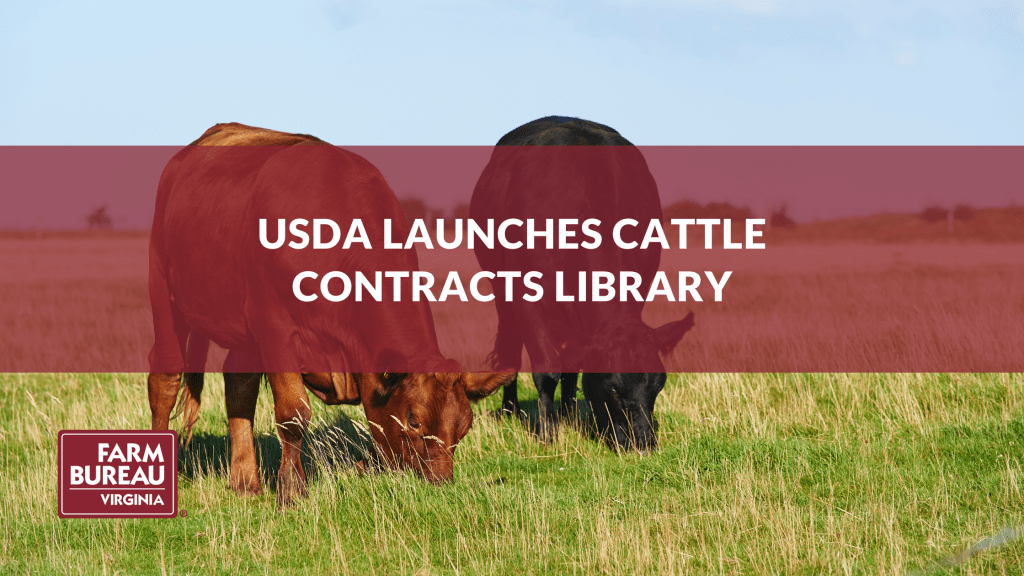
This week, the USDA launched a pilot Cattle Contracts Library which seeks to give cattle producers more pricing transparency. Following input from stakeholders, including Farm Bureau, USDA has finalized the Cattle Contract Library pilot program which will give producers a mechanism to find key terms, conditions and volumes by which cattle are contracted.
The Consolidated Appropriations Act of 2022 established the pilot Cattle Contract Library within the USDA’s Agricultural Marketing Service (AMS.) Under this pilot, AMS will collect, maintain and report aggregated information on contracts between cattle producers and packers for purchases of fed cattle.
The library will include different types of contracts and contract terms. This includes premium schedules, discount schedules, delivery and transportation, terms and payments, financing, risk sharing and other financial arrangements. Additionally, AMS will also report on the number of head of cattle purchased under the terms of a contract.
Upcoming Stakeholder Webinars
AMS will be conducting a series of stakeholder webinars to inform producers how to use this new tool. The first webinar is scheduled for Friday, February 8 at 11 a.m. The live dashboard will begin on February 6.
This week, we’re recapping the successes of Legislative Day and giving you updates on bills covering farm use placards, aerial application and more. Watch until the end to meet our newest lobbyist, Katelyn Jordan.
Arlington Million, Beverly D. Stakes and Secretariat Stakes to Run at Colonial Downs
After approval from the American Graded Stakes Committee, three internationally-renowned Thoroughbred stakes races will be moved to Virginia. Those turf races that will soon run at Colonial Downs in New Kent are the Grade 1 Arlington Million and Beverly D. Stakes and the Grade 2 Secretariat Stakes.
The relocation of these significant races follows approval from the Virginia Racing Commission for 27 live race dates at Colonial Downs during the 2023 meet to be held July 13-September 9. Colonial Downs also announced last week that they will modify their typical live race days to Thursday, Friday and Saturday as opposed to the traditional Monday, Tuesday, Wednesday schedule, making horse racing more accessible for Virginians and visitors from around the country. Next year’s meet will be the first under the operation of new owners, Churchill Downs Incorporated.
“It is an incredible honor to continue the legacy of these exceptional races by hosting them in our Commonwealth,” said Governor Glenn Youngkin. “I am deeply committed to growing our equine industry and as we work to revive the rich traditions of this sport in Virginia, these stakes races will accelerate our progress and ignite excitement for the fans.”
“Churchill Downs Incorporated remains steadfast in our goal to increase the relevance of the racing product at Colonial Downs and in Virginia,” said Bill Carstanjen, CEO of Churchill Downs Incorporated. “We appreciate the American Graded Stakes Committee for their approval of this move, which is an important step toward that goal in terms of wagering growth and entertainment value. We are also committed to increasing the flow of purse revenue from historical horse racing to allow for expansion of race dates in the future.”
“We are grateful to Churchill Downs for the emphasis they have put on bringing world-class races to Virginia which give jockeys, breeders and trainers more opportunities to showcase the best of Virginia’s equine industry,” said Debbie Easter, President of the Virginia Equine Alliance. “Governor Youngkin’s involvement and efforts to secure these three races in particular should be commended as we collectively work to ensure a bright future for horse racing in the Commonwealth.”
Next year will mark the 50th anniversary of Secretariat’s historic Triple Crown-winning season. The legendary horse will now be commemorated in the year of this milestone anniversary by debuting the stakes named in his honor on the Secretariat Turf Course at Colonial Downs in the state where he was born, bred and trained to be a champion.
This week, we’re giving you updates on bills covering farm use placards, cattle assessment, the Dairy Producer Margin Coverage Premium Assistance Program and mandatory farm practices. Watch until the end for a preview of our Legislative Day on January 22-23.
Largest grant round ever for program investing in local food and farming infrastructure
Gov. Glenn Youngkin today announced the largest ever award round from the Governor’s Agriculture and Forestry Industries Development (AFID) Fund Infrastructure Grant Program supporting local farms and food producers. A total of ten projects will receive $368,885 in competitively awarded, matching grants for new community infrastructure development projects that support local food production and sustainable agriculture. Created by the General Assembly in 2021, AFID Infrastructure grants are awarded biannually to support locally identified investments that aid small-scale farmers and food producers in growing their operations. This largest ever grant round is a result of the 2022 General Assembly’s decision to double the maximum award to $50,000. Independent businesses engaged in the processing of meat, poultry, and vegetables will benefit from funding this round, alongside multiple food processing facilities that are operated by non-profits or local governments.
“I am pleased to announce the AFID Infrastructure investments to support local producers and non-profits grow their operations and achieve success,” said Youngkin. “Given the importance of agriculture and forestry to the foundation of Virginia’s economy, my administration is committed to supporting the continued development of these industries as a growth engine and source of jobs throughout rural Virginia.”
“As a farmer myself, I understand how important it is for producers to have access to the processing infrastructure they need to get their products to their customers,” said Secretary of Agriculture and Forestry Matthew Lohr. “This latest round of funding demonstrates the ability of the AFID program to deliver on the Commonwealth’s commitment to supporting and growing our entire agricultural sector by supporting producers of all sizes.”
Administered by the Virginia Department of Agriculture and Consumer Services, the AFID Infrastructure Grant Program, in partnership with local governments, awards grants to develop community infrastructure in support of local food production and sustainable agriculture. Applications for the next round of this semi-annual grant program will be accepted from April 1 through May 15, 2023, with the awards announced in June. Additional information about the program is available here. Questions about the program should be directed to Jennifer.Perkins@vdacs.virginia.gov.
The following projects are receiving funding in this round of the AFID Infrastructure Grant Program:
Turkey Processing, Albemarle County $24,000 Albemarle County requests funding to purchase grinding, vacuum packaging, and freezing equipment for Kelly Turkeys to expand its existing product line of whole birds and bone-in breasts by adding ground turkey to its offerings. In operation since 2015, Kelly Turkeys grows and processes KellyBronze birds, an internationally known breed of heritage turkeys raised using sustainable farming methods.
Commercial Kitchen, Bedford County $21,500 Bedford County seeks funding to support a new commercial kitchen by established meat processor EcoFriendly Foods. The company has had success selling value-added products, such as hand pies, soups, and stews, which are prepared in rented kitchen space. The company anticipates sales to double with consistent access to a kitchen facility. Grant funds will purchase commercial kitchen equipment, including a tilt skillet and additional refrigerated storage space.
Vegetable Processing, Carroll County $50,000 Carroll County seeks funding to support the Virginia Produce Company with the purchase and installation of high-efficiency vacuum cooling equipment for produce. Vacuum cooling safely chills produce and removes problematic surface moisture in a fraction of the time as conventional methods, while also using 75% less energy. This rapid and efficient cooling method reduces product lost through moisture damage and increases shelf life, which expands the potential customer market. The Virginia Produce Company sources from more than 40 farms in the region to supply fresh produce to major food retailers.
Commercial Kitchen, City of Charlottesville $50,000 The Charlottesville Economic Development Authority requests funding to support New Hill Development Corporation, an African American led non-profit community development corporation, in the construction of a shared-use commercial kitchen. The Black Entrepreneurial Advancement and Community Opportunity Network (BEACON) kitchen will include packaging and production equipment to house up to 16 local food businesses. The BEACON kitchen will offer lower rental fees, helping producers overcome a barrier to entry for food startups.
Commercial Kitchen, Culpeper County $50,000 Culpeper County seeks funding to purchase and install a walk-in freezer and cooler as part of a larger commercial kitchen project in the George Washington Carver Food Enterprise Center, a non-profit focused on food security and training in the Piedmont. This facility will serve as a food business incubator and will offer courses on value-added food production, food safety, and business management. The center will primarily serve the broader Rappahannock-Rapidan region, as well as users from beyond.
Meat Processing, Franklin County $33,333 Franklin County seeks funding to support an expansion by KC Farms Meats, a family-owned custom meat processing business. KC Farms Meats offers custom meat processing services to 39 livestock producers in the region who sell directly to their customers. Funds will be used to purchase a new smoker and walk-in freezer, which will allow the business to expand its product offerings to include specialty sausages, hotdogs, bacon, and ham.
Farmers’ Market, City of Galax $15,052 The city of Galax seeks funding to improve the Galax Farmers’ Market. When the Galax Farmers’ Market was constructed in 2000, brick pavers were built around two oak trees that have since died. As a result, the remaining space is unsightly and inaccessible to people with disabilities. This funding will be used to rebuild the patio, which will improve the appearance and overall customer experience. In addition, the new patio will increase the space available for vendors and market opportunities for local producers. Appalachian Independence, a group that advocates for people with disabilities, has provided strong support for this project.
Apple Processing, Nelson County $25,000 Nelson County requests funding to purchase new UltraUV processing equipment for two apple orchards, Silver Creek and Seamans’ Orchards. Due to the increased demand for fresh sweet cider, the orchards seek to upgrade to a larger UV processing machine to triple production. The equipment will be located at a packing shed owned by the orchards and will be able to process the majority of juice apples grown in Nelson County. The UV treatment allows orchards to produce an FDA-approved product with an extended shelf life, which will allow locally produced cider to be distributed throughout the region.
Community Cannery, Prince Edward County $50,000 Prince Edward County seeks funding for equipment upgrades at its community cannery, a shared-use facility that is operated commercially by the food business incubator non-profit Virginia Food Works. Since 2020, the non-profit reports that nearly 100 clients have clocked nearly 1,700 hours of facility usage preparing foods for commercial sale. The public also relies on the cannery’s services to prepare and process seasonal vegetables and meats to supply foods for their families and businesses. This project builds on the AFID-funded installation of a new boiler at the facility. New funding will be used to replace many vital components of the cannery’s infrastructure, to include steam pipes, traps, valves, gauges, a half-ton chain hoist, pressure/temperature recorders, steam pot stems, and other equipment.
Food Hub, City of Roanoke $50,000 The city of Roanoke requests funding to support the Local Environmental Agriculture Project (LEAP), a non-profit focused on creating economically viable outlets for local farmers and food producers, such as farmers markets and commercial kitchens. LEAP aggregates and distributes food to an estimated 10,000 people each year. In addition, LEAP’s commercial kitchen supports over 40 food businesses with equipment, resources, and training. Their farmers markets host 50 local vendors, the majority of which are meat, produce, and dairy producers. In 2021, LEAP received support from the city of Roanoke to create a commercial kitchen and food hub in the underserved West End neighborhood. Funds will be used for the purchase and installation of a large walk-in cooler at the new food hub.