VFB Women’s Committe makes nearly 2,300 legislative contacts

VFBF President Wayne Pryor matched Women’s Committee
Chair Janice Burton’s $500 contribution to Agriculture in the
Classroom on behalf of the Southwest District, winners of the
legislative contacts challenge.

Last fall Virginia Farm Bureau Women’s Committee Chair Janice Burton issued a challenge to each women’s committee district to increase their activity during the 2012 General Assembly.

For the district that made the most legislative contacts, Janice would donate $500 to Agriculture in the Classroom. President Wayne Pryor offered to match Janice’s contribution for a grand total of $1,000.

President Pryor and Janice made good on their promise at the 2012 VFB Women’s Conference held last weekend at the Homestead.

Overall, members of the state women’s committee made 2,292 legislative contacts this session. The Southwest District, which includes Smyth, Lee, Russell, Tazewell, Wythe, Washington, Bland and Wise-Dickinson counties, made the most contacts with 1,361. Great job, ladies! And thanks to Janice and President Pryor for their generous incentives!

We here in Governmental Relations can’t stress enough the importance of contacting your legislators about bills or issues affecting Virginia agriculture, especially at crucial voting times. If you are a producer member and would like to receive our Action Alerts, please email kelly.pruitt@vafb.com.

Bills Blocking DOL Child Labor Regulations Introduced

By NIOSH

Update on Child Labor from AFBF:

U.S. Senators John Thune (R-S.D.) and Jerry Moran (R-Kan.) introduced common sense legislation last week, the Preserving America’s Family Farm Act, to prevent the Department of Labor (DOL) from enacting its controversial proposed restrictions on youth working on family farms. Both of Oklahoma’s Senators- Jim Inhofe and Tom Coburn, have signed on as co-sponsors.

The Department of Labor has proposed 85 pages of unreasonable and overreaching rules that would unnecessarily restrict the participation of young people in agriculture related activities,” said Thune. “Family farms and farming communities teach young people responsible work ethics and these proposed rules would change that by severely limiting the commonplace activities in which young people can learn about agriculture. This is another example of the Obama administration initiating unsolicited regulations that would prohibit normal practices that have been carried out in rural areas for generations—not to mention limiting a desperately needed workforce to replace the current generation of farmers whose average age is nearing 60 years old.”

“There is no better example of the vast overreach of government into the everyday lives of Americans than the Department of Labor’s proposed rule to regulate young people working on farms and ranches,” Sen. Moran said. “For generations, the contributions of young people have helped family farm and ranch operations survive and prosper. If this proposal goes into effect, not only will the shrinking rural workforce be further reduced, and our nation’s youth be deprived of valuable career training opportunities, but a way of life will begin to disappear. This proposal should alarm more than just rural America. If the federal government can regulate the relationship between parents and their children on their own family’s farm, there is virtually nothing off limits when it comes to government intrusion into our lives.”

In December of last year, Thune and Moran and 28 of their Senate colleagues sent a letter to Secretary Solis requesting that the proposed rule be withdrawn and outlined numerous concerns.

Legislation creates opportunities for more health care professionals in rural areas

Update on rural health by Trey Davis, Assistant Director of Governmental Relations

Farmers, like any other business owner, are constantly looking for new ways to maximize their profits while controlling expenses. In rural Virginia, the cost of health care has risen dramatically for farmers, their families, and their employees. Combined with a severe lack of access to hospitals and physicians in rural areas, health care is a growing problem that needs innovative solutions at both the state and federal level.

Allowing more people in rural areas that will diagnose conditions and provide treatment can go a long way towards controlling the “out-of-pocket” cost for farmers. HB 346, sponsored by Delegate John O’ Bannon (R-Richmond), is an opportunity to have more health care professionals in these underserved parts of the Commonwealth. The legislation will allow nurse practitioners to practice as part of “patient care teams” where a physician licensed to practice medicine in the Commonwealth provides management and leadership. It also streamlines requirements for written or electronic practice agreements for nurse practitioners, and provides that physicians practicing as part of a patient care team have the option of requiring nurse practitioners be covered by professional malpractice insurance.

HB346, a compromise between the Medical Society of Virginia (MSV) and the Virginia Council on Nurse Practitioners (VCNP), will increase the number of patients seen in rural areas by enabling physicians to manage more nurse practitioners. It also provides some new language that will allow more flexibility for NPs to treat patients in nursing homes and free clinics. As the bill awaits the Governor’s Signature, I hope farmers will be optimistic about having more medically licensed caregivers nearby. The less you have to travel to find quality care, than the lower your cost. The more nurse practitioners nearby, the greater your accessibility.

Health care costs and health care accessibility have been at the forefront of the public policy debate ever since the passage of the Patient Protection and Affordable Care Act (PPACA) by Congress in 2010. While the constitutionality of that law is set to be debated by the Supreme Court next week, the Virginia General Assembly is taking steps to provide greater access in rural areas.

We at Virginia Farm Bureau are thankful that the medical community is looking for legislative solutions that will provide farmers the quality health care they need at a business cost they can afford.

Farm Bureau has 34 successes at General Assembly

Martha Moore
Vice President, Governmental Relations

As the General Assembly concluded without a budget, Farm Bureau policy positions prevailed on 34 out of 40 issues. This number will change once we know the outcome on the state budget.

A big thank you goes out to those of you who made legislative contacts when we asked you as well as those of you who participated in Legislative Day. We can’t emphasize enough how crucial it is for legislators to hear the issues and how they affect agriculture straight from Virginia farmers like you. Your contacts made all the difference this year, and we can attribute our success to you.

If you are a producer member and would like to receive our action alerts, please email Kelly.Pruitt@vafb.com.

Below are some highlights from this year’s session:

Animal Care

• Successful in defeating all legislation that place arbitrary and unscientific animal husbandry practice restrictions on farmers and prevented giving human rights to animals

Game Laws

• Made coyotes and feral hogs nuisance species so that this would allow some permanency beyond regulations for an open season on these nuisance species

• Defeated all bills that would have allowed Sunday hunting

Property Rights

• Passed a resolution placing a proposed constitutional amendment on the ballot in November 2012 to permanently protect property owners from eminent domain takings for private benefit

• Ensured that landowners are fairly compensated for factors that impact the fair market value as “lost profits” and “lost access”

Please stay tuned on this issue as we are working on developing a statewide campaign on getting the ballot initiative passed. Look for more information on how your county Farm Bureau can help ensure that are successful in a major final piece of achieving our policy position on protecting your property rights from eminent domain abuse.

Virginia Cooperative Extension/ Agriculture Experiment Station

• Passed a commending resolution on the Agriculture Experiment Station’s 125th Anniversary to highlight the programs that have helped support farm profitability

Va. agricultural exports reached record high in 2011


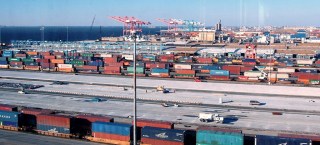
A view of the Port of Norfolk
By USDA


Gov. Bob McDonnell announced on March 13 that the commonwealth exported a record $2.35 billion in agricultural products in 2011, an increase of more than 6 percent from 2010 and more than 2 percent from 2009.
McDonnell spoke during the opening lunch at the Governor’s Conference on Agricultural Trade.
“Agriculture and forestry are vitally important to economic growth in Virginia,” he said. “With more than one-quarter of farm cash receipts attributable to export sales, continuing to grow Virginia’s agribusiness exports is a priority for my administration. … Exports are key factors in keeping our economy moving forward, and they support jobs, from our farms to our outstanding air, land and sea ports.”
Virginia’s strong position in the global marketplace is due in part to its diversified portfolio of products and export markets. Top export products in 2011 included soybeans; poultry; wheat; pork; lumber and wood products; corn; animal feed; leaf tobacco; fats and oils; cotton; marine and aquaculture products; fresh vegetables; raw peanuts; hides and skins; processed foods and beverages, including wine.

Virginia’s top three ag export markets in 2011 were Morocco, with exports totaling more than $360 million in 2011; China, which saw its exports from Virginia grow to $304 million; and Canada, with exports of $220 million.

Todd P. Haymore, Virginia Secretary of Agriculture, said in a Op/Ed piece in the Richmond Times-Dispatch for every $1 of agricultural products exported, another $1.40 is generated by in-state activities, such as processing, packaging and shipping. Importantly, exports generated nearly 30 percent of annual farm cash receipts last year.

“Virginians have no doubt as to the superiority of our agricultural and forestry products. Now, with the help of an aggressive global marketing strategy implemented by McDonnell, more countries around the world are discovering what Virginia has to offer,” Haymore said.
 
There is concern, on the national level, about the Obama administration’s approach to a major Asian-Pacific free trade deal currently in the advanced stages of negotiations. The Trans-Pacific Partnership Agreement (TPPA) aims to ease American exporters’ access to major Asian-Pacific markets, including Australia, New Zealand, Singapore, Vietnam, Japan and Taiwan.

However, the administration is considering carving out tobacco leaf and tobacco products from the agreement, a move that would shut out Virginia tobacco farmers from countries that account for 40 percent of global trade and 75 percent of Virginia’s agricultural exports.

Virginia farming and business communities have joined the Farm Bureau and Commissioner Lohr in urging the Obama administration to negotiate a trade agreement that benefits all of Virginia’s farmers. This is something we are monitoring and will continue to keep you posted.

AFBF Supports Farm Truck Measures in Transportation Bill

AFBF President
Bob Stallman

The American Farm Bureau Federation is supporting measures to make certain farm vehicles exempt from federal motor vehicle regulations that are appropriately aimed at the long-haul trucking industry. AFBF is urging senators to support two amendments to the pending transportation bill (S. 1813).

The first amendment, introduced by Sen. Jeff Merkley (D-Ore.), would provide an exemption for farm trucks. That measure is co-sponsored by Sens. Patrick Toomey (R-Pa.) and Roy Blunt (R-Mo.). If based solely on weight limits, even a one-ton pickup truck pulling a trailer could be subject to the long-haul regulations.

“The amendment is important because some states exempt farm vehicles while others do not,” said AFBF President Bob Stallman. “Under the current situation, merely the act of crossing state lines can trigger conflicting requirements for some farmers who are doing nothing more than hauling their own crop. These regulations can be particularly burdensome for farmers and ranchers living in counties bordering another state where their best market might be just across the state line.”

The second Farm Bureau-supported amendment to S. 1813 would exempt certain farm truck drivers from regulations on maximum driving and on-duty times during harvest and planting seasons. It is sponsored by Sens. Amy Klobuchar (D-Minn.) and Pat Roberts (R-Kan.).

“This measure is particularly crucial during the two busiest times of a farmer’s year,” Stallman said.

The amendment would apply to drivers transporting agricultural commodities within 100 miles of the farm that produced them, or those carrying farm supplies for agricultural purposes within 100 miles of the wholesale or retail distribution point. Each state would determine its own planting and harvest periods.

Clearing up ‘Farm Use’ Confusion

Hello! I am Andrew Smith, and I am Senior Assistant Director of Governmental Relations. One of the issues I handle for Virginia Farm Bureau is transportation.

I wanted to take a moment to let you know about a bill that passed this year in the General Assembly that we hope will clear up some confusion that began in 2010 when the legislature was attempting to limit the use of unregister farm vehicles (Farm Use) to the appropriate type of vehicles. In that year the types of vehicles were listed that are allowed to use the exemption with the intent to rule out the use on passenger vehicles.

In doing so, the language caused some confusion, even though when read properly, it was correct. To clarify the issue, the General Assembly passed House Bill 746 which breaks the vehicle types down with numerically as opposed to using commas which currently used in the “farm use” section of Virginia Code. This legislation passed both Chambers unanimously.

The wording that will be official beginning July 1 of this year will read:

“The provisions of this section shall only apply to (i) pickup trucks, (ii) panel trucks, (iii) sport utility vehicles, (iv) vehicles having a gross vehicle weight rating greater than 7,500 pounds, and (v) trailers and semitrailers.”
This language will appear in each of the appropriate Code sections. Even though this doesn’t change the meaning of the law, it is intended to make it easier to read and clear to the average person reading this Code section that benefits many in our industry.

State officials participate in Ag Literacy Week

Virginia Commissioner of Agriculture Matt Lohr reads to
a Harrisonburg elementary school.
Photo by VDACS

This week is Virginia Agriculture Week and Agriculture Literacy Week, and Virginians are celebrating by reading to children in pre-school through the third grade at public and private schools throughout the state.

State officials, including Virginia Commissioner of Agriculture Matt Lohr and Virginia Secretary of Education Laura Fornash, as well as Farm Bureau members and other people involved in agriculture will visit local school, after‐school program, or day care and read From Our Fields…To You, a book written by Virginia farmer and teacher, Kellie Worrell., and provide other activities on Virginia agricultural products.

During their annual Legislative Day event, Virginia Farm Bureau members gave each state legislator a copy of From Our Fields…To You to read during Ag Literacy Week, or any time during the month of March since the General Assembly is still in session.

Virginia Farm Bureau News Lead: Amendment would address farmers’ lost access and profits

This story appeared in the March 1 edition of News Leads, the week’s top ag stories sent out by the VFB Communications Department to media across the state:

Farmers whose land is taken using eminent domain should be able to access what’s left of their property and should be compensated for profits lost when a condemning authority has decided to take their land.

That’s one premise of a proposed amendment to Virginia’s constitution that was passed by this year’s General Assembly and will be on the ballot for voters in November.

As part of the language in the resolution, the state legislature has been asked to define lost profits and lost access.

“We feel that defining these terms is a critical step in moving the constitutional amendment forward,” said Trey Davis, assistant director of governmental relations for Virginia Farm Bureau Federation. “Anyone can have their property taken for eminent domain, and if they can’t access their (remaining) property or don’t get compensated for lost profits, that’s not fair.”

Earlier this winter, Attorney General Ken Cuccinelli cited an example of a dairy farmer whose land was taken by the Virginia Department of Transportation to build a road. VDOT deposited a sum amounting to 20 percent of the value of the farm buildings on that land into an account, but it took two years for the farm owner to get the money.

Without a barn and milking parlor or money to build new ones, the farm family was forced to sell its cows.

“This quick-take demolished their business,” Cuccinelli said.

The family had to wait two years before receiving any compensation, and they received no money for the business lost during those two years.

“With other parts of the state code, the law allows Virginians to seek and be compensated for lost profits, so why is it fair to exclude those affected by eminent domain?” Davis asked.

HJ3 and SJ3, the House and Senate versions of the constitutional amendment, tighten the definition of public use and require just compensation for owners whose property has been taken using eminent domain. Companion legislation, HB1035 sponsored by Del. Johnny Joannou, D-Portsmouth, and SB437 from Sen. Mark Obenshain, R-Harrisonburg, defines lost profits and lost access to property as required by the amendment.

“The financial penalty incurred by farmers during eminent domain takings is real and provable,” Davis said. “With the enactment of this legislation, farmers will at least have the opportunity to be justly compensated in court. I’m thankful that HB1035 and SB437 have seen bipartisan support and also that we have reached a compromise on language between many of the condemning authorities and property rights advocates.”

Agricultural trade conference will take place March 13 and 14

Governor Bob McDonnell will host the “Governor’s Conference on Agricultural Trade March 13 and 14 in Richmond. The two-day conference, which is co-hosted by Virginia Tech’s Department of Agricultural and Applied Economics, the Virginia Department of Agriculture and Consumer Services, Virginia Farm Bureau Federation and the Virginia Port Authority, will bring together Virginia-based agribusinesses, exporters, foreign ambassadors and embassy ministers and offer workshops on the international trade of agricultural goods.

Governor McDonnell will open the conference at a noon lunch on March 13 with a keynote speech on agricultural exports and the role agriculture and forestry, the state’s largest industries, play in Virginia’s economy. The governor will also announce total figures for agricultural exports from Virginia for 2011. In 2010, the Commonwealth totaled more than $2.24 billion in agricultural exports, the second highest total of all-time. Agricultural exports from Virginia reached an all-time high in 2009 when more than $2.3 billion of products were shipped into the global marketplace.

Speaking about the upcoming conference, Governor McDonnell said, “I am pleased to announce the upcoming Governor’s Conference on Agricultural Trade. My administration, working with our private sector partners, has aggressively pursued opportunities to open new markets around the world for Virginia agricultural products and the new export figures for 2011 to be announced at the conference will reflect the hard work and success of Virginia agribusinesses in this past year. With more than half a million jobs in Virginia’s agriculture and forestry industries, it is vital to the health of our economy that we continue to promote the trade deals that connect these fine products with domestic and overseas consumers. At this conference we will bring together stakeholders to share what works in agricultural trade and to chart a course for future growth.”

In addition to Governor McDonnell, the conference is scheduled to feature presentations from, among others, Ambassador Gabriel Silva Luján of Colombia; Ambassador Islam Siddiqui, Chief Agriculture Negotiator for the Office of the United States Trade Representative; Bob Stallman, American Farm Bureau Federation President; Todd Haymore, Virginia Secretary of Agriculture and Forestry; David Nelson, Rabobank America’s Global Strategist; and Randy Russell, a Principal at Russell and Barron.

Since taking office in 2010, Governor McDonnell led overseas economic development and job creation missions to Great Britain, the Netherlands, Germany, Japan, China, South Korea, Israel and India. These missions have resulted in more than $100 million in new agricultural exports from Virginia so far. Gubernatorial trade missions for 2012 are being planned now.

Details:
What: The Governor’s Conference on Agricultural Trade
Conference information and a tentative agenda available here: http://www.vafarmbureau.org/Agriculture/AgTradeConference.aspx
When: Tuesday, March13: 10:00 a.m. – 5:00 p.m. and Wednesday, March 14: 8:00 a.m. – 2:30 p.m.
Where: Omni Hotel, Richmond
Who: Governor McDonnell, Virginia-based agribusinesses, exporters, foreign ambassadors and embassy ministers