VSU announces new dean of school of agriculture

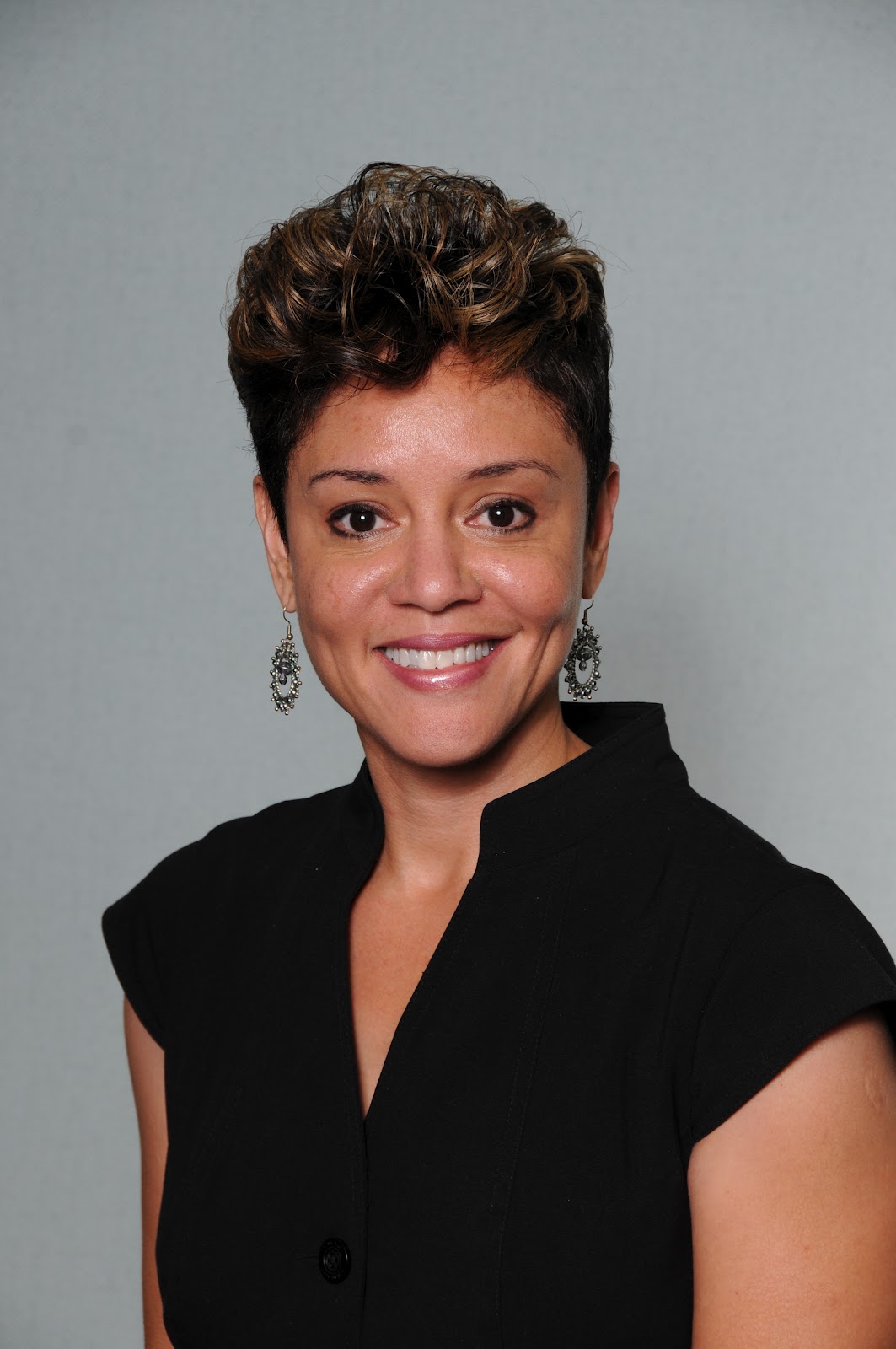
Dr. Jewel E. Hairston

Dr. Jewel E. Hairston has been announced as Dean of the School of Agriculture for Virginia State University.

While serving as Interim Dean As Interim Dean of the VSU School of Agriculture, she has led the School’s efforts in developing the strategic vision and plan for the Extension and Research Divisions and the Academic Departments of Agriculture, Family and Consumer Sciences and Hospitality Management.

“Dr. Hariston has a talent of bridging the gap between academics and small and disadvantaged farmers.  In this role, it is very important to inspire researchers/professors while challenging their assumptions to develop practical information that can be used by farmers to increase their profitability,” said Martha Moore, vice president of governmental relations for Virginia Farm Bureau Federation. “ In serving on various committees or discussing ideas about what farmers need from land grant institutions, Virginia Farm Bureau finds Dr. Hairston as a partner willing to help.  It is this cooperation that will help VSU move forward as well as helping small and disadvantaged farmers move the agriculture industry forward.”


In July 2008,  Hairston was appointed associate administrator for programs with Cooperative Extension at VSU where she provided leadership for Extension programming efforts in agriculture, aquaculture, family and consumer sciences, and 4-H youth development. She has also served as an assistant professor at Bowling Green State University and a Marketing Teacher and Adult Education Coordinator in Roanoke. She holds a Doctor of Philosophy degree in Career and Technical Education and Master of Science degree in Education (both from Virginia Polytechnic Institute and State University).

“She is a highly respected professional among her peers throughout the nation, Dr. Hairston is a life-long member of our community who has served VSU’s stakeholders with distinction,” said Dr. W. Weldon Hill, provost and vice president for academic Affairs for VSU.

Breaking News: DOL withdraws proposed regulations on child ag labor

Good news regarding child labor in agriculture:

The U.S. Department of Labor today issued the following statement regarding the withdrawal of a proposed rule dealing with children who work in agricultural vocations:

“The Obama administration is firmly committed to promoting family farmers and respecting the rural way of life, especially the role that parents and other family members play in passing those traditions down through the generations. The Obama administration is also deeply committed to listening and responding to what Americans across the country have to say about proposed rules and regulations.

“As a result, the Department of Labor is announcing today the withdrawal of the proposed rule dealing with children under the age of 16 who work in agricultural vocations.

“The decision to withdraw this rule – including provisions to define the ‘parental exemption’ – was made in response to thousands of comments expressing concerns about the effect of the proposed rules on small family-owned farms. To be clear, this regulation will not be pursued for the duration of the Obama administration.

“Instead, the Departments of Labor and Agriculture will work with rural stakeholders – such as the American Farm Bureau Federation, the National Farmers Union, the Future Farmers of America, and 4-H – to develop an educational program to reduce accidents to young workers and promote safer agricultural working practices.”

Governor McDonnell Announces New Virginia Wine Region Signs

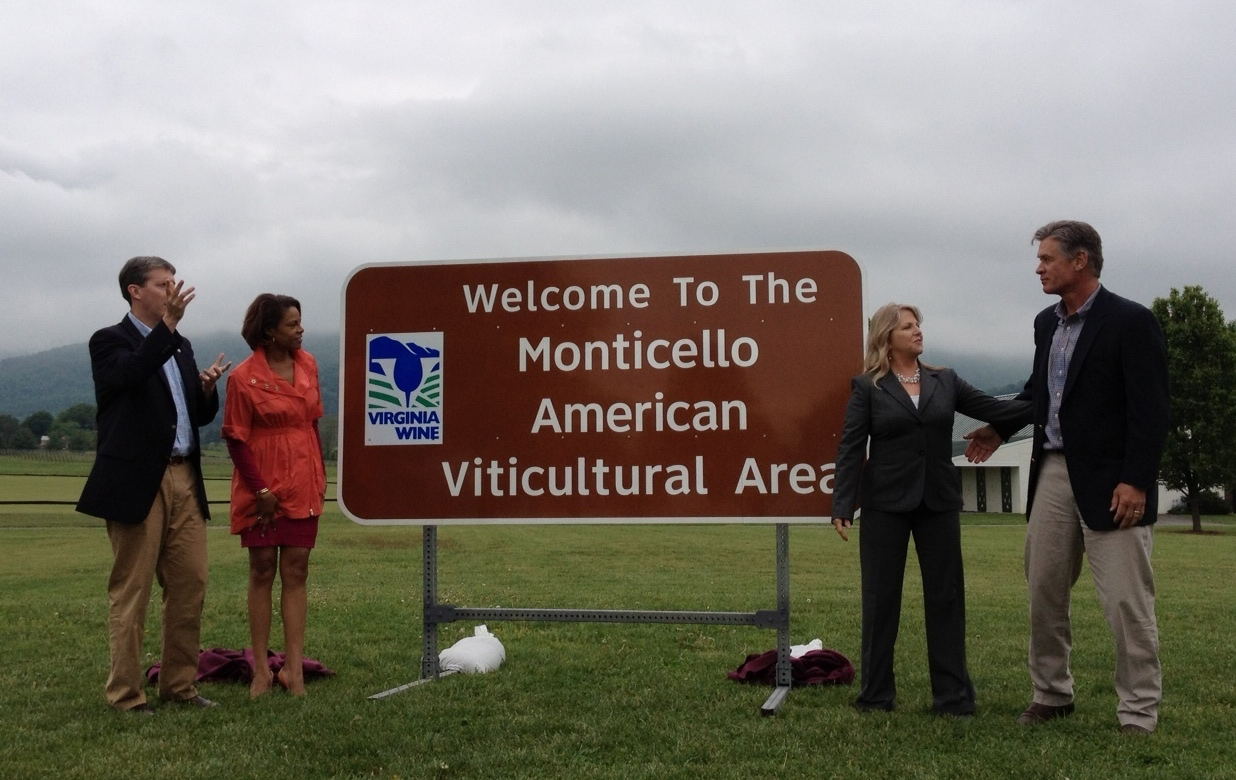
Governor Bob McDonnell has announced the unveiling of a new Virginia wine region sign program aimed at attracting more visitors to Virginia wineries. The signs will announce to travelers on selected primary and secondary roads that they have entered a particular Virginia American Viticultural Area (AVA) or wine region. The first phase of this program consists of seventeen signs in four Virginia AVAs and one well-known wine region.

Speaking about the new wine region signs, Governor McDonnell said, “In addition to having one of the fastest growing wine industries, the Commonwealth is blessed with some of the country’s most beautiful wineries and wine regions. The new signs will draw attention to the diverse wine regions and encourage travelers and tourists to see and taste what the Virginia wine industry has to offer.”

The first sign was unveiled earlier today in the Monticello AVA at King Family Vineyards in Crozet by First Lady Maureen McDonnell, Secretary of Agriculture and Forestry Todd Haymore, Interim Virginia Tourism Corporation Director Rita McClenny, and David King, co-owner of King Family Vineyards and a member of the Virginia Wine Board. As one of Virginia’s oldest AVA’s, Monticello is now home to 40 wineries. Throughout the spring and summer, signs will be placed at key points of entry in the Eastern Shore AVA, Northern Neck-George Washington Birthplace AVA, Shenandoah AVA and the Northern Virginia Wine Region.

The wine region sign program was funded by a grant from the federal Transportation Enhancement Program and matching funds from the Commonwealth Transportation Board (CTB). The Office of the Secretary of Agriculture and Forestry worked closely with Virginia Department of Transportation (VDOT) to design the signs and select locations that fit within the rules of the program and were best situated to promote the wine regions. The Virginia Wine Board will assist with any maintenance should a sign be damaged or destroyed. Based on grant fund availability, the Secretary of Transportation and the Secretary of Agriculture and Forestry intend to expand the sign program to other AVAs and wine regions once the initial phase is completed.

“I want to thank Transportation Secretary Sean Connaughton, CTB, VDOT, and the Virginia Wine Board for their assistance in making these wine region signs a reality,” said Secretary Haymore. “Cross secretariat cooperation is key to the Governor’s overall economic development and jobs creation agenda. This partnership, along with our on-going work with the Virginia Tourism Corporation, will help spur more growth and opportunities at wineries and their suppliers in rural areas throughout Virginia.”

An AVA is a designated wine grape growing region in the United States distinguishable by certain geographic features. Boundaries of AVA’s are defined by the United States Treasury Department’s Alcohol and Tobacco Tax and Trade Bureau (TTB) generally at the request of winery and vineyard owners. Virginia currently has six AVAs and another proposed AVA is currently being reviewed by the TTB.

Raising the profile of Virginia wines and wine tourism are key components of the governor’s economic development and jobs creation initiatives. The governor has promoted Virginia wines at the Virginia Executive Mansion and throughout Virginia, on other domestic business recruitment visits, and on international trade and marketing missions to India, Israel, Canada, and countries in Europe and Asia. First Lady McDonnell has incorporated wine and wine tourism promotions into her First Lady Initiative Team Effort or FLITE.

Virginia is home to more than 200 wineries and is fifth in the nation for wine grape production. A newly released economic impact study shows that Virginia’s wine industry contributes almost three-quarters of a billion dollars – or $747 million – annually to Virginia’s economy. Virginia wineries and vineyards support 4,800 jobs that provide $156 million total in wages.

Wine travel in Virginia has gained many recent accolades, including being named one of the ten best wine travel destinations in the world for 2012 by Wine Enthusiast Magazine. Last year, approximately 1.6 million people visited Virginia wineries. Tourism is an instant revenue generator for Virginia. In 2010, tourism generated $19 billion in revenue, supported 204,000 jobs and provided $1.2 billion in state and local taxes.

Virginia Farm Bureau achieves nine out of 11 budget successes

The General Assembly passed a budget on Wednesday, April 18. The next step is for the Governor to review the budget report and offer any amendments or veto the bill. If he signs the bill with no changes then the bill will become law on July 1, 2012.

Virginia Farm Bureau policy was achieved on nine out of 11 on the budget amendments. This brings our final total of successful issues for the General Assembly to 43 out of 51 policy issues.

Where Farm Bureau Policy Prevailed in the State Budget

Coyote Program: $40,000 was added each year of the biennium to bring the funding to a minimum amount of $120,000.

Reforestation of Timberlands Program; Computer Program Needed to Operate RT Program: $130,000 was added each year of the biennium to increase the amount of state matching fund to a total of $557,570. In addition, the General Assembly provided $120,000 each year of the biennium to replace the dysfunctional computer program used to distribute the funds to landowners. This was necessary to keep a functional RT Program.

Soil and Water Conservation District Operational and Technical Assistance Funding: The General Assembly restored $2.046 million for each year of the biennium for district operations. The General Assembly further requested the Secretary of Natural Resources to convene a stakeholder group to develop recommendations for a long-term adequate, consistent and reliable funding formula for local Soil and Water Conservation Districts. The General Assembly also prohibited the State Soil and Water Conservation Board or Department of Conservation and Recreation from changing any district boundary lines until after the General Assembly had time to respond and act upon the recommendations of the study.

Virginia Cooperative Extension: Both the House and Senate appropriated an additional $500,000 each of the fiscal years for a total of $1 million for the biennium.

Weights and Measures Program: The General Assembly eliminated the per device fee for weights and measures inspections. They added $250,000 for the first year of the biennium to the program to address the $2 million gap that has existed in the program for the last several years.

Agriculture and Forestry Industries Development Fund: The General Assembly maintained the $1 million in funding for each year of the biennium.

Virginia Department of Agriculture and Consumer Services International Marketing Opportunities: The General Assembly maintained the $260,000 each year of the biennium to support international marketing opportunities for Virginia agriculture and forestry products.

Beehive Grant Program: The General Assembly appropriated $250,000 to support the legislation creating the Beehive Incentive Grant Program.

Child Labor Update: Know the Facts

Wilmer Stoneman, Associate Director
VFB Govermental Relations

With the introduction of legislation designed to block implementation of the Department of Labor’s (DOL) proposed child labor regulations, press coverage of the issue – both positive and negative – has increased.  Some articles critical of the effort to block the DOL proposal contain inaccuracies and misstatements.  One recent instance occurred  in which Sen. Lamar Alexander (R-Tenn.) was criticized for supporting AFBF’s position.

It’s important to remember the facts when you come across one of these articles.

America’s farm and ranch families place a high priority on assuring that everyone who works on our farms and ranches, especially young people, are protected by appropriate safety measures. There is no doubt that the Department of Labor’s proposed rules regarding child labor will have a direct negative impact on our families and our farms and ranches.

Clearly, Congress intended there to be a parental exemption regarding the jobs they ask their children to carry out on the farm. It is clear that DOL has the authority to draft regulations relating to agricultural child labor that restrict youth 16 and under from performing tasks that are “particularly hazardous.” These regulations, known as hazardous occupation (HO) orders, are issued under the Fair Labor Standards Act and stipulate what tasks a youth may not perform on a farm. The law, however, also clearly states that a youth working for a parent or person standing in the place of the parent may perform any task.

The parental exemption has been violated. DOL has traditionally interpreted this parental exemption to include all farms substantially owned by the parent or guardian. Last September, however, DOL proposed to change that traditional interpretation, limiting the parental exemption only to farms “wholly-owned” by a parent or person standing in the place of a parent. This proposed interpretation meant that a brother and sister who jointly owned a farm themselves through a partnership or limited liability corporation would no longer be allowed to hire their nieces, nephews or grandchildren to help work on the farm. Such a proposed interpretation significantly restricted the statutory exemption. It was only after an outpouring of critical comments – numbering nearly 10,000 – from interested individuals and members of Congress that DOL announced it would re-propose the parental exemption portion of the rule; however, it is unclear what the new proposal will include or when it will be announced.

 There is no question that a number of simple everyday tasks would be prohibited by the DOL proposal. For example, there has been extensive discussion about the rule’s prohibition on the use of power-driven equipment and whether it would prohibit youth under the age of 16 from operating simple tools like a battery operated screwdriver. There is no question that it would. Taken directly from DOL’s proposed regulation, Ag. HO #2 prohibits a youth under age 16 from “any activity involving physical contact” with “all machines, equipment, implements…operated by any power source other than human hand or foot power,” and DOL has explicitly stated that this includes “batteries.” It appears quite explicit and clear in the rule that the department proposes to outlaw the use of battery-powered implements like screwdrivers. Moreover, expert comments submitted to the department support this reading of the DOL proposal. The National Institute on Occupational Safety and Health (NIOSH) referred to the proposed Ag. HO #2 and specifically noted that the “the proposed definition also exceeds the recommendations made by NIOSH [2002] and would prohibit the use of small handheld battery-powered equipment (e.g., a flashlight) that is not prohibited by any nonagricultural HO.”

 Farm Bureau members are well aware of the risks involved in agriculture and support appropriate regulatory safeguards. We are joined in our efforts by virtually every agricultural organization, including FFA and the National Association of State Departments of Agriculture.

The number of injuries to youths on farms has decreased drastically even without the DOL proposal. An Agricultural Safety Survey, published on April 5, 2012 by the USDA National Agricultural Statistics Service, shows that agriculture-related injuries to youth under 20 years of age decreased 54 percent from 2001 to 2009. Moreover, work-related injuries only contributed to a quarter of youth injuries occurring on farm operations.

Farmers and ranchers will continue to be committed to the safety when it comes to the younger members of our families making valuable contributions to our family businesses. Ensuring the safety of our children is our priority. The DOL proposal, however, extends caution beyond recognition, to the point of having severe negative effects on farm families. The proposal really does strip away the ability of youth to work in agriculture, and it nullifies the desires and goals of parents to pass on to our children the traditions and values that farm work provides. There is concern that the DOL simply does not understand the societal structure of the farming community, how farms are organized and how farm families help one another. While we support appropriate federal regulations in this area, those regulations should be based on reliable data and real risks.
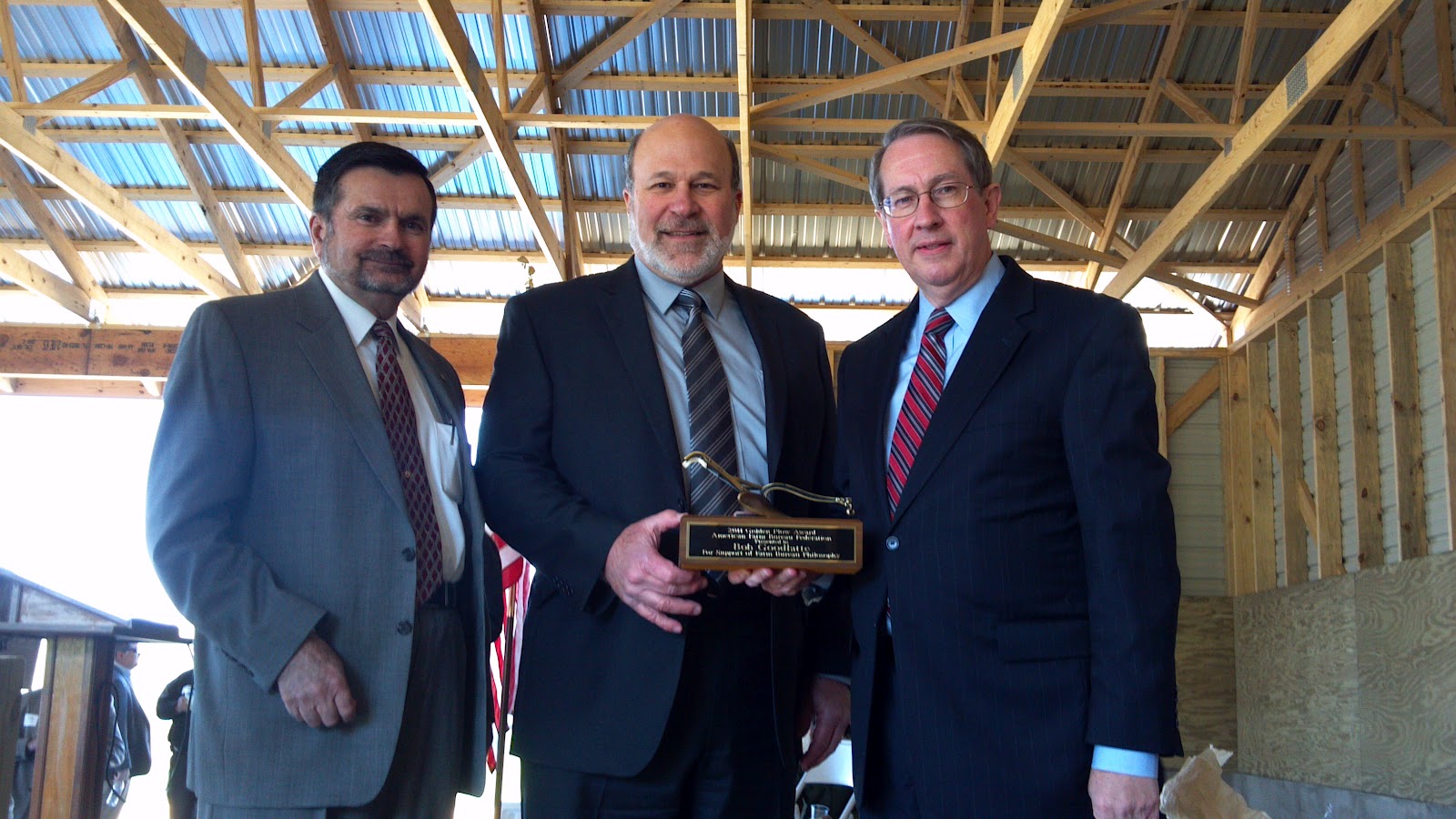
Rep. Goodlatte receives ‘Golden Plow’ Award at Valley Farm Bill Forum


Virginia Farm Bureau Federation President Wayne Pryor and American
Farm Bureau President Bob Stallman presented Rep. Bob Goodlatte (R-Va.)
with the AFBF Golden Plow Award last week.

Last week, Congressman Bob Goodlatte received the Golden Plow award for his continued support of America’s farmers and ranchers. The Golden Plow award is the highest honor bestowed on Members of Congress by the American Farm Bureau Federation (AFBF). Goodlatte was presented the award by Virginia Farm Bureau Federation President Wayne Pryor and AFBF President Bob Stallman during a forum on the 2012 Farm Bil Conservation Programl in the Shenandoah Valley.

“Congressman Goodlatte is a vigorous defender of private property rights, both real and intellectual, and he continues to lead the fight against regulatory overreach. He is a champion for private forestry and has worked tirelessly to ensure farmers of all sizes have access to the conservation programs that assist them in maximizing their farms’ economic returns while contributing measurable results toward enhancing the environment.”

The Virginia Farm Bureau nominated Goodlatte for the award. According to Stallman, since Goodlatte was first elected in 1992 to represent Virginia’s 6th Congressional District, he has “applied his common sense, expertise and determination to finding solutions to the challenges facing American agriculture.”

Goodlatte and Stallman also discussed the development of the next Farm Bill and the future of programs to help area farmers address water quality.

Many of the federal conservation programs that farmers across the Commonwealth use to implement a variety of environmental protection practices will expire on October 1, 2012. Practices include stream fencing, rotational grazing, buffers, cover crops, nutrient management, and many others.  These are critical for the management of our farms and the ability to comply with governmental mandates regarding water quality. The deadlines associated with the Chesapeake Bay Total Maximum Daily Load (TMDL) will not allow any delay or missed steps in implementation of such practices. 

“There are huge cuts compared to what was available when the last bill was written,” Goodlatte said. “It’ll be very difficult to write a farm bill in this environment.”

The event was held in a new winter feeding facility at Bob Threewitts’ Twin Oaks Farm in Keezletown. Installing the building was a voluntary conservation practice, which allows cattle manure to be contained in one area, Threewitts said.

Uranium: Read the Reports

Photo by Michael Brcak

Few things have generated the headlines more than the possibility of lifting the moratorium on uranium in Virginia. The 30-year moratorium has been in place since the issue was last looked at in the 1980s. The renewed interest in nuclear energy has reignited interest by investors to attempt to gain permits to mine the largest deposit known in Virginia on the Coles Hill property in Pittsylvania County.

Virginia Farm Bureau has had a policy to have any study of the mining of uranium be conducted by the unbiased party such as the National Academy of Sciences, and then the latest policy to keep the moratorium in place until all studies are thoroughly evaluated. Governor Bob McDonnell called for just that on January 19, 2011, in a directive to state agencies to delve into the issue to gain more site-specific information.

The Uranium Working Group is a multi-agency cooperation to pull together more information to aid the General Assembly to make a more informed decision when considering lifting the moratorium. We encourage all of our members to read the reports and follow the progress of the work group. The public is also asked to participate in public forums, submit questions, and comments. Virginia Farm Bureau will be submitting questions and comments and encouraging members to do so as well.

You can monitor the work group and read the state sponsored reports that have been completed to date at the Uranium Working Groups website at http://www.uwg.vi.virginia.gov/index.shtml

Extension article: Direct Marketers and the Virginia Sales Tax


By USDA

Spring has sprung, and soon farmers markets across the state will be buzzing with farmers selling their Virginia-grown products.

Virginia Cooperative Extension put out an excellent article in 2008 for farmers who direct market their products on collecting Virginia sales tax. We thought it would be helpful to post it here for those of you selling directly to consumers.

We’d like to note one update that has occurred since the article was published. During the 2011 Virginia General Assembly, legislation passed that states individuals who raise and sell agricultural products at local farmers markets and roadside stands do not have to collect sales tax if their annual income from their sales does not exceed $1,000. The seller is also exempt from collecting the litter tax if his annual income from such sales does not exceed $1,000, and that any container he provides to hold purchased items has been previously used.

Direct Marketers and the Virginia Sales Tax

Farm Business Management Update, April 2008 – May 2008
Bill Whittle (wwhittle@vt.edu), Extension Agent, Farm Business Management, Northwest District

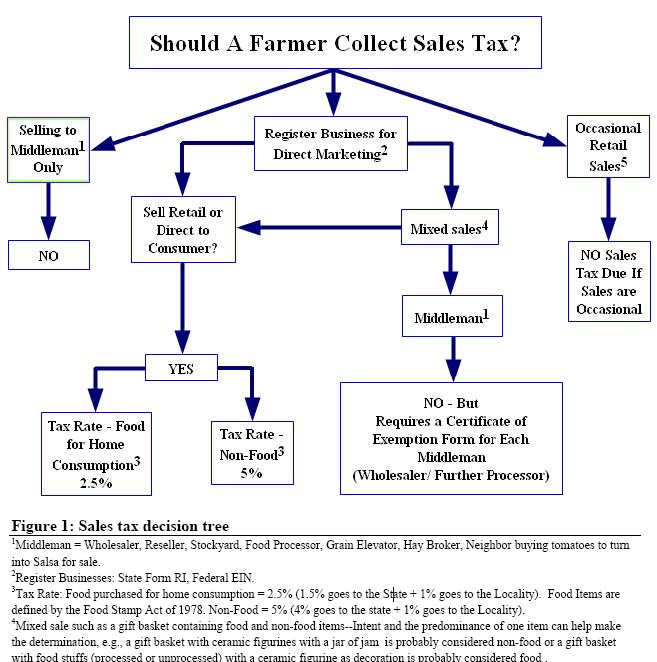
Historically, farmers have not paid sales tax on many purchases used in agriculture production, nor have they been concerned with collecting sales tax because they have sold a commodity product to a wholesaler or middleman. Many Virginia farmers have entered into the realm of “Direct Marketing” by selling produce, meats, further processed foods, feed for pleasure animals, etc., directly to the consumer. When they sell retail or to the “end-user” they must collect sales tax on gross receipts from all retail sales. See Figure 1 for a flow-chart defining when sales tax must be collected.

Farmers are obligated to collect and remit the sales tax on all retail sales to each customer. Retail sales can be thought of as the sale to the end user as opposed to a wholesaler. There are no exceptions or special circumstances allowed for farmers selling their own production. The tax must be separately stated and added to the sales price or charge. The Virginia Department of Taxation is the state agency responsible for insuring that this occurs.

Individuals, partnerships, corporations, etc. must file for a Certificate of Registration if starting a business in Virginia or desiring to conduct business as a dealer by selling directly to the consumer. The farmer must register with the state by filing State Form R1, Combined Registration Application Form (http://www.tax.virginia.gov/taxforms/Business/Registration/R-1.pdf ), and must collect and pay the tax due on retail sales. Once registered, the farmer will be assigned a Virginia tax identification number that will be used when conducting business with the state. If your application indicates that you will be collecting sales tax, the department will send you a Virginia Certificate of Registration for sales tax. This certificate permits sales tax collection, and allows the farmer to issue and receive exemption certificates. The Virginia Certificate of Registration must be displayed at your place of business. The farmer should also apply for a Federal Tax Identification Number (FEIN) by going directly to the IRS (http://www.irs.gov/businesses/small/article/0,,id=98350,00.html).

Sales tax rates fall into two basic categories that farmers selling retail need to be aware of. These are food and non-food categories. The basic sales tax for non-food items is 5% of gross sales and is comprised of 4% for the state and 1% for the locality. Food sales are taxed at a total rate of 2.5% of gross sales, which is comprised of 1.5% for the state and 1% for the locality. Department of Taxation Bulletin 5-78 discusses the sale of eligible food items subject to the reduced state tax rate of 1.5% as are deemed eligible under the federal food stamp definition.

Many direct marketers also have the opportunity to sell to a wholesaler or further-processor in addition to their retail customers. The only way a farmer does not have to collect sale tax from someone purchasing product for resale is if that person provides the appropriate Certificate of Exemption.

The sales tax applies to regular or recurring sales of farm products by farmers or peddlers at public markets, roadside stands, farms, etc. There is a provision for the occasional sale where you do not collect sales tax, but this is intended for the truly occasional sale, defined as three or fewer separate transactions within one calendar year, providing the activity does not require a Certificate of Registration. Because sales at fairs, flea markets, etc. generally involve multiple individual sales they are not considered occasional sales.

The laws governing Sales and Use Tax are generally straightforward, i.e. “If you are selling retail, then you must collect sales tax.” However, an individual farmer often has unique questions specific to his operation. To address specific questions, the Department of Taxation suggests that you write the Tax Commissioner for a ruling. Complete information on Virginia Sales and Use Tax can be obtained at the Virginia Department of Taxation website: http://www.tax.virginia.gov/ and use the Business Link to reach the Sales and Use Tax.

AFBF President responds to Reps. Hurt and Altmire’s "Preserving Rural Resources Act"

AFBF President
 Bob Stallman

Last week, American Farm Bureau Federation President Bob Stallman released a statement in support of Reps. Robert Hurt (R-Va.) and Jason Altmire (D-Pa.) H.R. 4278, the Preserving Rural Resources Act.

“H.R. 4278, the Preserving Rural Resources Act, introduced in the House of Representatives, addresses a critical issue,” Stallman said. “The legislation reinforces agricultural exemptions granted to farmers and ranchers by Congress in Section 404 of the Clean Water Act.

Farmers, ranchers and the forestry community are facing increased federal regulatory and compliance costs, as well as constraints on land used for the production of food, fiber and fuel. We’ve seen a concerted effort by regulators to narrow the scope and usefulness of the Clean Water Act exemption Congress explicitly intended for agriculture.” This legislation is intended to reaffirm the following exemptions:
• Normal farming, silviculture and ranching activities;

• Maintenance and emergency reconstruction of dikes, dams, levees, riprap, breakwaters, causeways and bridge abutments;

• Construction or maintenance of farm or stock ponds and irrigation ditches, and maintenance of drainage ditches;

• Construction of temporary sedimentation basins;

• Construction and maintenance of farm and forest roads or temporary roads for moving mining equipment; and

• Any activity with respect to a state approved programs
The Hurt (R-VA) and Altmire (D-Pa) amendment simply clarify that these exemptions apply to activities described listed above. AFBF is seeking bipartisan cosponsors to introduce this legislation in the Senate. 

AFBF Backs Senate and House Bills Reforming Estate Tax; Tell VFB your story in the comments!

The American Farm Bureau Federation has endorsed Senate legislation that would help protect America’s farm and ranch families from potentially crippling blows of the federal estate tax following a farm owner’s death.

The Senate bill, the Death Tax Repeal Permanency Act of 2012 (S. 2242), was introduced by Sen. John Thune (R-S.D.). The bill is similar to another Farm Bureau-supported, H.R. 1259, introduced in the House by Rep. Kevin Brady (R-Texas). The House bill now has more than 200 co-sponsors.

 In a letter to Thune and other sponsors, AFBF President Bob Stallman stated that estate taxes continue to be a problem for the nation’s farmers and ranchers. Individuals, family partnerships and family corporations own 98 percent of the nation’s 2 million agricultural operations. When estate taxes on an agricultural business exceed cash and other liquid assets, the tax can cripple a family-owned farm or ranch and hurt the rural communities and businesses that agriculture supports, according to AFBF.

The Unemployment Insurance Reauthorization and Job Creation Act of 2010 set the estate tax exemption at $5 million per person, with a top tax rate of 35 percent for 2011 and 2012. That legislation also put in place a new provision for 2011 and 2012 that allows the unused portion of a spouse’s exemption to be used by a surviving spouse, and it permanently reinstates stepped-up basis in regard to tax treatment. Legislation is necessary because without congressional action, in 2013, the estate tax exemption will shrink to $1 million per person with no spousal transfer and the top rate will increase to 55 percent.

“This will strike a blow to farm and ranch operations trying to transition from one generation to the next,” Stallman said. “A $1 million exemption is not high enough to protect a typical farm or ranch able to support a family and, when coupled with a top rate of 55 percent, can be especially difficult for farm and ranch businesses.”

 Stallman said the “on again, off again” nature of estate tax law makes it difficult, if not impossible, for farmers and ranchers to engage in planning for the transfer of a family business from one generation to the next. “It becomes a barrier to entry for new and beginning farmers” Stallman added

“While estate tax planning may be able to protect some family farms and ranches from the devastation of estate taxes, planning tools are costly and take money needed to operate and expand businesses,” Stallman said. “Even with planning, changing asset values and family situations make it impossible to guarantee that a well-thought-out estate plan will protect a family business from estate taxes.”

Virginia Farm Bureau wants to hear your concerns with the estate tax! Tell us your story in the comments. Please answer the following questions:

  1. How important is your farm to your family, kids and grandkids?
  2.  Have you thoughts about how a high estate tax bill could affect the future of your farm? Please share some of your concerns.
  3. Has your family been affected by the estate tax in the past? How?

Don’t forget to leave your name and county!