Farm Bureau: Maps Show Massive Increase in EPA Authority, Regulatory Uncertainty for Everyone Else

A series of maps released today by the American Farm Bureau Federation show how the EPA will radically expand its jurisdiction over land use if its controversial Waters of the United States rule takes effect as expected August 28. That expansion comes even as major parts of the rule remain largely incomprehensible to experts and laypeople, alike.

The maps, prepared by Geosyntec Consulting, show the dramatic expansion of EPA’s regulatory reach, stretching across wide swaths of land in Pennsylvania, Virginia and Montana. In Pennsylvania, for example, 99 percent of the state’s total acreage is subject to EPA scrutiny. Landowners have no reliable way to know which of the water and land within that area will be regulated, yet they must still conform their activities to the new law.

“Farmers face enforcement action and severe penalties under EPA’s new rule for using the same safe, scientifically sound and federally approved crop protection tools they’ve used for years,” AFBF President Bob Stallman said. “This rule creates a new set of tools for harassing farmers in court, and does it all with language that is disturbingly vague and subject to abuse by future regulators. It’s worth saying again: The EPA needs to withdraw this rule and start over.”

Maps prepared to date can be found here:
  •  Montana WOTUS Maps
  •  Pennsylvania WOTUS Maps
  •  Virginia WOTUS Maps

*Additional maps are being developed for parts of Missouri, New York, Oklahoma and Wisconsin.

The interactive maps in detail:

The maps’ base layer shows areas regulated as tributaries and adjacent wetlands without a case-specific “significant nexus” analysis under previous rules. Through a progression, the maps add “ephemeral streams”—low spots in the land that drain and channel water away from farmland after a rain but are otherwise dry. The EPA has sometimes asserted jurisdiction over such areas before, but only after a site-specific finding of a “significant nexus” to downstream waters. Under the new rule, all such “ephemeral tributaries” are regulated.

With this added jurisdiction in place, the Clean Water Act will prohibit many common agricultural practices in or around these ephemeral features. Any unpermitted discharge—whether pesticides, fertilizer or even disturbed soil—will leave farmers vulnerable to enforcement by EPA, the Corps, or private citizens, with severe potential penalties. This means unless farmers are able to navigate the regulatory system to secure a costly Clean Water Act permit, farming in many areas will be significantly restricted.

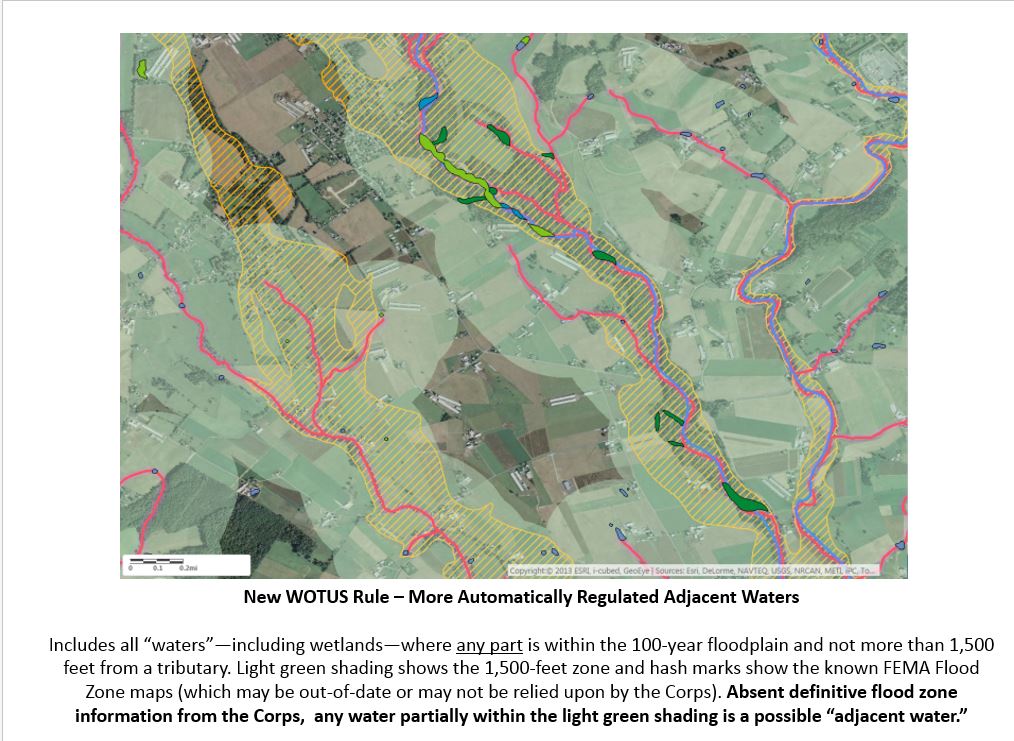
The maps’ next layer shows how the rule expands the definition of regulated “adjacent waters” to cover all waters (including wetlands) that lie, even partially, within 100 feet on either side of these newly regulated ephemeral drains. Next, they show where even more “adjacent waters” may lie—and this is where the vast uncertainty comes in. Where any part of a water or wetland is within the 100-year floodplain of a tributary, and not more than 1,500 feet (1/4 mile) from the tributary, that entire water feature is regulated. The uncertainty springs from the fact that many areas lack flood zone maps. What’s more, many such maps are out-of-date, and most ditches and ephemeral streams do not have mapped flood zones. The result is that farmers and other landowners lack even the basic tools to identify wetlands or other waters that are automatically regulated under the rule.

The final blow—the almost unlimited reach of the rule—is shown in the final map layer that covers waters that are not “tributaries” or “adjacent,” but may still be jurisdictional based on a “significant nexus” to downstream waters. The WOTUS rule allows “significant nexus” regulation of waters (including wetlands) that lie even partially within 4,000 feet (about ¾ mile) of any tributary. Mapping 4,000 feet from even just the known ephemeral streams—ignoring ditches and not-yet-identified ephemeral tributaries—shows that this 4,000-foot zone of uncertainty covers the entire landscape in many parts of the country.


Six Virginia Farm Bureau Members Compete for AFBF Rural Entrepreneurship Challenge

The 2016 American Farm Bureau Federation Rural Entrepreneurship Challenge kicked off with 165 applications, submitted by Farm Bureau members from 33 states. Six of the applications were from Virginia and they are: 
• Bryan Aycock, Willow Hill Farm (Palmyra, Fluvanna County, VA)
• Dr. Lynn C. Blackwood, Jr., Virginia Aqua-farmers Network LLC (Farmville, Prince Edward County, VA)
• Katelyn E. Junno Dinger, Farm Table (Pearisburg, Giles County, VA)
• Chezley Pillow, The Pillow Farm (Hot Springs, Alleghany County, VA)
• David Reavis, Three Brothers’ Distillery (Disputanta, Sussex County, VA)
• Jonathan Spence, Levee Ginseng (Floyd, Floyd County, VA)
Go Virginia!

Experts Directory from Virginia Tech College of Agriculture and Life Sciences Now Available

Need to find an expert on agricultural productivity or animal genetics? Bioengineering or bioluminescence? Climate change or community development? Diabetes or drought? 

Look no further than the new Experts Directory that contains detailed descriptions of nearly 300 authoritative sources from the Virginia Tech College of Agriculture and Life Sciencesand Virginia Cooperative Extension

Members of the media, fellow scientists, and others can easily find the expert they are searching for using keywords, departments, subject area, or names. 

A new Newsroom site also is available where you can learn about the latest news from the college, trends in agriculture, upcoming events, videos, research blog posts, and more. 
Go online to learn about the world-class research being conducted by faculty members and the wide array of experts in the College of Agriculture and Life Sciences and Virginia Cooperative Extension.

Nationally ranked among the top research institutions of its kind, Virginia Tech’s College of Agriculture and Life Sciences focuses on the science and business of living systems through learning, discovery, and engagement. The college’s comprehensive curriculum gives more than 3,100 students in a dozen academic departments a balanced education that ranges from food and fiber production to economics to human health. Students learn from the world’s leading agricultural scientists, who bring the latest science and technology into the classroom.

Bay Foundation Issues Statement In Stream Fencing Court Case

Peggy Sanner, Chesapeake Bay Foundation (CBF) Virginia Assistant Director and Senior Attorney, released the following statement regarding CBF’s lawsuit against the Commonwealth of Virginia seeking requirements that large livestock farms fence their animals out of streams:

“In our lawsuit, CBF asked a Richmond Circuit Court judge to find that, under Virginia law, the Commonwealth’s largest animal operations must ensure livestock are fenced out of streams to protect downstream users from manure-carried pathogens and other pollutants. We are disappointed by the decision of the court, which disagreed with our position.

“CBF has decided not to appeal the judge’s order. Instead, CBF will press legislators and the McAuliffe administration to fully fund state stream fencing programs and continue our work with farmers to ensure that their farms are not polluting local waters and the Bay.

“Across the Commonwealth, farmers recognize that stream fencing improves herd health and farm bottom lines, and they have been signing up in unprecedented numbers for state cost-share funds to assist them in excluding livestock. To ensure adequate funding and technical assistance are available to meet the demand, currently estimated at over $70 million, CBF will work closely with legislators, agency staff, and other partners in the coming months and years. With more than 8,000 stream miles in Virginia polluted by pathogens and other manure-carried pollutants, Virginia has much work to do.”

From the Field: What are Other State Farm Bureaus Doing to Promote Agriculture?

From the Field is a bi-monthly column written by Mark Campbell, Farm Bureau Field Services Director for the Central District. He writes about Farm Bureau member benefits and County Farm Bureau activities.

Last week I and all of the other field staff attended the 2015 Farm Bureau Southern Region Field Staff Conference in Gatlinburg, TN.  This conference is held every three years in different locations throughout the southern region which encompasses the states from Virginia and Kentucky to Texas and Oklahoma.  One of the best things about these conferences and others like it is the networking.  The sharing of ideas and experiences with the same job is always beneficial.  I am proud to report that Virginia Farm Bureau is doing a lot of things right and have many programs in place that some states are just now getting around to implementing.
All of the states are dealing with lower membership numbers compared to a couple of years ago.  Most states are engaging the existing members more to increase retention.  Arkansas reported that they started doing member appreciation days at county Farm Bureau offices and they thought this helped strengthen membership.  Several county Farm Bureaus in Virginia have been doing this for years and the staff and members always enjoy it.  North Carolina has implemented radio and highway billboard sign ads across the state to mainly strengthen the image of Farm Bureau and agriculture in general.  Some states are just now starting anniversary billing for membership which we have had for a few years.

On leadership training and development, several states do a regional or state wide training for new county Farm Bureau directors.  In Virginia, we do one on one training at the county level; usually right before the monthly board of directors meeting.  This has worked well for all involved as it limits travel and time away from the farm for the volunteers.  Most states have a yearly conference for county Farm Bureau presidents.  Texas has theirs in conjunction with a commodity conference.
Several other states have the Member Deals Plus program but it has a different name in each state.  Similar to what we have been doing the past year, Arkansas is making a concerted effort to add businesses to the program in each county to give the program more value to the members.  We had a contest this spring at Sales Conference and at the VFB Women’s Conference where we received over 200 referrals.  We have also analyzed existing programs to determine to continue with them or not.
Under the promotion category, I liked what Florida does.  Several counties in the state cook or cater meals for the county fair livestock exhibitors and their families.  They recognized that meals over several days at a fair can be expensive on a family.  So they provide meals to the exhibitor families for $3.00/person.  It is their way of helping to promote agriculture.  In Virginia, several county Farm Bureaus pay for a dinner for livestock exhibitors and buyers, provide t-shirts, or purchase animals.  Florida also promotes the Bonnies Plants scholarship program for 3rd graders on the best and biggest cabbage.  This has been well received by students and teachers and ties in with their Ag in the Classroom program.
It was good to hear some new ideas, and good to know that many of those things are already taking place in Virginia.  However, we are always looking to be more effective, efficient, and providing value to our members.  So if you have any ideas, feel free to contact one of the field staff. 
Until next time,

Mark

Stallman: Secret Documents Show EPA Dismissed Concerns about WOTUS Rule

Just when it seems EPA’s handling of the waters of the U.S. rule couldn’t be more suspect, secret documents have come to light that show the process may be even worse than we thought.

Sen. Jim Inhofe, chairman of the Environment and Public Works Committee, asked the Corps of Engineers to provide documents that came to his attention concerning the EPA’s and Corps’ development of the rule. The Corps provided the documents, but asked that they be kept from public view. Evidently, they show that Corps staff had questions about the validity of EPA’s economic analysis and the rule’s unworkability due to lack of clarity concerning what “waters” were to be regulated. The documents also show that staff’s concerns, even those based on the view that the rule didn’t go as far as they would like, were ignored or overridden. Chairman Inhofe remarked that while the rule was “purportedly a joint effort of EPA and the Corps,” it appears that the Corps was cut out of the process.

In other words, this was EPA’s show, and political officials in the administration were determined to push the rule through over objections by agency staff, not to mention the objections of thousands of farmers and other landowners, other regulated sectors and state and local governments. The documents reveal a dysfunctional process, and they show that an “ends justify the means” mentality prevailed at EPA.

Unfortunately, this isn’t very surprising. All of this seems to validate much of what we have been saying about the serious flaws in EPA’s economic analysis, and about how difficult it is for anyone, including apparently the Corps, to know what is a “water” and which “waters” are regulated under the rule.

The fact that these documents exist and that the Corps has asked the committee to keep them hidden from the public begs the question: what else is out there? What other internal agency documents might reveal what’s behind the flawed economic analysis, or other factors that shaped the rule? What EPA documents have not been revealed that would shed light on how the agency made decisions and whether it genuinely considered the public’s concerns?

It’s time for some transparency.