
Robert Harper with Virginia Farm Bureau’s grain division provides this week’s market updates.
#merchandiserminute #grainfuture #virginiafarmbureau
Robert Harper with Virginia Farm Bureau’s grain division provides this week’s market updates.
#merchandiserminute #grainfuture #virginiafarmbureau
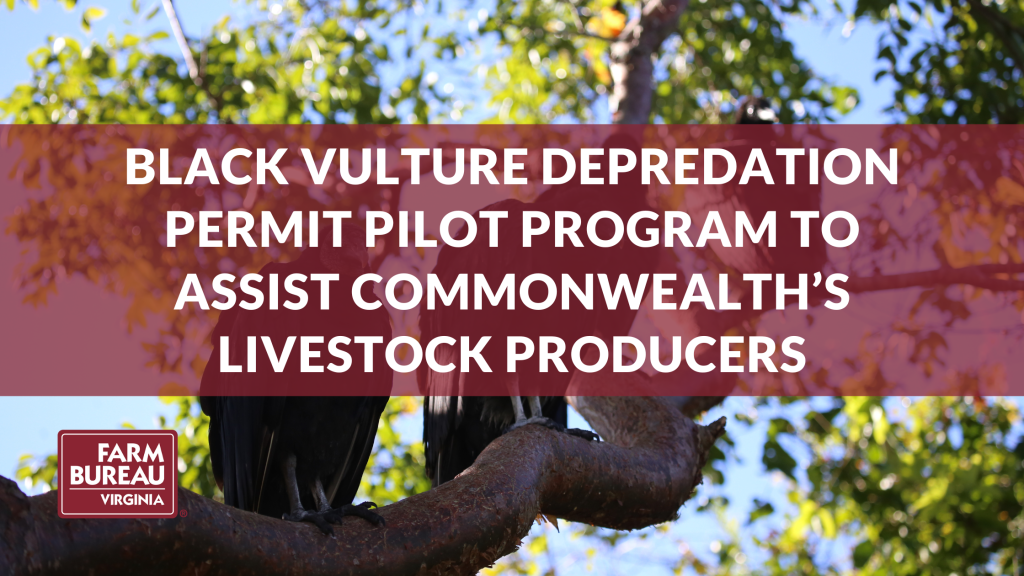
The Virginia Department of Agriculture and Consumer Services (VDACS) announces a new program to assist livestock producers who are experiencing losses of livestock due to Black Vulture predation. The program will allow these livestock producers to obtain a permit to “take” up to five Black Vultures per year. Black Vulture attacks on livestock is recognized as a potentially serious threat to Virginia’s livestock producers.
The program will be implemented through the Virginia Cooperative Wildlife Damage Management Program. This cooperative program, between VDACS and the USDA Animal and Plant Health Inspection Service Wildlife Services, provides assistance to livestock producers who experience wildlife predation on their livestock. VDACS has obtained a depredation permit through the U.S. Fish and Wildlife Service, which authorizes the issuance of sub-permits to livestock producers.
Livestock producers in Virginia may apply for a sub-permit, which allows the lethal “take” of five Black Vultures per year. A sub-permit will be provided at no charge to the livestock producer. Producers wishing to take more than five Black Vultures must obtain their own individual depredation permit.
To qualify, livestock producers must have already implemented non-lethal, mitigating actions such as attempting to disperse the vultures through hazing solutions using light or sound, and best management practices to reduce attractants, such as open garbage, dead livestock, or outdoor feeding of domestic or wild animals.
Click here for additional information and instructions on how to apply .To apply for a Black Vulture depredation sub-permit or for more information on the sub-permit requirements, please contact Chad Fox with the USDA-APHIS Wildlife Services at 540.381.7387 or email at chad.j.fox@usda.gov.

Dairy producers can now enroll for 2023 coverage through the Dairy Margin Coverage (DMC) Program, an important safety net program from the U.S. Department of Agriculture (USDA) that helps producers manage changes in milk and feed prices. Last year, USDA’s Farm Service Agency (FSA) took steps to improve coverage, especially for small- and mid-sized dairies, including offering a new Supplemental DMC program and updating its feed cost formula to better address retroactive, current and future feed costs. These changes continue to support producers through this year’s signup, which ends December 9, 2022.
“Dairy producers are the backbone of many agricultural communities across rural America,” FSA Administrator Zach Ducheneaux said. “Dairy Margin Coverage provides critical assistance to our nation’s small- and mid-sized dairies, helping make sure they can manage the numerous and often unpredictable uncertainties that adversely impact market prices for milk. This year showed why enrolling in DMC makes good business sense. Early in the year, some economists predicted that DMC would not trigger any payments for the calendar year, but then fast forward to now, when we’re starting to see payments trigger and a return on investment.”
DMC is a voluntary risk management program that offers protection to dairy producers when the difference between the all-milk price and the average feed price (the margin) falls below a certain dollar amount selected by the producer.
So far in 2022, DMC payments to more than 17,000 dairy operations have triggered for August for more than $47.9 million. According to DMC margin projections, an indemnity payment is projected for September as well. At $0.15 per hundredweight for $9.50 coverage, risk coverage through DMC is a relatively inexpensive investment.
DMC offers different levels of coverage, even an option that is free to producers, aside from a $100 administrative fee. Limited resource, beginning, socially disadvantaged or a military veteran farmers or ranchers are exempt from paying the administrative fee, if requested. To determine the appropriate level of DMC coverage for a specific dairy operation, producers can use the online dairy decision tool.
For the full FSA press release, including details on Supplemental DMC and DMC payments, click here.
Virginia dairy producers who participate in the federal coverage program may be refunded for their Tier 1 premium payment through the state’s Dairy Producer Margin Coverage Premium Assistance Program.
Robert Harper with Virginia Farm Bureau’s grain division provides this week’s market updates.
#merchandiserminute #grainfuture #virginiafarmbureau

As the days turn cooler and shorter, many Virginians are using firewood to keep warm and spend quality time with friends and family.
While seemingly harmless, moving firewood can enable the easy movement of destructive forest and agricultural pests. When firewood is moved from one area to another, the invasive emerald ash borer, spongy moth, Asian longhorned beetle, and spotted lanternfly often “hitchhike” to destroy crops, infect more trees and sometimes even entire forests.
Since it’s difficult to determine if firewood is infested, the best option to keep Virginia’s forests and crops safe is to buy firewood where you plan to burn it. A general rule is to get firewood that’s at least local to the county where it’ll be used. If you heat your home with firewood, harvest it locally or purchase it from a reputable dealer in compliance with state and regional firewood regulations.
“Invasive insects and disease are a critical threat to our forests,” said Virginia State Forester
Rob Farrell. “When you buy firewood near where you’ll burn it, you help protect Virginia’s forests while supporting local economies. Simple choices and a little planning can make a big difference in ensuring Virginians will have forests to enjoy for generations to come.”
“Invasive insects and diseases can lurk both inside and on the surface of firewood, so transporting firewood can allow potentially destructive and non-native organisms to move hundreds of miles and start infestations in new places,” said Joseph Guthrie, Commissioner of the Virginia Department of Agriculture and Consumer Services. “When traveling from one location to another, never transport firewood to your destination unless it is heat-treated and certified.”
Going camping? Make plans to buy firewood when you get there or gather it onsite (if permitted). If you have leftover firewood, leave it behind when you go. Packaged heat-treated (not kiln-dried) firewood, which will have a seal of certification from the U.S. Department of Agriculture or a state agency is also a safe option. Certified heat-treated firewood may be moved as long as it remains sealed. Once the packaging has been opened, it will attract insects and should not be moved.
To find local firewood dealers across Virginia, visit Firewoodscout.org. For more information on invasive insects in Virginia, visit the Virginia Department of Agriculture and Consumer Services website. For more information about protecting trees from tree-killing insects, visit https://www.dontmovefirewood.org/.

The Office of Pesticide Services (OPS) has launched a new online certification system for pesticide applicators. Using the online system can potentially reduce the overall processing time, eliminate postage costs and enable easy online payments for both prospective and currently certified pesticide applicators. While the current process of sending in paper copies remains an option, applicators now have the option to complete and submit an application and the corresponding fee to become a certified applicator or to have their certification reinstated or add a category via an online portal. Applicators may also submit change of information forms and all other related activities online.
Applicators electing to use the online system will have all of their Letters of Authorization to test, applicator certificates and other similar correspondence sent electronically. Applicators electing to continue to use the paper-based process will continue to have any Letters of Authorization to test, applicator certificates and other correspondence sent via regular mail. All applications and other submissions will continue to be processed based on the date of receipt in OPS. This includes both paper and online submissions.
Interested applicators may access the online portal. Once on the Online Registration Landing Page, select the link under the Pesticide Applicator Certification header to go to the Online Certified Pesticide Applicator Page. Further instructions are provided online to assist you at each step:
Should you have any questions, please send an email to opsclrt.vdacs@vdacs.virginia.gov.
Robert Harper with Virginia Farm Bureau’s grain division provides this week’s market updates.
#merchandiserminute #grainfuture #virginiafarmbureau

Farmers have an opportunity to submit ideas for changes they would like to see in hunting, trapping, and wildlife regulations for the 2023-2024 seasons. The Department of Wildlife Resources (DWR) will take this information into account when considering potential regulation changes. It is important for farmers to voice their concerns about areas that affect them, such as wildlife damage to crops and livestock, and offer possible solutions.
This is the beginning stage of the 2023-2024 Wildlife Regulation Cycle. For the full timeline, click here. Members of the public are welcome to attend DWR Board meetings to provide in-person comments.
Please take the time to complete DWR’s comment form, which can be found here. Comments are due December 2, 2022. Virginia Farm Bureau members who need assistance should contact Stefanie Taillon at stefanie.taillon@vafb.com.

Virginia agricultural producers and agribusiness enjoy access to grants, loans and conservation support not available to other industries. If you work with farmers, agribusiness or value-added product producers, you don’t want to miss this opportunity to hear the Directors of USDA RD, USDA AMS, USDA-NRCS (Virginia), VDACs, VA FAIRS, and Virginia FSA discuss in detail each grant, loan and conservation opportunity offered by their Agency. Participants will have the opportunity to ask questions.
This webinar is designed for business advisors, entrepreneurial support organizations, units of government and economic development agency staff. Familiarity with basic grant processes and nomenclature will be assumed during this fast-paced two hours of discussion on the details of major public sector financial support for Virginia’s Ag sector.
Presentation materials including URL’s and Points of Contact for each opportunity will be available to participants after the webinar.
Robert Harper with Virginia Farm Bureau’s grain division provides this week’s market updates.
#merchandiserminute #grainfuture #virginiafarmbureau

