Farm Bureau concerned about AgBMP Cost Share Funding

Creek crossover for cattle

Farm Bureau has raised concerns about the cuts to the local Soil and Water Conservation Districts. The Governor’s budget cut $2.046 million of support for operations and technical assistance distributed to the 47 local Soil and Water Conservation Districts.

This concerns Farm Bureau because of the water quality goals contained in the Watershed Implementation Plan for the Chesapeake Bay that apply to agriculture hinges on implementation of conservation practices by farmers. Local Soil and Water Conservation Districts are the “hands on the ground” in working with farmers in implementing voluntary and cost-shared conservation practices. Without a strong local delivery and reporting system, farmers may not be able to achieve the goals set forth that are applicable to agriculture.

Farm Bureau is encouraging its members to ask the members of the Virginia General Assembly to restore these funds and look at adequate and stable funding for this local delivery system.

Farm Bureau has also raised concerns about the funding available for farmers for implementation of agriculture best management cost share practices. While Farm Bureau appreciates the infusion of funding in the 2011 General Assembly, this infusion is not consistent for the next two fiscal years. Farm Bureau is awaiting the Secretary of Natural Resources Ag BMP Cost Share Needs Assessment analysis. Farm Bureau believes this analysis will show that this conservation practices cost share program will not be funded at a level in order to allow farmers to meet the water quality goals.

Secretary of Education releases Virginia Cooperative Extension study

The Virginia Secretary of Education released the “Analysis of the Virginia Cooperative Extension (VCE) Structure, Funding Trends, and Research” report in late November. The Secretary of Education presented the study recommendations to the House Appropriations Special Subcommittee on Extension on Monday, December 19, 2011. She also presented the study recommendations to the State Extension Leadership Council on Wednesday, December 22, 2011.

The full study can be found at http://www.ext.vt.edu/files/vsoe-report-complete.pdf. Director of Extension Ed Jones reported to the State Extension Leadership Council that they plan to have regular updates on these recommendations on their websites as well as adding the ability for stakeholders to ask questions regarding the study.

This study makes a lot of references to Agency 229. Agency 229 is the category reference in Virginia’s state budget that allocates funding to Virginia Tech’s Virginia Cooperative Extension Service as well as the Agriculture Experiment station. The study has a number of recommendations including better financial reports to the Virginia General Assembly for expenditures of Agency 229, trends between extension divisions and research divisions within Agency 229, comparison of expenditures for on-campus Extension activities vs. off-campus Extension activities. Other recommendations include better communication with Extension’s Leadership Council and within the university structure.

Virginia Farm Bureau has commented that this study helps to shed light on many of the questions our members were asking about where the funding for Extension is being utilized. The enhanced financial reports should help stakeholders to be able to better understand how the funding has been utilized. Many of the recommendations are directed to Virginia Tech to improve their processes for stakeholder input, improved communication as well as a re-evaluation of management decision making processes and allocation of resources. Virginia Farm Bureau will be monitoring how Virginia Tech implements these recommendations as well as the new financial reports.

Virginia Farm Bureau is encouraging its members to become more active in their local Extension Leadership Councils (ELCs) and ask for regular local ELC reports to their county Farm Bureaus. This should help strengthen the grassroots communications and feedback process.

VFBF News Lead: Hand-held phone ban to take effect Jan. 3 for all commercial drivers

This story appeared in the Dec. 22 edition of News Leads:

Farmers and others who drive commercial motor vehicles will be subject to stricter rules governing the use of hand-held mobile phones starting Jan. 3, 2012.

The Federal Motor Carrier Safety Administration and the Pipeline and Hazardous Materials Safety Administration have amended their respective regulations to restrict the use of hand-held phones by CMV drivers. The change is intended to help prevent distracted driver-related crashes involving commercial vehicles.

The regulatory changes will apply to anyone operating a commercial motor vehicle, including farmers and farm employees who are exempt from having to secure a commercial driver’s license to transport farm products.

“We are encouraging our members who farm to be mindful of this change,” said Andrew Smith, senior assistant director of governmental relations for Virginia Farm Bureau Federation, the state’s largest farm organization. “This is for everyone’s safety and stands to benefit all drivers.”

Essentially, CMV drivers will be restricted from holding a mobile phone to conduct voice communication; dialing such a phone by pressing more than one button; or reaching for the phone in an unsafe manner, such as when it is under the driver’s seat or in a sleeper berth.

CMV drivers who want to use a mobile phone while driving will need to use a compliant phone such as one that is hands-free.

A limited exemption will be in place for drivers who need to use a hand-held mobile phone to communicate with law enforcement or other emergency service providers.

The SMCSA and PHMSA also are implementing new disqualification sanctions for drivers who do not comply with the restriction for new drivers who have multiple convictions for violating state or local laws that restrict hand-held mobile phone use.

Additionally, motor carriers are prohibited from requiring or allowing CMV drivers to use hand-held mobile phones.

Critical Issues Campaign success! House Sends Robert Hurt’s Farm Dust Regulation Prevention Act To The Senate

The letters you sent during our Stand Our Ground: Critical Issues campaign made a difference! Thank you to those who participated!

House Sends Robert Hurt’s Farm Dust Regulation Prevention Act To The Senate

The House has voted to approve Robert Hurt’s Farm Dust Regulation Prevention Act (H.R. 1633), a bipartisan bill that he co-authored with Representative Kristi Noem (R-SD). H.R. 1633 was passed the House by a vote of 268-150 and will now be reported to the Senate.

“I am pleased to see the Farm Dust Regulation Prevention Act (H.R. 1633) was approved by the full House today with bipartisan support, and it is my hope that our colleagues in the Senate will recognize the importance of providing regulatory relief to our job creators and take action on this legislation to do so,” said Hurt


“Over the past three years, the American entrepreneurial spirit has been crippled by federal government regulations, resulting in millions of Americans out of work, and many businesses closing their doors. At a time when too many Central and Southside Virginians are struggling to find jobs, we must continue to promote policies that will remove the federal government as a barrier to job creation in order to foster an economic environment that both provides an opportunity for job creators to hire and incentivizes them to expand.

“The Farm Dust Regulation Prevention Act gets to the root of this problem by removing the federal government from the business of over-regulating. This legislation provides us with a step forward to getting our economy back on track by providing immediate relief to farmers and rural areas through preventing more stringent, job-crushing dust standards from being implemented by the Environmental Protection Agency (EPA). By passing this legislation, the House has taken one more step toward our goal of creating certainty for our job creators, removing the roadblocks posed by excessive regulations, and getting our economy back on track so that our small business owners can get back to creating the jobs that Central and Southside Virginians and all Americans need and deserve.”

Animal Care Update: Virginia Farm Bureau pleased with horse processing legislation

Hello everyone! My name is Lindsay Reames, and animal care is one of the issues I cover for Virginia Farm Bureau.

Many Virginia farmers were pleased with recent legislation that eliminates a major hurdle for horse processing. H.R. 2112, contained in the 2012 federal appropriations bill, was signed into law by President Obama in late November.

In 2009, a law passed prohibiting the funding of a USDA inspector at horse processing plants, essentially shutting down horse processing plants. That law ended humane horse processing in this country, causing many horses to endure long trips to slaughter plants in Canada or Mexico. A recent Government Accounting Office Report confirmed that many horses were being neglected and abandoned because of the shuttering of U.S. plants. Horse rescues were getting full and unable to care of additional animals.

During the two-year funding void, there was little or no option for horse owners. The economic downturn resulted in many horses being abandoned or left with owners who could no longer afford to care for them.

Virginia farmers take excellent care of their livestock, including their horses. Without any domestic horse processing facilities, many horses needlessly suffered. By passing H.R. 2112, horse owners will be able to humanely dispose of their animals.

Virginia Advances Coalfields Expressway and Route 58 Improvements in Western Virginia


Route 460 Connector Phase 1 Ceremonial Groundbreaking Breaks
 Interstate Park (Photo by Trevor Wrayton, VDOT)


From the Governor’s Office:
Governor Bob McDonnell has announced that the Virginia Department of Transportation (VDOT) has reached agreements with its private-sector partners to advance the Coalfields Expressway and the Route 58 Corridor Improvement projects. Both of these projects will benefit transportation and economic development in western Virginia.

“When eventually completed, the Coalfields Expressway will provide a modern, safe and efficient highway through the coalfields region of southwestern Virginia, and will open the region to new economic development opportunities,” said Governor McDonnell. “Route 58 has long been envisioned as a means to stimulate economic development in southwest and southside Virginia. It will make the communities along Route 58 more accessible, speed travel times, and provide a direct freight link with Virginia’s port.”
VDOT and the new Office of Transportation Public-Private Partnerships (OTP3) are advancing both of these projects under the Public Private Transportation Act (PPTA). The PPTA allows VDOT to partner with the private sector to deliver projects quickly and more efficiently.
Funding for these projects is from the governor’s historic transportation package and was programmed into the Six-Year Improvement Program by the Commonwealth Transportation Board.

Coalfields Expressway
VDOT has negotiated a $3.8 million amendment to its existing PPTA contract with Alpha Natural Resources to begin preliminary engineering of the Pound Connector and Doe Branch sections of Coalfields Expressway.
Coalfields Expressway – U.S. Route 121 – is a proposed four-lane highway stretching approximately 49 miles from Pound in Wise County through Dickinson and Buchanan counties to the West Virginia state line.
The Doe Branch section ties the Route 460 Connector Phase II and Hawks Nest in Buchanan County and travels west to Route 80 in the Haysi area of Dickinson County, about 4.8 miles. The Pound Connector is about 6.8 miles, beginning at Route 23 in the Pound area of Wise County and extends into Dickinson County where it will connect to Route 83 via a connector road.
Last July, VDOT completed the first section of rough grade road bed for the Coalfields Expressway. Alpha Natural Resources constructed the rough grade road bed at a cost of $10 million, a savings to VDOT of over $90 million by coordinating the road bed development on mountainous terrain as part of an active surface mining operation.
Route 58 Corridor Improvements
VDOT negotiated a $119.75 million amendment under its existing PPTA contract with Branch Highways Inc. to build the next phase of Route 58 improvements along the 36-mile corridor between Hillsville and Stuart.
Under the PPTA agreement, construction is expected to begin in spring 2012 to widen 8.2 miles of Route 58 between Meadows of Dan and Laurel Fork. This project is referred to as the Tri-County (3.2 miles) and Laurel Fork (5 miles) sections of Route 58.
The Route 58 Corridor from Hillsville to Stuart is the last remaining section to complete the widening of Route 58 from Virginia Beach to I-77.
In December 2003, VDOT signed a public-private partnership agreement with Branch Highways Inc. to develop and widen 36 miles of the Route 58 Corridor from Hillsville to Stuart as funding became available. The corridor begins southwest of Hillsville and continues east through Carroll, Floyd, and Patrick counties to approximately one mile west of Stuart.
The first phase of widening Route 58 under this contract, a three-mile Blue Ridge Parkway crossing at Meadows of Dan, was completed in May 2006. The second phase of widening, the $83-million Hillsville Bypass, was opened to traffic in August 2011.

County Farm Bureaus recognized for participation in Stand Our Ground: Critical Issues campaign

Channing Snoddy, president of Fluvanna County
Farm Bureau, received an American flag from the
U.S. Capital on behalf of his county reaching the goal
for the Stand Our Ground: Critical Issues campaign. 

In 2010, Farm Bureau members responded to Action Alerts regarding federal legislation that would unfairly blame farmers and overestimate their impact on the Chesapeake Bay. Their efforts resulted in 28,000 contacts made to U.S. Sens. Warner and Web and Virginia’s delegation in the House of Representatives, including personal visits, emails, phone calls and more than 18,000 letters. These contacts played a huge role in the defeat of the legislation

With the success of our Stand Our Ground: Chesapeake Bay campaign in 2010, we wanted to keep the momentum going in 2011 with other critical federal issues. We began the Stand Our Ground: Critical Issues campaign in July, and challenged county Farm Bureaus to make as many legislative contacts as possible on these four of our federal critical issues with Virginia’s congressional delegation by November 15, 2011. Those four issues were the 2012 Farm Bill, ag labor, air quality and water quality.

These issues along with a specific contact goal were recommended by the VFBF Legislative and National Affairs Advisory Committees and approved by the VFBF Board. These issues are aligned with American Farm Bureau priority issues.

The goal for each county Farm Bureau was to get a minimum of 2 percent of its producer membership to make contacts for each issue. Members from counties that achieved this goal were recognized at the Virginia Farm Bureau Federation Annual Convention last week by wearing purple ribbons. We had 75 counties reach and exceed their 2 percent goal, which is wonderful accomplishment!  The county that made the lost contacts in each district received an American flag from the U.S. Capital, and were recognized at the Leadership Breakfast during the convention. Click below to see what counties reached their goal.

Below are the counties that reached their campaign goal. Counties noted in red are the district winners.

Accomack
Albemarle
Alleghany
Amelia
Amherst
Augusta
Bedford
Bland
Botetourt
Brunswick
Buckingham
Caroline
Carroll
CC-JC-NK-Y
Charlotte
Chesapeake
Chesterfield
Clarke
Craig
Culpeper
Dinwiddie
Essex
Fauquier
Floyd
Fluvanna
Franklin
Giles
Gloucester-Mathews
Goochland
Grayson
Greene
Greensville
Hanover
Henrico
Henry
Highland-Bath
Isle of Wight
King William
Lee
Lunenburg
Mecklenburg
Middlesex
Montgomery
Nansemond
Nelson
Northampton
Northumberland-Lancaster
Nottoway
Page
Patrick
Pittsylvania
Powhatan
Prince George
Prince Edward
Pulaski
Rappahannock
Roanoke
Rockbridge
Rockingham
Russell
Scott
Shenandoah
Smyth
Southampton
Stafford
Surry
Sussex
Tazewell
Virginia Beach
Warren
Washington
Westmoreland
Wise – Dickenson
Wythe

Virginia Farm Bureau members learn about Gov Relations tools, participate in policy discussion at annual convention

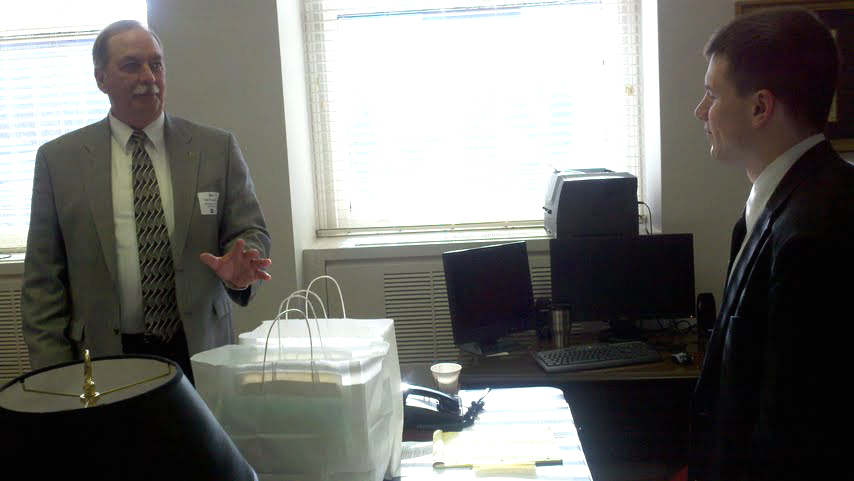
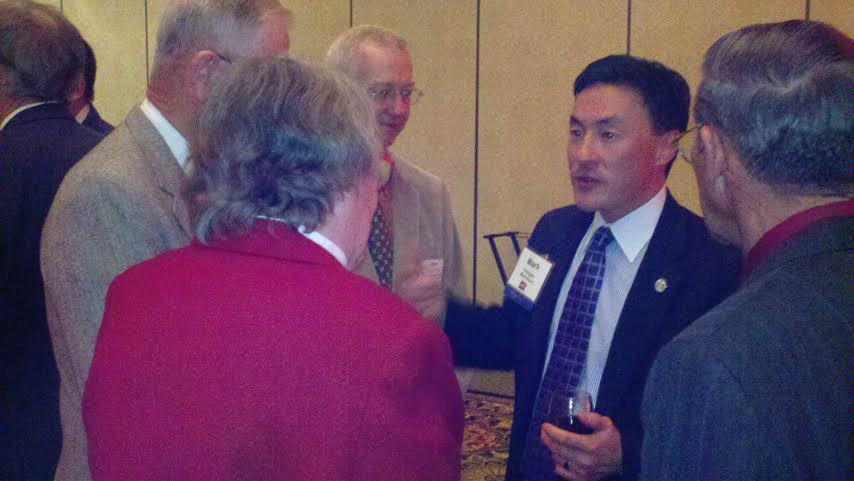
Rob Hall of Northumberland/Lancaster County Farm Bureau and Ricky Kurtz from Gloucester/Mathews County Farm Bureau visit the Governmental Relations booth in the exhibit hall at the Virginia Farm Bureau Federation’s Annual Convention.


Virginia Farm Bureau members from across the state are meeting in Norfolk this week for the organization’s annual convention. Along with attending workshops and other programs, members will discuss and set policy for the upcoming year.

On Tuesday, members stopped by the Governmental Relations booth in the convention’s exhibit hall to learn about five of Farm Bureau’s critical issues: animal care, property rights, Virginia Cooperative Extension funding, water quality and game laws. They also learned about receiving Capital Connections Action Alerts from the GR Department, as well as how to sign up to receive e-mail alerts on new posts on the Plows and Politics blog (hint: enter your e-mail address under FOLLOW BY E-MAIL in the top left of this page). Both are very important tools to keep members updated and active during the General Assembly and Congress on issues that may need legislative contacts.

On Wednesday, members heard from Secretary of Agriculture Todd Haymore at breakfast. Afterwards, members entered General Session where they heard from updates from the insurance company and participated in policy discussions.

During the remainder of the convention, members will set policy, determine what county representatives will attend the American Farm Bureau Federation’s annual meeting in January, and hold elections for the VFB Board of Directors.

Virginia Farm Bureau members will set policy at annual meeting next week

As many as 900 farmers and others with an interest in agriculture and agribusiness will gather next week for the Virginia Farm Bureau Federation’s annual convention at the Norfolk Waterside Marriott.

This is a very important step in Farm Bureau’s legislative process. During general sessions of the convention, voting delegates from each of Virginia’s 88 county Farm Bureaus will discuss and cote on the organization’s state and federal legislative policies for the coming year. They also will elect members of the VFBF board of directors to represent Districts 1, 4, 7, 10 and 13.

With the theme “Ag Trade: Growing Opportunities,” this year’s Virginia Farm Bureau Federation Annual Convention will focus on how farmers can increase their profitability through trade.

Topping the conference is a keynote speech by J.J. Keever, senior deputy executive director of external affairs for the Virginia Port Authority, titled “Agriculture & Maritime: Partnering for a Brighter Future.” Keever will talk about how farmers can take advantage of the Port of Virginia to increase agricultural exports.

Participants also will have the opportunity to attend two educational conferences: “Port of Virginia: Proximity & Potential Profit” and “Conservation Easements: The Right Fit for Your Farm?”

Greg Edwards, director of external affairs for the Virginia Port Authority, will piggyback on Keever’s keynote speech and offer farmers tangible ways to get involved in exporting their products through the Port of Virginia.

Lisa Anne Hawkins, Kevin Schmidt and Laura Thurman will participate in a panel discussion on conservation easements and how farmers can benefit from them. Hawkins is a founding partner of the law firm Lenhart Obenshain PC and has worked on easements to preserve thousands of acres of land in Virginia. Schmidt is the coordinator of the Virginia Department of Agriculture and Consumer Services’ Office of Farmland Preservation. Thurman is the easement project manager for the Shenandoah Valley region of the Virginia Outdoors Foundation.

Stay tuned to the blog for live updates from convention next week. And if you’re a producer member attending the convention, stop by the Governmental Relations booth in the exhibit hall to learn more about our 2012 critical issues.

Happy Thanksgiving!

Conservation easement workshops scheduled for December and January

Over the past two years, Governor McDonnell has made the preservation of working lands a priority for his administration. The Virginia Department of Agriculture and Consumer Services (VDACS) has recently posted the online registration for the next two “Conservation Easement Workshop for Working Lands” sessions. These workshops, led by Secretary Todd Haymore and Commissioner Matthew Lohr, are a great opportunity for farm and forest landowners in Virginia to learn more about conservation easements and see if it is a good idea for their farm and get questions answered. This past spring the first one was held in Rockbridge County, and we had good attendance from actual farmers in that section of the Valley. The next two sessions are as follows:

December 13, 2011: Pittsylvania County at Olde Dominion Agricultural Complex in Chatham

January 5, 2012: Dinwiddie County at Eastside Community Enhancement Center in Petersburg

For more information, visit www.vdacs.virginia.gov/preservation/workshop.shtml