Governor Signs Property Rights Bills; Coalition Officially Launches Campaign

Virginia landowners will be confident that their private property cannot be taken and given to another private owner under eminent domain if the commonwealth’s voters approve Question 1 on the Nov. 6 ballot.

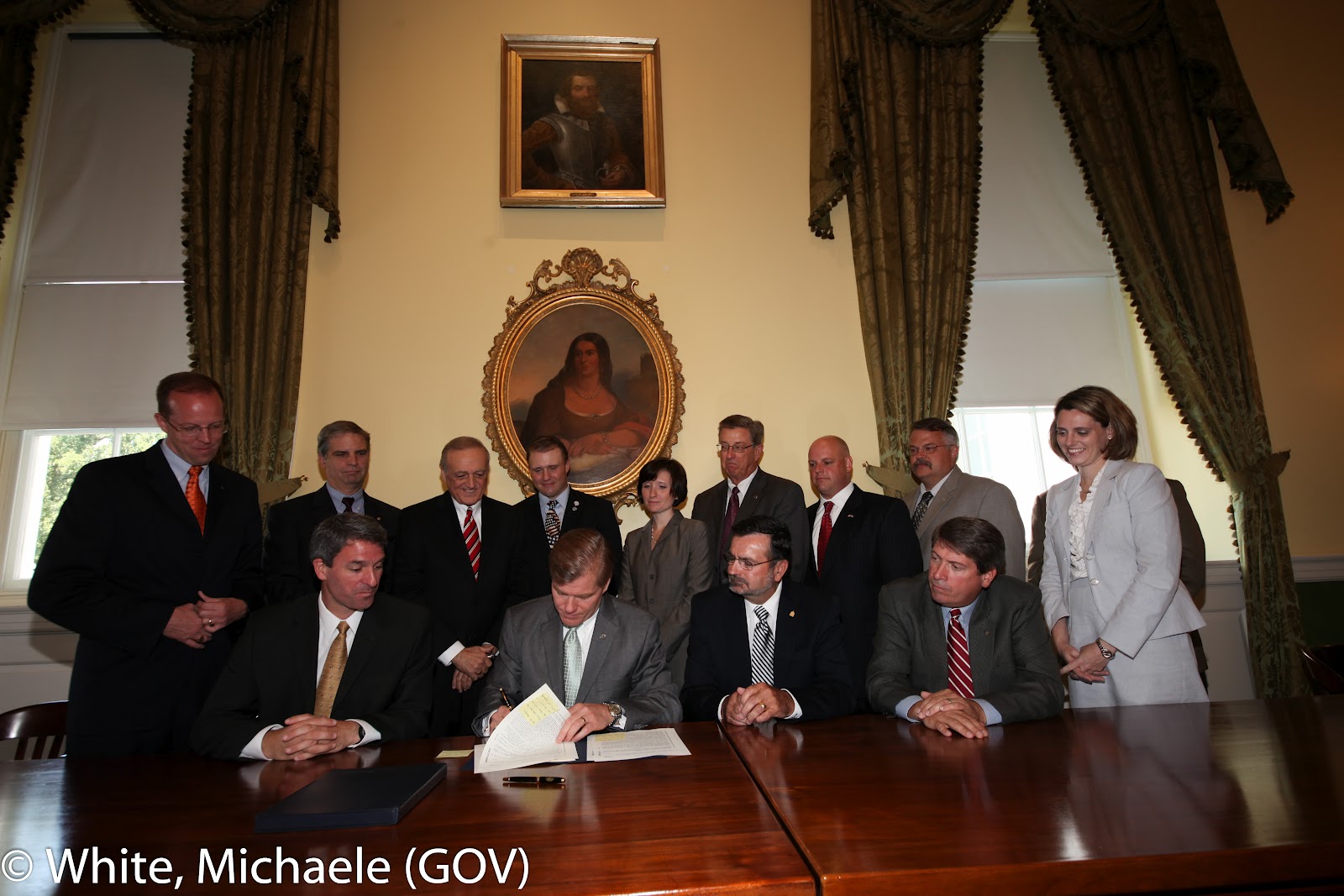
Bipartisan legislation was signed by Gov. Bob McDonnell yesterday to place a proposed constitutional amendment on this fall’s ballot to protect the private property rights of Virginia’s farmers, small businesses and individuals. The amendment specifies that eminent domain cannot be used unless it is for a true public use and further ensures just compensation for the landowner, including the opportunity for lost access and lost profits to be considered as part of that compensation. The language in the amendment also clarifies what is a true “public use” and specifies that no more land than is necessary can be taken.

The “Private Property Rights” amendment and companion legislation was supported by Attorney Gen. Ken Cuccinelli and patroned by Sen. Mark Obenshain, R-Harrisonburg; Del. Rob Bell, R-Albemarle; and Del. Johnny Joannou, D-Portsmouth.

At the July 16 bill signing, a coalition of private property rights advocates announced the launch of a campaign encouraging Virginians to “Vote Yes for Private Property Rights.”

“Our members are excited about the opportunity that this constitutional amendment will provide. No longer will our farms, homes or businesses be taken and given to another private property owner under Kelo-type eminent domain abuses,” said Wayne F. Pryor, president of the Virginia Farm Bureau Federation. Martha Moore and Trey Davis, Farm Bureau Governmental Relations staff, were also in attendance.

“Our members are grateful to Gov. McDonnell, Attorney Gen. Cuccinelli and the General Assembly for understanding that, while sometimes the government may want someone’s property for a well-agreed public use, taking someone’s home, farm or business so someone else can develop the land is just plain wrong,” said Nicole Riley, state director for the National Federation of Independent Businesses. “This amendment ensures that, if property is taken for a legitimate public use, private property owners will be justly compensated.”

Elected officials “have given Virginians the opportunity to approve this historical measure,” added Katie K. Frazier, president of the Virginia Agribusiness Council. “Our job now is to educate the public on what this constitutional amendment does and why it is important to them. We’ll be doing so through grassroots activism and communication.”

The “Vote Yes for Private Property Rights” campaign is supported by Farm Bureau, the NFIB, the Virginia Agribusiness Council, the Virginia Forestry Association, the Virginia Poultry Federation, Americans for Prosperity, the Family Foundation of Virginia and other advocacy groups. The coalition will be posting campaign signs, distributing literature and organizing other activities through the fall.

Agriculture and Forestry U.S. Senate Candidates Forum to be held in July

The Virginia Farm Bureau Young Farmers Committee will be hosting the Agriculture and Forestry U.S. Senate Candidates Forum in July. They have partnered with other agriculture and forestry groups to host this event in conjunction with their 2012 Young Farmer Summer Expo in Lynchburg. These partners are Virginia Farm Bureau Federation, Virginia Agribusiness Council, Virginia Forestry Association and Virginia Forest Products Association.

George Allen (Republican Nominee) and Tim Kaine (Democratic Nominee) have both agreed to participate. You will have the opportunity to submit written questions for each candidate during the forum. This is the only event planned with a specific focus on Virginia’s agriculture and forestry industry before the election on November 6. Time will be set aside to meet and greet the candidates.

WHEN: Friday, July 27, 3:00 PM to 5:30 PM

WHERE: James River Conference Center
400 Court Street
Lynchburg, VA 24504
(The Center is located in downtown Lynchburg off Rt. 29 Business. Traveling west on Main Street, turn left on 5th Street then right on Court Street. The Center will be on your right.)

RSVP: Please let Norma Opel know you are coming by Monday, July 23 by emailing her at norma.opel@vafb.com or by phone at 804-290-1013.


Allen


Kaine


From the Field: Introducing Mark Campbell

Welcome to the new column, “From the Field.” My name is Mark Campbell, and I am the Senior District Field Services Director for Virginia Farm Bureau Federation in the central part of the state. I will be sharing Farm Bureau activities and events throughout the state and other agricultural information and interesting stories, as well as my love for all things agriculture. “From The Field” will be posted here every other Wednesday.

I work out of and live in Nelson County—one of the most beautiful areas of the state! My wife, Dana, our two sons Hayden (9) and Daniel (7) and I live on our family farm, Deer Creek Farm, where I was raised. The rolling and sometimes mountainous terrain of Nelson County is best suited to cattle and sheep and fruit trees. While we do not have fruit trees on our farm, Nelson County is a leader in production of fresh apples and peaches. Nelson is also a high ranking county for vineyards and wineries. Another business that has really taken off in Nelson County is micro-breweries. The county also has a large wholesale nursery. There’s a lot more about Nelson County, click here http://www.nelsoncounty.com/

When I am not working for Farm Bureau, I enjoy working on our farm raising registered Simmental and SimAngus cattle. We sell bulls and replacement heifers to other cattlemen. We send the steers and cull heifers through the Virginia Retained Ownership Program, administered by Virginia Tech in coordination with Iowa State University. The cattle are fed at several participating feedyards in southwest Iowa near the Nebraska border, and are harvested in Iowa. In addition to the cattle, the only crops we raise are grass and trees. Over the years, I have installed several conservation projects with cattle water tanks and implemented a rotational grazing program.

Oh, by the way, we have a small flock of commercial sheep and one Italian Maremma guard dog. That is our new project and I am still working, and sometimes get frustrated trying to integrate them into our cattle system.

My sons are just now getting old enough to start showing cattle at some shows. They really enjoy it and are gaining knowledge about genetics, nutrition and animal care. They are also at that age where they tell everyone they know about everything they know. You know what I mean–some things you wished they didn’t share! Oh well, that makes it real and genuine. So they are doing a great job of being advocates for agriculture. They have a real passion for agriculture.

I thoroughly enjoy being involved in agriculture. It has always been a part of my life. I am an alumnus of Virginia Tech with a Bachelor of Science degree in Animal Science. I was a member of Alpha Gamma Rho, Block and Bridle, and was on the Livestock Judging Team. After college, I worked four years with USDA Grain Inspection Packers and Stockyards Administration (GIPSA) in the Packers and Stockyards Administration division. After that, I started with Virginia Farm Bureau in the northern field district, and then transferred to my current district in central Virginia. My Farm Bureau career has presented me the opportunity to work with 21 county Farm Bureaus and lots of wonderful people over the past 14 years.

My job as District Field Services Director (DFSD) allows me the opportunity to interact with over 100 producer members and assist 10 county Farm Bureaus on a monthly basis who are involved in all facets of agriculture. In central Virginia, we have a wide assortment of agriculture products such as beef cattle, apples, peaches, corn, soybeans, wheat, barley, vegetables, nurseries, tobacco, vineyards, dairy, horses, sheep, goats, hay, timber, poultry, hogs, honey, and even rabbits. I may have missed a few, but you get the picture.

As a DFSD, I am a liaison between Virginia Farm Bureau and 10 county Farm Bureaus. DFSDs work closely with county Farm Bureaus and Virginia Farm Bureau to strengthen the Farm Bureau organization, improve the agriculture industry, promote agriculture, monitor legislation and contact our elected legislators, and help develop future agriculture leaders. In other words, we do whatever we can through Farm Bureau to make things better in the agriculture community.

I am pretty much in agriculture mode all of the time with a few exceptions. And even then, agriculture always finds a way in. The boys and I like model railroading. We are working on a new layout with grain, cattle, and corn ethanol set in Nebraska. We plan to have two trains; one with hopper cars for the grain, and one with tanker cars for the ethanol. Go figure! Agriculture. It’s a way of life.

My next post will be about a successful member benefit that Louisa County Farm Bureau offers to their producer members. Thanks for reading and doing all that you do for Farm Bureau and Virginia agriculture.

Mark

Land Preservation Opportunity for County Farm Bureaus

As part of Governor McDonnell’s new project to increase the amount of working farm and forestland in Virginia, Virginia Farm Bureau has been working with interested parties on the development of the new “Working Lands Variant” Conservation Easement from the Virginia Outdoors Foundation.

Below is a letter from Matt Lohr presenting an opportunity and resources for those of you that may have interest within your county membership to hear more about an option for preserving your land.

Please contact Trey Davis, Assistant Director of Governmental Relations, at (804) 290-1017 or trey.davis@vafb.com if you have further questions with the information contained in the letter.

New AFBF Campaign: Stop the Flood of Regulation

Farmers are working to stop an effort by the U.S. Environmental Protection Agency to regulate waterways Congress never intended the agency to regulate.

The American Farm Bureau Federation has launched its “Stop the Flood of Regulation” campaign because it believes the EPA is trying to improperly alter the Clean Water Act. That law gives the EPA the power to write rules to protect navigable waters.

Using what is called a guidance document, the EPA is seeking to take the word “navigable” out of the law, which would allow it to regulate even a roadside ditch that holds water after a heavy rain.

“A guidance document is supposed to be a non-binding policy document for field offices on how to implement current law and current policies,” said Cody Lyon, AFBF grassroots and advocacy director.

Of concern to Farm Bureau, Lyon said, is that “there’s uncertainty with how this guidance document can be implemented. This could be interpreted many different ways around the country or even many different ways within a state. For 40 years the Clean Water Act has done a great job. The problem is the guidance document goes beyond Congressional intent, and they’re also ignoring the Supreme Court precedents that have determined the definition of ‘navigable.’”

That could be problematic for farmers and ranchers, who fear that even a farm pond or ditch could now fall under EPA permitting regulations.
“We’re talking thousands, tens of thousands of dollars,” he said, because the guidance could affect “anything dealing with livestock operations, anything dealing with applications of pest management tools, anything dealing with wetlands, groundwater, runoff, storm water. You could start having a flood of regulations that start coming in just from this one guidance document.

“We’re trying to make sure we stop this flood of regulations at the very beginning, before it starts getting out of control.”

Farm Bureau is asking its members who farm to tell their Congressional representatives how hard the new rule could hit them, and to ask for support of H.R. 4965, a bill that would preserve existing U.S. water rights and responsibilities in the Clean Water Act.

AFBF President Bob Stallman said the EPA guidance document “improperly changes the law of the land,” and he asserted that, in issuing it, the EPA is bypassing the necessary public outreach required under the Administrative Procedures Act.

Please stay turned for more information and action alerts related to this campaign in the next few weeks. To sign up action alerts, please contact Kelly Pruitt at kprui@vafb.com or 804-290-1293 with your producer membership number.

Still Affected by the Storms?

Is your operation still being affected by last week’s storms? Below are some resources that may be helpful.
Here are some potential rental generator companies. Be sure to ask such questions as:

• KW Rating for the generator
• Amp Rating Phase
• Length of cabling needed
• Do you have an electrician to wire it in?
• Do you have fuel to support the generator?
Grainger has a complete line of generators and they are an affinity partner of Va. Farm Bureau. They also have other storm clean up supplies.Farm Bureau members can get a 10% discount and free shipping on all orders placed online.  Pleaseask for the FB discount and have you membership number when placing the order.  The program access number is on the back of you membership card.

Garner Emergency Services

Kenny Hayes
713-392-8808
DRC Emergency Services

Tony Swain

757-592-0929

Ashbritt

Rob Ray
954-868-9502
Sunbelt Rentals
Scott Brown
804-283-1748
Here are potential fuel providers with coverage in Virginia. They may or may not serve private citizens.

James River Solutions:

To Place and Order: 800-825-5599 or 804-358-9000
Emergency / After Hours: 804-393-1150

Mansfield Oil Company:

Bulk Fuel:

To Place and Order: 800-283-3835

Delivery / Account Questions: 800-234-2835
DRC Emergency Services, LLC
Tony Swain

251-402-3052

These contacts may have knowledge of bulk water tanker style carriers:

Diamond Springs Water *

804-222-5100
800-350-0525 (toll-free)
Crystal Springs *
800-959-4619

Virginia Farm Bureau News Lead: Farm Bureau ‘concerned’ about court ruling on health care legislation

This story will appear in the July 5th edition of News Leads, the week’s top ag stories sent out by the VFB Communications Department to media across the state.

The U.S. Supreme Court issued a 5-4 ruling June 28 upholding President Obama’s health care legislation, which includes a requirement that all people have health insurance. That same day the nation’s largest agricultural organization voiced its apprehension.

“Farmers, ranchers and rural residents need affordable and accessible health care. We remain concerned that mandating individuals and businesses to buy insurance will impose an expense that creates economic hardship, particularly for self-employed individuals and small businesses,” said Bob Stallman, president of the American Farm Bureau Federation.

Stallman noted that Farm Bureau historically has supported market-based reforms as the best way to control costs and increase options for individuals and businesses that purchase health insurance. “The plan reviewed by the Supreme Court would impose a new financial burden on our members,” he said. “As the legal and political interpretation of this ruling is further analyzed and debated in the weeks and moths ahead, it is important to remember that access to affordable health care eludes many American families across the country.”

Moving forward, Stallman said, “Farm Bureau will encourage Congress and the president to work together to address concerns on this issue, which affects millions of small business owners and individuals throughout rural America.”

Virginia Farm Bureau Federation has in recent years monitored developments in federal health care legislation.

“While the Patient Protection and Affordable Care Act (PPACA) does have provisions that will benefit rural Virginians, such as increased funding for rural hospitals, Virginia Farm Bureau has remained opposed to the legislation. It does not get to the root of the health care problem for our producer members, which is to place price controls on skyrocketing out-of-pocket costs and putting more doctors into rural areas,” said Trey Davis, assistant director of Governmental Relations. “We look forward to engaging our legislative representation here in the General Assembly to ensure that Virginia’s farmers’ health care needs are addressed in the implementation of the PPACA.”

‘Vote Yes’ Campaign Signs Arriving Soon to a County Farm Bureau Office Near You

Virgina Farm Bureau Board of Directors
Thomas Graves

Photo by Kathy Dixon

The Virginia Farm Bureau Governmental Relations Department has been busy gearing up for the “Vote Yes on Question 1” property rights campaign this fall. The campaign is to educate voters about the property rights constitutional amendment which will appear as question 1 on the Nov. 6 ballot.

One of the tools we will be using is campaign signs. Your county Farm Bureau has been sent a sample “Vote Yes on Question 1″ 14″x22” campaign sign. They will be ordering more for distribution to Farm Bureau members in the next few weeks.

Please keep in mind that although the campaign signs are weather resistant, they are only built to last two or three months out in the elements at best. So if you are interested in hosting a sign or several signs on your property, please think about posting them around September to hit voters hard before Nov. 6.

To amend the Constitution of Virginia, a state senator and/or delegate must introduce a bill, in the form of a resolution, with the wording of the amendment. If the bill is passed by one house, it goes to the other house and goes through the same process. The bill must pass by a majority.

The bill must go through the same process the following year and be approved in exactly the same form. We achieved this last winter in the Virginia General Assembly. After this process, the amendment goes on the November ballot, where it must be approved by a majority of voters.

If the property rights constitutional amendment passes, it will make sure:

• Private property may be only taken for a true “public use,” and not taken and then given to another private landowner;

• In the unfortunate circumstances where your property is taken, you will be correctly paid for the loss of value to your property; and,

• No more of your property may be taken than that which is absolutely necessary.

Introducing the Grassroots Advantage

In the next few weeks, you’ll start seeing this logo on all things Virginia Farm Bureau Governmental Relations. It’s called the Grassroots Advantage, and it’s one of the many membership advantages to being a Farm Bureau member.

But the Grassroots Advantage doesn’t just benefit you–it benefits all Virginia agriculture. Your membership helps give Virginia farmers a unified voice, and Farm Bureau is respected among elected officials because they know its policies come directly from farmers like you at the grassroots level. Your membership also helps address issues that affect all Virginians–private property rights and the need to preserve clean water and air.

So not only do you receive the Grassroots Advantage from the Governmental Relations Department with representation at the Virginia General Assembly and Congress, as well as Farm Bureau’s policy development process, but all of Virginia receives the Grassroots Advantage thanks to you, your membership, your participation in the grassroots process, and when contact your legislators on important issues affecting agriculture and all Virginians.

At Virginia Farm Bureau, you, our producer members, ARE the Grassroots Advantage.

Breaking News: Senate Passes Farm Bill

Wilmer Stoneman
Associate Director
Governmental Relations

Many thought the odds were against it, but the farm bill has made it over a major hurdle. Senators approved their version of the bill (S. 3240) in a strong bipartisan vote of 64 to 35.

But this is just the first step. We still have a lot of concerns that need to be addressed as the farm bill moves forward. The House Agriculture Committee announced earlier this week that it was postponing its consideration of a farm bill draft until July 11. The committee was originally slated to take the legislation up next week.

American Farm Bureau Federation President Bob Stallman said this yesterday: “There is still a lot of hard work ahead to fully secure the kind of policy we believe our farm and ranch families need, but we applaud the Senate for approving a workable bill and moving this process forward. The Senate has provided us solid footing by approving a bill that stands firm on $23 billion in savings, yet protects and strengthens the federal crop insurance program and provides a commodity title that attempts to encourage producers to follow market signals rather than make planting decisions in anticipation of government payments.”

 In votes taken Wednesday, Farm Bureau was successful in: opposing an amendment that would have prohibited any program to promote and provide research and information for a particular agricultural commodity without reference to specific producers or brands (a check-off program) from being mandatory or compulsory; opposing an amendment that would have eliminated the $4 billion cut to the Supplemental Nutrition Assistance Program (SNAP) program and added $50 million annually to the Fresh Fruit and Vegetable Program from the current $150 million authorization; opposing an amendment that would have imposed a $250,000 Adjusted Gross Income (AGI) means test for all programs in the farm bill, including conservation; and opposing an amendment that would have reduced loan rates and eliminated other changes to the sugar program made in the 2008 farm bill.

Farm Bureau was not successful in efforts: to oppose an amendment requiring conservation compliance as a requisite for crop insurance; and to oppose an amendment establishing payment limits for marketing loans and loan deficiency payments at $75,000 a year for individual farmers and $100,000 a year for couples. 

Farm Bureau’s position was also unsuccessful when an alternative amendment passed that would limit crop insurance premium subsidies to any person with an adjusted gross income exceeding $750,000. AFBF had supported a related unsuccessful amendment that called for a study of such an eligibility requirement and to disallow the action if it carried negative ramifications for the cost, availability or administration of the crop insurance program.