Virginia Ag Leaders participate in Ag Literacy Week

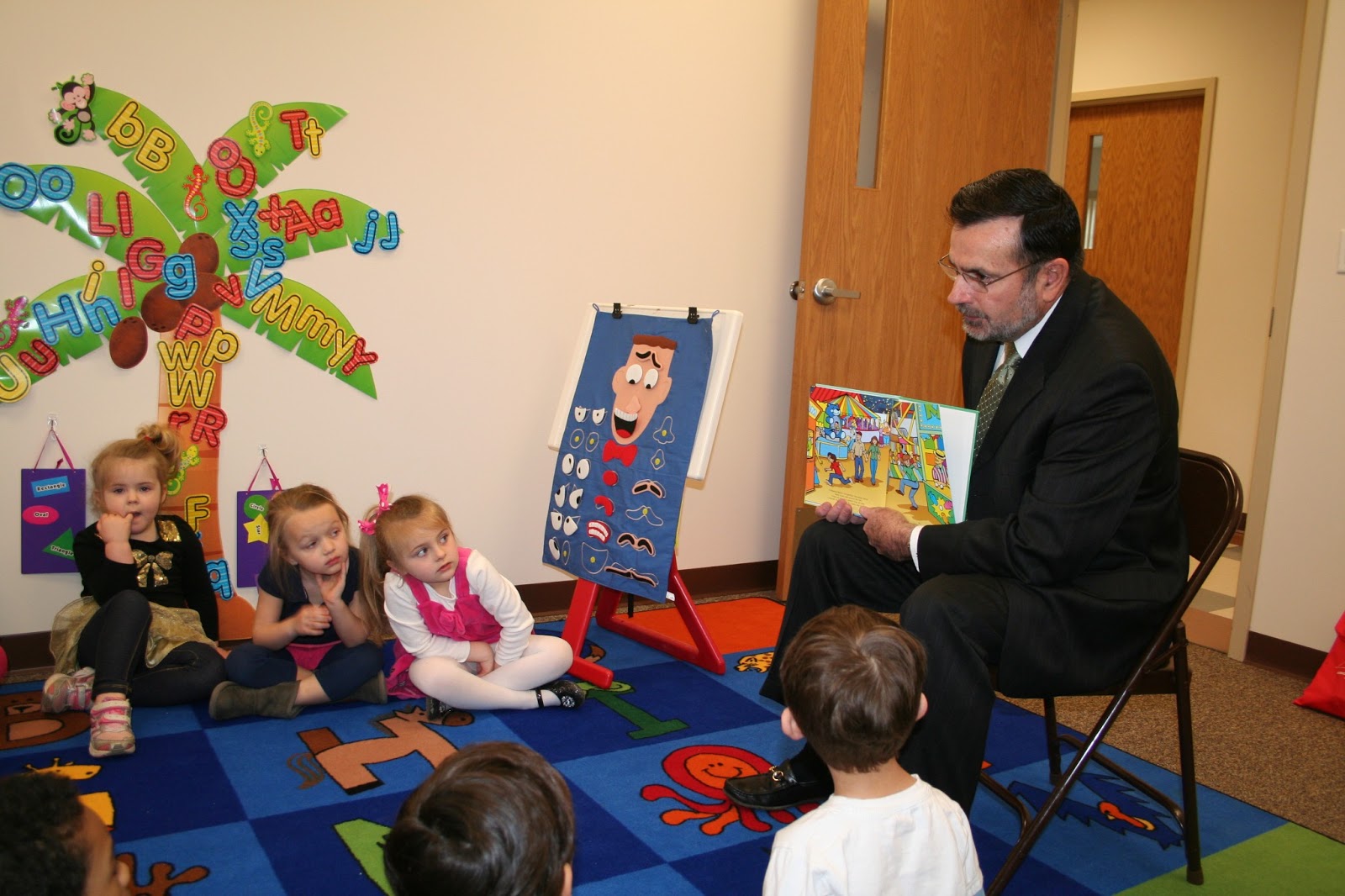
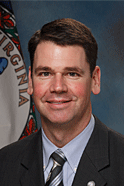
VFBF President Wayne F. Pryor reads to students at Mt.
Gilead Baptist Pre-school
Photo by Sara Owens

In addition to this week being Virginia Agriculture Week, it is also Agriculture Literacy Week, and Virginians are celebrating by reading to children in pre-school through the third grade at public and private schools throughout the state.

Virginia Commissioner of Agriculture Matt Lohr, Virginia Farm Bureau President Wayne F. Pryor as well as Farm Bureau members and other ag industry leaders will visit local schools, after‐school programs, or day care centers and read Kelly’s Big Day, a book written by Tammy Maxey, senior education program coordinator for Ag in the Classroom, and provide other activities on Virginia agricultural products.

During their annual Legislative Day event, Virginia Farm Bureau members gave each state legislator a copy of Kelly’s Big Day to read during Ag Literacy Week.

Virginia celebrates National Ag Day

Happy National Agriculture Day! To celebrate, we found an article by Virginia Cooperative Extension Agent Scott Reiter in Prince George County with current statistics that you may or may not have known about American and Virginia agriculture.

American agriculture: generations nourishing generations
By Scott Reiter (Extension Agent) 

American Agriculture: Generations Nourishing Generations is the theme for National Agriculture Week March 17-23, 2013. This is also the celebration of the 40th National Agriculture Day on March 19. Agriculture provides almost everything we eat, use, and wear on a daily basis. But too few people truly understand this contribution. 

More than three million people farm or ranch in the United States. Individuals, family partnerships or family corporations operate almost 99 percent of U.S. farms. Over 22 million people are employed in farm or farm-related jobs, including production agriculture, farm inputs, processing and marketing and wholesale and retail sales. Virginia has over 47,000 farms and provides 357,000 of those jobs. Agriculture and forestry has a $79 billion impact in Virginia making it the states largest industry.

 Forty-one percent of U.S. total land area is farmland (938.28 million acres). Virginia has 8.1 million acres of farmland which is 32% of the states land area. We have lost 500,000 acres of farmland in Virginia to development of housing, roads, and other industry since 2002.

 The top five Virginia agricultural commodities are poultry and eggs, cattle and calves, dairy products, corn, wheat, and soybeans, and nursery-greenhouse production. U.S. farmers produce 46% of the world’s soybeans, 41% of the world’s corn, 20.5% of the world’s cotton and 13% of the world’s wheat. In the Petersburg area, crop production of corn, soybeans, wheat, cotton, tobacco, and peanuts are the leading source of income. Cattle and calves, nursery & greenhouse, and dairy follow in value. There are also numerous small farms selling vegetables directly to consumers. Many local vegetable farms can be found in the “Buy Fresh, Buy Local” guides(www.buylocalvirginia.org) or the Virginia Grown Guide (www.virginiagrown.com

Virginia ranks high nationally in the production of many crops. Leaf tobacco, 3rd in the nation; fresh market tomatoes, 4th; turkeys and wine, 5th; apples, summer potatoes, and fresh market snap beans, 6th; grapes, 8th; peanuts and sweet potatoes, 9th; and fresh market cucumbers, 10th. As you can see, Agriculture is abundant in variety and amounts of products produced.

 Farmers and ranchers are independent business people who provide for their families by growing and producing food and fiber. They use modern production techniques to increase the quality and quantity of the food they produce. In the 1960s, one farmer supplied food for 25.8 persons in the U.S. and abroad. Today, one farmer supplies food for 144 people in the U.S. and abroad. Quite simply, American agriculture is doing more – and doing it better.

 – The efficiency of U.S. farmers benefits the United States consumer in the pocketbook. Americans spend less on food than any other developed nation in the world. American consumers spend the lowest percentage of their annual income on food – just 10 percent. 

– A farmer receives about 19¢ for the wheat in a 1 pound loaf of bread, they get about 10¢ for the corn in an 18 ounce box of corn flakes, and a dairy farmer receives about $1.72 for his fluid milk in 1 gallon of milk at current market prices. The rest of the retail price is processing, packaging, transportation, and profit margins.

 – Agriculture generates 20% of the U.S. Gross Domestic Product.

 – One-fourth of the world’s beef and nearly one-fifth of the world’s grain, milk and eggs are produced in the U.S.

 – The United States exports $43.5 billion in agriculture products and imports $26.4 billion in farm products, equaling a positive net trade balance of $17.1 billion.

 – Cotton is by the far the most dominant fiber produced in the United States and is used for apparel, home fabrics as well as industrial uses.

 – Farmers use reduced tillage practices on more than 72 million acres to prevent erosion.

 – Farmers maintain over 1.3 million acres of grass waterways, allowing water to flow naturally from crops without eroding soil.

 – Agricultural land provides habitat for 75 percent of the nation’s wildlife.

 – Forests cover 16 million acres in Virginia and the forestry industry generates over $25 billion in timber, manufacturing, and supporting industries.

 Now you might ask, “What does Generations Nourishing Generations mean?” As mentioned earlier most farms are family businesses. It is not uncommon to see 2 or 3 generations in a family farm working together. And consider that some farms have been in existence since the founding of Jamestown. This means you may have the same land farmed by the same family for 10 or more generations!! Not many businesses have that kind of history. In Prince George, we have one of the oldest continuously operated farms in the United States. Brandon Plantation has been farmed since 1614 although not by the same family. Since 1619, Brandon has been operated by four families. The Harrison’s farmed from 1720-1926 at which time the Daniel family bought the farm and continue operations today.

 So you can see that many generations of farmers have feed the many generations of families in the United States. The next time you go to the grocery store, pass a farm field, or sit down to eat think about where your food comes from. And if you get a chance, thank the people that grow and deliver nutritious food to your family every day.

VDACS Commissioner Shares Top 10 Misconceptions about Agriculture

VDACS Commissioner
Matt Lohr
MY TOP 10 LIST OF MISCONCEPTIONS ABOUT AGRICULTURE
By Matthew J. Lohr, Commissioner, Virginia Department of Agriculture and Consumer Services 
As we approach Virginia Agriculture Week March 17 – 23, I decided this is the perfect time to address some of the common misconceptions about agriculture. Many of you will have a similarly-titled list, but our Top 10 may differ. If you want to share your list with us at VDACS, please e-mail it to our Communications Director at elaine.lidholm@vdacs.virginia.gov.
Like David Letterman, we will go from #10 to #1.
#10 – Small farms are unimportant. In many ways, small farms are the backbone of Virginia agriculture. They range in size from three or four acres to 150 acres or so, but they probably do the best job of any farms to provide local food. Many small farms sell directly to the consumer through roadside stands, on-farm sales, farmers’ markets and events. They are at the heart of the Buy Local movement and not only provide food but also provide that all important one-on-one relationship between farmer and consumer. They are also one of the fastest growing segments of Virginia agriculture.
#9 – All large farms are corporate farms. In Virginia nearly 90 percent of our farms are family-owned and operated. Many family farms are incorporated for business purposes or to ensure an orderly transition from one generation to the next, but incorporated is not the same as corporate. The vast majority of our farmers live on the land they work, and they have a very special bond with the land that may go back generations. Their roots run deep.

#8 – Farmers are destroying the environment. This is absolutely not true. In fact, farmers are the original good stewards of land and water resources. These resources are, after all, how they make their living, so it makes sense to protect them. I find it interesting that many of the complaints to our Ag Stewardship Program about perceived environmental problems are unsubstantiated. What the public perceives as an environmental problem often is not. At the same time that farms give us environmental benefits such as green spaces and wildlife habitat, they use far fewer resources than the average urban or suburban home. 
#7 – There’s no future in agriculture. I’ll admit that for a few years, many of us were concerned about the future of agriculture and the next generation of farmers. But things are changing. Fox News recently ran a feature that said ag degrees are the hot ticket for job growth. They quote data from the Food and Agriculture Education Information System that says enrollment in U.S. college and university agriculture programs are up 21 percent since 2006. The data show more than 146,000 undergraduates in ag programs. This growing interest is critical for the future of food production, as world population growth is creating a greater demand for food, and the average age of farmers in many states is near 60.
#6 – Farmers are uneducated. This is a persistent myth and one we need to bust. The days are long gone when you learned everything you needed to know about farming from your grandfather. That doesn’t mean we discount grandpa’s advice, born from years and years of experience. It does mean that today’s farmers need post-high school training in a variety of areas: animal science, agronomy, environmental science, business, marketing, communications, perhaps even law and psychology. Today’s farmers also need to be life-long learners. If you’ve been on a farm recently, you’ve probably seen a farmer using his cell phone in the field to make decisions about planting or applying pesticides or fertilizer. That’s the kind of on-the-job training every farmer needs these days to stay competitive and make a profit.
#5 – The cost of food goes directly into the farmer’s pocket. A persistent myth in the eyes of the public and the media is that the only factor in food prices is what the farmer charges. Don’t we wish this were true? But in reality, only 15 to 16 cents of every food dollar goes into the farmer’s pocket. The rest goes for things like transportation, processing, packaging and marketing. Farmers can barely pass along their direct costs for feed, fertilizer, labor or insurance. Their indirect costs are even more difficult, and when drought, hail, hurricanes, flooding or other natural disaster wipe out a crop, they can lose most of their year’s income but still have to bear all of those direct costs.
#4 – Food costs too much. In some parts of the world, this definitely is true. It not only costs too much but is unavailable to many people. But in the United States, we have one of the most abundant and affordable food supplies in the world. In 2011, the share of final household consumption on food in the U.S. was 6.7 percent. The percentage in Switzerland was 10.2; in Japan, it was 14. China checks in at 21.3 percent and in Cameroon it’s 46.9. (Source: Economic Resource Service, USDA)
#3 – Our food is unsafe. Sometimes we get overwhelmed by the headlines of a problem with one commodity or one producer. The reason these stories are called news is because they are not normal. Normal in the U.S. is a safe, abundant, affordable food supply. I Googled “safety of the U.S. food supply” just to see what would pop up, and I found many articles and studies with this same fundamental message: The American food supply is the safest in the world thanks to industry and government efforts. Because our food supply is so safe, we have a luxury people in many countries don’t have; we can take it for granted.
#2 – Farmers abuse their animals. The very idea sends me into orbit. In any industry you will find a few bad players, and agriculture is not immune. But consider this, why would a farmer abuse his or her animals when those animals are the source of his livelihood? That’s just nuts. It may be a marketing ploy, but there is a lot of truth to the statement that “Our milk comes from contented cows.” Contented cows are going to produce more milk than cows that are stressed, neglected, starved or otherwise treated ill and farmers know it. The same goes for any other food animal.
#1 – All farmers are rich. Do I hear the farmers among you laughing? I can’t think of a single farmer I’ve known whose goal was to get rich. In Virginia it’s usually more like, “I hope I can make a decent living for my family.” If your goal is to get rich, frankly, there are many ways to accomplish that goal that are easier and quicker than getting rich through agriculture. We do have some wealthy farmers in Virginia, and I am proud of them. But even among those who are wealthy, I think the motivators for farmers tend to be of a more noble nature. We farm because we love it or because we love the lifestyle or we think it’s a good way to raise our children. We may farm out of a deep-seated desire to help, to make a positive difference in the world. Or we simply may realize that farming is not only the world’s oldest profession, but that it is the only one that is truly necessary. Bottom line, when we can’t feed ourselves, nothing else matters because we will be dead in four or five days.

Time to Schedule Your Annual Water Well Checkup

Just as you check your furnace or smoke detector batteries seasonally, spring is a good season to have an annual water well checkup before the peak water use season begins, according to the National Ground Water Association. NGWA calls attention to the need for annual well water checkups during Groundwater Awareness Week (March 10-16).
 An annual checkup by a qualified water well contractor is the best way to ensure problem-free service and quality water.
 Also, preventative maintenance usually is less costly than emergency maintenance, and good well maintenance—like good car maintenance—can prolong the life of your well and related equipment. NGWA further recommends you test your water whenever there is a change in taste, odor, or appearance, or when the system is serviced.

 Wells can provide high-quality drinking water, and about half the U.S. population receives its drinking water from wells. But with well ownership comes the responsibility of keeping the water well in good working order. A check of your well by a qualified water well contractor may include:
  • A flow test to determine system output, along with a check of the water level before and during pumping (if possible), pump motor performance (check amp load, grounding and line voltage), pressure tank and pressure switch contact and general water quality (odor, cloudiness, etc.).
  • A well equipment inspection to assure it’s sanitary and meets local code.
  • A test of your water for coliform bacteria and nitrates, and anything else of local concern. Other typical additional tests are those for iron, manganese, water hardness, sulfides and other water constituents that cause problems with plumbing, staining, water appearance and odor.
It is also recommended that well owners:
  • Keep hazardous chemicals, such as paint, fertilizer, pesticides and motor oil far away from wells, and maintain a “clean” zone of at least 50 feet between your well and any kennels and livestock operations.
  • Maintain proper separation between your well and buildings, waste systems and chemical storage areas.
  • Periodically check the well cover or well cap on top of the casing (well) to ensure it is in good repair and securely attached. Its seal should keep out insects and rodents.
  • Keep your well records in a safe place. These include the construction report, and annual water well system maintenance and water testing results.
Visit http://www.ngwa.org or www.wellowner.org for more information.

Virginia Ag Exports Reach All-time High

Governor Bob McDonnell announced today that agricultural exports from Virginia reached a new all-time high of $2.61 billion in 2012, shattering the previous record set last year by almost 12 percent. The Governor’s announcement came during his keynote remarks at the fifth annual Governor’s Conference on Agricultural Trade in Richmond. The conference runs through Friday.

The Commonwealth previously reached a record level of agricultural exports in 2011, when more than $2.35 billion in products were shipped into the global marketplace from Virginia ports. The 2011 figure was a six percent increase from 2010. Agricultural exports, which also include forestry products, have grown in value by approximately 17 percent since 2010. The growth in agricultural exports comes despite a continued slow economic recovery worldwide.

Virginia’s strong position in the global marketplace is enhanced by a number of factors, including: quality producers, agribusinesses, and exporters; an excellent sea, air, and land port system; and a diversified portfolio of export markets and products. Top export products in 2012 included: soybeans; soybean meal; lumber, logs, and wood products; unmanufactured leaf tobacco; soybean oil; wheat, corn, barley and other grains; pork; animal feed; processed foods and beverages, including wine; animal fats and oils; wood pellets; cotton, seafood, and raw peanuts.

Virginia’s top three export markets in 2012 were the same as 2011, albeit in different order. China, by far, is Virginia’s top agricultural export customer with exports totaling more than $638 million in 2012, up from $304 million and the second spot in 2011. Agricultural exports to China, largely driven by soybean and grain shipments, have increased by almost 230 percent since 2010 when $194 million of goods were shipped there from Virginia. Canada holds the second spot with exports totaling more $205 million in 2012. Morocco, after being Virginia’s top agricultural export destination in 2011, is now third with approximately $139 million in goods purchased.

Virginia’s other top export markets, along with values shipped rounded to the nearest million dollars, include: Switzerland, $122 million; Turkey, $94 million; Saudi Arabia, $90 million; Indonesia, $82 million; Vietnam, $82 million, Venezuela, $67 million; Cuba $66 million; Mexico, $61 million; Japan, $53 million; Egypt, $52 million; Ireland, $49 million; Taiwan, $43 million; Russia, $42 million; Malaysia, $41 million; Hong Kong, $39 million; Chile, $38 million; Poland, $37 million; Italy, $37 million; Tunisia, $35 million; Jamaica, $34 million; Georgia, $32 million; Germany, $31 million; and India, $28 million.

Some key points from this year’s Virginia agricultural export study:

• The export commodity showing the largest percentage growth was wood pellets, which saw a more than 800 percent increase from 2011 to 2012. Exports grew from almost $4 million to approximately $35 million, largely driven on new sales to the European Union.

• The export value of soybeans more than doubled between 2011 and 2012, from $327 million to $734 million. A significant portion of this growth is attributable to the McDonnell administration’s efforts to find new customers in the global marketplace.

• The Commonwealth saw key growth in areas where the Governor’s agricultural export initiative focuses resources and attention: China, India, Mexico and other Latin American countries, and several countries in Europe.

• Virginia’s agricultural exports to China increased by more than 100 percent from 2011 to 2012. In fact, approximately 15 percent of Virginia’s agricultural export trade in 2012 was with China.

• Exports to India grew from $5 million in 2011 to $28 million in 2012. Most of the growth was associated with new sales of soybean oil and lumber, logs, and wood products.

• Exports to Mexico grew by more than $20 million, with new business in poultry and pork.

• Exports to Cuba reached an all-time high of $66 million. Virginia is now the second largest U.S. agricultural exporter to Cuba.

• Peanut exports grew from about $6.5 million to approximately $17 million, largely based on new trade into the European Union.

Agriculture and forestry are Virginia’s largest industries, with a combined economic impact of $79 billion annually: $55 billion from agriculture and $24 billion from forestry. The industries also provide approximately 500,000 jobs in the Commonwealth according to the Weldon Cooper Center for Public Service at the University of Virginia.
From the Field: Farm Bureau members start policy development process

From the Field is a bi-monthly column written by Mark Campbell, Farm Bureau Field Services Director for the Central District. He writes about Farm Bureau member benefits and County Farm Bureau activities.

District Leadership and Policy Development Meetings have already started and will continue through March.  These meetings involve Governmental Relations staff providing a summary of what took place during the General Assembly session as it relates to Farm Bureau policies, and Farm Bureau producer members surfacing issues that they think Farm Bureau should do something about. 
Usually, only state and national issues are requested.  But this year, we asked the members to come up with local issues as well.  Local issues are action items for the county Farm Bureaus, but Virginia Farm Bureau staff are available to provide information, research and advice. 
The state and national issues that were surfaced provide county Farm Bureau members and staff a flavor for what the issues are and if some issues are concerns of multiple counties.  These surfaced issues provide food for thought to county Farm Bureaus when they develop resolutions.  Resolutions, or formal position statements, are voted on at the county Farm Bureau membership business meeting by the members, and then forwarded to the Virginia Farm Bureau Convention.  Resolutions or existing policies that are approved by the voting delegates at the state convention become Farm Bureau policy. 

Policies of a national scope are forwarded to the American Farm Bureau Convention, where they are voted on by voting delegates from across the country.  As you can see all Farm Bureau policies start at the county level.  That is why we often refer to Farm Bureau as a grassroots membership organization.
The central district meeting was on March 4th in Zion Crossroads.  At this meeting, the main areas of concern were keeping the Land Use Assessment program, water issues, and transportation regulations.  Since the housing market has been in the dumps, county reassessments are down as well.  These lower property reassessments have resulted in some counties taking a closer look at the Land Use program and debating on keeping it or not.  Thankfully, county Farm Bureau members have worked the issue in their county to encourage the board of supervisors to keep the program. 
As money becomes harder and harder to come by for county governments; I encourage you and your county Farm Bureau to develop a long term strategy to keep the Land Use Assessment program viable in your county.  I think this will be a critical local issue for years to come. 
The water issues dealt with concerns with impacts to water flow and quality from urban development to farms downstream, looming EPA regulations, and funding for agriculture Best Management Practices (BMPs) cost share programs.  The transportation issue drew concern with bureaucracy and lack of clarity when transporting products across state lines.
If you are a producer member and interested in attending, please call you county Farm Bureau office for dates of meetings in your area.  There is no charge for the meeting or meal, and we would love to hear from you.  Your input is critical to Farm Bureau continuing to be a successful grassroots membership organization. 
Until next time,
Mark

Pink Slime: A Year Later

Charlie Drumheller, a member of Augusta County Farm Bureau,
was one of many Farm Bureau members negatively affected
by the “pink slime” news stories last year.

In March of 2012, ABC News aired a series of television reports on lean finely textured beef, a product used in ground beef that is made from trimmings and on which ammonia is used to remove potential pathogens.  They raised questions about its quality and dubbed it “pink slime,” sparking a public relations furor that roiled social media, consumer advocates and the nation’s beef industry.
A number of fast-food restaurants and grocery retailers – including Wal-Mart Stores Inc, Safeway Inc and Supervalu Inc – also stopped selling ground beef containing the product, even though the U.S. Department of Agriculture and industry experts say it is safe to eat.
Approximately 650 people lost their jobs, and the nation’s beef industry took a very hard hit.
Almost a year later, the beef industry is still trying to recover, while other livestock industries are feeling the effects. ABC News has been hit with several defamation lawsuits from Beef Products, Inc. and others, but will that stop ABC and other news outlets from the next slanted agriculture story?
Charlie Drumheller is a member of Augusta County Farm Bureau.  He has been in the beef industry for forty plus years, primarily in the area of quality assurance and food safety. With the first anniversary of the “pink slime” debacle around the corner, Charlie wanted to share some of his thoughts on the public relations nightmare.

The Pink Slime story was a lot of things, but most importantly, it was effective. Never mind that it was full of distortions and some outright lies. It did deliberately and intentionally damage the meat business.
 While many of you know that you are loosely associated with the meat industry, you may feel that it really didn’t directly affect you. Nothing could be further from the truth, except perhaps the story itself. If you raise livestock, even if it is not cattle, you have been dealt a damaging blow. Let’s examine some ways this story has influenced your ability to profit from your endeavors.
 The value that the packers are willing to pay for cattle is now reduced because of the extra waste that will now be incurred. It is estimated that 13 pounds is now wasted.  Less value for the cattle paid by the packers filters down to the price that the feedlots and backgrounders are willing to pay.
 Perhaps you purchase ground beef from grocery retailers.  The price of ground beef rose more than 15% right after the story hit the media.  Ground beef consumer pricing will remain higher because this option is no longer viable.
 Well, what about the safety of this LFTB (lean finely textured beef)?  This product has been tested every way possible to insure that a safe product is being produced.  It is very simply mechanically deboned meat.  The process has been used for many years.  It is all beef and the ammonium hydroxide that it is treated with is done to eliminate any pathogens.
 Probably the worst fear is that now that a template has been established, what other industries are in the crosshairs now? 

Farm Bureau Urges New Ag Labor Guestworker Program

A new, modern guestworker program for agricultural workers is needed so that U.S. farmers and ranchers can continue growing food, tending livestock and contributing to the nation’s economy, American Farm Bureau Federation President Bob Stallman told Congress this week.
“We want to keep these jobs in America for U.S. workers, not outsource them,” Stallman testified to the House’s Judiciary Subcommittee on Immigration and Border Security. Farm Bureau urged lawmakers to implement a new, market-based labor program administered by the Agriculture Department.
The new program would serve as a substitute for and eventually replace the H-2A program now in place, Stallman explained. It would also provide farmers with access to a legal and stable workforce over the long-term. In addition, the new program would provide employers with greater certainty that they will have access to the workforce they need, when they need it and at a competitive cost.
“Ultimately, agriculture’s goal is to develop a program that treats workers fairly, while being efficient and economical for employers to use,” Stallman said, noting that workers would be able to work for multiple employers under a structure that enforces worker rights and protects them from exploitation.  

Stallman also addressed agriculture’s short-term labor needs in his testimony.
“In order to provide short-term stability and an orderly, effective transition to a new guestworker program it is imperative that any legislation approved by Congress include provisions permitting current agricultural workers who might not otherwise qualify to obtain work authorization,” Stallman said.
“Any new program will take time to be implemented fully,” Stallman said. “Granting existing experienced agricultural workers work authorization is a crucial
part of making sure that there is not economic dislocation in the agricultural sector while we transition to a new program.”
AFBF economists estimate that the agricultural economy and the broader U.S. economy are facing $9 billion or more in lost productivity each year if the agriculture labor force issue is not addressed.
In closing, Stallman reiterated the cooperative efforts of a broad coalition—the Agriculture Workforce Coalition—that is working in a unified manner “to construct a model agricultural labor program that will work” for all sectors of agriculture.

USFRA responds to MSN’s "14 Foods You Should Never Eat" article

MSN.com recently ran an article on the 14 foods you should never eat, which includes hamburgers, corn, wheat and even McDonald’s. And why should one avoid these foods? Cattle raised for beef are “pumped full of growth hormones.” Corn is nothing more than “pesticide factories with roots.” Or, how about their statement that modern wheat is “nothing like the grain your mother or grandmother consumed.” And, avoid McDonald’s all together because their food comes from factory farms.    
Read the article here: http://on-msn.com/Z70ra3
USFRA’s Response:
The MSN.com article is based upon today’s fiction – not reality. Growing and raising safe food for everyone is paramount to farmers and ranchers. Not only because it’s the right thing to do, but they too feed their families the same food they raise. Here’s a breakdown of some of the article’s misconceptions.
  • Cattle raised for beef are loaded with hormones. Hormones are naturally occurring in any living organism. It’s a fact. Hormones have been used by American farmers and ranchers since the 1950s. They’re used under the guidance of veterinarians and animal nutritionists and given to animals only in targeted ways – in very low doses and at particular times in the animal’s life. For example, in beef cattle, supplemental hormones can help stimulate growth by improving how feed is converted into lean muscle. Over the past decade, they have been studied heavily, looking closely to monitor any impact they have in the short and long term. They continue to be approved for use in this country and many others because studies have shown they pose no risk to consumers.
The U.S. Farmers and Ranchers Alliance is made up of agricultural groups at the national, regional and state levels (including Virginia Farm Bureau) that are answering Americans’ questions about agriculture. 

VALOR fellows participate in seminar at Virginia Farm Bureau, General Assembly

VALOR fellows with Gov. Bob McDonnell

This week, the inaugural fellows of the Virginia Agriculture Leaders Obtaining results (VALOR) program participated in their fourth of 12 seminars at the Virginia Farm Bureau building and the General Assembly in Richmond. VALOR is a two-year program that focuses on leadership development, team building, advocacy training, exploration of industry issues, and stakeholder networking.  The program’s 10 members were chosen from among peers across the state.

Members of the VALOR inaugural class are:

  • Roger Elkins of Jonesville, operator of Elkins Sandy Spring Farm;
  • Dana Fisher of New Market, agricultural education teacher at Central High School;
  • Ben Grove of Blacksburg, development officer with College of Agriculture and Life Sciences;
  • Ian Heatwole of Weyers Cave, producer and manager of Fox Run Farms LLC and FRF Cross Keys LLC;
  • Matt Hickey of Staunton, owner of Classic Carriage LLC and vice president of Blue Ridge Mass Appraisal Company;
  • C.J. Isbell of Rockville, co-owner and managing member of Keenbell Farm LLC;
  • Teresa Lindberg of Jarratt, agricultural education teacher at Edward W. Wyatt Middle School and past-president of the Virginia Association of Agricultural Educators;
  • Hunter Richardson of Shacklefords, owner/operator of Scattered Acres Farm;
  • Ken Ryan of Edinburg, Va., credit analyst with MidAtlantic Farm Credit; and
  • Andrew Smith of Beaverdam, senior assistant director of governmental relations with Virginia Farm Bureau Federation and owner of a commercial hay operation.

At Virginia Farm Bureau, VALOR fellows heard from Martha Moore, Vice President of VFBF Governmental Relations, and Donna Johnson, past-president of the Virginia Agribusiness Council about lobbying for agriculture. They also received media training from Norm Hyde and Sherri McKinney from the VFBF Communications Department.

The second half of the seminar took place at the General Assembly where fellows met with, Governor Bob McDonnell, Chief of Staff Martin Kent, Secretary of Agriculture and Forestry Todd Haymore, Deputy Secretary of Agriculture and Forestry Travis Hill, and Delegate Bobby Orrock. Participates also met with their legislators and toured the State Capitol.

Previous seminars have included meeting with faculty members of Virginia Tech’s College of Agriculture and Life Sciences, industry leaders and touring agriculture operations across the state.