VSU to Hold 29th Annual Ag Field Day Aug. 28


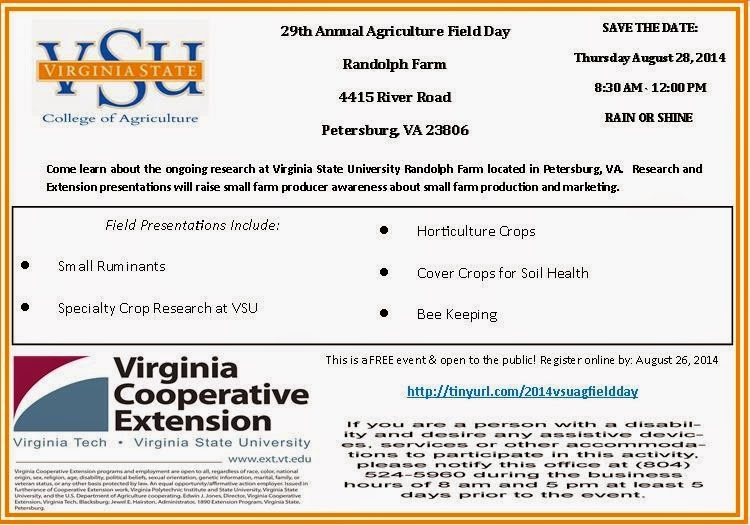
Come learn about the ongoing research at Virginia State University Randolph Farm located in Petersburg, VA.  Research and Extension presentations will raise small farm producer awareness about small farm production and marketing.
29th Annual Agriculture Field Day
Randolph Farm
4415 River Road
Petersburg, VA 23806
Thursday August 28, 2014
8:30 AM – 12:00 PM
RAIN OR SHINE
Field Presentations Include:
· Small Ruminants
· Specialty Crop Research at VSU
· Horticulture Crops
· Cover Crops for Soil Health
· Bee Keeping
This is a FREE event & open to the public! Register online by: August 26, 2014

Virginia on List of States with Most Farmers Markets

From WTOP:

The mantra, “buy local” is catching on as farmers markets become more abundant nationwide and Virginia is among the states experiencing the most growth.

Farmers markets are being celebrated as part of National Farmers Market Week, which goes from Aug. 3-9.

The number of farmers markets nationwide has increased a whopping 76 percent since 2008, according to the U.S. Department of Agriculture. There are more than 8,200 farmers markets around the country, according to the department.

Virginia is seeing big growth in the number of farmers markets, too. The commonwealth ranked ninth in the U.S. for its number of farmers markets, according to rankings released by the U.S. Department of Agriculture.

There are about 250 farmers markets in Virginia, but that number continues to grow, says Elaine Lidholm, director of communications for the Virginia Agriculture and Consumer Services Department.

It’s ahead of Missouri at No. 10 and trailing Wisconsin. The top three states are California, New York and Michigan. They are followed by Ohio, Illinois, Massachusetts and Pennsylvania.

“We are always happy to be in the top 10 and this year we’re No. 9,” says Lidholm.
Last year, Virginia came in at No. 9, too.

Considering the size of Virginia compared to some of the other big agricultural states, she says it makes the commonwealth’s ranking an even bigger deal.

Virginians are latching on to the mantra, “buy fresh, buy local,” says Lidholm. She says one reason behind the growth is that Virginians love their farmers markets.

“It says how much Virginians support farmers markets. Because we wouldn’t have them if they weren’t viable,” she says.

Other reasons for the success behind the large number of farmers markets in the commonwealth, she says is the diversity of products in Virginia from peaches to seafood and of course, the all-important direct farmer-to-consumer relationship.

Lidholm says while the ranking is great news for Virginia, the biggest winners are the customers who have more and more access to farm fresh products.

“The consumers are buying it literally hours after it’s been picked.”

Looking to start selling your products at a farmers’ market? Go here for some helpful advice from Modern Farmer: http://modernfarmer.com/2014/07/dos-donts-marketing-farmers-markets/

AFBF, PANE Release Immigration Reform Ad

The Partnership for a New American Economyand the American Farm Bureau Federation today released a new ad calling on Congress to pass immigration reform now. The ad features Bernie Thiel, a Texas farmer who has had to destroy some of his own crops for two years in a row because he has been unable to find the workers he needs to harvest.

The ad, which premiered today in Washington, D.C., taxis and airports, will play in the following locations:

  • Washington, D.C., taxis
  • Reagan National and Dulles International airports
  • Movie theatres in 16 key congressional districts
  • Rodeos in Idaho and Louisiana
  • State Fairs

“A farmer should never have to destroy a crop due to the lack of an adequate labor force,” said AFBF President Bob Stallman. “If that situation doesn’t illustrate the clear need for agricultural labor reform, I’m not sure what will. Ultimately, as a nation we will decide whether we import our labor or import our food. While our nation’s current political climate makes comprehensive reform a challenge, we are determined that ensuring an adequate farm workforce and securing our borders are compatible goals that are worthy of continued pursuit.”

Breaking News: Va. Farm Bureau Federation AgPAC Endorses Chafin in Special Election

2014 isn’t a normal election year but due to a number of resignations in the General Assembly special elections are being held in a number of seats. The members in the 38th Senate District called on the Virginia Farm Bureau AgPAC to evaluate the candidates and determine if an endorsement should be made in this important race. After candidates interviewed with local members of involved counties and made a recommendation to the VFBF AgPAC Board of Trustees the board issued an endorsement in the race.
Below is their endorsement. If you are a producer member interested in participating in future LEC interviews, please contact your county Farm Bureau president or Field Services Director for more information.

Virginia Farm Bureau Federation AgPAC has announced its endorsement of Del. A. Benton “Ben” Chafin Jr., R-Lebanon, in the special election for the Virginia Senate’s 38th District seat. 

Candidates who receive VFBF AgPAC endorsements “have demonstrated a clear understanding of the needs and challenges farmers are facing and/or have proven their support through their favorable voting records while holding positions in the General Assembly,” said Wayne F. Pryor, chairman of VFBF AgPAC and president of Virginia Farm Bureau. “We believe candidates such as Del. Chafin will help agriculture and forestry maintain its vitality as the No. 1 industry in Virginia.” 

The non-partisan VFBF AgPAC was created by Farm Bureau in 1999 and employs in-kind contributions to support candidates who can best support agriculture and Farm Bureau issues.

Franklin County Farm Bureau Receives Ag Literacy Mini-Grant

Franklin County Farm Bureau has received one of 11 $500 mini-grants from The American Farm Bureau Foundation for Agriculture. The grants are awarded through the Foundation’s White-Reinhardt Fund for Education program to communities across the nation.
The grants are allocated through county and state Farm Bureaus and are used to create new agricultural literacy projects or expand on existing agricultural literacy efforts.
Criteria for selecting winners included: the effectiveness of demonstrating a strong connection between agriculture and education; how successfully the project enhances learner engagement in today’s food, fiber, and fuel systems; and the processes and timelines for accomplishing project goals.

Franklin County won for its “What’s in the Garden?” project which educates pre-K-5 students on how food grows from soil to table through hands-on activities, interactive labs and age-appropriate printed materials.
“The mini-grant program was developed to help Farm Bureau members provide free tools to share with educators in their communities,” said Julie Tesch, executive director of the Foundation. “Our primary overall goal is to help teach young rural and urban students about the importance of agriculture and the vital role it plays in our everyday lives.” 

The White-Reinhardt Fund for Education is a project of the Foundation in cooperation with the American Farm Bureau’s Women’s Leadership Committee. The fund honors two former committee chairwomen, Berta White and Linda Reinhardt, who were trailblazers in early national efforts to expand the outreach of agricultural education and improve agricultural literacy.

Bills Address Farm Concerns with EPA ‘Waters’ Proposal


Three bills that have bipartisan support in Congress address serious concerns voiced by the American Farm Bureau Federation about the U.S. Environmental Protection Agency’s proposed “Waters of the U.S.” rule.

Issued earlier this year, the rule would give the EPA broad jurisdiction over dry land features and farming practices that historically has been relegated to individual states under the Clean Water Act.

H.R. 5078, the Waters of the United States Regulatory Overreach Protection Act of 2014, was introduced by Rep. Steve Southerland, R-Fla., and has been approved by the House Transportation and Infrastructure Committee. It would prohibit the EPA and the Army Corps of Engineers from implementing a rule that broadens the scope of the Clean Water Act and would effectively block the proposed “Waters of the U.S.” rule. The Senate version of this bill is S.2496.

A third bill addresses concerns about common farm practices that have been exempt from Clean Water Act regulation but could lose that status under the proposed rule.

In March the EPA and Army Corps of Engineers issued an interpretive rule to clarify how “Waters of the U.S.” would affect normal farming, ranching and forestry exemptions. AFBF analysis determined that the interpretive rule narrows the list of existing exemptions and would require compliance with otherwise voluntary U.S. Department of Agriculture Natural Resources Conservation Service standards. The proposal puts the USDA in the unprecedented position of enforcing Clean Water Act compliance.


Reps. Chris Collins, R-N.Y.; Bob Gibbs, R-Ohio; Frank Lucas, R-Okla.; Collin Peterson, D-Minn.; Reid Ribble, R-Wis.; Kurt Schrader, D-Ore.; and Glenn Thompson, R-Pa., have introduced H.R. 5071, The Agricultural Conservation Flexibility Act. The bill clarifies that existing Clean Water Act exemptions for normal farming, ranching and forestry apply to all conservation activities without regard to the interpretive rule. 

The bill further states that no soil and water conservation practices will be treated as new uses of areas of navigable waters, impairments of the flow of navigable waters or reductions in the reach of those waters under recapture provisions in Section 404 of the Clean Water Act. The bill also clarifies that normal farming, ranching and forestry activities will be treated as such without regard to their date of commencement.

The AFBF has assembled articles and analysis relevant to the proposed rule at ditchtherule.fb.org. The organization asserts that the EPA proposal exposes U.S. farmers and ranchers to potential fines and penalties for ordinary farming activities.

AFBF President Bob Stallman called the rule “an end-run around Congress and the Supreme Court. … If more people knew how regulators could use the proposed rule to require permits for common activities on dry land or penalize landowners for not getting them, they would be outraged.”


Please check your email for the latest action alert on these bills. If you are a producer member and would like to start receiving action alerts, contact Kelly Pruitt at 804-290-1293 or kprui@vafb.com.  

AFBF President’s Bob Stallman Reports on Ditch the Rule in Ag Agenda Column

AFBF President
Bob Stallman
Americans expect straight talk from their government. If our government says something, you ought to be able to take it to the bank, as the saying goes.

The Environmental Protection Agency is not meeting that expectation. Instead of making things clear when it comes to how the proposed “Waters of the U.S.” rule would affect farmers and other landowners, the EPA is muddying the waters.

It’s Complicated
Two Supreme Court rulings have limited EPA’s and the Corps of Engineers’ authority under the Clean Water Act to waters that are navigable or have a “significant nexus” to navigable waters. EPA claims the rulings “complicated” the permitting process. The reality is not all that complicated: The agencies dislike the rulings and are simply trying to write regulations that allow them to do what the Supreme Court has said they cannot do—regulate nearly all waters.

EPA has said that it only wants to bring “clarity and consistency” to the process. That sounds reasonable. Good talking point. The only problem is the statement does not reflect what is in the proposed rule. The regulation will automatically regulate countless small and remote so-called “waters” that are usually dry and, in fact, look like land to you and me. This is far more than a “clarification.” It is a dramatic expansion of federal power. Expanding the federal government’s jurisdiction under the guise of bringing clarity and consistency to the process is the opposite of straight talk.

We Read the Fine Print
When regulators show up on farms and ranches, they won’t be looking back at talking points to decide whether farming requires an expensive federal permit. They will use the regulation. So let’s take a look at the fine print.

Ditches—The rule regulates ditches as “tributaries.” EPA claims that the rule would exclude ditches, but the so-called ditch exclusion only covers ditches dug entirely in “uplands.” The rule doesn’t define “uplands” (so much for clarity), but we know that uplands are not wetlands, and most ditches are “wetland” at some point along their length. That’s just one reason Farm Bureau believes the narrow ditch “exclusion” will be meaningless.

Farming exemptions—EPA offers assurances that all farming and ranching exemptions are being preserved under the rule. But those exemptions are extremely limited when it comes to activities in jurisdictional waters. That’s why the exemptions will not protect most ordinary farming and ranching from permit requirements if ditches and low spots in farm fields are regulated, as they will be under the proposed rule.

Under the rule, federal permits would be needed for common farming activities such as applying fertilizer or pesticides, or moving cattle, if materials that are considered pollutants would fall into regulated low spots or ditches. Farmers can’t wait for federal permits to fertilize or protect their crops from pests and diseases. Permits also would be required for activities such as plowing, planting and fencing in these new “waters of the U.S.” unless a farmer has been farming the same land for decades, raising hurdles for beginning farmers.

Landowners could be in for a rude awakening—faced with penalties or lawsuits for the very things EPA says the rule doesn’t cover. Farm Bureau is dedicated to preventing that from happening, and we thank those leaders in the House and Senate who, in a bipartisan manner, are standing up for farmers and other landowners.

We hope EPA officials will read the fine print. We have, and that’s how we know it’s time to Ditch the Rule!