Uncategorized
Trade Speakers Touched on Factors that can Enhance, Block Exports
The conference was held March 7 and 8.
Ambassador Darci Vetter, chief agricultural negotiator in the Office of the U.S. Trade Representative, outlined benefits of U.S. participation in the Trans-Pacific Partnership.
The TPP is an agreement among the U.S. and Australia, Brunei, Canada, Chile, Japan, Malaysia, Mexico, New Zealand, Peru, Singapore and Vietnam. Its implementation has been a goal of the Obama administration.
Vetter said the TPP will foster “unprecedented access to the region that will support two-thirds of the world’s middle class by 2030.” That’s important from an agricultural standpoint, she noted, because “when people enter the middle class they change the way they eat,” purchasing more fresh fruits and vegetables and more proteins.
Vetter said TPP participation will afford U.S. exporters “trade liberalization for every agricultural product, without exception.” For example, she said, Brunei, Japan, Malaysia, New Zealand and Vietnam would eliminate duties on 93 percent of all ag tariff lines, and 70 percent of those tariff lines would be eliminated immediately.
The American Farm Bureau Federation has estimated that net exports of U.S. soybeans and grain products will increase in value by $297 million when the TPP is fully implemented, and net dairy exports will increase by $131 million.
The agreement also stands to raise trade standards related to sanitary and phytosanitary issues, intellectual property, labor and human rights and environmental issues.
Failure by Congress to approve TPP participation presents a significant risk, Vetter said. “The rest of the world is continuing to move. These countries will continue to negotiate preferential agreements with each other.”
Ray Owens, senior economist and research advisor for the Federal Reserve Bank of Richmond, called the U.S. economy “relatively solid” but noted that in election-year rhetoric “we continually hear there’s something really broken in our economy.”
All things considered, “we at the Federal Reserve think this is about as fast as the economy can grow,” he said. The Richmond Fed serves the Fifth Federal Reserve District, which consists of Maryland, the District of Columbia, Virginia, North Carolina, South Carolina and most of West Virginia.
If globalization yields rising incomes, and if global economic policy is well-run, Owens said, the U.S. stands to benefit. But it is important to adapt quickly to rapid international developments. “We have to keep a much sharper eye, be much more agile, be quicker on our feet.”
Dr. John Clifford, deputy administrator and chief veterinary officer for the U.S. Department of Agriculture’s Animal & Plant Health Inspection Service, told conference participants that trade interruptions related to animal health issues can be lasting ones.
In 2003, he reminded them, officials confirmed a single case of bovine spongiform encephalopathy in a cow of Canadian origin that was in the United States. It resulted in numerous bans on U.S. beef, and “we are still, today, trying to gain some of those markets back,” Clifford said.
An outbreak in 2014 and 2015 of avian influenza in commercial turkey flocks in the Midwest had a similar result on poultry and egg exports. Jim Sumner, president of the USA Poultry and Egg Export Council, said the outbreak and unrelated economic conditions formed the “perfect storm” for exports.
“About 18 countries banned U.S. poultry,” he said. “Fortunately some of those have lifted their restrictions,” though challenges still remain in major markets like China, South Korea, Mexico and Russia.
Virginia’s 2015 Agricultural Exports Valued at $3.19 Billion
Gov. Terry McAuliffe noted on March 7 that the decrease “is in (market) value, not in volume” and noted that the value of ag exports to Virginia’s top trading partners increased last year.
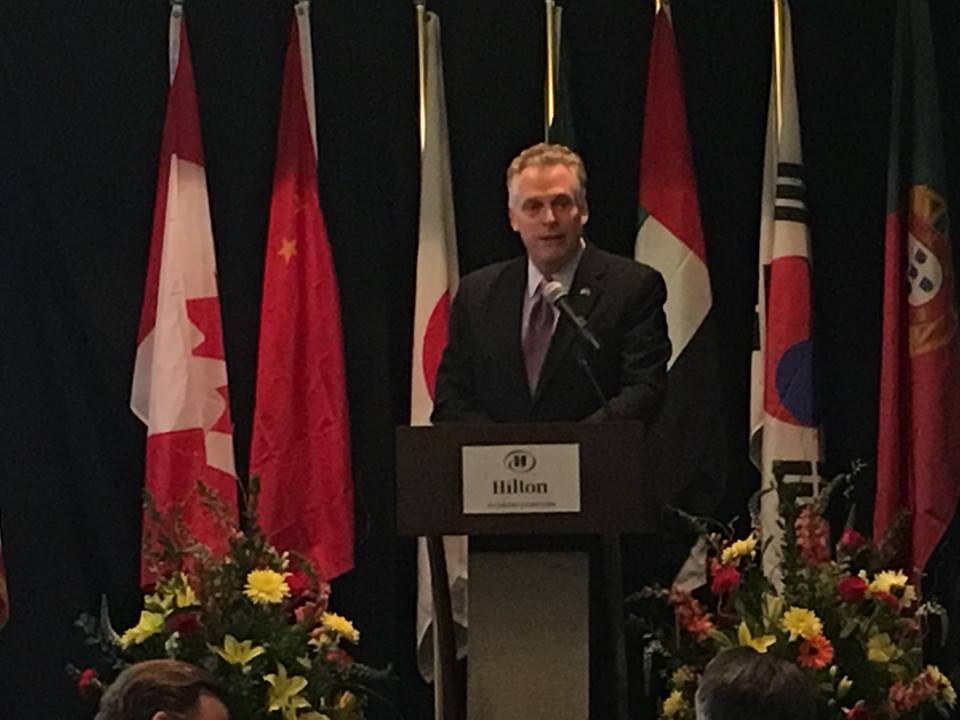
McAuliffe spoke at the opening luncheon of the eighth annual Governor’s Conference on Agricultural Trade, announcing that Virginia has strengthened its position as the second-largest exporter of agricultural goods on the East Coast and narrowed the gap between the commonwealth and first-ranked Georgia.
Virginia agricultural exports reached an all-time high of $3.35 billion in 2014, the fourth consecutive year in which those exports set a record. Nationwide, ag exports were affected last year by depressed commodity prices; decreased shipments to certain regions due to prohibitive shipping costs; new trade bans; and various geopolitical challenges.
“Despite the global headwinds we faced this year, we will continue building the infrastructure to increase exports, and the new resources for that effort that I placed in my proposed budget … will help the cause,” McAuliffe said.
The governor told conference participants that he and his staff took part in 13 trade missions last year. “Ninety-five percent of the world’s customers live outside of America. So you have to go where the customers are.”
In spite of a challenging global marketplace, “Virginia continues to be a leader in promoting agricultural exports, which have grown in value by 42 percent since 2010 when we launched a strategic initiative to increase shipments of these products,” said Todd Haymore, secretary of agriculture and forestry.
The top three export markets for Virginia in 2015 were China, Canada and Switzerland; all have held those spots since 2013. China imported more than $694 million in agricultural purchases, while Canada imported just over $291 million and Switzerland took in about $204 million. The value of exports to China and Canada increased by 1.4 and 4.3 percent, respectively, over 2014 levels, while those to Switzerland increased by 17 percent.
The remainder of Virginia’s top 10 export markets, along with the values shipped, are Mexico, $179 million; Japan, $175 million; United Kingdom, $134 million; Morocco, $103 million; Republic of Korea, $94 million; Taiwan, $90 million; and Indonesia, $70 million. All countries saw increases in value since 2014 except Indonesia.
Top agricultural and forestry exports from Virginia in 2015 included soybeans; pork; lumber and logs; soybean meal; leaf tobacco; processed foods and beverages, including wine, craft beer and distilled spirits; wood pellets and chips; poultry; soybean oil; wheat; animal feed; corn; raw peanuts; seafood and other marine products; and cotton.
The Governor’s Conference on Agricultural Trade was co-hosted by the Virginia Farm Bureau Federation, the Virginia Department of Agriculture and Consumer Services, the Virginia Port Authority and Virginia Tech’s Department of Agricultural and Applied Economics.
Save RFD-TV!
Click on the link below to submit comments to the FCC urging Verizon to bring back RFD-TV to their channel line-up.
http://www.rfdtv.com/story/31286442/submit-your-comments-to-the-fcc
This Week’s Commodity Comments: March 2, 2016
Supreme Court Will Not Examine Lawfulness of EPA’s Bay ‘Blueprint’
“EPA has asserted the power to sit as a federal zoning board, dictating which land can be farmed and where homes, roads and schools can be built,” Duvall said. “We remain firm in opposing this unlawful expansion of EPA’s power.” Duvall said Farm Bureau will closely monitor the agency’s actions in connection with the Bay blueprint, as well as any efforts to impose similar mandates in other areas.
“This lawsuit has ended, but the larger battle over the scope of EPA’s power is not over,” Duvall said.
Farmers to Learn about Communicating at Inaugural Farming Leaders Conference
Consumers are asking questions about farms and food, and sometimes the farmer’s voice isn’t heard.
To better prepare farmers to communicate with the public, several organizations will host a Farming Leaders Conference March 19 at Blue Ridge Community College. The conference is sponsored by the Farm Credit Knowledge Center, Farm Credit of the Virginias, Rockingham County Farm Bureau and the Rockingham Farm Bureau Young Farmers and Ranchers Committee.
The agenda will cover communication styles, modern communication issues and positive media interaction. “The goal of the conference is to prepare those involved in the agriculture community for formal and informal interactions with consumers regarding food and farming,” said Jesse Martin, producer of On the Farm Radio and an organizer of the event.
Presenters include Martin; Dr. Alex White, a dairy science professor at Virginia Tech; Lauren Arbogast, an agriculture lifestyle blogger; Matt Lohr, director of the Farm Credit Knowledge Center; and a team of communicators from the Virginia Farm Bureau Federation.
The conference is open to anyone. Registration is $15, and space is limited. Register online at farmingleaders.com.
This Week’s Commodity Comments: February 17, 2016
Virginia is Top State for Agricultural Exports to Cuba
Farmers’ Input Sought for Survey on USDA Programs
Take the survey online through March 15 at http://usdaprograms.questionpro.com/.