Some farm-use vehicles required to display new tag by July 1 

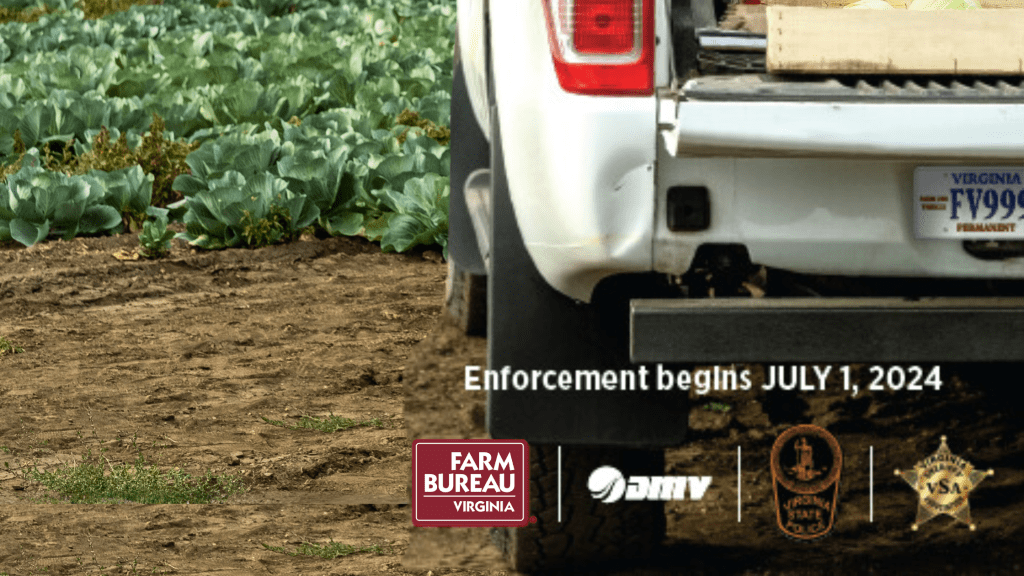
DMV-issued permanent farm use placards are required for unregistered farm use panel trucks, pickup trucks and sport utility vehicles with a gross vehicle weight rating (GVWR) of less than or equal to 7,500 pounds beginning July 1, 2024. DMV issued placards must be displayed in front and rear of vehicles at all times. Trailers, semitrailers, and vehicles with a GVWR of greater than 7,500 pounds must only display the traditional red and white farm use tag if operating under the exemption. This requirement is a result of legislation passed by the 2023 General Assembly to cut down on abuses by the non-farming community and to clarify the program.  

Placards are $15 per vehicle and are valid for the vehicle’s lifetime but are not transferable. Vehicles claiming the exemption must be titled. If a title is needed, a separate $15 titling fee will be imposed. Applications for the permanent farm use placard are available at https://tinyurl.com/dmvfarmuse

The Basics: Permanent Farm Use Placards 

No vehicle inspection required. § 46.2-1157 only vehicles requiring inspection are registered vehicles. 

Must have liability insurance. § 46.2-684.1. any motor vehicle, trailer, or semi-trailer that is exempt from motor vehicle registration requirements (like farm use vehicles), must be insured under a general liability policy that includes personal injury liability insurance and property damage liability insurance under a motor vehicle insurance policy or an umbrella or excess insurance policy. 

Maximum distance allowance of up to 75 miles or to a storage house, packing plant, market, or between your tracts of land. While operating a farm use vehicle, a farmer may stop for a meal or dispose of incidental trash from their or an employee’s home and trash generated on the farm. 

Required to have a title. However, if a title is needed, there will be a separate $15 titling fee and no sales or use tax will be imposed if purchasing a permanent placard. 

DMV and DMV Select. The application is available at DMV, or online at the DMV’s website. Print and mail-in options are available. 

Items needed for application 

The permanent placards are valid for the lifetime of the vehicle, but are not transferable. 

  • $15 application fee per vehicle 
  • Name of owner or lessee of vehicle 
  • Approximate farm location and acreage where the vehicle is used; type of agricultural commodities produced on the farm 
  • Title for each vehicle requiring placard, or, if title is needed, an additional $15 titling fee per vehicle 
  • Statements signed by owner or lessee that the vehicle will only be used for the purposes allowed under the Farm Use Exemption AND that the vehicle is an insured. TIP: It might be helpful to bring your insurance policy with you. 

For more information, please see the following documents: 

Expansion of High-Tech Indoor Farm in Prince William County 

Gov. Glenn Youngkin signs CEA legislation and announces expansion of high-tech indoor farm in Prince William County on June 6, 2024. Photo by Christian Martinez, Office of Gov. Glenn Youngkin.

Beanstalk Farms Inc. will build its second indoor farm and distribution facility in the Freedom I-66 Industrial Business Park in Manassas. The project includes 18 new jobs and a capital investment of $4.1 million. Beanstalk Farms expects to produce 2.1 million pounds annually of leafy greens and fresh-cut herbs. 

Following the announcement of the expansion, Gov. Youngkin signed House Bill 1429 and Senate Bill 483, which clarifies that the existing classification of farm machinery includes CEA machinery, allowing localities to exempt equipment from personal property taxes, or adopt a reduced tax rate. The same exemption provisions already exist for traditional agricultural operations. The legislation was patroned by Senator Lashrecse Aird, Senate District 13, and Delegate Amy Laufer, House District 55. This is the second year that Youngkin has signed agricultural technology tax exemption legislation. In 2023, legislation was signed to exempt items used in the construction of controlled environment agriculture facilities from sales taxes. 

“Congratulations to Beanstalk Farms for their investment in this community and in Virginia. I am pleased that the Commonwealth’s pro-business climate and partnerships continue to be a factor in securing and scaling up projects such as this,” said Gov. Glenn Youngkin. “The legislation I signed today reinforces Virginia’s position as a top state for the controlled environment agriculture industry.”

The Virginia Department of Agriculture and Consumer Services worked with Prince William County, the Prince William County Department of Economic Development and Tourism and the Industrial Development Authority of the County of Prince William to secure this new expansion project. Youngkin approved a $100,000 grant from the Governor’s Agriculture and Forestry Industries Development Fund, which Prince William County will match with local funds.  

“This is a great day for the future of controlled environment agriculture in Virginia. We are providing support for Beanstalk Farms expansion, encouraging investment in Prince William County, and creating high paying jobs to this area through the Governor’s Agriculture and Forestry Industries Development Fund grant award. In addition, Governor Youngkin is helping to spur growth in this industry by expanding tax relief through the approval of the agricultural sales tax exemption legislation last year and his signature today on the tangible personal property tax relief legislation,” said Secretary of Agriculture and Forestry Matthew Lohr. 

Cattle Pulse: Is Beef for Dinner?

CattlePulse is a monthly update from Virginia Farm Bureau on the Virginia feeder cattle markets, the national trends that affect them and stories of cattle producers across the commonwealth.

The host, Virginia Farm Bureau’s Elijah Griles, covers economics, market trends and stories about Virginia’s cattle industry from across the Commonwealth. CattlePulse is the home for regular market updates about Virginia feeder cattle sales, timely and relevant production advancements, and interviews with producers and industry professionals.  

This month’s episode details national beef demand expectations as summer grilling season arrives, regional feeder steer price comparisons, and another new Virginia monthly average price record. Do you have questions, comments or suggestions for Elijah? Contact us at 804-290-1713 or elijah.griles@vafb.com.

Listen to the latest episode

Consumer Demand Counts CattlePulse

In this month’s episode of CattlePulse, host Elijah Griles unpacks the factors behind the recent futures contract dip, looks at how consumer demand is holding up to record high retail prices, and highlights another month of record high feeder calf prices.We want to hear from you!Have a question or a topic you'd like us to cover in a future episode?Email Elijah at elijah.griles@vafb.com.
  1. Consumer Demand Counts
  2. Virginia Heifers Heat Up Despite Statewide Freeze
  3. New Year's Reflections
  4. 'Tis the Season for Seasonal Trends?
  5. Beef Imports & Market Mayhem

Cattle Pulse: Records Are Made To Be Broken

CattlePulse is a monthly update from Virginia Farm Bureau on the Virginia feeder cattle markets, the national trends that affect them and stories of cattle producers across the commonwealth.

The host, Virginia Farm Bureau’s Elijah Griles, covers economics, market trends and stories about Virginia’s cattle industry from across the Commonwealth. CattlePulse is the home for regular market updates about Virginia feeder cattle sales, timely and relevant production advancements, and interviews with producers and industry professionals.  

Listen to the latest episode

Consumer Demand Counts CattlePulse

In this month’s episode of CattlePulse, host Elijah Griles unpacks the factors behind the recent futures contract dip, looks at how consumer demand is holding up to record high retail prices, and highlights another month of record high feeder calf prices.We want to hear from you!Have a question or a topic you'd like us to cover in a future episode?Email Elijah at elijah.griles@vafb.com.
  1. Consumer Demand Counts
  2. Virginia Heifers Heat Up Despite Statewide Freeze
  3. New Year's Reflections
  4. 'Tis the Season for Seasonal Trends?
  5. Beef Imports & Market Mayhem

Virginia to offer nutrient management training in June

The Virginia Department of Conservation and Recreation will offer a two-part agriculture nutrient management training in June. The training is for anyone interested in learning about the development of agricultural nutrient management plans or how to become a certified plan writer.

The first session, June 11-12, is a lecture series by Virginia Tech professors on soil science, soil fertility and crop production. This is a virtual course hosted through Microsoft Teams and will run from 9 a.m.-4:30 p.m. each day. Registration is $150 with a deadline of June 3.

The second session, June 25-27, will cover nutrient management plan writing using a case-study farm. The training will be held in the Bioscience Building of Blue Ridge Community College in Weyers Cave. Each day will run from 9 a.m. until 4:30 p.m. Registration is $150 with a deadline of June 17.

Nutrient management continues to be an important factor in a farmer’s decision-making process when considering application of materials to supply nutrients to crops and forages. Nutrient management plans determine rates for applying manure, fertilizers, biosolids and other soil amendments so that yields are maximized, and nutrient loss to ground and surface waters is minimized. Application rates are determined by a process using actual yield records or soil productivity when yield records aren’t available.

To register and for more information on nutrient management certification please visit www.dcr.virginia.gov/nmtrain.

Dairy Producers in Virginia Reminded to Enroll in 2024 Dairy Margin Coverage by April 29  

The U.S. Department of Agriculture (USDA) is encouraging dairy producers to enroll by April 29, 2024, for 2024 Dairy Margin Coverage (DMC), an important safety net program that helps offset milk and feed price differences. This year’s DMC signup began Feb. 28, 2024, and payments, retroactive to January, began in March 2024. So far, DMC payments triggered in January and February of 2024 at margins of $8.48 and $9.44 respectively.   

2024 DMC Coverage and Premium Fees   

FSA revised DMC regulations to extend coverage for calendar year 2024, which is retroactive to Jan. 1, 2024, and to provide an adjustment to the production history for dairy operations with less than 5 million pounds of production. In previous years, smaller dairy operations could establish a supplemental production history and receive Supplemental Dairy Margin Coverage.

For 2024, dairy producers can establish one adjusted base production history through DMC for each participating dairy operation to better reflect the operation’s current production.  

For 2024 DMC enrollment, dairy operations that established supplemental production history through Supplemental Dairy Margin Coverage for coverage years 2021 through 2023, will combine the supplemental production history with established production history for one adjusted base production history.    

For dairy operations enrolled in 2023 DMC under a multi-year lock-in contract, lock-in eligibility will be extended until Dec. 31, 2024. In addition, dairy operations enrolled in multi-year lock-in contracts are eligible for the discounted DMC premium rate during the 2024 coverage year. To confirm 2024 DMC lock-in coverage or opt out in favor of an annual contract for 2024, dairy operations having lock-in contracts must enroll during the 2024 DMC enrollment period.        

DMC offers different levels of coverage, even an option that is free to producers, minus a $100 administrative fee. The administrative fee is waived for dairy producers who are considered limited resource, beginning, socially disadvantaged or a military veteran. To determine the appropriate level of DMC coverage for a specific dairy operation, producers can use the online dairy decision tool.    

Congress passed a 2018 Farm Bill extension requiring these regulatory changes to the program. DMC is also authorized through calendar year 2024. 

DMC Payments   

DMC payments are calculated using updated feed and premium hay costs, making the program more reflective of actual dairy producer expenses.  These updated feed calculations use 100% premium alfalfa hay.    

More Information  

DMC is a voluntary risk management program providing protection to dairy producers when the difference between the all-milk price and the average feed price (the margin) falls below a certain dollar amount selected by the producer.  In 2023, DMC payments triggered in 11 months including two months, June and July, where the margin fell below the catastrophic level of $4.00 per hundredweight, a first for DMC or its predecessor Margin Protection Program. 

USDA also offers other risk management tools for dairy producers, including the Dairy Revenue Protection (DRP) plan that protects against a decline in milk revenue (yield and price) and the Livestock Gross Margin (LGM) plan, which provides protection against the loss of the market value of milk minus the feed costs. Both DRP and LGM livestock insurance policies are offered through the Risk Management Agency. Producers should contact their local crop insurance agent for more information.   

For more information on DMC, visit the DMC webpage or contact your local USDA Service Center.