Farmers Will Benefit from Restored Balance of Power

On January 17, the Supreme Court heard oral arguments in two cases that sought to overturn Chevron deference: Relentless v. Dept. of Commerce and Loper Bright Enterprises v. Raimondo. On June 28, the U.S. Supreme Court struck down Chevron deference, which is a judge-made rule that allows federal agencies—not courts—to decide the meaning of federal statutes. If a statute is ambiguous (or even silent), the agency could to decide what it meant. The doctrine was created by the Supreme Court 40 years ago in a case called Chevron v. Natural Resources Defense Council.

“Farm Bureau applauds the U.S. Supreme Court for recognizing the damage Chevron deference has caused to the federal government’s balance of power. For decades, Congress has passed vague laws and left it to federal agencies and the courts to figure out how to implement them,” said American Farm Bureau Federation (AFBF) president Zippy Duvall. “AFBF has been a leading voice on this issue and has argued on behalf of farmers who are caught in a regulatory back and forth when administrations change the rules based on political priorities instead of relying on the legislative process. We are pleased the Court heard those concerns.”

“The Constitution built a system of checks and balances among three branches of government, to prevent any one branch from becoming too powerful. The legislative branch creates the laws, the executive branch enforces the laws, and the judicial branch interprets the laws. Chevron deference created a super-branch of government. The Supreme Court restored balance with today’s decision.”

Some farm-use vehicles required to display new tag by July 1 

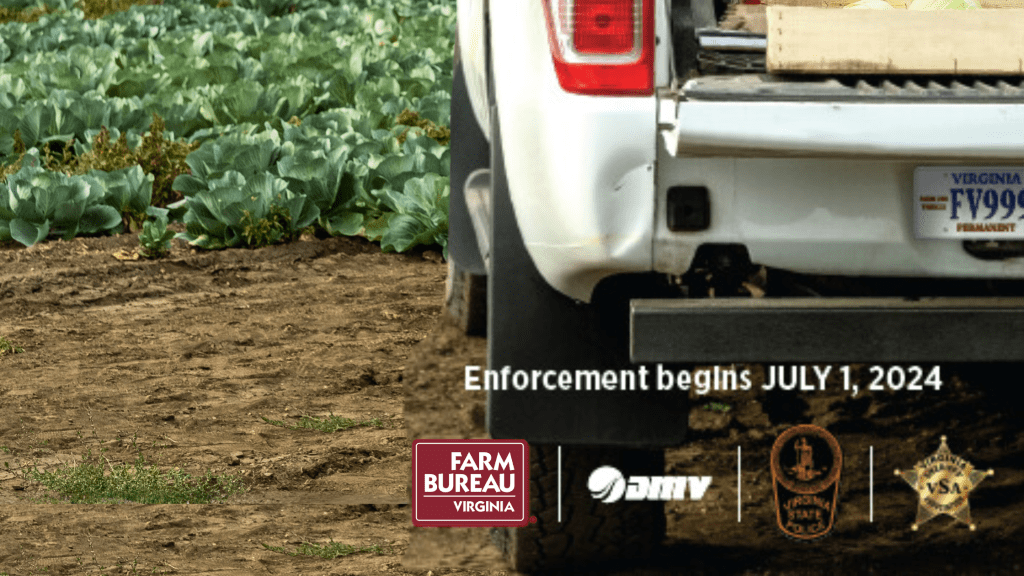
DMV-issued permanent farm use placards are required for unregistered farm use panel trucks, pickup trucks and sport utility vehicles with a gross vehicle weight rating (GVWR) of less than or equal to 7,500 pounds beginning July 1, 2024. DMV issued placards must be displayed in front and rear of vehicles at all times. Trailers, semitrailers, and vehicles with a GVWR of greater than 7,500 pounds must only display the traditional red and white farm use tag if operating under the exemption. This requirement is a result of legislation passed by the 2023 General Assembly to cut down on abuses by the non-farming community and to clarify the program.  

Placards are $15 per vehicle and are valid for the vehicle’s lifetime but are not transferable. Vehicles claiming the exemption must be titled. If a title is needed, a separate $15 titling fee will be imposed. Applications for the permanent farm use placard are available at https://tinyurl.com/dmvfarmuse. 

The Basics: Permanent Farm Use Placards 

No vehicle inspection required. § 46.2-1157 only vehicles requiring inspection are registered vehicles. 

Must have liability insurance. § 46.2-684.1. any motor vehicle, trailer, or semi-trailer that is exempt from motor vehicle registration requirements (like farm use vehicles), must be insured under a general liability policy that includes personal injury liability insurance and property damage liability insurance under a motor vehicle insurance policy or an umbrella or excess insurance policy. 

Maximum distance allowance of up to 75 miles or to a storage house, packing plant, market, or between your tracts of land. While operating a farm use vehicle, a farmer may stop for a meal or dispose of incidental trash from their or an employee’s home and trash generated on the farm. 

Required to have a title. However, if a title is needed, there will be a separate $15 titling fee and no sales or use tax will be imposed if purchasing a permanent placard. 

DMV and DMV Select. The application is available at DMV, or online at the DMV’s website. Print and mail-in options are available. 

Items needed for application 

The permanent placards are valid for the lifetime of the vehicle, but are not transferable. 

  • $15 application fee per vehicle 
  • Name of owner or lessee of vehicle 
  • Approximate farm location and acreage where the vehicle is used; type of agricultural commodities produced on the farm 
  • Title for each vehicle requiring placard, or, if title is needed, an additional $15 titling fee per vehicle 
  • Statements signed by owner or lessee that the vehicle will only be used for the purposes allowed under the Farm Use Exemption AND that the vehicle is an insured. TIP: It might be helpful to bring your insurance policy with you. 

For more information, please see the following documents: 

Expansion of High-Tech Indoor Farm in Prince William County 

Gov. Glenn Youngkin signs CEA legislation and announces expansion of high-tech indoor farm in Prince William County on June 6, 2024. Photo by Christian Martinez, Office of Gov. Glenn Youngkin.

Beanstalk Farms Inc. will build its second indoor farm and distribution facility in the Freedom I-66 Industrial Business Park in Manassas. The project includes 18 new jobs and a capital investment of $4.1 million. Beanstalk Farms expects to produce 2.1 million pounds annually of leafy greens and fresh-cut herbs. 

Following the announcement of the expansion, Gov. Youngkin signed House Bill 1429 and Senate Bill 483, which clarifies that the existing classification of farm machinery includes CEA machinery, allowing localities to exempt equipment from personal property taxes, or adopt a reduced tax rate. The same exemption provisions already exist for traditional agricultural operations. The legislation was patroned by Senator Lashrecse Aird, Senate District 13, and Delegate Amy Laufer, House District 55. This is the second year that Youngkin has signed agricultural technology tax exemption legislation. In 2023, legislation was signed to exempt items used in the construction of controlled environment agriculture facilities from sales taxes. 

“Congratulations to Beanstalk Farms for their investment in this community and in Virginia. I am pleased that the Commonwealth’s pro-business climate and partnerships continue to be a factor in securing and scaling up projects such as this,” said Gov. Glenn Youngkin. “The legislation I signed today reinforces Virginia’s position as a top state for the controlled environment agriculture industry.”

The Virginia Department of Agriculture and Consumer Services worked with Prince William County, the Prince William County Department of Economic Development and Tourism and the Industrial Development Authority of the County of Prince William to secure this new expansion project. Youngkin approved a $100,000 grant from the Governor’s Agriculture and Forestry Industries Development Fund, which Prince William County will match with local funds.  

“This is a great day for the future of controlled environment agriculture in Virginia. We are providing support for Beanstalk Farms expansion, encouraging investment in Prince William County, and creating high paying jobs to this area through the Governor’s Agriculture and Forestry Industries Development Fund grant award. In addition, Governor Youngkin is helping to spur growth in this industry by expanding tax relief through the approval of the agricultural sales tax exemption legislation last year and his signature today on the tangible personal property tax relief legislation,” said Secretary of Agriculture and Forestry Matthew Lohr. 

Cattle Pulse: Is Beef for Dinner?

CattlePulse is a monthly update from Virginia Farm Bureau on the Virginia feeder cattle markets, the national trends that affect them and stories of cattle producers across the commonwealth.

The host, Virginia Farm Bureau’s Elijah Griles, covers economics, market trends and stories about Virginia’s cattle industry from across the Commonwealth. CattlePulse is the home for regular market updates about Virginia feeder cattle sales, timely and relevant production advancements, and interviews with producers and industry professionals.  

This month’s episode details national beef demand expectations as summer grilling season arrives, regional feeder steer price comparisons, and another new Virginia monthly average price record. Do you have questions, comments or suggestions for Elijah? Contact us at 804-290-1713 or elijah.griles@vafb.com.

Listen to the latest episode

Rebuilding the Herd? Markets, Mexico & Theileria – CattlePulse

This month on CattlePulse, host Elijah Griles breaks down the latest cattle market developments, including the first signs of herd rebuilding in years, USDA's plan to reopen the Mexican border to feeder cattle imports, and what declining beef prices could mean for demand. Plus, Elijah talks with Dr. Alan Young of Medgene about the Asian longhorned tick and a new vaccine designed to combat Theileria orientalis Ikeda.In this episode:Feeder cattle futures softened in July, with the August contract at $353/cwt. and September at $348/cwt., down 2% and 3% month-over-month, respectivelyThe July Cattle Inventory Report showed total U.S. cattle inventory at 94.2 million head, up 200,000 head from last year and marking the first July inventory increase since 2018Beef cow numbers were estimated at 28.5 million head, the lowest July total since the report began in 1973Beef replacement heifers increased 3% year-over-year to 3.8 million head, providing the first meaningful evidence of heifer retention and potential herd rebuilding in nearly a decadeDespite signs of expansion, the 2026 calf crop was estimated at just 32.5 million head, down 2% from last year and the smallest calf crop on recordUSDA announced a phased reopening of the U.S.-Mexico border to feeder cattle imports beginning August 24 at Douglas, Arizona, following more than a year of closure due to New World Screwworm concernsA new sterile male screwworm fly production facility in Mexico is expected to strengthen long-term eradication effortsBoxed beef prices have declined roughly 10% since July 4th, raising questions about whether beef demand is beginning to soften beyond the typical post-holiday seasonal slowdownDr. Alan Young explains how the invasive Asian longhorned tick spreads Theileria orientalis Ikeda and why the parasite poses a growing threat to cattle healthTheileria infection can suppress the immune system, cause anemia, reduce fertility, lower performance, and increase susceptibility to secondary infectionsMedgene recently introduced the first U.S. vaccine targeting Theileria orientalis IkedaThe vaccine is designed primarily for naïve calves and is most effective as part of a whole-herd health strategyVaccination currently requires a two-dose series administered three to four weeks apart, with future boosters likely needed to maintain protectionProducers interested in the vaccine should consult their veterinarian, as it is available by prescriptionMedgene Disclaimer: Potency and efficacy of prescription platform product biologics have not been established. This product is prepared for use only by a veterinarian prescription. Medgene’s prescription platform system ensures that all the ingredients that go into our vaccines are animal origin free.Resources mentioned:USDA July Cattle Inventory ReportUSDA APHIS New World Screwworm UpdatesMedgene LabsVirginia weather and markets:Drought conditions improved modestly across parts of Virginia, with 11% of the state now drought-freeSevere drought remains across portions of the Blue Ridge, Northern Virginia, and Southside, while 4% of the state remains in extreme droughtNOAA's August outlook calls for near-normal precipitation and a 33-40% chance of above-normal temperaturesVirginia's six-market average for 500-pound feeder steers was $427.92/cwt. in July, down 6% from June but still 16% above year-ago levelsPersonal note:There will be no September episode of CattlePulse as Elijah takes paternity leave to welcome his first child. The show will return in October.Have a question or topic suggestion?CattlePulse is produced by Virginia Farm Bureau. Email Elijah at elijah.griles@vafb.com.
  1. Rebuilding the Herd? Markets, Mexico & Theileria
  2. Road Trip to Beef Cattle U
  3. The Screwworm Is Back
  4. Enjoy It While It Lasts
  5. Fertilizer Prices and Product of the USA

Cattle Pulse: Records Are Made To Be Broken

CattlePulse is a monthly update from Virginia Farm Bureau on the Virginia feeder cattle markets, the national trends that affect them and stories of cattle producers across the commonwealth.

The host, Virginia Farm Bureau’s Elijah Griles, covers economics, market trends and stories about Virginia’s cattle industry from across the Commonwealth. CattlePulse is the home for regular market updates about Virginia feeder cattle sales, timely and relevant production advancements, and interviews with producers and industry professionals.  

Listen to the latest episode

Rebuilding the Herd? Markets, Mexico & Theileria – CattlePulse

This month on CattlePulse, host Elijah Griles breaks down the latest cattle market developments, including the first signs of herd rebuilding in years, USDA's plan to reopen the Mexican border to feeder cattle imports, and what declining beef prices could mean for demand. Plus, Elijah talks with Dr. Alan Young of Medgene about the Asian longhorned tick and a new vaccine designed to combat Theileria orientalis Ikeda.In this episode:Feeder cattle futures softened in July, with the August contract at $353/cwt. and September at $348/cwt., down 2% and 3% month-over-month, respectivelyThe July Cattle Inventory Report showed total U.S. cattle inventory at 94.2 million head, up 200,000 head from last year and marking the first July inventory increase since 2018Beef cow numbers were estimated at 28.5 million head, the lowest July total since the report began in 1973Beef replacement heifers increased 3% year-over-year to 3.8 million head, providing the first meaningful evidence of heifer retention and potential herd rebuilding in nearly a decadeDespite signs of expansion, the 2026 calf crop was estimated at just 32.5 million head, down 2% from last year and the smallest calf crop on recordUSDA announced a phased reopening of the U.S.-Mexico border to feeder cattle imports beginning August 24 at Douglas, Arizona, following more than a year of closure due to New World Screwworm concernsA new sterile male screwworm fly production facility in Mexico is expected to strengthen long-term eradication effortsBoxed beef prices have declined roughly 10% since July 4th, raising questions about whether beef demand is beginning to soften beyond the typical post-holiday seasonal slowdownDr. Alan Young explains how the invasive Asian longhorned tick spreads Theileria orientalis Ikeda and why the parasite poses a growing threat to cattle healthTheileria infection can suppress the immune system, cause anemia, reduce fertility, lower performance, and increase susceptibility to secondary infectionsMedgene recently introduced the first U.S. vaccine targeting Theileria orientalis IkedaThe vaccine is designed primarily for naïve calves and is most effective as part of a whole-herd health strategyVaccination currently requires a two-dose series administered three to four weeks apart, with future boosters likely needed to maintain protectionProducers interested in the vaccine should consult their veterinarian, as it is available by prescriptionMedgene Disclaimer: Potency and efficacy of prescription platform product biologics have not been established. This product is prepared for use only by a veterinarian prescription. Medgene’s prescription platform system ensures that all the ingredients that go into our vaccines are animal origin free.Resources mentioned:USDA July Cattle Inventory ReportUSDA APHIS New World Screwworm UpdatesMedgene LabsVirginia weather and markets:Drought conditions improved modestly across parts of Virginia, with 11% of the state now drought-freeSevere drought remains across portions of the Blue Ridge, Northern Virginia, and Southside, while 4% of the state remains in extreme droughtNOAA's August outlook calls for near-normal precipitation and a 33-40% chance of above-normal temperaturesVirginia's six-market average for 500-pound feeder steers was $427.92/cwt. in July, down 6% from June but still 16% above year-ago levelsPersonal note:There will be no September episode of CattlePulse as Elijah takes paternity leave to welcome his first child. The show will return in October.Have a question or topic suggestion?CattlePulse is produced by Virginia Farm Bureau. Email Elijah at elijah.griles@vafb.com.
  1. Rebuilding the Herd? Markets, Mexico & Theileria
  2. Road Trip to Beef Cattle U
  3. The Screwworm Is Back
  4. Enjoy It While It Lasts
  5. Fertilizer Prices and Product of the USA

Virginia to offer nutrient management training in June

The Virginia Department of Conservation and Recreation will offer a two-part agriculture nutrient management training in June. The training is for anyone interested in learning about the development of agricultural nutrient management plans or how to become a certified plan writer.

The first session, June 11-12, is a lecture series by Virginia Tech professors on soil science, soil fertility and crop production. This is a virtual course hosted through Microsoft Teams and will run from 9 a.m.-4:30 p.m. each day. Registration is $150 with a deadline of June 3.

The second session, June 25-27, will cover nutrient management plan writing using a case-study farm. The training will be held in the Bioscience Building of Blue Ridge Community College in Weyers Cave. Each day will run from 9 a.m. until 4:30 p.m. Registration is $150 with a deadline of June 17.

Nutrient management continues to be an important factor in a farmer’s decision-making process when considering application of materials to supply nutrients to crops and forages. Nutrient management plans determine rates for applying manure, fertilizers, biosolids and other soil amendments so that yields are maximized, and nutrient loss to ground and surface waters is minimized. Application rates are determined by a process using actual yield records or soil productivity when yield records aren’t available.

To register and for more information on nutrient management certification please visit www.dcr.virginia.gov/nmtrain.