Author: VFB Governmental Relations
Congresswoman Spanberger Hosts Meat Processing Roundtable
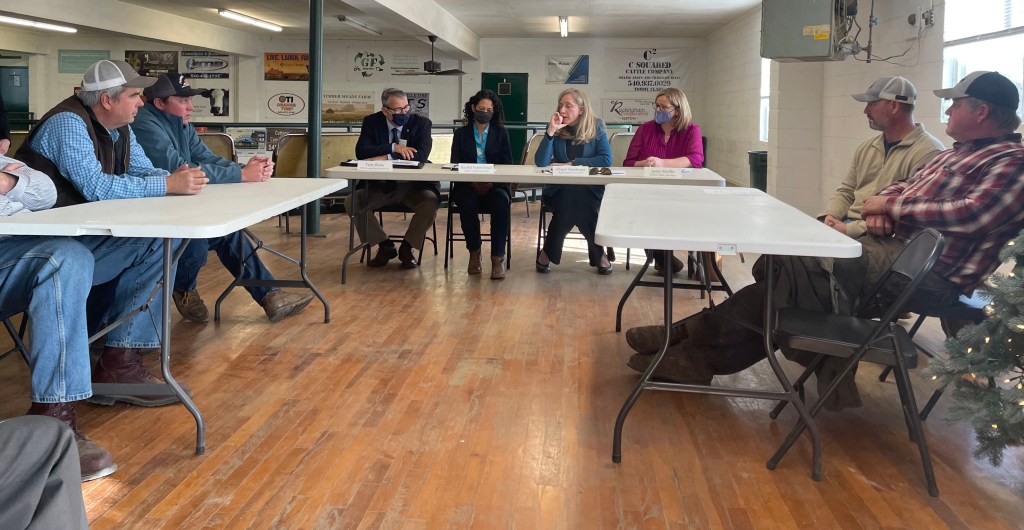
This week, Virginia Farm Bureau participated in a roundtable discussion hosted by Congresswoman Abigail Spanberger, with USDA Under Secretary for Rural Development Xochitl Torres Small, USDA Under Secretary for Marketing and Regulatory Programs Jenny Moffitt, and USDA Rural Development Acting State Director for Virginia Terry Rosta. The officials led a conversation with local cattle producers and processors and agriculture organizations on the challenges associated with expanding meat processing capacity.
Fueled by a high consumer demand for local meat, farmers across Virginia are experiencing extreme backlogs at local slaughter and processing facilities, with most completely booked for six months to a year or more. While this may seem like an opportunity for new businesses, the roundtable discussion highlighted barriers to entry, including the difficulties in securing capitol for high upfront investment costs, finding specialized labor, competing with market concentration, dealing with unfavorable local zoning ordinances and gaining access to technical assistance to navigate regulatory hurdles.
This event was related to the recent announcement of the Food Supply Chain Guaranteed Loan Program, part of USDA’s Build Back Better initiative to strengthen critical supply chains and our food system. The program guarantees loans of up to $40 million for qualified lenders to finance food systems projects, specifically for the start-up or expansion of activities in the middle of the food supply chain. Of note, of the $100 million allocated to the program, 19% is specifically reserved for meat and poultry processors. This new program was inspired by legislation introduced earlier this year by Congresswoman Spanberger and co-patron Congressman Dusty Johnson of South Dakota, called the Butcher Block Act. Interested borrowers should discuss the Food Supply Chain Guaranteed Loan Program with their preferred lenders.
In addition, in July 2021, USDA announced $500 million for expanded meat and poultry processing capacity as part of efforts to increase competition, level the playing field for family farmers and ranchers and build a better food system. For processors interested in expanding, this included over $55 million for Meat and Poultry Inspection Readiness Grants to help facilities come in compliance with federal and state inspection standards. While the initial application period has passed, a second grant round is expected.
USDA Provides Additional Pandemic Assistance to Hog Producers

The USDA announced a new program to assist hog producers who sold hogs through a negotiated sale during the period in which these producers faced the greatest reduction in market prices due to the COVID-19 pandemic. The Spot Market Hog Pandemic Program (SMHPP) is part of USDA’s Pandemic Assistance for Producers initiative and addresses gaps in previous assistance for hog producers. USDA’s Farm Service Agency (FSA) will accept applications through February 25, 2022.
SMHPP provides assistance to hog producers who sold hogs through a negotiated sale from April 16, 2020 through September 1, 2020. Negotiated sale, or negotiated formula sale, means a sale of hogs by a producer to a packer under which the base price for the hogs is determined by seller-buyer interaction and agreement on a delivery day. USDA is offering SMHPP as packer production was reduced due to the COVID-19 pandemic due to employee illness and supply chain issues, resulting in fewer negotiated hogs being procured and subsequent lower market prices.
“Previous pandemic assistance used flat rates across the hog industry, and this didn’t take into account the various levels of harm felt by different producers,” said FSA Administrator Zach Ducheneaux. “We worked closely with industry partners and USDA’s Agricultural Marketing Service to target assistance to hog producers who were hit the hardest during the pandemic. This is one more example of our efforts to provide new, broader, and more equitable opportunities for farmers, ranchers and producers.”
The Department has set aside up to $50 million in pandemic assistance funds through the Coronavirus Aid, Relief and Economic Security (CARES) Act for SMHPP.
SMHPP Program Details
Eligible hogs include hogs sold through a negotiated sale by producers between April 16, 2020, and September 1, 2020. To be eligible, the producer must be a person or legal entity who has ownership in the hogs and whose production facilities are located in the United States, including U.S. territories. Contract producers, federal, state and local governments, including public schools and packers are not eligible for SMHPP.
SMHPP payments will be calculated by multiplying the number of head of eligible hogs, not to exceed 10,000 head, by the payment rate of $54 per head. FSA will issue payments to eligible hog producers as applications are received and approved.
Applying for Assistance
Eligible hog producers can apply for SMHPP starting December 15, 2021, by completing the FSA-940, Spot Market Hog Pandemic Program application. Additional documentation may be required. Visit farmers.gov/smhpp for a copy of the Notice of Funds Availability, information on applicant eligibility and more information on how to apply.
Applications can be submitted to the FSA office at any USDA Service Center nationwide by mail, fax, hand delivery or via electronic means. To find your local FSA office, visit farmers.gov/service-locator. Hog producers can also call 877-508-8364 to speak directly with a USDA employee ready to offer assistance.
USDA touches the lives of all Americans each day in so many positive ways. In the Biden-Harris Administration, USDA is transforming America’s food system with a greater focus on more resilient local and regional food production, fairer markets for all producers, ensuring access to healthy and nutritious food in all communities, building new markets and streams of income for farmers and producers using climate smart food and forestry practices, making historic investments in infrastructure and clean energy capabilities in rural America, and committing to equity across the Department by removing systemic barriers and building a workforce more representative of America. To learn more, visit www.usda.gov.
USDA Opens 2022 Signup for Dairy Margin Coverage Program
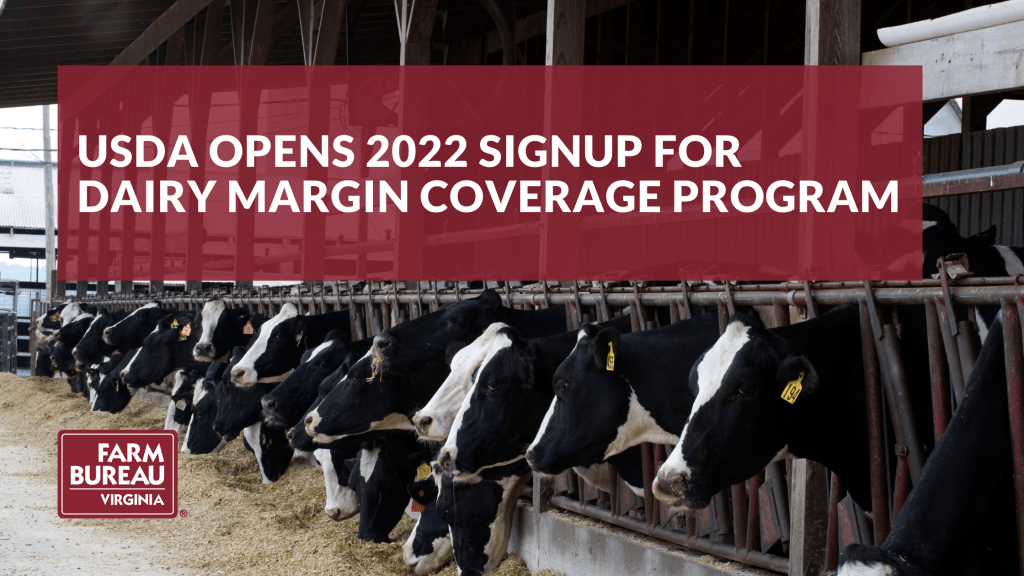
The USDA opened the signup period for the Dairy Margin Coverage (DMC) Program for the 2022 calendar year. Enrollment for the DMC program ends on February 18, 2022.
Virginia’s dairy industry, one of the Commonwealth’s top commodities, produces safe, wholesome products that are enjoyed locally and around the world. According to 2020 USDA data, the state’s dairy industry produced nearly 1.5 billion pounds of milk with cash receipts of $297.6 million. While this is certainly impressive, Virginia dairy farmers have experienced a host of challenges, such as volatile and increasingly depressed milk prices in recent years due to factors outside of their control. Weather events, shifting consumer preferences, trade disruptions and the ongoing pandemic have all impacted milk prices while input costs have risen sharply over the past few years.
“The USDA’s DMC program provides a crucial safety net for dairy producers when the difference between the all-milk price and the average feed price falls below a certain dollar amount that is selected by the producer. This year’s DMC program has been expanded to include Supplemental DMC, which provides additional protection for small and mid-sized dairy operations. I encourage all dairies in Virginia to participate in the federal DMC program and to take advantage of the Supplemental DMC program if it is applicable to their operation,” said Brad Copenhaver, Commissioner of the Virginia Department of Agriculture and Consumer Services (VDACS). “In addition, I am extremely pleased that VDACS can assist the state’s dairy farmers with a new state reimbursement program. The new Dairy Producer Margin Coverage Premium Assistance Program reimburses Virginia dairies for the premium payment they make for participation in the federal DMC program at the tier 1 level.”
This reimbursement removes some of the volatility for producers while also providing risk management for dairy farms. To become eligible for the new Dairy Producers Margin Coverage Premium Assistance Program, Virginia dairies must participate in the federal DMC program at the tier I level and have a resource management plan or nutrient management plan that is certified or undergoing certification by the Virginia Department of Conservation and Recreation or a local soil and water conservation district.
Virginia’s Dairy Producer Margin Coverage Premium Assistance Program will allow some dairy farmers who otherwise couldn’t afford to participate in the federal DMC program to do so by having their Tier 1 premium payments returned to them. Dairy producers simply have to show they have paid their premiums and that they have a nutrient management plan. Participation would certainly be a benefit should prices continue to fall and input costs continue to rise.
The Dairy Producer Margin Coverage Premium Assistance Program is a result of Delegate Wendy Gooditis’s House Bill No. 1750 and Senator Mark Obenshain’s Senate Bill No. 1193, which were unanimously approved during the 2021 General Assembly first special session and signed into law by Governor Ralph Northam. Program funding for the current fiscal year is set at one million dollars. Reimbursement to eligible dairies will be provided on a first-come, first-served basis and is limited to the availability of funds. The application period for the Dairy Producer Margin Coverage Premium Assistance Program is currently underway and is scheduled to end on February 1, 2022. Click here for the application.
Update: 2021 Redistricting in Virginia
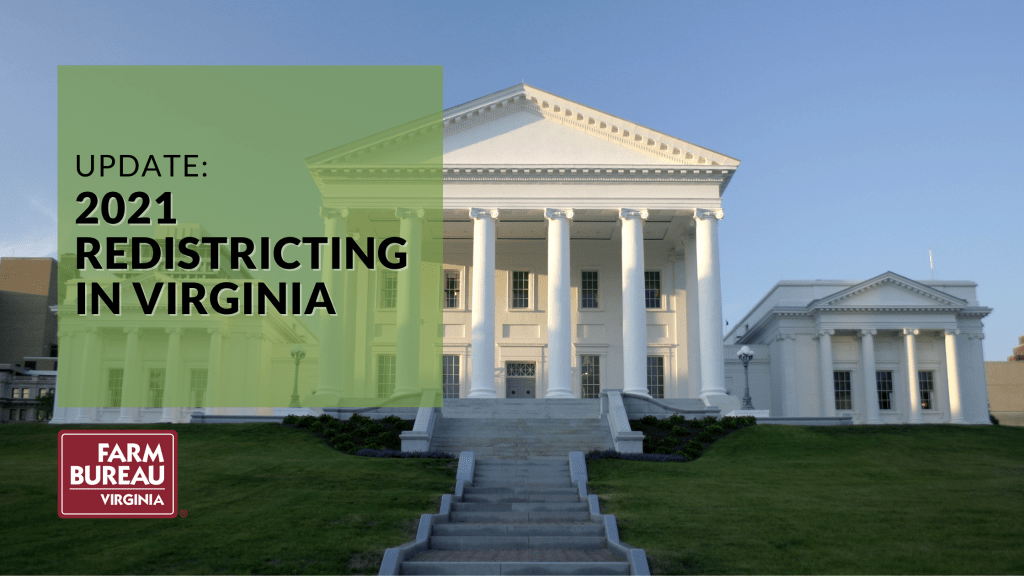
In October 2021, the newly formed Virginia Redistricting Commission was under the gun to meet a deadline to submit new state House, Senate, and Congressional district maps to the General Assembly for approval. The commission members were unable to come to an agreement, and therefore, responsibility for the drawing of new maps was handed to the Supreme Court of Virginia. These maps, drawn by two experts (Special Masters), chosen by the court, were released to the public on Wednesday, December 8. The proposed new districts will greatly impact upcoming elections. In addition to significant shifts in congressional districts that will remove multiple incumbents from their current districts and attract new candidates for the 2022 elections, analysis by the Virginia Public Access Project (VPA) estimates approximately half of incumbent state delegates and senators were drawn into shared districts.
The proposed maps can be viewed using the links below:
Curious if your representatives would change, but don’t have time to peruse the maps? Luckily, VPAP offers a Voter Impact tool that allows you to enter your address and quickly see how different plans would affect you. For those interested in a really deep dive, the full memo from the Special Masters detailing their process can be found here.
As with earlier stages of this process, multiple public comment opportunities are available:
- Virtual Public Hearings
- December 15 and 17 from 1-4 p.m.
- In order to participate and offer public comment, participants must notify the Clerk of Court prior to the meeting by sending an email to Redistricting@vacourts.gov indicating they wish to offer public comment and specifying which date they prefer. The email must include the requester’s name and email address and indicate in what area of the Commonwealth of Virginia the person resides. In response, a meeting link will be sent by email in advance of the hearing to the email address provided. Requests to participate must be received at least 24 hours before the start of the public hearing.
- Written Comments
- Comments on maps proposed by Special Masters may be made directly on the interactive maps by clicking on the appropriate link on the Court’s website.
- Email comments to Redistricting@vacourts.gov.
Merchandiser Minute – December 10, 2021
Check out this week’s video!
Merchandiser Minute – December 3, 2021
Check out this week’s video!
Merchandiser Minute – November 19, 2021
Check out this week’s video!
Congress Builds Bridges to Pass $1T Bipartisan Infrastructure Package
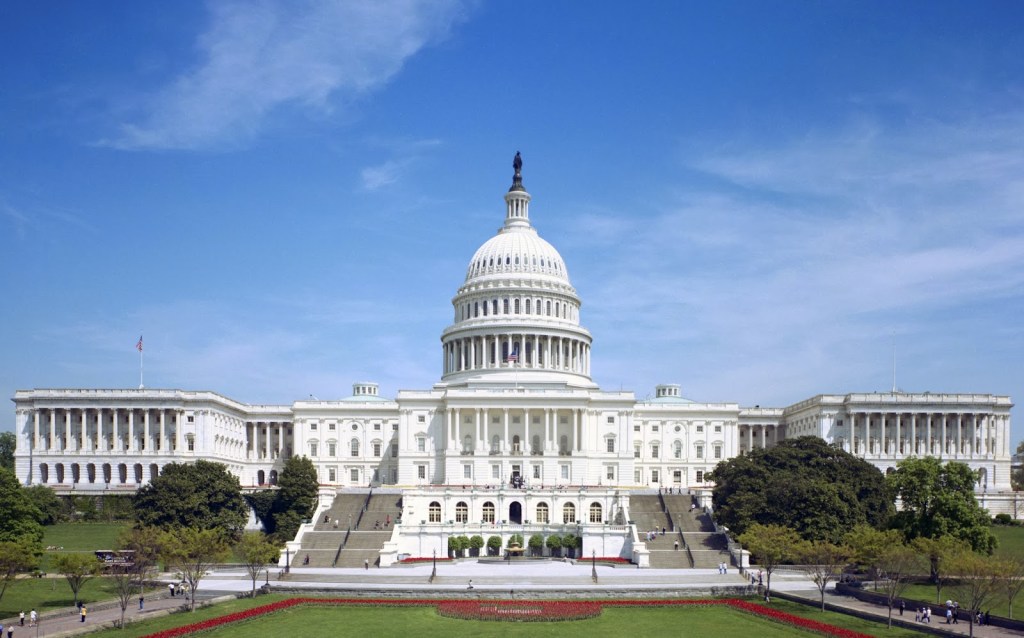
Earlier this year, the American Society of Civil Engineers gave the United States a “C- grade” on the nation’s infrastructure. I think I would agree with them on that, as I am writing this on my laptop in the waiting room of a service center after blowing out two tires on a pothole deep enough to swim in.
While a C- is an upgrade from the D+ ASCE issued in 2017, it continues to illustrate that our country has underinvested in the infrastructure we rely on to travel and move our farm goods to market. The underinvestment isn’t limited to just roads and bridges but includes our ports, canals, railways, and increasingly strained power grid. Imagine what would happen to your farm’s safety and productivity if you deferred maintenance, failed to mend fences, ignored damaged equipment, and generally underinvested in the things that make you successful; unfortunately that is the current state of U.S. infrastructure and why Farm Bureau has been calling for a significant investment in our nation’s infrastructure for years.
At long last, Congress has taken a step forward and passed the Bipartisan Infrastructure Package which will dedicate $1.2T over the next decade to infrastructure. Before we outline how that money will be spent and what it means here in Virginia, it is important to note that this bipartisan infrastructure legislation is different than the partisan spending plan, called the “Build Back Better Act,” currently being debated in Congress.
At its core, the Bipartisan Infrastructure Package is a traditional infrastructure bill, but it also contains significant investments to benefit U.S. farmers, and rural communities.
Every day, Americans make 178M vehicle trips over structurally deficient bridges. In fact, over 40% of the bridges in the United States are over 50 years old. Anyone who hauls livestock or timber has noticed new weight restrictions popping up on Virginia bridges to try and address the issue of infrastructure in a state of disrepair. The infrastructure bill contains $110B for roads and bridges, including $530M specifically for Virginia.
Virginia is blessed with a deep-water port that moves goods in and out of the Commonwealth efficiently. However, much of our country’s inland waterways rely on 50+ year old locks, dams, and general infrastructure, which creates a supply chain bottleneck between farms and ports. The bipartisan infrastructure bill invests $17.3 billion to shore up our ports and inland waterways.
Broadband is infrastructure, and unfortunately, 1 in 4 U.S. farms have no access to high-speed internet. This tool is essential to modern agriculture and gives families access to online health care, education, and allows farmers to use precision ag technologies to reduce inputs, protect water quality, and improve soil health. The infrastructure bill invests $65 billion in broadband expansion so rural Americans aren’t left behind without affordable broadband service. A minimum of $100M of this amount is specifically being allocated to Virginia.
Beyond “shovel ready” infrastructure, the bill will help to address transportation-related supply chain issues that impact the rural and farm economy. Notably, to help alleviate the driver shortage and strengthen our supply chains, the bill includes provisions to help train and recruit truck drivers, and an exemption for livestock and insect (managed pollinators) haulers from Hours of Service regulations within a 150 air-mile radius from their final destination. This funding is targeted to focus on our nation’s infrastructure challenges and help keep Virginia farmers competitive internationally, and we look forward to seeing the implementation of the bill.
We are grateful to all our members who continue to make their voices heard on why infrastructure is critical to the agriculture industry and rural Virginia. Your efforts keep our lawmakers accountable to work together and find solutions that help this industry succeed.

Merchandiser Minute – November 12, 2021
Check out this week’s video!
 Plows and Politics