Robert Harper with Virginia Farm Bureau’s grain division provides this week’s market updates.
Author: VFB Governmental Relations
Merchandiser Minute: Beans Stay Strong
Robert Harper with Virginia Farm Bureau’s grain division provides this week’s market updates.
Meat Processing Listening Sessions
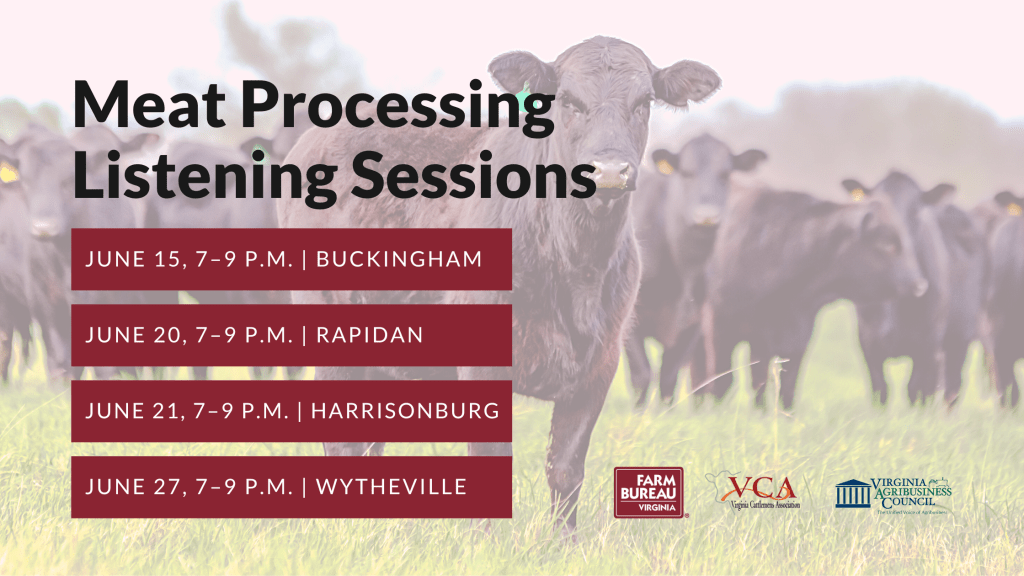
You are invited to attend a listening session to share your thoughts on the challenges and opportunities associated with Virginia’s meat processing and slaughter industry. Staff from the Virginia Department of Agriculture and Consumer Services will be present to receive feedback that will inform the development of a statewide meat processing strategic plan.
If you have comments to share, but are unable to attend a session, please take a few minutes to complete an electronic survey by clicking here.
Available Sessions
June 15, 7–9 p.m.
Buckingham Agriculture Resource Network (The BARN)
11851 W James Anderson Hwy
Buckingham, VA 23921
June 20, 7–9 p.m.
The Carver Center
9432 James Madison Hwy
Rapidan, VA 22733
June 21, 7–9 p.m.
VDACS Harrisonburg Regional Animal Health Laboratory
261 Mt. Clinton Pike
Harrisonburg, Virginia 22802
June 27, 7–9 p.m.
Wytheville Meeting Center
333 Community Blvd
Wytheville, VA 24382
For questions, contact Sam Norman at (804) 290-1014.
The sessions are hosted by:
Merchandiser Minute: May Crop Report
Robert Harper with Virginia Farm Bureau’s grain division provides this week’s market updates.
What does the Proposed SEC Climate Rule Mean for Your Farm?
At the end of April, Farm Bureau joined more than 100 agriculture groups on a letter expressing concern with a proposed rule that would require farmers to report personal and business-related information to the Securities Exchange Commission (SEC), an agency with little to no existing oversight of agriculture. The Enhancement and Standardization of Climate Related Disclosures for Investors proposed rule would mandate extensive climate disclosures by public companies, including measured impacts for their entire supply chain. Companies would be required to report on greenhouse gas emissions, climate-related targets and goals, as well as how climate risks impact their business. This is an end run around legislation to get companies to report certain climate change information in their financial reports.
For many farmers, the impact of this rule could be severe. The agriculture sector provides nearly every raw product that goes into the supply chain, with a valued contribution of over $1 trillion to the U.S gross domestic product in 2020 and employing over 21 million people. While farmers are not public companies and therefore not “registrants” that are required to report directly to the SEC, their obligations through their regulated customers could be burdensome because the rule extends reporting requirements for public companies to report on Scope 3 emissions, which are the result of activities from assets not owned or controlled by an organization but contribute to its value chain such as farms and ranches.
This could create burdensome reporting requirements for family farms and ranches selling into supply chains and force the disclosure of private information. And may create multiple, new sources of substantial costs and liabilities. These include reporting obligations, technical challenges, significant financial and operational disruption and the risk of financially crippling legal liabilities.
Farmers are already heavily regulated by multiple agencies at the local, state, and federal level and the proposed SEC reporting requirements will no doubt make an already complicated patchwork of regulations even more cumbersome. Unlike public companies, it is extraordinarily rare for a farm to employ a compliance team tasked with fulfilling such a regulatory burden.
Farmers are focused on growing the food, fuel, and fiber this country needs, and have not had to worry about regulations intended for Wall Street. When factoring in productivity and population gains, both per unit and per capita agricultural emissions are declining. That means U.S. agriculture is producing more food, fiber, and renewable fuel for more people while using fewer resources and emitting fewer greenhouse gases. The additional efforts to adopt conservation practices through voluntary, market-based incentives have helped farmers and ranchers trap 759 million metric tons of carbon in the soils, representing 12.7% of total U.S. emissions. There is no need for the agriculture industry to face additional regulation.
Do you want to take action? Please Click Here to submit your comments through Farm Bureau’s action alert before June 17, 2022 and tell the SEC to stop this invasive regulatory overreach!
Want to dig deeper into the proposed SEC rule? Click Here for an AFBF Market Intel with more details.
Want to learn more about agricultural sustainability? Click Here for the most recent Inventory of U.S. Greenhouse Gasses and Sinks.
Merchandiser Minute: Rate Hike
Robert Harper with Virginia Farm Bureau’s grain division provides this week’s market updates.
Informational Webinar: Large-Scale Solar Projects and Land-Use Planning:

Virginia Tech and Virginia Cooperative Extension are hosting an informational webinar to learn more about large-scale solar projects and land-use planning policies. This session will highlight research from West Virginia University’s Land Use and Sustainable Development Law Clinic regarding solar land-use practices around the United States. The session will also include an update from Jennifer Friedel, Esq., Associate Professor of Practice at Virginia Tech on new policies in Virginia. Register to hear these presentations and ask your questions. Speakers include:
- Whitney Morgan, Land Use and Sustainable Development Law Clinic, West Virginia University College of Law, Morgantown, West Virginia
- Jesse Richardson, Professor of Law, Lead Land Use Attorney, West Virginia University College of Law, Morgantown, West Virginia
- Jennifer Friedel, Asst. Prof. of Practice, Director, Virginia Land-Use Value Assessment Program, Department of Agricultural and Applied Economics, Virginia Tech
Large-Scale Solar Projects and Land-Use Planning: Sharing Research on Experiences from Other States and an Update from Virginia
WEBINAR
May 25, 2022, 10 – 11 a.m.
If you are a person with a disability and desire any assistive devices, services or other accommodations to participate in this activity, please contact John Ignosh, Dept. of Biological Systems Engineering, VCE Northern District Office at 540-432-6029/TDD* during business hours of 8 a.m. and 5 p.m. to discuss accommodations 5 days prior to the event. *TDD number is (800) 828-1120.
Merchandiser Minute: Tight Supplies and Strong Demand
Robert Harper with Virginia Farm Bureau’s grain division provides this week’s market updates.
Free Webinar: Shared Cost Meat Processing for Livestock Producers
Consumer demand for locally-sourced meats and producer meat enterprise interest are at all-time highs and outpace current local meat and poultry processing capacity in many localities. Shared Cost Meat Processing for Livestock Producers — Co-ops and Collaboration will introduce farmers, ranchers and local meat and poultry processors to opportunities and challenges in establishing or expanding local meat and poultry enterprises. The presentations will not only focus on market demand and regulations, but will also examine business structures that can benefit smaller scale farms and processing such as cooperatives and other collaborative business entities. Our presenters are each highly experienced in rural cooperative and business development, including meat processing and marketing, and accessing grants and financing options of importance for smaller-scale operations. Webinar topics include:
- Enterprise entry challenges
- Local retail/wholesale meat marketing
- Local meat processing challenges and opportunities
- Opportunity for a regional cooperative or collaboratively-owned meat enterprise
- Cooperatives vs. other business ownership models
- Grants and other financial assistance options
Shared Cost Meat Processing for Livestock Producers – Co-ops and Collaboration
FREE WEBINAR
May 24, 2022, 6:30 – 8:30 p.m.
The Webinar opens at 6:00p.m., presentation begins at 6:30p.m.
Please direct webinar questions and comments to [Stricha@clemson.edu].
This event is being presented and sponsored by:
Carolina Common Enterprise, Matson Consulting, South Carolina Center for Cooperative and Enterprise Development and the Virginia Foundation for Agriculture, Innovation & Rural Sustainability.
The sponsors offer their programs to people of all ages, regardless of race, color, gender, religion, national origin, disability, political beliefs, sexual orientation, gender identity, marital or family status and are equal opportunity employers.

Additional Resources
For additional information concerning small-volume red meat processing and meat marketing in Virginia, please refer to our study guides at https://www.vafairs.com/resources/.
Merchandiser Minute: April Options Expire
Robert Harper with Virginia Farm Bureau’s grain division provides this week’s market updates.
 Plows and Politics