2022 Pesticide Collection (Disposal Program)

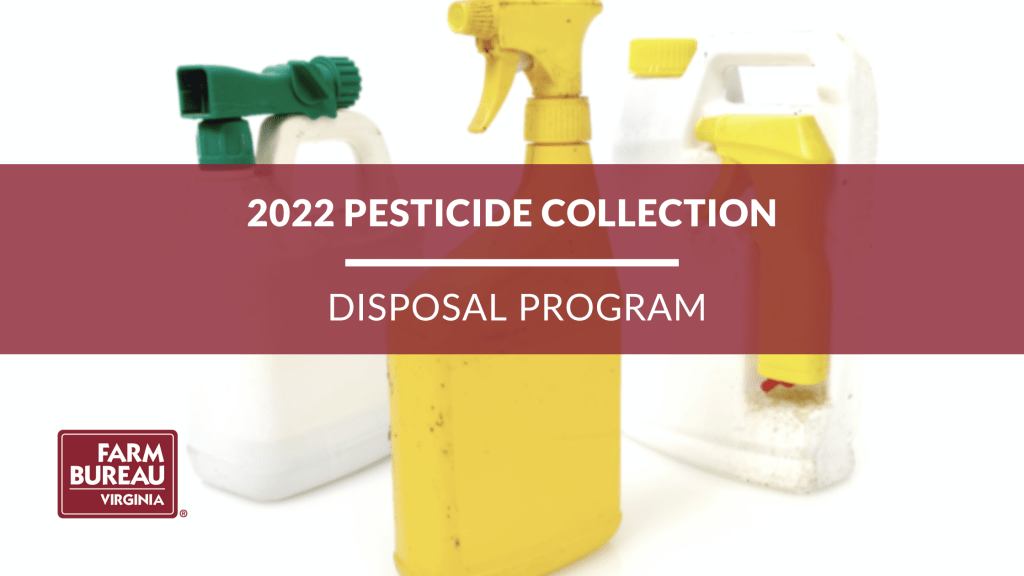
The Virginia Department of Agriculture and Consumer Services’ (VDACS) Office of Pesticide Services (OPS) is hosting the Pesticide Collection Program again this year. This program assists agricultural producers, licensed pesticide dealers, homeowners and more with properly disposing of unwanted pesticides. The program is administered at no cost to participants and is led by VDACS with Virginia Cooperative Extension and the Division of Consolidated Laboratory Services.

The Pesticide Collection Program divides the state into five regions and each year collections are carried out in a different region. The Program requires participants to transport their unwanted agricultural and commercial pesticides to a central collection site where the hazardous waste disposal contractor will package the pesticides for eventual disposal. If a participant cannot safely transport unwanted pesticides, the program may make arrangements to containerize the pesticides for transport.

For more information regarding this year’s program, collection sites, and dates click here. All participants are asked to complete the registration form and submit it to the VDACS-OPS Office via email to ops.enf@vdacs.virginia.gov or by mail to VDACS-OPS, PO Box 1163, Richmond, VA 23218.

Collection Dates:

  • August 9, Southern States (5784 Valley Pike, Stephens City, VA)
  • August 10 CFC Farm & Home Center (15172 Brandy Road, Culpeper, VA)
  • September 6, CFC Farm & Home Center (12645 Lee Highway, Sperryville, VA)
  • September 7, Rockingham County Fairgrounds (4808 South Valley Pike, Harrisonburg, VA)
  • September 8, Ivy Materials Utilization Center (4576 Dick Woods Road, Charlottesville, VA)
  • October 11, Page Cooperative Farm Bureau (127 Big Oak Road, Luray, VA)
  • October 12, Madison County Fairgrounds (1015 Fairground Road, Madison, VA)
  • October 13, Rockbridge Farmers’ Cooperative (33 Yellow Rail Lane, Lexington, VA)

For each date, the collection time is 9 a.m. – 1 p.m.

If you have any questions, feel free to email the above address or call the office at (804) 371-6559.

Get Titled! Securing Titles for Farm Use Placards

With recent changes to the motor vehicle code for permanent farm use placards in Virginia, many farmers are faced with a problem; they own a vehicle and never found it necessary to have the vehicle titled in their name. Whether they never took it on the road, or some other reason, they now are posed with the problem of how to get their vehicle’s title in their name. Under current Virginia law, all motor vehicle owners, including owners of trailers or semitrailers, are required to obtain the certificate of title for the vehicle before it is operated on any highway (§ 46.2-600).

If you have the title signed over to your name from the previous owner, simply follow these instructions from Virginia Department of Motor Vehicles (DMV). If you don’t have a title in your name, you can complete this form (Affidavit in Lieu of Title Certificate – VSA 12) to submit with this form (Application for Certificate of Title – VSA17A) along with any other documentation proving ownership. Again, you can review the process on DMV’s website. Forms of proof of purchase, such as a bill of sale, will be very helpful in these situations. DMV also offers a form the seller and buyer can complete in place of a bill of sale.

DMV plans to have the new permanent farm use placards for sale by late September, and resolving missing titles now will make purchasing new permanent farm use placards simpler. Keep in mind, the law has an effective date of July 1, 2023, to allow farmers a full year to learn about and prepare for the new requirements.

Lastly, the requirement for liability insurance coverage on all exempted vehicles, such as farm use, went into effect July 1, 2022.

Regulatory Update: Pesticides and Proposition 12

All farmers have an interest in a regulatory process that is transparent, fact-based and respects the will of Congress while observing the separation of powers in the Constitution. Federal regulations have a direct impact on farmers’ lives and livelihoods, and over the years, the extent of that regulatory landscape has increased. There has recently been action related to the availability of neonicotinoid pesticides, and California’s Proposition 12 which would impact the pork industry. Virginia Farm Bureau Federation (VAFB) and American Farm Bureau Federation (AFBF) continue to take a stand against regulatory overreach and are working to protect your ability to farm.

EPA has released its final biological evaluations (BEs) for several neonicotinoid pesticides (clothianidin, imidacloprid, and thiamethoxam), and the BE reflects a “likely to adversely affect” (LAA) determination for 67%, 79% and 77% for the products, respectively.

Unfortunately, the final BE does not reflect the refinements offered in comments on the draft biological evaluations. As with the draft BEs last August, the final BEs are overly conservative and in some instances fail to use important data. As a result, we are concerned the BEs drastically overstate the impact of the pesticides on endangered species and their habitats.

The BEs do not incorporate scientific and commercial data that could have provided a more realistic picture of the potential impact of the chemistries on species. For example, nearly all applications of neonicotinoids in soybeans are made as seed treatments, using a minuscule amount of pesticide buried underground where it is far less likely to impact species or habitat. However, the final BEs assume growers exclusively make foliar spray and soil applications using many times more active ingredient than is reflected by real-world USDA and market survey data. The BEs also continue to assume a species will be adversely affected if only one individual in a species is impacted, which greatly inflates effects assessments.

Despite groups like VAFB and AFBF highlighting these shortcomings in draft BE public comments, EPA doubled down on using inappropriate and overly cautious assumptions in its final BEs, which leads to significant overestimations on the impact on species.

Based on the BE, the next stage is formal consultation with the Fish and Wildlife Service and National Marine Fisheries Service in the development of a Biological Opinion. It is expected that this final BE will spur anti-pesticide organizations to call for restrictions on how these products can be used while the Biological Opinion is being developed. Farm Bureau and other grower groups will continue to advocate for complete data to be used in these evaluations, and to preserve valuable crop protection tools as this process moves forward.

Shifting focus to the courts: the U.S. Solicitor General, one of the highest ranking officials in the Department of Justice, filed a brief to the U.S. Supreme Court in support of a challenge to California’s Proposition 12. The state law seeks to ban the sale of products from veal calves, breeding pigs and egg-laying hens that don’t meet California’s arbitrary production standards, even if the livestock was raised on farms outside of California. The AFBF and National Pork Producers Council (NPPC) filed the challenge, arguing Proposition 12 violates the U.S. Constitution’s Commerce Clause.

In the amicus brief, Solicitor General Elizabeth Prelogar argues that AFBF and NPPC have stated a valid claim that Proposition 12 violates the constitution and will create burdens in interstate commerce.

“Other States might well condition in-state sales on even more square feet of space per hog, or on compliance with requirements concerning animals’ feed, veterinary care or virtually any other aspect of animal husbandry. The combined effect of those regulations would be to effectively force the industry to ‘conform’ to whatever State (with market power) is the greatest outlier.”

In addition to the amicus brief filed by the Biden Administration and the U.S. Solicitor General, Virginia Farm Bureau was proud to see Virginia Attorney General, Jason Miyares, join 25 other state attorneys general in filing an amicus brief urging the high court to overturn Proposition 12. The brief states

“California’s rules represent a substantial departure from current practices and standards in most States, yet the Constitution does not permit California to set a single, nationwide animal-confinement policy.”

 It is critical to remember that, because California has less than .15% of U.S. breeding hogs, their restrictions will almost exclusively apply to out of state producers. The brief further lays out concerns by noting, “Allowing the California law to stand would balkanize markets and lead to interstate conflict: precisely the problems under the Articles of Confederation that the framers sought to fix by assigning the interstate commerce power to Congress.”

The pork industry plays an important role in Virginia’s economy, with hogs ranking 13 in Virginia’s top 20 commodities and generating $58,647,000 in farm cash receipts. All producers share the goal of ensuring animals are well cared for, but Proposition 12 fails to advance animal health or food safety. Instead, it will make caring for animals more difficult and drive up the cost of food for families across America, and potentially eliminate Virginia producers’ access to the California market.

A Recap of Meat Processing Listening Sessions

The need for additional meat processing capacity is not a new issue in Virginia. However, this need has intensified over the past several years, both within and outside of the agriculture industry, due to supply chain issues triggered by the COVID-19 pandemic. There are a multitude of challenges inhibiting expansion, but no single solution. To address this, Virginia Farm Bureau (VAFB) worked with the Virginia Agribusiness Council and the Virginia Cattleman’s Association to pass legislation during the 2022 General Assembly to direct the Virginia Department of Agriculture and Consumer Services (VDACS) to establish a five-year strategic plan for increasing meat processing capacity within the commonwealth.

To give producers and processors an opportunity to weigh in on this work, VAFB recently hosted four listening sessions across Virginia. Great attendance and productive discussion were had at sessions in Buckingham, Culpeper, Harrisonburg and Wytheville. In addition to VDACS and VAFB staff, the groups were fortunate to be joined by Secretary of Agriculture and Forestry Matt Lohr, VDACS Commissioner Joe Guthrie, Delegate Michael Webert, Delegate Tony Wilt, Senator Travis Hackworth, Delegate Marie March and Senator Todd Pillion’s Legislative Director, Tyler Lester.

As you may expect, each region presented a slightly different perspective on the challenges and opportunities associated with meat processing, but there were also many common themes. Good things are currently happening in the industry–the people and product are held in very high regard, and demand for a local product is through the roof. Direct sales and value-added products can provide a livestock producer with much needed additional income, but the extreme wait time to secure a slot at a processing facility is a major roadblock. For those looking to start a facility, obstacles such as gaps in technical assistance, struggles navigating the regulatory process, and difficulties securing buy-in from local governments and the general public were mentioned. Those currently operating facilities elaborated on hurdles resulting from the rendering process, lack of available labor and the need for additional costly infrastructure and cold storage space.

If you were unable to attend a listening session in person, but would like to share your thoughts, please take a few minutes to complete a survey by clicking here. The strategic plan is due to the General Assembly by January 1, 2023.

VDACS Food Safety Program Permit

During the 2022 General Assembly session, a new law was passed providing the authority for the issuance of permits by the Virginia Department of Agriculture and Services (VDACS) to any Virginia food manufacturer, food storage warehouse, or retail food establishment (i.e., supermarkets, grocery stores, convenience stores). It also requires that all food establishments regulated by VDACS be issued and have a valid permit from the agency’s Commissioner to operate in the Commonwealth.

Please note that food establishments permitted by VDACS will continue to receive regular, ongoing inspections by VDACS’s Food Safety Program to ensure that the inspected establishments are maintained in a clean, healthy, and sanitary condition. The only change in the regulatory process will be the issuance of the annual permit.

All food establishments under VDACS’s jurisdiction will be receiving a food establishment permit on or about July 1, 2022. Permits will be mailed directly to each of the food establishments.
A permit will not be issued until January 1, 2023, to any food manufacturer, food storage warehouse, or retail food establishment located in a locality that adopted a local food inspection or permitting ordinance prior to January 1, 2022. This applies to the following 10 localities: City of Alexandria, Arlington County, City of Danville, Fairfax County, City of Hampton, City of Hopewell, City of Norfolk, City of Petersburg, City of Portsmouth, and City of Roanoke.

The permit will remain valid for a period of 12 months after the date of issuance. When that time has elapsed, VDACS will provide a replacement permit. While food establishments will continue to pay the existing annual food safety fee, there will be no additional cost associated with this permit.

FAQs

1) Do I need to apply for a permit if I am an existing food establishment that is currently in operation?

No, other than those establishments located in one of the localities listed in number 2 below, your permit will be mailed to you the first week of July. If you have not received your permit by July 25, 2022, please email foodsafety@vdacs.virginia.gov.

2) If my food establishment is in the City of Alexandria, Arlington County, City of Danville, Fairfax County, City of Hampton, City of Hopewell, City of Norfolk, City of Petersburg, City of Portsmouth, or City of Roanoke, when will I receive my permit?

Your permit will be mailed to you the first week of January, 2023. If you have not received your permit by January 25, 2023, please email foodsafety@vdacs.virginia.gov.

3) I have a VDACS Certificate of Inspection. Does the permit replace that Certificate?

Yes. Your permit will replace your Certificate of Inspection.

4) I am getting ready to open a new firm, how do I apply for a permit?

Please submit the applicable application for your business type. To locate the application form, select the link for your business type on this website.

5) Once I submit my application, how soon will I receive my permit?

When your application is submitted, it will be reviewed by the VDACS Food Safety Program. After your application is reviewed, you will receive a call from your Food Safety Specialist to schedule your pre-opening inspection. The pre-opening inspection must be completed prior to manufacturing or selling food products. You will receive your permit after the successful completion of the pre-opening inspection. We make every effort to perform pre-opening inspections as soon as possible.

6) If I am a new owner of a food establishment, can the permit from the previous owner transfer to me?

No. If you are a new owner, you need to submit a new application and apply for a new permit. To locate the application form, on this website select the link for your business type.

7) If I move my existing business to a new physical location within Virginia, can the permit transfer?

No. If you move your business to a new location, you need to submit a new application and apply for a new permit. To locate the application form, on this website select the link for your business type.

8) I am the manager/operator of a farmers’ market. Do I need to obtain a permit for the market?

No. Individual farmers’ market vendors who are under inspection with the VDACS Food Safety Program will be issued a permit. A permit will not be issued for the overall market.

9) Is there a fee associated with the permit?

No, there is no fee associated with the permit. There is an annual $40.00 annual inspection fee for establishments inspected by the VDACS Food Safety Program that will not change. You will receive an invoice during our next billing cycle which is usually in the fall of each year.

10) Does my permit expire?

Yes. Your permit will expire on July 1, 2023. At that time, VDACS will provide a replacement permit.

11) Will I need to renew my permit?

No. Your permit will be renewed automatically as long as your food establishment remains in substantial compliance with all applicable laws and regulations. You will receive a new permit each July. The renewal of a permit does not coincide with the frequency of your routine inspections from the VDACS Food Safety Program.

12) If I have additional questions, who should I contact?

Please email foodsafety@vdacs.virginia.gov or call 806-786-3520