
Robert Harper with Virginia Farm Bureau’s grain division provides this week’s market updates.
Robert Harper with Virginia Farm Bureau’s grain division provides this week’s market updates.
While Virginia Farm Bureau Federation AgPAC issues endorsements in state races, it does not endorse congressional candidates during federal election years. Instead, Virginia Farm Bureau sends a questionnaire to all candidates with questions regarding federal agriculture issues. To view the questionnaire and candidate responses, click on the button below.
Election Day is November 8, 2022. In-person early voting at your local registrar’s office runs from September 23, 2022 through November 5, 2022. Times vary by locality, so be sure to confirm details with your local office. Voting will also be available Saturday, October 29, 2022 and November 5, 2022 from 9 a.m. to 5 p.m. The deadline to register to vote or update an existing voter registration is October 17, 2022 (voters may register after this date, through Election Day, and vote using a provisional ballot). The deadline to apply for a ballot to be mailed to you is October 28, 2022. For more information, visit the Virginia Department of Elections website.
Robert Harper with Virginia Farm Bureau’s grain division provides this week’s market updates.
Robert Harper with Virginia Farm Bureau’s grain division provides this week’s market updates.
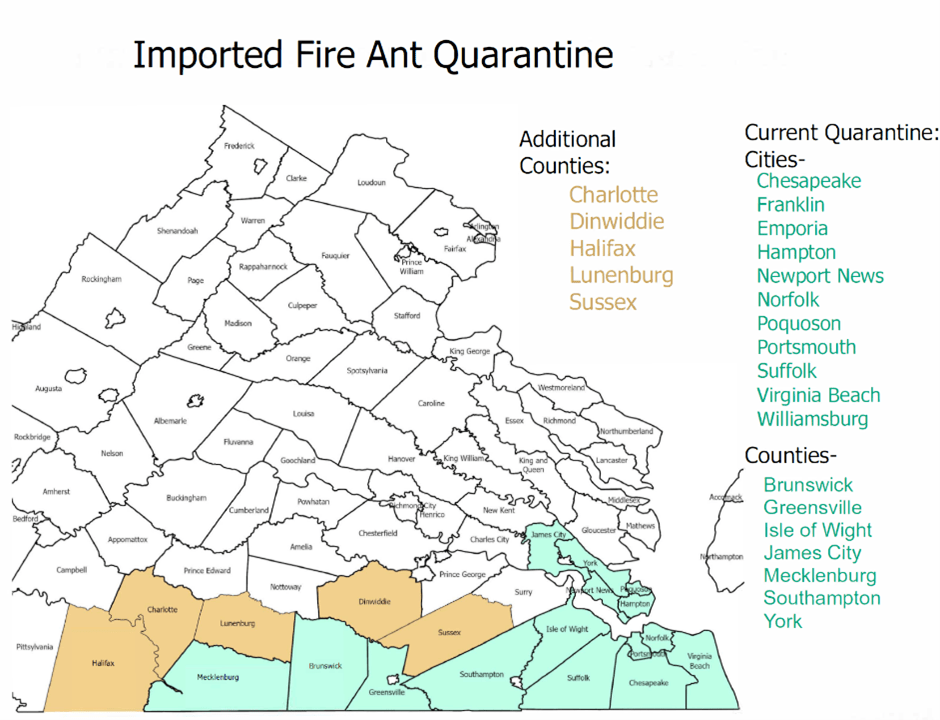
The Virginia Department of Agriculture and Consumer Services (VDACS) is expanding the Imported Fire Ant Quarantine in December of 2022 to include the counties of Halifax, Charlotte, Lunenburg, Dinwiddie and Sussex. While the quarantine will not take place until the end of the year, VDACS is working hard to communicate with the impacted locality staff, industry groups, state agencies and other organizations who may be impacted by the quarantine.
In a recent letter from VDACS, the Commissioner shared the following information with us. VDACS conducted surveys that indicate imported fire ant populations have become established in those localities and the quarantine is necessary to prevent the artificial spread of this insect pest to uninfested areas of the Commonwealth. It is anticipated that the United States Department of Agriculture (USDA) will also expand the federal Imported Fire Ant Quarantine which will restrict the interstate movement of regulated articles from these same Virginia localities.
Once established, the imported fire ant has the potential to spread to uninfested areas, either through natural means or through the artificial movement of infested articles. The quarantine is intended to prevent the artificial spread of this pest. Under provisions of the quarantine, regulated articles are prohibited from moving out of the quarantined area unless they are certified as free of imported fire ant.
Once the quarantine has been expanded, businesses located in the counties of Halifax, Charlotte, Lunenburg, Dinwiddie and Sussex that are shipping to locations outside of the quarantined area are required to follow the USDA-approved treatment and shipping options which are outlined in the Quarantine Treatments for Nursery Stock, Grass Sod, and Related Materials manual; the manual can be found on the USDA website. Businesses may enter into a compliance agreement with VDACS to facilitate shipping those regulated articles in accordance with the quarantine. Please see the map below of Virginia’s current Imported Fire Ant Quarantine and expansion of the new localities.
Robert Harper with Virginia Farm Bureau’s grain division provides this week’s market updates.
The Virginia Department of Agriculture and Consumer Services (VDACS) is launching the new Virginia Produce Safety Grower Portal, a free online portal to assist fruit and vegetable growers operating in the Commonwealth to meet the requirements of the federal Food Safety Modernization Act (FSMA): Produce Safety Rule (21 CFR 112). The new online tool allows VDACS to quickly determine if a grower’s operation is subject to the federal requirement, or if they are exempt. The online portal allows growers to submit applications, update business information, obtain technical assistance, market to a variety of audiences, and apply for annual exemptions, if eligible.
“The Virginia Produce Safety Grower Portal allows Virginia produce farmers to update farm registration information, obtain educational data, and print a certificate of registration that features the newly designed Virginia Grown logo. Farm information will be shared with the Virginia Grown program as a way to integrate both the regulatory and marketing/promotions function of the agency,” said Joseph Guthrie, VDACS Commissioner.
Virginia produce growers can create an account to complete the registration process at producesafety.vdacs.virginia.gov. Farms and businesses will need to register one time initially and then verify their information at least annually. Portal registration includes:
Farms within Virginia that grow, harvest, pack or hold produce intended for human consumption and for sale are encouraged to utilize the online portal to register their business with the VDACS Produce Safety Program. This registration process is intended to verify who is and who is not covered under the Food Safety Modernization Act (FSMA): Produce Safety Rule (21 CFR 112). This process also allows VDACS to provide valuable education, technical assistance, and information to regulated farms and businesses, exclude farms that are not required to comply with the rule, and prioritize federally required inspections for those operations that are not exempt.
The VDACS Produce Safety Program will issue exemption certifications based on eligibility as outlined in the Code of Federal Regulation Title 21. Since farm information may change from year to year, producers must update their information and reapply for an exemption annually (at least 30 days before the one-year expiration date). Exemption certificates expire one year following the issue date of the exemption.
Contact the VDACS Produce Safety Program with any questions or concerns at produce.safety@vdacs.virginia.gov or (804) 786-4003.
This project was supported by the Food and Drug Administration (FDA) of the U.S. Department of Health and Human Services (HHS) as part of a financial assistance award U18FD005901 totaling $3,408,835 with 100 percent funded by FDA/HHS. The contents are those of the author(s) and do not necessarily represent the official views of, nor an endorsement, by FDA/HHS, or the U.S. Government.
Robert Harper with Virginia Farm Bureau’s grain division provides this week’s market updates.
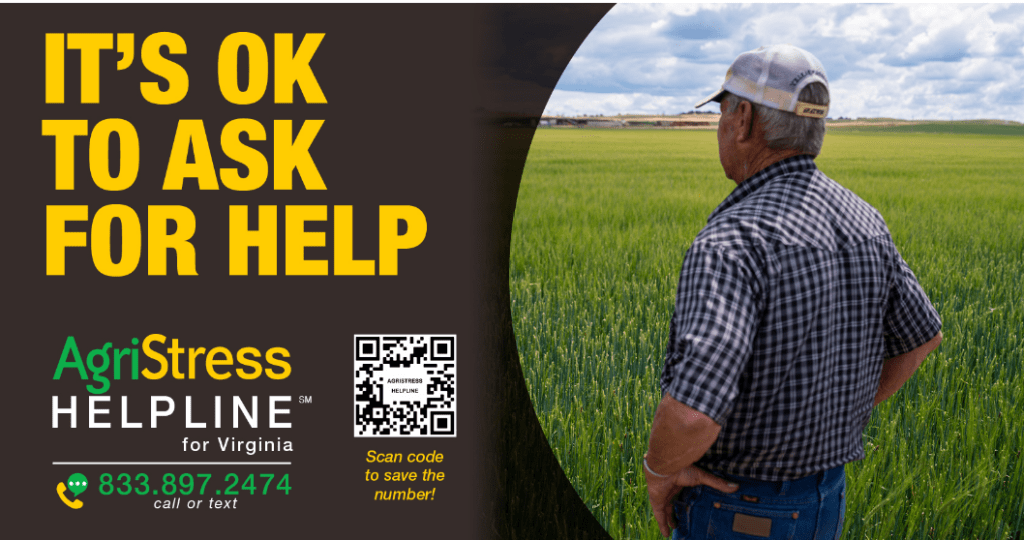
The Virginia Department of Agriculture and Consumer Services (VDACS) announces the official launch of the AgriStress Helpline for Virginia to provide the Commonwealth’s agricultural producers with mental health support. The helpline is available 24 hours a day, 7 days a week, and has interpretation services for 160 languages. Farmers can call or text 833-897-2474 to speak directly with a healthcare professional. Crisis specialists have access to a Virginia specific curated database of agricultural and health resources.
“The physical demands of farming, isolation, weather variability, fluctuating input cost and commodity prices can all impact mental health. Stigma and privacy concerns associated with obtaining mental health services may cause some producers to refuse to seek out these very important resources,” said Matthew Lohr, Secretary of Agriculture and Forestry. “The AgriStress Helpline for Virginia is specifically geared to those in the state’s agricultural community who are seeking mental health support. A call or text to 833-897-2474 will put them in contact with trained professionals who can offer support and/or help find mental health resources in a specific area of the state.”
VDACS partnered with AgriSafe to launch the AgriStress Helpline for Virginia, which is supported by grant funding from the U.S. Department of Agriculture National Institute of Food and Agriculture Farm and Ranch Stress Assistance Network. VDACS received $500,000 in funding which will support a wide range of agricultural stress programming in addition to the AgriStress Helpline for Virginia. AgriSafe is a national 501c3 organization representing health and safety professionals who strive to reduce health disparities in the agricultural community.
“I am pleased that through our partnership with AgriSafe, we have a dedicated helpline for Virginia agricultural producers. In addition to being a free, confidential resource, this new helpline aids our efforts to promote mental health and stress awareness and broaden the availability of resources to reduce stress points in rural Virginia,” said Joseph Guthrie, Commissioner of VDACS. “Anyone who considers themselves part of Virginia’s agricultural community is encouraged to call or text 833-897-2474 any time they are in crisis. The helpline is staffed by mental health professionals who are trained to respond appropriately and specifically to agricultural communities with Virginia specific resources.”
In addition to the new helpline, VDACS is also collaborating with the Virginia Farm Bureau Federation, Virginia Tech, AgrAbility Virginia, FARMVA, and other industry organizations, to offer trainings and other services to destigmatize and recognize the critical issue of stress among Virginia farmers.
This week showed a defensive futures trade as corn, bean and Chicago wheat went to the downside. Influences are still centered around weather, war in Europe, inflation and fear of weakening demand. As you are preparing and starting the corn harvest, time spent on your marketing plan will be valuable to you. Give Farm Bureau Grain Division a call to discuss local basis bids and truck availability.
#merchandiserminute #grainfutures #virginiafarmbureau
 Plows and Politics