From the Field: Policy Discussions and Table Cloths

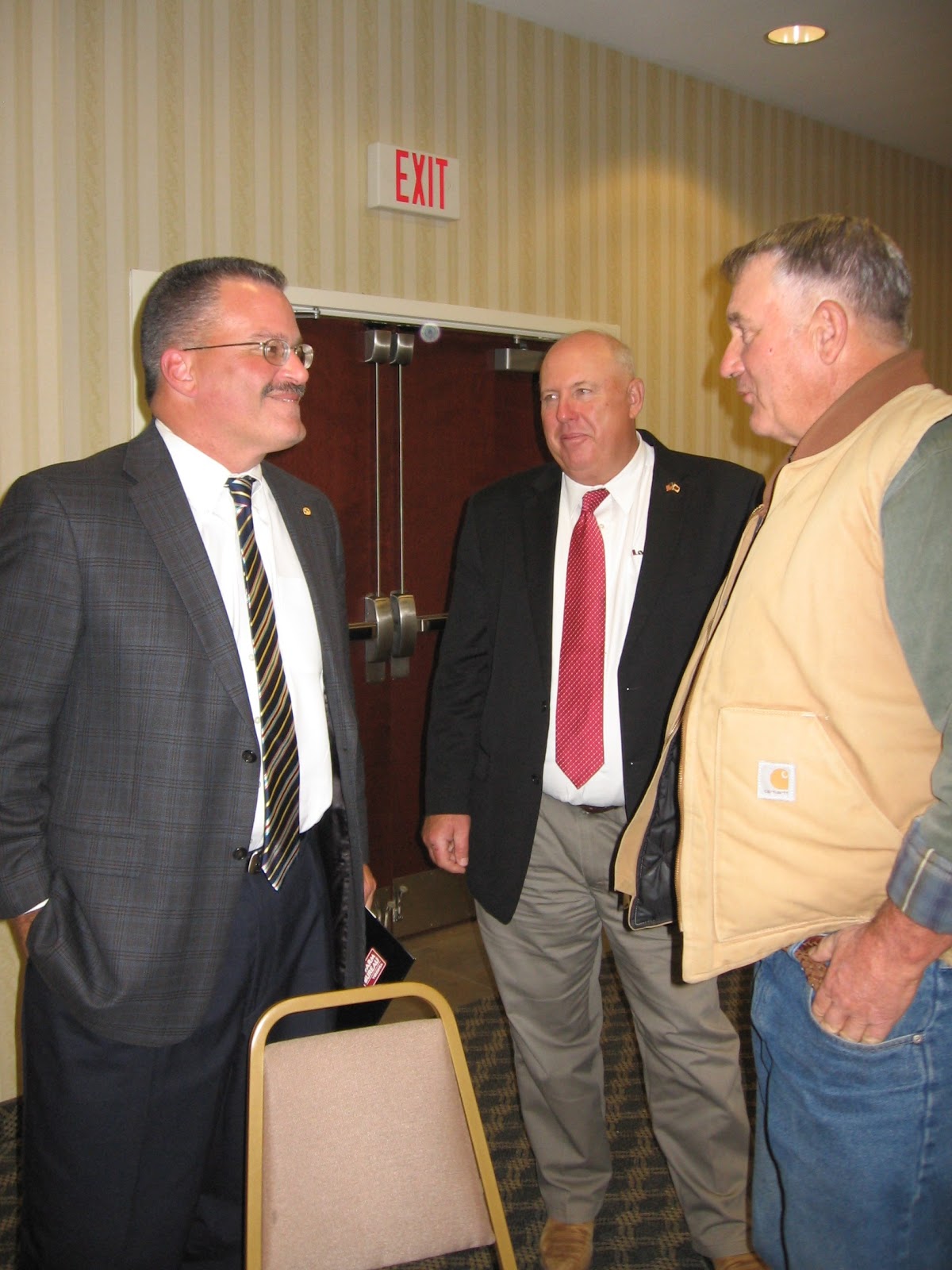
Delegate Ed Scott and Farm Bureau members

From the Field is a bi-monthly column written by Mark Campbell, Farm Bureau Field Services Director for the Central District. He writes about Farm Bureau member benefits and County Farm Bureau activities.

Yesterday started out as a typical day with a schedule of assisting a County Administrative Assistant in the Louisa County Farm Bureau office with the end-of-year tax package, developing a budget for that same county Farm Bureau, and finishing the day with the Senatorial District Meeting in Zion Crossroads.

The Senatorial District Meetings are regional meetings where Farm Bureau producer members meet with Virginia delegates and senators to discuss Farm Bureau’s priority issues for the upcoming General Assembly session. The meeting started at 5:30 p.m. for orientation of the issues for Farm Bureau members. The issues were property rights and trespass, funding for Soil and Water Districts, additional funding for agriculture BMPs, and additional funding for predator control, especially east of the Blue Ridge Mountains.

I got to the meeting location one hour in advance to get set up. Upon arriving, the first thing I saw was bare wooden tables with no tablecloths. I quickly remembered that I should have brought some plastic roll-out tablecloth that I had used at this location before, since they don’t provide table linens. Luckily, there was a Wal-Mart across the road. I thought they might have what I needed. After a little searching I found the holiday section of the store where there were some tablecloths, but not the quick, inexpensive, cut to preferred size roll-out tablecloths. Most were all fabric. Alas, I found some that would work. Now my dilemma was which kind to pick. Do I go with the ones with the Santa Claus and elves or do I go with the ones with the holly and pine branches? I went the conservative route and chose the holly and pine branches tablecloths, and I purchased all they had.

At about 5:15 p.m., Andrew Smith from the VFB Governmental Relations department called me on my cell phone and said “aahhh, are you going to be here soon and are there no tablecloths?” I replied, “Not to worry. I am pulling into the parking lot now.” Problem solved.


Approximately 41 people from several counties in central Virginia were signed up to attend, and everything was perfect when they arrived. Counties represented were Albemarle, Cumberland, Fluvanna, Greene, Louisa, Madison, Orange, and Spotsylvania. The legislators and legislative aides of those legislators that could not attend arrived at 7:00 p.m. They were Senator Bryce Reeves, Delegate Ed Scott, Delegate Peter Farrell’s legislative aide, Stefanie Kitchen; Delegate Rob Bell’s legislative aide, Jordan Dix; and Senator Garrett Jr.’s legislative aide, Susan Lascolette.We had a delicious dinner prepared by a caterer from Madison County that I use quite a bit for Farm Bureau meetings. We even had leftovers, which were quickly snapped up by members at the end of the meeting.

There was good discussion on all issues from members and legislators. Senator Bryce Reeves and Jordan Dix, legislative aide to Delegate Rob Bell, especially thanked Farm Bureau members for their yeomen’s work on getting the constitutional amendment on eminent domain passed by such a wide margin.

Several members were very knowledgeable about the agriculture BMPs, watershed implementation plan, cost share conservation programs, and soil and water districts. Brad Jarvis of Madison County was one member who gave detailed information on these areas. Members with this wealth of knowledge on issues and testimonials provide the legislators a keen understanding of the issues.

 After a successful meeting, I looked back on my day–a day that involved analyzing financial statements, crunching budget numbers, picking out tablecloths, and discussions of policies with state legislators. That’s a day in the life of a Farm Bureau fieldman.

To cap off the day, I cranked up a little George Strait and Jason Aldean on the radio for the drive home. I will have a few days off for the holiday and weekend with some down time and relaxation of splitting wood, synchronizing cows to get them ready for A.I. breeding, and, of course, spending time with family on Thanksgiving.

I wish you a wonderful Thanksgiving and the time to cherish your family.

Until next time,
Mark

Farm Bureau focuses on Farm Bill, Estate Tax during Lame Duck Session

http://c.brightcove.com/services/viewer/federated_f9?isVid=1

During its upcoming lame-duck session, Congress has some big policy moves to make. At the top of lawmakers’ to-do list, farmers and ranchers say, should be the farm bill and estate and capital gains taxes.

Many of the provisions of the 2008 farm bill expired on Sept. 30. Most farmers are okay for now because the 2008 bill covers the 2012 crops, not just fiscal 2012. However, dairy farmers are struggling without a Milk Income Loss Contract program, which expired at the end of September.

And even growers who are currently feeling few effects of not having a farm policy in place are at a loss in terms of planning for the future.

Just before Congress adjourned in October, hundreds of Americans, including farmers, congressional members and leaders from agriculture, conservation, energy, consumer and nutrition organizations, gathered on Capitol Hill at the Farm Bill Now rally. They called on lawmakers to pass a new, comprehensive, five-year farm bill. Such a bill, Farm Bureau says, is necessary to ensure stability for growers and allow them to plan for the future.

The Senate passed its version of the farm bill in June and the House Agriculture Committee approved its own legislation the following month. Farmers and ranchers had hoped to see Congress compromise on the two measures before heading home in the run-up to the election.

“Now it’s a lame duck must-do,” said Dale Moore, American Farm Bureau Federation policy specialist.

Sen. Debbie Stabenow (D-Mich.), chairman of the Senate Agriculture Committee, said she thinks there’s a good chance Congress will get the farm bill done, after House Majority Leader Eric Cantor (R-Va.) said in late October that the House would vote on a measure after the election.

Farmers and ranchers are also anxious for Congress to act on estate and capital gains taxes. On Jan.1, the estate tax exemption is slated to drop from the current $5 million to $1 million per person and the top tax rate will climb from the 35 percent in place now to 55 percent. The spousal transfer for the exemption will also disappear.

As part of an ongoing AFBF campaign, farmers and ranchers are e-mailing and calling their lawmakers to let them know how important estate tax reform is to keep family operations going and ease the transition following the death of a family member. Until estate taxes are permanently eliminated, farmers want Congress to keep or improve the current exemption, indexed for inflation, maintain spousal transfer and continue the top tax rate.

“If Congress doesn’t act on estate taxes, many more surviving farm family members could be faced with making critical decisions to sell land, buildings or equipment to generate enough money to pay the tax,” said Pat Wolff, AFBF tax specialist.

As with estate taxes, farmers are disproportionately affected by capital gains taxes. And, as with estate taxes, without congressional action, the capital gains tax rate will go up on Jan. 1, 2013.

With the new year, the top long-term capital gains tax rate will rise from the current 15 percent to 20 percent, and the dividends tax rate will more than double to 39.6 percent. Nationwide, 40 percent of all agricultural producers report some capital gains, nearly double the share for all taxpayers. And the average amount of capital gains reported by farmers is about 50 percent higher than the average capital gains reported by other taxpayers, according to AFBF.

USFRA responds to consumers concerns about GMOs

The U.S. Farmers and Ranchers Alliance, agricultural groups at the national, regional and state levels (including Virginia Farm Bureau) that are answering Americans’ questions about agriculture, recently responded on their Web site, http://www.fooddialogues.com, to some concerns about GMOs and biotechnology. After Proposition 37 failed in California, this is a very timely discussion.

If you’re interested in learning more about USFRA and are a producer member attending the 2012 Virginia Farm Bureau Annual Convention in Chantilly, please contact your county Farm Bureau about attending the USFRA workshop on Tuesday, Nov. 27

USFRA’s View:

Consumers have a number of questions concerning the use of biotechnology in crops. Combining science with food raises many concerns and questions and during the New York Food Dialogues, the USFRA panel discussion with tackle a number of these questions. As the event takes place, you may be challenged to provide some answers as well from your followers and consumer audience. Here’s some background on this topic from the USFRA overview of biotechnology:


USFRA supports farmers’ choices to plant and grow conventional crops, biotech crops, organic crops or a combination. Similarly, USFRA supports consumers’ choices to purchase foods they prefer. Many of our farmers plant biotech seeds for reasons such as protecting their crops from adverse weather. Some of our farmers choose organic production. All of these methods of production contribute to meeting consumer demands for food products as well as producing healthy choices for everyone and protecting the environment.

Farmers also use biotech seeds for a number of reasons – to reduce crop damage from weeds, diseases and insects as well as from adverse weather conditions such as drought or flooding. Biotech seeds often allow farmers to be more precise about their use of inputs like nutrients, pesticides and water needed to grow crops.

Safety and FDA Review

“FDA has no basis for concluding that bioengineered foods differ from other foods in any meaningful or uniform way, or that, as a class, foods developed by the new techniques present any different or greater safety concern than foods developed by traditional plant breeding.”

Since 1995, food from biotech seeds has been commercially available and has been proven safe for human and animal consumption. No other crops have been more studied or subject to greater scientific review. Biotech seeds undergo testing for safety, health and nutritional value – and regulation is overseen by The Food and Drug Administration (FDA), The U.S. Department of Agriculture (USDA), Animal and Plant Health Inspection Service and the Environmental Protection Agency (EPA).

Research shows that the current commercial crops from biotech seeds have the same nutritional properties as non-biotech seed crops and are not harmful for humans and animals to consume. In the years that farmers have grown crops from biotech seeds (since 1995), there has not been a single instance of harm to human health.

For roughly 10,000 years, farmers have been genetically altering plants and seeds through selective breeding to improve characteristics such as hardiness, yield, taste and nutrition. Today’s biotech seeds are part of this evolution – their development is sped up and more precise by inserting the genes from one plant into another in a laboratory setting.

For more information on USFRA’s view on biotechnology, visit http://www.fooddialogues.com/foodsource/topics/biotech-seeds

Ballot Initiaive on GMOs fails in California

Lindsay Reames
Assistant Director
Governmental Relations

The property rights constitutional amendment wasn’t the only ballot initiative we were watching on Nov. 6.

Californians rejected Proposition 37, which would have mandated genetically modified foods (GMO) to be labeled as such and was opposed by agriculture groups.

Supporters of the measure argued that consumers have a right to know what’s in their food and that information should be made available on labels. About 60 countries around the world already require such labels, proponents stressed.

Opponents countered that labeling foods would cost families hundreds of dollars a year in higher grocery bills. They also accused the initiative of sowing fear that genetically-engineered foods are unsafe.

The proposition lost steam when local California writers such as The Los Angeles Times Alexandra Le Tellier questioned the science behind some anti-GMO research. “Is it (research) credible?” she asked. “Or is it science for the sake of fulfilling an agenda?” After noting that much of the criticism of GMO foods centered around pesticides, Le Tellier asked, “If the problem is the pesticides, then why isn’t the Proposition 37 labeling initiative about that?” Proposition 37 was defeated 53 percent to 47 percent.

This ballot intitiave was interesting to Farm Bureau because legislation calling for GMO food labeling was introduced and failed in Virginia last year, and we’re sure it will be coming back in the 2013 Virginia General Assembly.

Stay tuned to Plows and Politics and if you havent, please join the Capitol Connections Action Center (contact Kelly Pruitt at kelly.pruitt@vafb.com) for updates on this and other legislative issues.

Statement by Bob Stallman, President, AFBF, Regarding Election and Lame Duck Session

Bob Stallman, president of American Farm Bureau Federation released a statement on Wednesday regarding the 2012 Presidential Election and the Lame Duck Session. Read it below:

“The American Farm Bureau Federation congratulates President Barack Obama on his re-election, as well as those candidates elected to serve during the 113th session of Congress. A number of important issues lie ahead of us, both for our nation, and for American agriculture. It is vital that, under the president’s leadership, all our elected officials come together in a bipartisan fashion to resolve the challenges we face.

“Farmers and ranchers, like all Americans, have a list of issues that they are relying on the administration and Congress to address. But we cannot wait until 2013 for the action to start. Serious work on the farm bill, the fiscal cliff and critical tax policy fixes all must start during the lame duck session of the 112th Congress.

“Farm Bureau also looks forward to working in a cooperative and positive manner with the Obama administration and the new Congress on issues such as turning around our economy, ensuring agriculture an adequate labor supply, pursuing a trade agenda focused on reducing barriers and expanding exports and the continued fiscal challenges we face as a nation. There are many points of view on these issues, but we also know that our elected leaders have one thing in common: each ran on a platform to make America better and improve this country for all Americans.

“We will do our part to help identify opportunities for cooperation, not only to improve the lives of Farm Bureau members and their rural communities, but for all Americans proudly served by our farm and ranch families.”

From the Field: County Farm Bureaus Have Programs to Help Members and Communities

From the Field is a bi-monthly column written by Mark Campbell, Farm Bureau Field Services Director for the Central District. He writes about Farm Bureau member benefits and County Farm Bureau activities.

Earlier this year, you may remember me informing you about Louisa County Farm Bureau providing a poultry litter spreader for rent as a service to the farmers in the county. Well, this is just one county of several that have looked at discount programs and community services at the local level. American Farm Bureau and Virginia Farm Bureau have several member discount programs that certainly are available to all counties. But, in some cases, county Farm Bureaus have carved out niches to further expand the membership advantage in their county.

While not specific to just Farm Bureau members, Tazewell County Farm Bureau in cooperation with local veterinarians and the county government sponsor a free rabies clinic every November that is available to all county citizens, and there is no limit to the number of pets. This one-day clinic is a cooperative effort in that all three parties chip in money to cover the costs of the rabies vaccination and share the workload. Two veterinarians cover eight locations across the county. The Tazewell County Farm Bureau Women’s Committee helps staff the locations and prepares the certificates. It has been going on for about five years, and turnout has been great.

A few other county Farm Bureaus such as Bland, Franklin, Montgomery, Pulaski, and Prince George offer member programs with discounts to Texas Roadhouse (yummy- my favorite!), O’Charley’s, Advance Auto Parts, Gardner’s Frozen Treats, Anderson Animal Extractions, tax preparation service, Sam’s Club and vendor fee at the farmers market. The local discount programs have been well received in those counties. The reciprocal part of the agreement is that the county Farm Bureaus promote the businesses and the discount to their respective members.

Farm Bureaus time and time again to meet their purpose and fulfill their mission that is described in the bylaws as “…working to achieve educational improvements, economic opportunity (like the examples anove), social advancement, and thereby promote the national welfare…” A big thank you goes out to all of the Farm Bureau volunteer leaders and county Farm Bureaus that worked tirelessly to get the constitutional amendment on eminent domain passed by a huge majority. If you are not actively involved in your county Farm Bureau, I encourage you to do so. New ideas are always welcome and an extra helping hand with activities is certainly welcomed. Your District Field Services Director is your local liaison to Virginia and American Farm Bureau and always ready to assist you and your county Farm Bureau.

Until next time,
Mark

BREAKING NEWS: Property Rights Constitutional Amendment Passes!

We did it!!!! Thank you, Virginia Farm Bureau producer members! Without your grassroots support, the property rights constitutional amendment wouldn’t have been a reality!

Once the votes are certified, the amendment will go into affect Jan. 1, 2013. 
From the Richmond Times-Dispatch:

Virginians overwhelmingly approved a constitutional amendment on Tuesday night that will restrict the state’s ability to take private property for commercial purposes.

The amendment – backed by almost 80 percent of voters — requires that private property be taken by the government only for a true “public use” and not given to another private landowner, such as a developer, even in the case of job creation. Exceptions would include utilities or the elimination of a public nuisance. 

The amendment ensures that property owners who have their land taken are properly compensated, including lost profits to businesses.

County Farm Bureau leaders convene in Roanoke for annual Resolutions Committee meeting

Virginia Farm Bureau County leaders from across the state convened in Roanoke today for the 2012 VFB Resolutions Committee meeting.

This meeting is one of Farm Bureau’s most important yearly functions.

Among the topics discussed are funding for conservation practices required to meet water quality commitments; damage to their farms from wildlife such as coyotes, elk, geese, deer and bears; and protecting their property from trespassers and liability claims from those who trespass.
The meeting also included discussion of issues relating to taxes, farmland preservation and farm commodities.

Policies developed during the resolutions meeting will be considered for official VFBF policy during the organization’s annual convention November 27-29 in Chantilly.

Many of the resolutions approved at the meeting will be lobbied for during the 2013 Virginia General Assembly, as well as in Congress.

Interested in getting involved in the VFB policy process? Contact your county Farm Bureau office for more information.

New ID Policies in Place for Upcoming Election

In 2012 changes were made to Virginia’s voter identification laws. Virginia voters are reminded that state law requires all voters to provide an acceptable form of identification (ID) at the polls. Voters arriving to the polls without ID will be required to vote a provisional ballot and will have until noon on the Friday after the election to deliver a copy of identification to their locality’s electoral board in order for their provisional ballot to be counted. Please see below in “Provisional Ballot Process for Voters Who Arrive Without Identification” for more information on how the provisional ballot process will work for those arriving to the polls without ID.

Virginia’s ID requirements also apply to absentee voters who vote in-person. Please see below in “Special Federal ID Requirements for Certain First Time Voters”for other potential special cases for first-time voters.

Acceptable forms of identification include the following:

•Virginia voter registration card

•Valid Virginia driver’s license

•Military ID

•Any Federal, Virginia state or local government-issued ID

•Employer issued photo ID card

•Concealed handgun permit

•Valid student ID issued by any institution of higher education located in the Commonwealth of Virginia

•Current utility bill, bank statement, government check or paycheck indicating the name and address of the voter
•Social Security card (*please see below as the social security card does not satisfy special federal ID requirements)

A voter who does not bring an acceptable ID to the polls will be offered a provisional ballot.


Don’t have one of these forms of ID?

All Virginia active registered voters will be mailed a new Virginia voter registration card prior to the November 2012 General Election. If you are not registered but are eligible for registration, please register today and a voter registration card will be mailed to you by your local general registrar’s office after your application has been processed.

Provisional Ballot Process for Voters Who Arrive Without Identification

All active registered voters in Virginia will be mailed a new voter identification card prior to the November 2012 General Election. Voters without any other ID should bring this form of ID with them to the polls as this will satisfy the voter ID requirements for Virginia and federal law.

A voter who arrives at the polling place without an acceptable form of identification will be given the opportunity to vote a provisional ballot. After completing the provisional ballot, the individual voting will be given written instructions from the election officials on how to submit a copy of his/her identification so that his/her vote can be counted.

A voter will have until noon on the Friday following the election to deliver a copy of the identification to the local electoral board. Voters may submit a copy of their ID via fax, email, in-person submission, or through USPS or commercial delivery service. Please note that the copy of the ID must be delivered to the electoral board by noon on Friday, or the provisional ballot cannot be counted. A Friday postmark will not be sufficient if the copy of the ID is not delivered to the electoral board by noon on Friday.

The written notice given to the voter will provide the necessary information, including email, fax, and address of where the ID should be delivered.

Dos and Don’t For Campaigners and Authorized Representatives

Special Federal ID Requirements for Certain First Time Voters

For persons who registered to vote in Virginia by mail, federal law requires them to show identification (ID) when voting (in-person or absentee) for the first time in a federal election if they did not send a copy of one of these IDs with their voter registration applications. Voters subject to this special ID requirement will have the phrase “First-time Federal” after the “ID Required” item in their on-line voter registration record. Any of the following types of ID are acceptable:

1.A current and valid photo ID (for example a driver’s license);

2.or a current utility bill, bank statement, government check or paycheck that shows name and address;

3.or another government document that shows name and address (for example a voter card).

This federal ID requirement applies the first time a person votes in any federal election, either on the day of the election or by absentee ballot. If the voter does not present one of these forms of ID at the polls, that person will be offered a provisional ballot that includes a voter information statement under felony penalty. This is a paper ballot that the local electoral board may count if the voter later provides the required identification. Such persons have the right to appear before the Electoral Board and can request an extension up to one day to present evidence. If the voter returns an absentee ballot by mail without a copy of one of these forms of ID, the absentee ballot will be treated as a provisional ballot and counted only if the voter provides a copy of ID to the electoral board by the deadline applicable to all voters.

Please remember that these requirements apply to first-time voters who are voting absentee by mail and in-person.

*Note: In nearly all cases, the Virginia identification requirements mirror and satisfy the federal ID requirements. However, a social security card does not satisfy the federal ID requirements, if you are a first-time voter who fits the criteria listed in this section. Please also remember that the federal ID requirements apply to both absentee voting and voting at the polling place on Election Day.