From the Field: Patience and Safety on the Farm

From the Field is a bi-monthly column written by Mark Campbell, Farm Bureau Field Services Director for the Central District. He writes about Farm Bureau member benefits and County Farm Bureau activities.
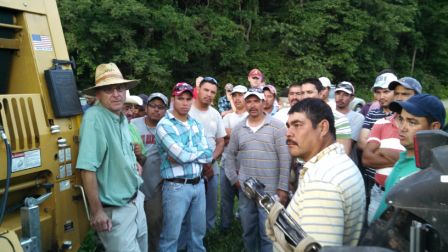
Participants in Nelson County Farm Bureau’s safety program
There are many jobs on a farm, but planting, haymaking, and harvest seem to be the most stressful.  Often, farmers are dealing with a small time window regarding the weather and the calendar.  Weather has been challenging to say the least this year on making hay.  However, no one is really complaining because it has been a terrific year for growing grass and crops.  I dare go out on a limb and say that it is the best that I can remember.  Although I concede that many people claim a longer existence and memory.
During these busy times, patience and safely operating equipment are critical.  I am a pretty patient guy, but I don’t deal well with equipment breakdowns.  It seems that many of these equipment breakdowns occur during haymaking with acres of hay on the ground and storm clouds billowing in the distance.  I will say that time and experience have refined and strengthened my patience over the years. I love the story that my pastor sometimes tells on patience.  The more that he prays for patience; the more problems he seems to have.  He chalks that up to the Lord training him to be more patient. 
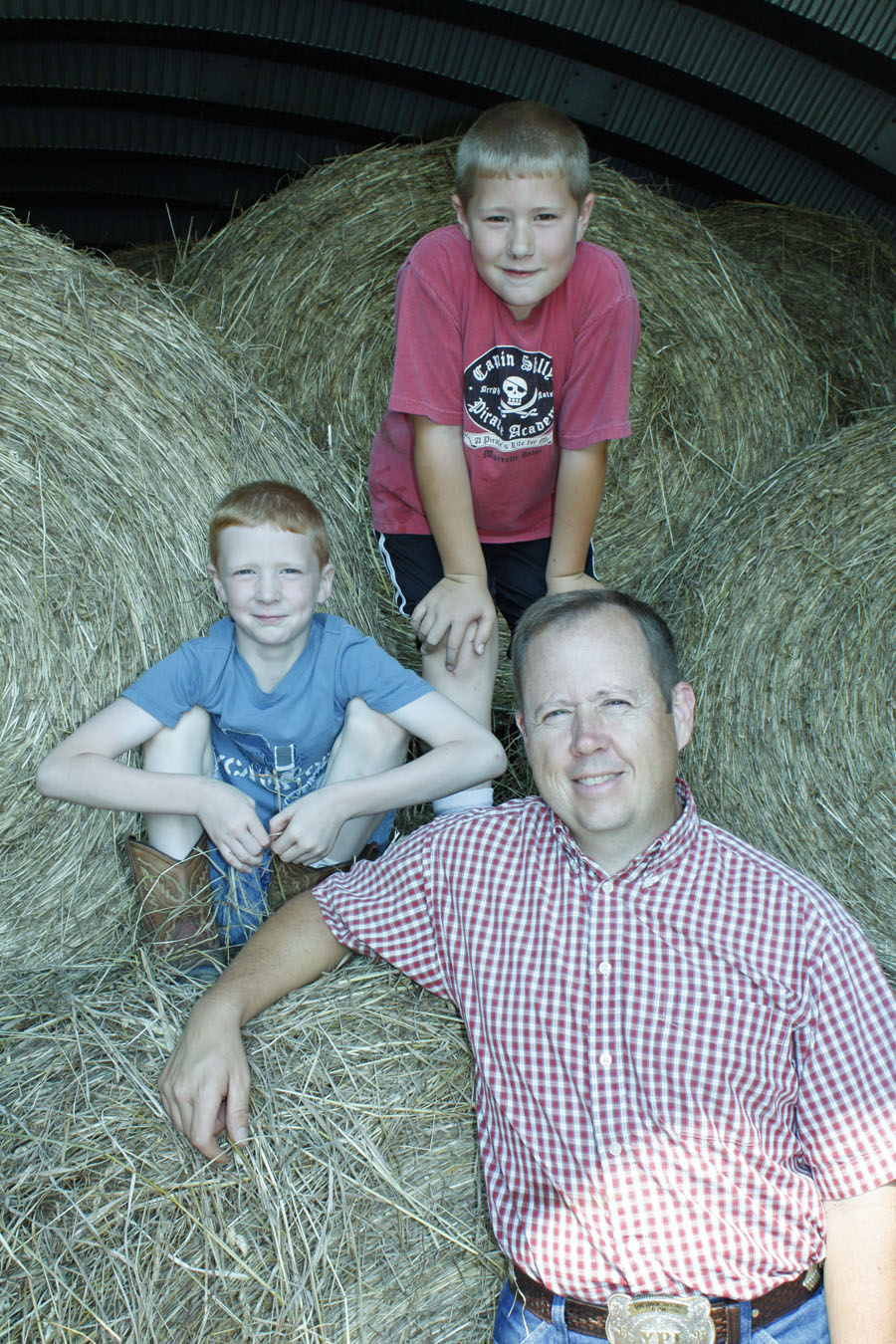
Why am I talking about patience in a blog about agriculture?  Well there are a couple of reasons.  First and foremost is that most farm accidents happen when people are in a hurry and taking short cuts.  Many accidents happen when people are fixing or repairing equipment out in the field.  The second is other people are watching.  No, I’m not talking about the NSA–I mean family members or employees.  My young sons are always watching, and as you parents know, they will soon model what they see and hear.  My sons, even at ages 8 and 10 are safety conscious and love to put on the tractor flashers and lights whenever they get the chance. 

Nelson CountyFarm Bureau recently held a safety program at the beautiful location of Dickie Brothers Orchard www.dickiebros.com in Massies Mill.  Fifty-five people attended the event.  Saunders Brothers www.saundersbrothers.com, a large scale nursery, brought 23 employees to the safety program.  Immediately after the safety program ended, Jim Saunders summarized the presentations in Spanish for the employees that he brought. 
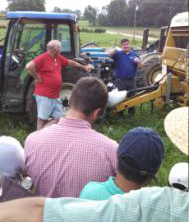
Jimmy Maass, VFB Safety Manager, stresses the need to be safe first before being fast.  We all recognize the need to push it a little harder to get the work done.  But be safe first.
Jimmy, who spoke at the event, talked about tractor rollovers and the VFB incentive for placing a roll bar on your tractor.  The incentive is $400.  So visit your county Farm Bureau office if your older tractor does not have a roll bar, and pick up an application.  He also spent a good bit of time talking about power take-offs (PTOs).  He then demonstrated PTO entanglement with a dummy. 
With some of the farms in the county having multiple employees that operate equipment; I foresee more interest in having safety demonstrations.
Let’s hope that the good rains keep coming and everyone stays safe out there. 
Until next time,

Mark

Working Group Launched to Discuss On-Farm Activities; Comments Welcome

Trey Davis
Assistant Director
As a result of several bills considered by the 2013 session of the Virginia legislature, a working group has been formed to discuss what on farm activities should be protected and what local governments can do to assist farmers. Commissioner Matt Lohr of VDACS has convened the “On-Farm Activities Working Group” made up of representatives of the agriculture industry, local governments, and other interested parties.  Virginia Farm Bureau is pleased to be a part of these meetings which are open to the public.
The purpose of this group is to facilitate discussions and ideas and to formulate recommendations for the 2014 legislative session. This group has no authority to change current policy or regulations. A report will be made to the House Committee on Agriculture, Chesapeake and Natural Resources and to the Senate Committee on Agriculture, Conservation and Natural Resources.
The list of participants and a public comment page can be found here: http://www.vdacs.virginia.gov/news/farmactivities.shtml.   Please feel free to submit comments and ideas for consideration of the group.  They must be approved by VDACS before being posted on the website.
Please contact Trey Davis, VFBF Assistant Director of Governmental Relations, at trey.davis@vafb.com if you have any further questions.

Breaking News: House Rejects Farm Bill

The House of Representatives voted Thursday to defeat the 2013 five-year $1 trillion farm bill in a 195-234 vote.

The down vote means the bill won’t go to conference in the Senate, which passed its own version last week. The White House had threatened to veto the House version.

In the final vote tally, only 24 Democrats voted for the bill, with 64 Republicans voting against.

American Farm Bureau Federation President Bob Stallman has released the following statement:

“The American Farm Bureau Federation is highly disappointed the House did not complete work on the 2013 farm bill, the ‘Federal Agriculture Reform and Risk Management Act of 2013.’  It was a balanced bill that would have provided much needed risk management tools and a viable economic safety net for America’s farmers and ranchers.
“We commend House Agriculture Chairman Frank Lucas (R-Okla.) and Ranking Member Collin Peterson (D-Minn.) for their commitment and hard work in bringing the bill to the floor and working toward its passage. We look forward to working with them as we regroup and move forward. We also appreciate House Speaker John Boehner (R-Ohio) for working with the Agriculture Committee leadership to bring the bill to the floor.
“A completed farm bill is much needed to provide farmers and ranchers certainty for the coming years and to allow the Agriculture Department to plan for an orderly implementation of the bill’s provisions.”

Stay tuned to Plows and Politics for updates, as well as information and action alerts from Virginia Farm Bureau. If you are a producer member and would like to receive these alerts, please contact Kelly Pruitt at 804-290-1293 or kprui@vafb.com.

AFBF: Death Tax Repeal Act ‘Gets the Job Done’

AFBF President
Bob Stallman
The American Farm Bureau Federation supports legislation introduced today in both the House and Senate that would permanently repeal the estate tax. Sen. John Thune’s (R-S.D.) bill, The Death Tax Repeal Act of 2013, coupled with bipartisan legislation of the same title introduced by Reps. Kevin Brady (R-Texas) and Mike McIntyre (D-N.C.), is welcomed by America’s farm and ranch families.
While significant tax relief was enacted last year to help farmers cope with estate taxes, AFBF believes that permanent repeal is still the best solution to protect all farms and ranches. The legislation introduced today would repeal the estate tax, maintain stepped-up basis and make permanent a 35 percent maximum gift tax rate and $5 million lifetime gift tax exemption indexed for inflation. 

 “Individuals, family partnerships and family corporations own 98 percent of our nation’s 2 million farms and ranches,” said AFBF President Bob Stallman.  “When estate taxes on an agricultural business exceed cash and other liquid assets, surviving family partners may be forced to sell land, buildings or equipment needed to keep their businesses running. This not only can cripple a farm or ranch operation, but also hurts the rural communities and businesses that agriculture supports.”

The value of family-owned farms is usually tied to illiquid assets, such as land, buildings and equipment, said AFBF. With 85 percent of farm and ranch assets illiquid, producers have few options when it comes to generating cash to pay the estate tax. Recent increases in agriculture cropland values, on average 15 percent from 2011 to 2012, have greatly expanded the number of farms and ranches that now top the estate tax exemption.
“Farm Bureau believes the estate tax should be eliminated permanently,” concluded Stallman. “We fully support The Death Tax Repeal Act of 2013 to get the job done.”

Veto Threat Looms as Farm Bill Debate Begins in House

From National Journal:

The House is scheduled to begin debate on the farm bill on Tuesday with the knowledge that if the House version makes it through Congress and goes to the White House, President Obama’s senior advisers will recommend that he veto it.
The issue for the White House is a $20.5 billion cut over 10 years in the Supplemental Nutrition Assistance Program, better known as SNAP or food stamps.
The reduction proposed in the House bill is five times greater than the SNAP-slash in the Senate-passed farm bill, which would cut $4 billion from a program expected to cost about $760 billion over the next 10 years. The White House did not threaten to veto the Senate bill, so it may be willing to live with a reduction somewhere between the Senate and House figures, a number that would have to be worked out by a conference committee.

The Office of Management and Budget issued the veto threat on the House farm bill on Monday evening while the House Rules Committee was listening to Agriculture Committee Chairman Frank Lucas, R-Okla., and ranking member Collin Peterson, D-Minn., make a presentation on the committee-passed bill. House Rules ranking member Louise Slaughter, D-N.Y., read part of the White House announcement.

“The bill makes unacceptable deep cuts in SNAP, which could increase hunger among millions of Americans who are struggling to make ends meet, including families with children and senior citizens,” the statement said. “The administration believes that Congress should achieve significant budgetary savings to help reduce the deficit without creating hardship for vulnerable families—for example, by reducing crop insurance subsidies…. If the President were presented with H.R. 1947, his senior advisors would recommend that he veto the bill.”
Lucas and Peterson did not indicate any reaction to the Statement of Administration Policy. They asked that floor debate be allowed on all the issues, but for the number of amendments to be limited. House members filed 226 amendments to the bill by Monday’s 2 p.m. deadline. The Rules Committee will issue a rule on amendments at 2 p.m. Tuesday.
As is the custom with farm bills, there was a strong spirit of bipartisanship expressed during the Rules hearing. Lucas said that the committee had attempted to write a balanced bill and noted that it passed the committee on a vote of 36-10. Peterson, who chaired the committee before Lucas, said that “in most areas of the bill, if I were chairman I wouldn’t do anything different.”
But Peterson also noted that many Democrats have problems with the size of the cut to SNAP. He said that it would have been his choice to update the eligibility standards and asset tests for SNAP, but that the committee had been unable to do that. Instead, the bill would limit the tie between low-income energy assistance and SNAP qualification and limit the use of what is known as categorical eligibility—a provision from the 1996 welfare-reform law that gives states flexibility to set the income levels and asset tests used to qualify for SNAP. Peterson said he believes it’s not fair that qualification standards vary by state, but he added that the national standard for the value of a car that a SNAP beneficiary can own is only $4,500.
Rep. Jim McGovern, D-Mass., noted that he had offered an amendment in committee to eliminate the SNAP cut. He said he would also offer an amendment on the floor and is currently searching for offsets to remove the $20.5 billion cut in the bill. McGovern said that he expects to fight the bill but that he respected Lucas and Peterson for the difficulty in putting it together.

Rep. Tom Cole, R-Okla., whose district adjoins Lucas’s, said he has learned from his farm constituents that they need the certainty of a five-year farm bill to make decisions about buying equipment and planting crops.
Rep. Rob Woodall, R-Ga., asked Lucas and Peterson if there were any “poison pills” they would prefer not to see debated. Lucas said any bill can have “an Achilles’ heel,” but he believes this bill has achieved a balance. Peterson noted that he and House Speaker John Boehner, R-Ohio, disagree over the dairy title, but each has agreed to support the bill regardless of how the title turns out on the House floor.
The House schedule calls for the last vote of the week to be held Thursday at 3 p.m., but after the Rules meeting both Lucas and Peterson expressed confidence that the bill will pass by then. “Yes, yes, yes,” Lucas said of Thursday’s final passage.

Please check your email for the latest action alerts regarding the Farm Bill from Virginia Farm Bureau’s Governmental Relations Department. If you are a producer member and wish to receive the latest action alerts by email, please contact Kelly Pruitt at 804-290-1293 or kprui@vafb.com.

This article appears in the June 18, 2013, edition of National Journal Daily as House Takes Up Farm Bill Under Threat of a Veto.

October 1 Deadline for Employers to Provide ACA Information to Employees

In preparation for the January 2014 start up of the Affordable Care Act’s (ACA) health insurance Exchanges, employers must meet the October 1 deadline to provide notice to employees (full and part-time) about the Exchanges and their potential eligibility for premium tax credits. New employees hired after October 1 must be given this notice within 14 days of their start date. Guidance released by the Department of Labor (DOL) can be found here.
The requirement to provide notice applies to employers covered by the Federal Labor Standard Act (FLSA).  In general, this means employers with one or more employee who have a volume of $500,000 of annual business. DOL guidance relating to the applicability of the FLSA can be found here.

Employers must notify workers about premium tax credits and eligibility requirements for the Exchange.  An employee whose employer-provided insurance costs exceed 9.5 percent of their income are eligible for premium assistance and to enter the Exchange.  To determine if an employee’s share of coverage exceeds 9.5 percent of income, a comparison is made between an employee’s W-2 Box 1 income and the employee contribution amount for the lowest cost for a self-only health insurance plan offered by an employer.
The notice for employers offering healthcare coverage can be found here.
The notice for employers without a healthcare plan can be found at here
The ACA assesses applicable large employers (more than 50 full time employees or their equivalent) who offer coverage but have at least one full-time employee receiving a premium tax credit the lesser of $3,000 for each employee receiving a premium credit or $2,000 for each full-time employee. The ACA assesses applicable large employers that do not offer coverage and have at least one full-time employee who receives a premium tax credit a fee of $2,000 per full-time employee, excluding the first 30 employees from the assessment.  
Farm Bureau created documents explain how to determine if an employer is an applicable large employer. You can find them here: 
and here:

From the Field: Time for a Legislative Tune-Up

From the Field is a bi-monthly column written by Mark Campbell, Farm Bureau Field Services Director for the Central District. He writes about Farm Bureau member benefits and County Farm Bureau activities.

This is one of the busiest times of the year for farmers and ranchers.  Whether you raise row crops or livestock, the longer hours of daylight are a blessing.  There always seems to be plenty of work to do.  When things were a bit slower over the winter, I bet some of you prepared your equipment while still parked in the sheds and shops.  You greased all of the fittings, changed the oil, inspected for leaks or needed repairs to make sure that everything was ready to go.
I urge you to consider the same philosophy to legislative matters now.  If you have been actively involved in Farm Bureau programs; you are well aware that legislative action requests are almost a weekly occurrence in the winter months.  But now, things are a bit slower since the Virginia General Assembly is not in session.  But I call your attention to the national level by contacting your congressman and senators.  One easy way to do it is to go to their website and type your comments.  Another is to go to our website at www.vafarmbureau.organd click on the “Policy & Action” tab.  There you can see the issues and detailed information on the topics.  While Congress is in session throughout the year with some recesses here and there, this time of year is an opportune time to contact them.  Farm Bureau has three topics than we think need to be addressed.  They are Immigration reform, Farm Bill, and Clean Water Act.

The IRS scandal that was recently discovered is an example of an increasing number of government agencies that are becoming activist in nature.  EPA for the past few years has placed an increased burden, or some may say harassment, on anyone that works with natural resources such as farmers and ranchers.  From water quality and dust regulations to oil and coal; several industries have come under the gun of the EPA.  Just two summers ago, the Department of Labor (DOL) proposed regulations that would in essence prevent any children from working on farms and ranches.  It wasn’t until a huge outcry from rural America; that DOL decided to rescind the proposal.
Citizens like you taking action in government policies and laws is critical.  In order to restrain the over reach of these agencies and burdensome regulations; you must act by contacting your legislators.  I leave you with these quotes from two of our country’s founding fathers, Thomas Jefferson and James Madison.  Their commentary on a limited government rings as true today as it did in their time.
“There are more instances of the abridgement of the freedom of the people by gradual and silent encroachments of those in power than by violent and sudden usurpations.”  James Madison, June 16, 1788.
“A wise and frugal government…shall restrain men from injuring one another, shall leave them otherwise free to regulate their own pursuits of industry and improvement, and shall not take from the mouth of labor the bread it has earned.  This is the sum of good government”  Thomas Jefferson, March 4, 1801.
Until next time,

Mark

Farm Bureau Commends Senate for Passing Farm Bill; Immigration Bill hits Senate Floor

The American Farm Bureau Federation has commended the Senate for quickly moving forward to complete work on the bipartisan 2013 farm bill, the Agriculture Reform, Jobs and Food Act. The bill provides needed risk management tools and a viable economic safety net for America’s farmers and ranchers, according to AFBF President Bob Stallman.
“We appreciate the Senate’s decision to protect and strengthen the federal crop insurance program and not reduce its funding, as well as the approval of a commodity program that provides farmers varied safety net options,” Stallman said. “This approach to farm policy will encourage farmers to follow market signals rather than basing planting decisions on anticipation of government farm benefits. Most importantly, the program will be viable because the Senate stood firm on a budget savings level of $24 billion.”
Stallman credited the Senate Agriculture Committee, Chairwoman Debbie Stabenow (D-Mich.) and Ranking Member Thad Cochran (R-Miss.) for thorough yet expedient work on the Senate package.

“We now look forward to working with the House as it moves forward with its farm bill legislation,” Stallman said. “Timely completion of the farm bill will help provide farmers and ranchers certainty for the coming year and allow the Agriculture Department to plan for an orderly implementation of the bill’s provisions.”


The House will take up its version of the farm bill before the end of the month. 

As the farm bill moves to the House, S. 744, the Border Security, Economic Opportunity and Immigration Modernization Act, takes the spotlight in the Senate. The 900-page immigration reform bill, which covers a gamut of topics, from border security to agricultural guestworker programs, is expected to be the topic of conversation in the Senate until the July 4 recess.
“Hopefully we will see a successful vote and the bill will pass out of the Senate. Then there’s still going to be discussions in the House and right now it is a little unclear how leadership will handle the immigration issue in the House,” said American Farm Bureau Federation labor specialist Kristi Boswell. “There seems to be the sentiment that the Senate bill will not be picked up directly, that the House will have their own bill.”
Boswell adds House Judiciary Committee Chairman Bob Goodlatte has also been given this month to have his committee discuss immigration reform and mark up individual piece-by-piece bills including an agricultural guest worker program
Please check your e-mail for the latest action alert on the immigration reform bill. If you are a Farm Bureau producer member and would like to receive action alerts, please contact Kelly Pruitt at 804-290-1293 or kprui@vafb.com.

Extension Announces Events for Virginia Forest Landowners

Upcoming Events for Virginia Forest Landowners from Virginia Cooperative Extension:
Rockbridge Forestry & Wildlife Association
6 p.m.
Thursday, June 13
$11*
Speaker: Mr. Bruce Bytnar
Mr. Bytnar retired in January 2008 following working more than 32 years as a National Park Ranger.  He worked as a commissioned law enforcement ranger, naturalist, wildland firefighter, resource manager, search and rescue manager, supervisor, and manager. His last position was as the Ridge District Ranger on the Blue Ridge Parkway. He now works as an environmental educator at Boxerwood Gardens Nature Center.  The program is oriented toward the State of Virginia’s standards of learning. His personal objective is to get students interested in the outdoors and eventually national parks.
He has also just completed writing a book based on his experiences working in national parks. He has also included messages about very real threats to our parks and what citizens can do to assist those stewards who have the responsibility to protect our treasures found in national parks. The book is titled “A Park Ranger’s Life: True Stories from Thirty Two Years Protecting Our National Parks.” It should be available by early November. For more information check his blog at http://www.aparkrangerslife.blogspot.com/.
For more information, call 540/261-3803 or 540/377-9285; Please RSVP by June 6.

Now That I Own Woods, What Do I Do Next?
6:30 – 9:00
Tuesday, July 9 – Vansant/Grundy area
Free
This program will cover topics related to woodland management, such as: management planning, forest management options, wildlife management, and more.  
For more information, please contact Andrew Brownor Bill Worrell 276/889-8056.
Now That I Own Woods, What Do I Do Next?
6:30 – 9
Thursday, July 11, Lebanon
Free
This program will cover topics related to woodland management, such as: management planning, forest management options, wildlife management, and more.  
For more information, please contact Andrew Brown or Bill Worrell 276/889-8056.
Working Woods Walk
2 – 4:00 p.m.
Sunday July 21 – James Madison’s Montpelier
$5 with the purchase of a mansion tour; $10 for the Working Woods Walk alone.
This two-hour hike of the Montpelier Demonstration Forest will help visitors understand society’s dependence on forests now and during the Madison’s time.  And how to care for our forests today.
Contact Adam Downing, 540/948-6881 for more information.

Focusing on Land Transfer to Generation NEXT
12:30 – 7
Tuesdays August 13 & 20 (this is a 2-part program) – Fredericksburg 
$60/person or couple* (we strongly encourage family participation)
Are you prepared to pass the environmental and heirloom values rooted in your forest to the next generation?  Join us for a workshop with free legal guidance from professionals in intergenerational land transfer.  
Contact Adam Downing 540/948-6881 for more information, or visit: 
Friday September 6 – Sunday September 8 – Airfield Conference Center, Wakefield
·         Individual, No Lodging – $40*
·         Couple, No Lodging – $80*
·         Individual, Lodging On-site, Dorm Style – $60**
·         Couple, Lodging On-site, Dorm Style – $120**
·         Couple, Lodging On-site, Hotel Style – $160**
New to forest management?  Immerse yourself in a weekend of forestry-related classes, field trips, and hands-on activities.  This program will introduce you to management planning, working with a professional forester, tree identification, using forestry equipment, and much more. Additionally, there is plenty of time to share experiences with fellow forest owners and natural resource professionals.  Register on-line with a credit card here. 
8:30 – 4
Dates to be determined.
Locations will include: Northampton, Culpeper, Patrick and Roanoke Counties.
$45/person*
*Meals included; **Meals and lodging included

USDA Announces Conservation Reserve Program Sign-Up

Vilsack

Secretary of Agriculture Tom Vilsack would like to remind farmers that the U.S. Department of Agriculture (USDA) will conduct a four-week Conservation Reserve Program (CRP) general sign-up beginning May 20 and ending on June 14. Vilsack also announced the restart of sign-up for continuous CRP, including the Conservation Reserve Enhancement Program, State Acres for Wildlife Enhancement Initiative, the Highly Erodible Land Initiative, the Grassland Restoration Initiative, the Pollinator Habitat Initiative and other related initiatives. Sign-up for continuous CRP began on May 13 and will continue through Sept. 30, 2013.


 “As always, we expect strong competition to enroll acres into CRP, and we urge interested producers to maximize their environmental benefits and to make cost-effective offers,” said Vilsack. “CRP is an important program for protecting environmentally sensitive lands from erosion and sedimentation, and for ensuring the sustainability of our groundwater, lakes, rivers, ponds and streams. Through the voluntary participation of our farmers and ranchers, CRP helps us to protect our natural resources, preserve wildlife habitat and bring good paying jobs to rural America related to hunting, fishing, and outdoor recreation.

Vilsack encouraged producers to look into CRP’s other enrollment opportunities offered on a continuous, non-competitive, sign-up basis.

CRP has a 27-year legacy of successfully protecting the nation’s natural resources through voluntary participation, while providing significant economic and environmental benefits to rural communities across the United States. Producers enrolled in CRP plant long-term, resource-conserving covers to improve the quality of water, control soil erosion and develop wildlife habitat. In return, USDA provides participants with rental payments and cost-share assistance. Contract duration is between 10 and 15 years. Currently, 27 million acres are enrolled in CRP through 700,000 contracts on 390,000 farms throughout the U.S., with enrollment in 49 states and Puerto Rico. Contracts on an estimated 3.3 million acres will expire on Sept. 30, 2013. Enrollment authority for all types of CRP, which had expired Sept. 30, 2012, was extended through 2013 by the American Taxpayer Relief Act of 2012.


Offers for general sign-up CRP contracts are ranked according to an Environmental Benefits Index (EBI). USDA’s Farm Service Agency (FSA) collects data for each of the EBI factors based on the relative environmental benefits for the land offered. FSA uses the following factors to assess the environmental benefits for the land offered:
 
  • Wildlife habitat benefits resulting from covers on contract acreage;
  • Water quality benefits from reduced erosion, runoff and leaching;
  • On-farm benefits from reduced erosion;
  • Benefits that will likely endure beyond the contract period;
  • Air quality benefits from reduced wind erosion; and
  • Cost.

 CRP soil rental rates for non-irrigated cropland were updated this year to better reflect location and market conditions. A nationwide cap was placed on the maximum amount that may be paid per acre for the general sign-up. Taken together these steps help ensure that taxpayer dollars are spent in a fiscally responsible manner while producing the maximum environmental benefits for each dollar spent.

 CRP is the largest USDA conservation program and continues to make major contributions to national efforts to improve water and air quality, prevent soil erosion, and protect the most sensitive areas including those prone to flash flooding and runoff. At the same time, CRP has helped increase populations of pheasants, quail and ducks and is recognized as benefiting certain rare species like the sage grouse, the lesser prairie chicken and other grassland birds. Highlights of CRP accomplishments include:
  • The restoration of more than two million acres of wetlands and two million acres of riparian buffers;
  • Prevention of more than 600 million pounds of nitrogen and more than 100 million pounds of phosphorous from flowing into our nation’s streams, rivers, and lakes.
  • Providing $1.8 billion annually to landowners — dollars that make their way into local economies, supporting small businesses and creating jobs; and
  • Sequestering more carbon than any other conservation program in the country. By placing vulnerable cropland into conservation, CRP sequesters carbon in plants and soil and reduces both fuel and fertilizer usage. In 2011, CRP resulted in carbon sequestration equal to taking almost 10 million cars off the road.

For more information on CRP and other FSA programs, visit a local FSA service center or www.fsa.usda.gov.