Tell EPA to "Ditch the Rule" Tuesday During Twitter Chat

Join experts from EPA for a Twitter chat on the proposed rule to clarify Clean Water Act protection for certain types of streams and wetlands. The chat will take place on Tuesday, May 13, 2014 from 1 to 2 p.m. Eastern Time through EPA’s water Twitter account @EPAwater or https://twitter.com/EPAwater. To participate in the chat or ask a question go https://twitter.com/EPAwater or follow the hashtag #USwaters on Twitter.  
Tuesday’s Twitter chat would be a great opportunity to let the EPA know you want them to “Ditch the Rule!” Go to http://ditchtherule.fb.org/#filter=.gosocialfor tweets to send the EPA during the Twitter chat.
The American Farm Bureau Federation has asked its members to resist a proposed rule from the Environmental Protection Agency that it says will impose unworkable regulations on the nation’s farms.
Published Monday in the Federal Register, the more-than-111,000-word “Waters of the U.S.” proposed rule reflects the EPA’s latest interpretation of the 1972 Clean Water Act. The rule could ultimately lead to the unlawful expansion of federal regulation to cover routine farming and ranching practices as well as other common private land uses, such as building homes.
“This rule is an end run around congressional intent and rulings by the U.S. Supreme Court, alike,” AFBF President Bob Stallman said. “Congress and the courts have both said that the 50 states, not EPA, have power to decide how farming and other land uses should be restricted. It’s time to ditch this rule.”
Among other things, the rule would expand federal control over land features such as ditches and areas of agricultural land that are wet only during storms.

EPA says its new rule clarifies the scope of the Clean Water Act. However, EPA’s “clarification” is achieved by categorically classifying most water features and even dry land as “waters of the United States.”
If carried out, Farm Bureau says, ordinary field work, fence construction or even planting could require a federal permit. The result will be a wave of new regulation or outright prohibitions on routine farming practices and other land uses.
“Congress, not federal agencies, writes the laws of the land,” Stallman said. “When Congress wrote the Clean Water Act, it clearly intended for the law to apply to navigable waters. Is a small ditch navigable? Is a stock pond navigable? We really don’t think so, and Farm Bureau members are going to be sending that message.”
EPA contends that an entire set of exemptions will protect many farmers from the burdensome new rule. But Stallman counters that those exemptions will only apply to farming that has been ongoing since the 1970s, not new or expanded farms. Even for those farms, the exemptions do not cover weed control, fertilizer use or other common farm practices. The already narrow exemptions, Stallman said, have existed for years but have been further narrowed by EPA guidance issued simultaneously with the proposed rule.
“The EPA exemptions offer no meaningful protection for the hundreds of thousands of farmers and ranchers whose operations and livelihoods are threatened by this expansion of EPA’s regulatory reach,” Stallman said.
“EPA and the Army Corps of Engineers have said the WOTUS rule provides clarity and certainty. The only thing that is clear and certain is that, under this rule, it will be more difficult for private landowners to farm and ranch, build homes or make changes to the land—even if the changes that landowners propose would benefit the environment. This is pure and simply wrong, and it is why we need to ditch the rule.”
From the Field: County Farm Bureaus Support Youth Livestock Shows and Clubs

 From the Field is a bi-monthly column written by Mark Campbell, Farm Bureau Field Services Director for the Central District. He writes about Farm Bureau member benefits and County Farm Bureau activities.


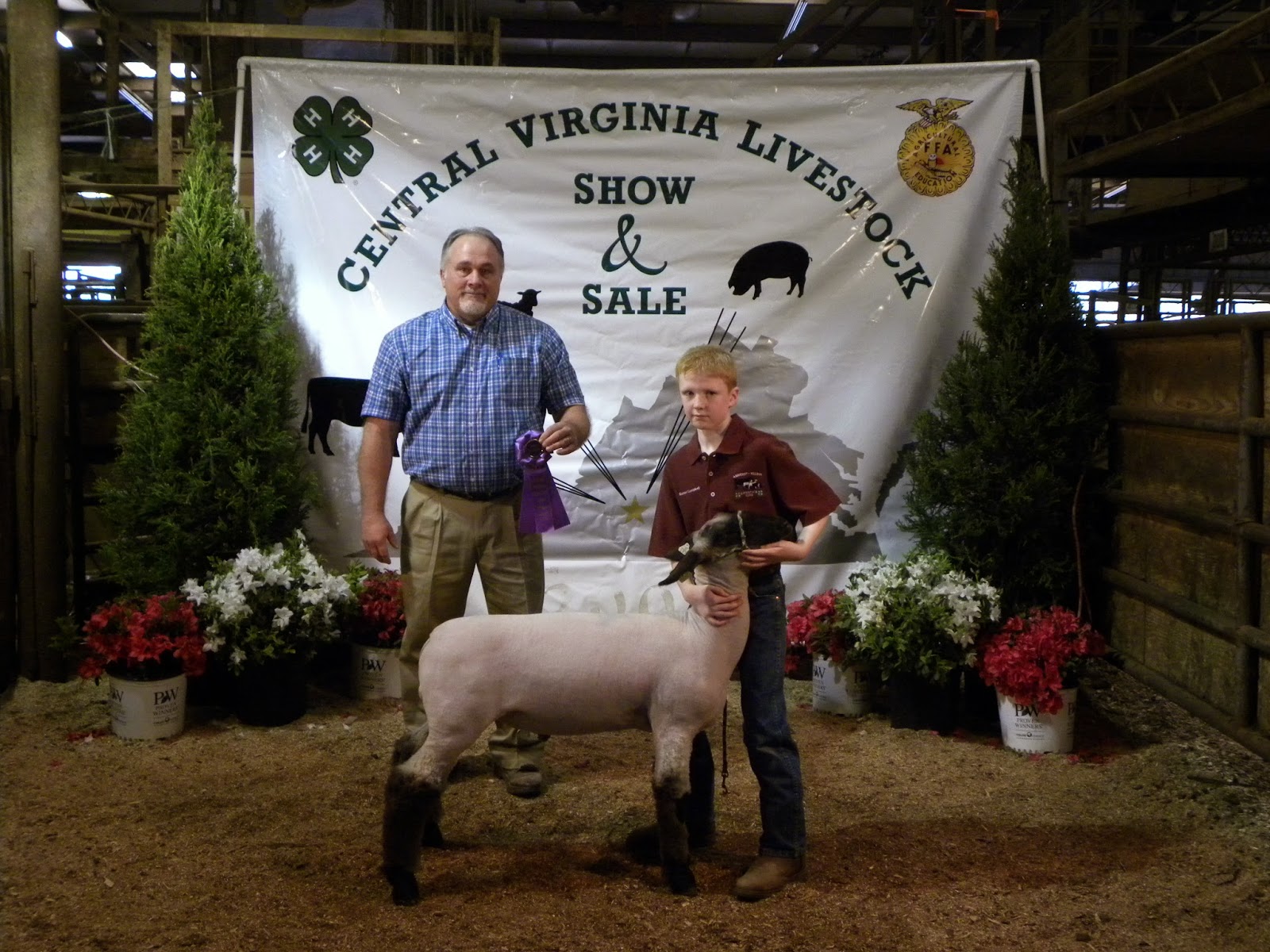
Champion market lamb showed by my son, Daniel,
and judge Corey Childs.
Now that spring is finally here, several livestock shows are taking place across the state, and county Farm Bureaus are very supportive of the youth livestock exhibitors. 
How, you may ask?  County Farm Bureaus support the livestock shows and county fairs mostly in a financial manner, but many individual Farm Bureau members volunteer with the logistics.  County Farm Bureaus buy animals at the sale after the show, sponsor a buyers’ dinner, or make a contribution to the 4-H livestock club.  The contributions are often significant reaching several thousand dollars per year.
On May 3rd, the Central Virginia Livestock Show and Sale was held at the Lynchburg Livestock Market.  It was a regional show with the counties of Amherst, Appomattox, Bedford, Campbell, and Nelson represented. 

The buyers’ dinner was sponsored by Campbell County Farm Bureau.  Campbell County Farm Bureau was also a significant buyer in the sale by purchasing several animals.  Bedford County Farm Bureau and Bedford Young Farmers were buyers as well.  Both of these county Farm Bureaus helped support the sale and offered a better price for the kids.  These two county Farm Bureau names were called by the auctioneer several times throughout the sale.  Their financial support was spread over many kids. 
At most sales like these, the county Farm Bureau purchases are as “support,” which means that they pay the difference between the final purchase price and the established floor price.  The animals purchased as “support” are then resold to a buyer or packer at market price.  There are other buyers at the sale too which include businesses and families.  A large portion of these purchases at the Central Virginia Livestock Show and Sale went for processing for people that wanted to fill their freezers with some high quality meat. 
Animals that are shown in breeding classes such as heifers, ewe lambs, gilts, and does are not sold and usually return back to the herd or flock back home at the family farm.  The Amherst and Nelson County Farm Bureaus make donations to the 4-H livestock club, and Appomattox donates to the FFA chapter which has its own small farm and a large number of exhibitors.  This kind of support is not isolated to central Virginia.  In fact, many county Farm Bureaus all over the state are supportive in similar fashion.
The county Farm Bureaus recognize the importance of supporting the next generation of agriculturalists and realize how vital they are to the future of the agriculture industry.  These livestock exhibitors are members of 4-H, FFA, or both.  They put in a lot of time and effort into preparing their animals for the shows which begins months prior.  Their livestock project teaches them about animal husbandry, nutrition, and business management. 
All of the exhibitors have to complete a record book, which is very detailed listing such things as cost of feed/head/day, feed labels, calculated average daily gain, and management activities.  The cost of inputs and price of the animal all add up, and getting a good price at the sale is essential in having a profitable project.  The kids are strongly encouraged to get buyer interest for their animals prior to the sale, and this helps with communication skills and builds confidence. 

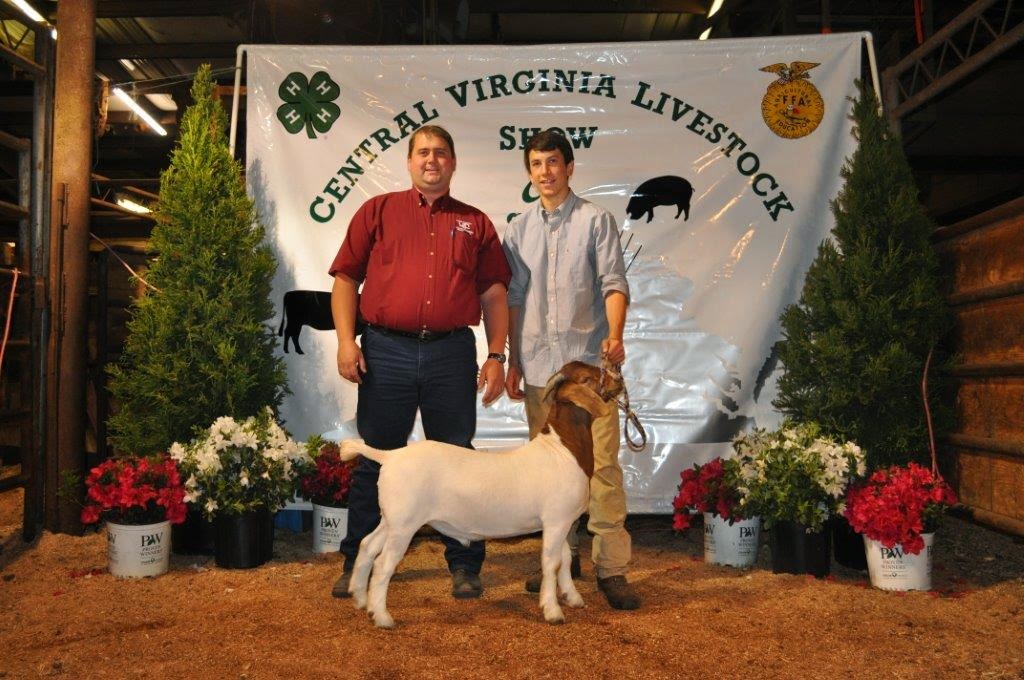
Champion market goat shown by Phillip Saunders of
Nelson County with buyer W.P. Johnson of
Bedford County Farm Bureau
The Amherst/Nelson 4-H livestock club swept up by having grand champion steer, market lamb, market goat and market hog all from Nelson and Amherst counties. These lessons of animal care, business management, and leadership and communication skills learned by the youth livestock exhibitors are strong reasons that county Farm Bureaus are more than willing to support the livestock shows and sales.  Some shows taking place this month that I know about are in Blackstone and Fredericksburg.  Check with your county extension office to find out when the closest show is to you.  It is an enjoyable time to watch the next generation of agriculturalists and a good opportunity to support the youth. 
Until next time,
Mark

Franklin County Women’s Committee Receives AFBF Food Link Grant

Franklin County Farm Bureau Women’s Committee was one of four county Farm Bureaus to receive a $700 grant from the American Farm Bureau Women’s Leadership Committee to help fund “Our Food Link” activities.
Other grant recipients include Oklahoma, Rhode Island and Utah Farm Bureaus; Dickey County (North Dakota), Franklin County (Virginia), Jerome County (Idaho) and Summit County (Ohio).
Grant-winning programs demonstrate a strong connection between the food system and agriculture, while creatively engaging consumers in a way that encourages them to learn more about food and agricultural products.
“Year-round outreach through ‘Our Food Link’ is more important than ever because the average American is now at least three generations removed from the farm,” explained Terry Gilbert, a Kentucky farmer and chair of the AFBWLC. Farm and ranch families make up less than 2 percent of the U.S. population today.

 Throughout the year, Farm Bureau members help consumers of all ages and backgrounds connect with sources of clothing, food, shelter and energy in their communities. Program activities range from outreach at supermarkets or farmers’ markets to hosting interactive booths at community events, speaking with lawmakers and neighbors about food or visiting a classroom to help students understand agricultural topics.

Franklin County’s activities answer the question “Where does our food come from?” and will be in two phases. Phase 1 will be an all-day event at a local elementary school where students and staff explore various aspects of agriculture, including compost, worms, soil and honey bees, healthy plants and finish with farm to table activities in 12 interactive stations that encourage different learning styles (hands on, auditory, visual and written). Phase 2 will continue using the same stations at the Franklin County Fair.
“Though a rural county, there is a growing number of “transplants” whose exposure to agriculture is limited,” said Debbie Brubaker, Franklin County Women’s Committee Chair. “We will provide unique learning opportunities that allow participants to explore the start to finish process of agriculture products and services. There will be a variety of agriculture fields covered using hands-on activities, interactive discussion, taste testing, age appropriate visuals, make and takes and live animals.”
“Our Food Link” activities may also include the collection of food and monetary donations for Ronald McDonald House Charities or other charities.
The launch of the program was spearheaded in January by the AFB Women’s Leadership Committee, although Gilbert noted, “All Farm Bureau members are invited and encouraged to consider participating in ‘Our Food Link’ activities. The flexibility of the program makes it a great fit for anyone looking for creative ways to reach the non-farming public with information about today’s agriculture,” she said.

Download the free “Our Food Link” Planning Toolkit and publicity tools at http://bit.ly/1j1jH5H.