State Veterinarian’s Office Urges Horse Owners to Check with Vets for Vaccination Schedule

The Virginia Department of Agriculture and Consumer Services (VDACS) urges all horse owners to check with their veterinarians for West Nile Virus (WNV), Eastern Equine Encephalitis (EEE) and rabies vaccination recommendations for their animals. Virginia only had one confirmed case of WNV and one of EEE in 2013, although the number of horses affected in other states was much higher.
State officials are concerned that horse owners may be lulled into inaction by the lack of disease activity last year and neglect vaccination this year. “Timely vaccination has been shown to decrease WNV and EEE disease incidence,” said Dr. Charles Broaddus, Program Manager for VDACS’ Office of Veterinary Services. “Without vaccination, we would expect to see many more infected horses, so we still urge horse owners to consider EEE and WNV vaccination. We believe that in most cases, private veterinarians will recommend them for their clients.”
Vaccines drastically reduce the incidence of WNV and EEE in horses. They are effective for six to twelve months, so horses should be re-vaccinated at least annually. In areas where the disease occurs frequently, most veterinarians recommend vaccination every six months. For the vaccine to be effective it must be handled and administered properly and be given at least two weeks before the horse is exposed to the virus. Additionally, to stimulate full immunity, horses must be vaccinated twice, about 30 days apart, the first year they are vaccinated. Other prevention methods include destroying standing water breeding sites for mosquitoes, using insect repellents and removing animals from mosquito-infested areas during peak biting times, usually dusk to dawn. 

Dr. Broaddus also suggests that owners check about rabies vaccinations for their horses. The number of rabies cases in horses has grown in the past few years. In fact, recently rabies cases have exceeded cases of WNV or EEE.
Rabies vaccines are also very effective and vaccinating horses annually can prevent rabies in both horses and humans. In addition to taking measures to decrease the likelihood that horses will be exposed to rabies, routine rabies vaccination is a very important aspect of disease prevention. Virginia did not report any horses positive for rabies in 2013, but had four positive in 2012.
All three of these diseases – EEE, WNV and rabies – cause neurologic signs in horses, such as  staggering, circling, depression, loss of appetite and sometimes fever and blindness. There is no cure for these diseases, which can kill anywhere from 30 percent (WNV) to 90 percent (EEE) to 100 percent (rabies) of the horses infected. Humans can become infected with rabies by handling a rabid horse but cannot become infected with EEE or WNV by handling an infected horse, nor can a horse acquire the virus from another infected horse. The presence of an infected horse in the area indicates that mosquitoes carrying EEE or WNV are present and those insects pose a threat to both humans and horses.      

For more information, contact the Office of Veterinary Services, Division of Animal Industry Services, VDACS, at 804.786.2483 or see vdacs.virginia.gov/animals/diseases.shtml. Information about rabies and rabies exposures can be found on the Virginia Department of Health’s Rabies Control page at vdh.virginia.gov/Epidemiology/DEE/Rabies/. Horse owners 
Sign-Up Begins Today for USDA Disaster Assistance Programs Restored by Farm Bill

Agriculture Secretary Tom Vilsack has announced that eligible farmers can sign up for U.S. Department of Agriculture (USDA) disaster assistance programs restored by passage of the 2014 Farm Bill.
“We implemented these programs in record time and kept our commitment to begin sign-up today,” said Agriculture Secretary Vilsack. “To ensure enrollment goes as smoothly as possible, dedicated staff in over 2,000 Farm Service Agency offices across the country are doing everything necessary to help producers that have suffered through two and a half difficult years with no assistance because these programs were awaiting Congressional action.”
Depending on the size and type of farm or ranch operation, eligible producers can enroll in one of four programs administered by the Farm Service Agency. The Livestock Forage Disaster Program (LFP), and the Livestock Indemnity Program (LIP) will provide payments to eligible producers for livestock deaths and grazing losses that have occurred since the expiration of the livestock disaster assistance programs in 2011, and including calendar years 2012, 2013, and 2014. The Emergency Assistance for Livestock, Honeybees, and Farm-Raised Fish Program (ELAP) provides emergency assistance to eligible producers of livestock, honeybees and farm-raised fish that have suffered losses because of disease, severe weather, blizzards and wildfires. 

Enrollment has also begun for the Tree Assistance Program (TAP), which provides financial assistance to qualifying orchardists and nursery tree growers to replant or rehabilitate trees, bushes and vines damaged by natural disasters.
Producers signing up for these programs are encouraged to contact their local FSA office for information on the types of records needed and to schedule an appointment. Taking these steps in advance will help producers ensure their application moves through the process as quickly as possible.
Supporting documents may include livestock birth records, purchase and transportation receipts, photos and ownership records showing the number and type of livestock lost, documents listing the gallons of water transported to livestock during drought, and more. Crop records may include purchase receipts for eligible trees, bushes, or vines, seed and fertilizer purchases, planting and production records, and documentation of labor and equipment used to plant or remove eligible trees, bushes, or vines.
Producers have three to nine months to apply depending on the program and year of the loss. Details are available from any local FSA office.

For more information, producers may review the 2014 Farm Bill Fact Sheet, and the LIP, LFP, ELAP and TAP fact sheets online, or visit any local FSA office or USDA Service Center.

New GMO Labeling Bill Launches National Conversation

Farmers have welcomed the introduction of the bipartisan Safe and Accurate Food Labeling Act (H.R. 4432), which will make it clear that the Food and Drug Administration is the nation’s foremost authority on the use and labeling of foods containing genetically modified ingredients.  The legislation will provide a federal solution to protect consumers from a confusing patchwork of 50-state GMO labeling policies, and the misinformation and high food costs that would come with them. 

“The diversity of innovative options farmers have in regard to how they grow our food is one of the reasons U.S. consumers enjoy a wide variety of foods that are also among the most affordable in the world,” American Farm Bureau Federation President Bob Stallman said in a statement.  “Farm Bureau supports all production practices – and common sense, science-based regulations – that ensure consumers are receiving safe and healthy food. But we will stand adamantly opposed to those who want to take tools and technologies away from America’s farmers and affordable choices away from consumers.”

The GMO labeling ballot initiatives and legislative efforts that many state lawmakers and voters are facing are geared toward making people wrongly fear what they’re eating and feeding their children, despite the fact that every credible U.S. and international food safety authority that has studied GMO crops has found that they are safe and that there are no health effects associated with their use.

In addition, much of the activity at the state level undermines the public’s understanding of the many benefits of biotechnology.  GMO crops use less water and pesticides, reduce the price of crops by as much as 30 percent and are key to feeding a growing world population of 7 billion people.

The Safe and Accurate Food Labeling Act protects consumers on two fronts.  First, it requires FDA to conduct a safety review of all new GMO traits well before they’re available on supermarket shelves and empowers the agency to mandate the labeling of GMO food ingredients if the agency determines there is a health, safety or nutrition issue with a new GMO technology. 

Second, it will ensure farmers have access to the technology they need to provide consumers with the variety of food options and price points they expect, and need.  This legislation will ensure food safety is the leading driver of a national labeling policy, while maintaining the affordability of the U.S. food supply. 

The bill would not prevent companies from voluntarily labeling their products for the absence or presence of GMO ingredients, but would instead direct FDA to establish federal standards for those voluntary labels. 

In his statement, Stallman noted farmers’ and ranchers’ appreciation for the bipartisan leadership of the bills’ sponsors, Reps. Mike Pompeo (R-Kan.), G.K. Butterfield (D-N.C.), Marsha Blackburn (R-Tenn.), Jim Matheson (D-Utah) and Ed Whitfield (R-Ky.)

“With the introduction of this legislation and the leadership of the bill’s sponsors, Farm Bureau looks forward to a national-level discussion that will affirm FDA’s role in assuring consumers about GMO safety and reduce the confusion that would result from a patchwork of state labeling initiatives,” Stallman said. 

For more information about the importance of biotechnology in agriculture, or to urge your congressional representative to support The Safe and Accurate Food Labeling Act, please see the FBAct Insider’s biotechnology section, http://www.fbactinsider.org/issues/biotechnology-and-the-farm.

Join Farm Bureau and USFRA for a Screening of ‘Farmland’

Join Virginia Farm Bureau and the U.S. Farmers & Ranchers Alliance for a screening of Academy Award®-winning filmmaker James Moll’s new feature length documentary, Farmland, May 1 at the Regal MacArthur Center Stadium at 7 p.m.

Through this film from Award-Winning Director, James Moll, you’ll step inside the world of farming for a first-hand glimpse into the lives of young farmers and ranchers, learn about their high-risk/high-reward jobs and passion for a way of life that has been passed down from generation to generation, yet continues to evolve.

“In Farmland, audiences will hear thoughts and opinions about agriculture, but not from me, and not from a narrator,” Moll says about his film. “They’re from the mouths of the farmers and ranchers themselves.”

From the FARMLAND film site:
Most Americans have never stepped foot on a farm or ranch or even talked to the people who grow and raise the food we eat. Farmland will take an intimate look at the lives of farmers and ranchers in their ’20’s, all of whom are now responsible for running their farming business.

Visit www.FarmlandFilm.com for additional information about the film and to watch the trailer. 

Farmland was produced by Moll’s Allentown Productions, with generous support from the U.S. Farmers & Ranchers Alliance®(USFRA®).

For more information on attending the screening, contact Kathy Dixon in the VFB Communications Department at 804-290-1137 or kathy.dixon@vafb.com

From the Field: Making Congressional Connections

From the Field is a bi-monthly column written by Mark Campbell, Farm Bureau Field Services Director for the Central District. He writes about Farm Bureau member benefits and County Farm Bureau activities.

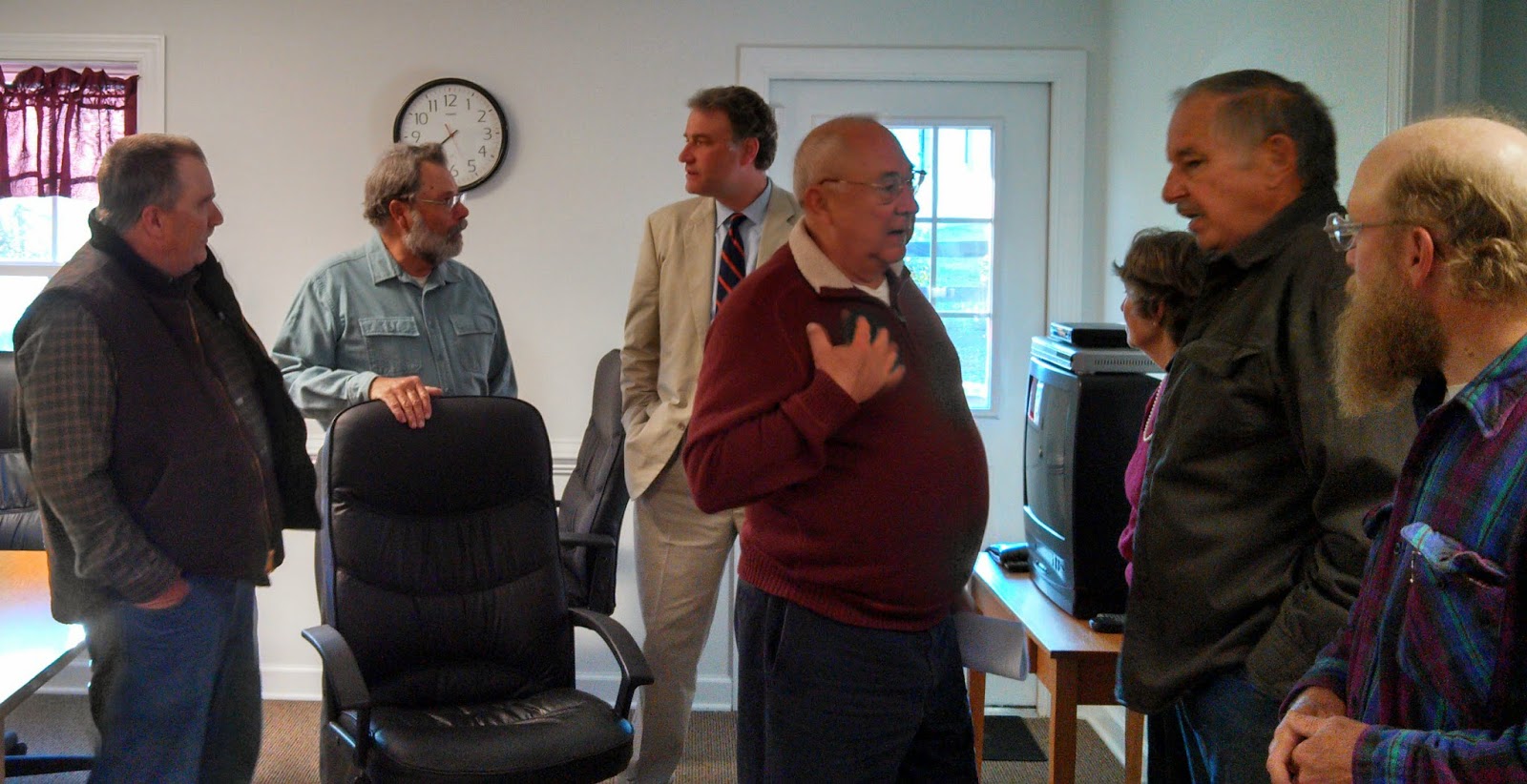
Congressman Robert Hurt met with constituents in the 5th district this week. He has a large area to cover as the 5th congressional district stretches from the North Carolina and Virginia state line to Warrenton and is almost the size of Massachusetts. Scott Leake, director of outreach and coalitions from the Charlottesville district office, also attended and has attended numerous Farm Bureau meetings in the past.
The meetings with farmers were in Charlottesville and Fork Union. On Tuesday afternoon, Congressman Hurt met with several farmers and members of the Charlottesville Chamber of Commerce Agribusiness Committee in Charlottesville. The second meeting was in Fork Union at the Fluvanna County Farm Bureau office at 7:30am on Wednesday. It was attended by several Farm Bureau producer members. 

At both meetings, Congressman Hurt provided an update on happenings at the federal level and the constant battle to reign in government agencies from overreaching their authority. He also expressed strong concern about the annual deficits and the national debt which is now over $17 trillion and noted that the debt is a national security issue.
The people that attended were offered an opportunity to make comments and ask questions. The common theme of questions and comments from both meetings was about the overreach of federal government agencies and the burden of those agencies, not just on agriculture and forestry, but everyone.
EPA was mentioned because of their recent proposed rule to deem all waters, not just navigable, under their jurisdiction. Congressman Hurt acknowledged that EPA has far exceeded its authority and operates in an intimidating fashion. He added that this expansion of power by governmental agencies has been allowed to happen over the past 50 years under Democrat and Republican presidents and Congresses, but it needs to get back to where the Congress elected by the people dictate to the agencies not the agencies writing their own laws.
On a positive note, Congressman Hurt and Scott Leake were very proud of the FFA chapters in the district. Nelson County has had national winning teams at competitions for several years. Fluvanna implemented a horticulture class in 2013, built a greenhouse and established an FFA chapter. Both of these FFAs have benefited from significant support from the county Farm Bureaus.

The roundtable meetings were beneficial to both farmers and Congressman Hurt. If there is ever an opportunity for you to meet with your congressman or senator in your area, try to go. Their schedules are very busy and you don’t have to travel to Washington D.C. All of these legislators have district offices and many of those people, like Scott Leake, are in tune with what is going on in the counties within the district and are accessible. So if you can’t meet or speak with your legislator directly, the district offices are a great option.
Until next time,
Mark

Governor Names New State Forester

On Friday, Gov. McAuliffe announced Bettina K. Ring as the new State Forester of Virginia.
She most recently served as Senior Vice President of Family Forests at the American Forest Foundation where she was responsible for overseeing the American Tree Farm System®, the largest and oldest sustainable woodland program in America, supporting more than 80,000 family forest owners collectively managing 27 million acres of certified woodlands. 
Ring has a long history in the conservation and forestry sectors, having spent 14 years at the Virginia Department of Forestry, departing the agency in 2001 as Deputy State Forester.  In her role, Ring was responsible for operations, and helped to develop and implement a new mission, vision and strategic plan for the department. 
In the years following her Department of Forestry service, Ring held various leadership positions within nonprofit organizations focusing on natural resources management and conservation, including the Colorado Coalition of Land Trusts, The Wilderness Land Trust and the Bay Area Open Space Council. 

She holds a Bachelors degree in Forestry and Wildlife from Virginia Tech and a Masters degree in Business Administration from James Madison University.

Breaking News: Virginia Farm Bureau Responds to AG brief in AFBF Bay Litigation

We heard earlier this week that VA Attorney General Herring filed an amicus “Friend of the Court” brief in the AFBF appeal of decision in their litigation against EPA regarding the Chesapeake Bay.  The Pennsylvania US district court ruled that EPA did not require authority from Congress to act on environmental issues.  We believe that is the exact opposite of our fundamental rules of government; EPA only has the authority expressly granted from Congress. 
As you may have heard 21 Attorneys General from across the US have filed a similar brief on behalf of AFBF’s position. This action was inevitable in order to counter that brief especially since the Chesapeake Bay Foundation has intervened in the case.
This is a setback but hopefully not fatal to the appeal.
Below is a statement from Virginia Farm Bureau Federation President Wayne F. Pryor that has been sent to various media and newspapers across the state: 

“Like most Virginians, the commonwealth’s farmers support and see the tremendous value of a productive and healthy Chesapeake Bay. We simply disagree about the role of the federal government, specifically the Environmental Protection Agency, in maintaining the progress we have made and further improvements we all desire.
It is surprising that Attorney General Herring would defend an EPA action that undeniably ties states’ hands and restricts their authority to make their own local land use and development decisions. The pending American Farm Bureau Federation appeal of a federal district court lawsuit does not challenge Virginia’s own cleanup plan or Virginia’s ability to work collaboratively with other bay watershed states and with the EPA to clean up the bay. What it does challenge is the EPA’s edict that Virginia and the other bay states cannot change their cleanup plans without EPA approval. As Rep. Bob Goodlatte noted in the April 11 article “Herring supports federal plan to clean up Chesapeake Bay,” no state should have to say, “Mother, may I?” to make its own land use and water quality decisions.
Fortunately, 21 other state attorneys general recognize this EPA power grab for what it is and have challenged it. If or when the commonwealth of Virginia decides it wants to pursue the bay cleanup in a manner contrary to EPA’s wishes—perhaps in a way that will lower its $15 billion dollar price tag for citizens—the commonwealth will thank the American Farm Bureau for preserving its ability to do so.

On behalf of farmers across Virginia, I call upon Attorney General Herring to work directly with us to continue our progress toward conservation goals for the Chesapeake Bay.”