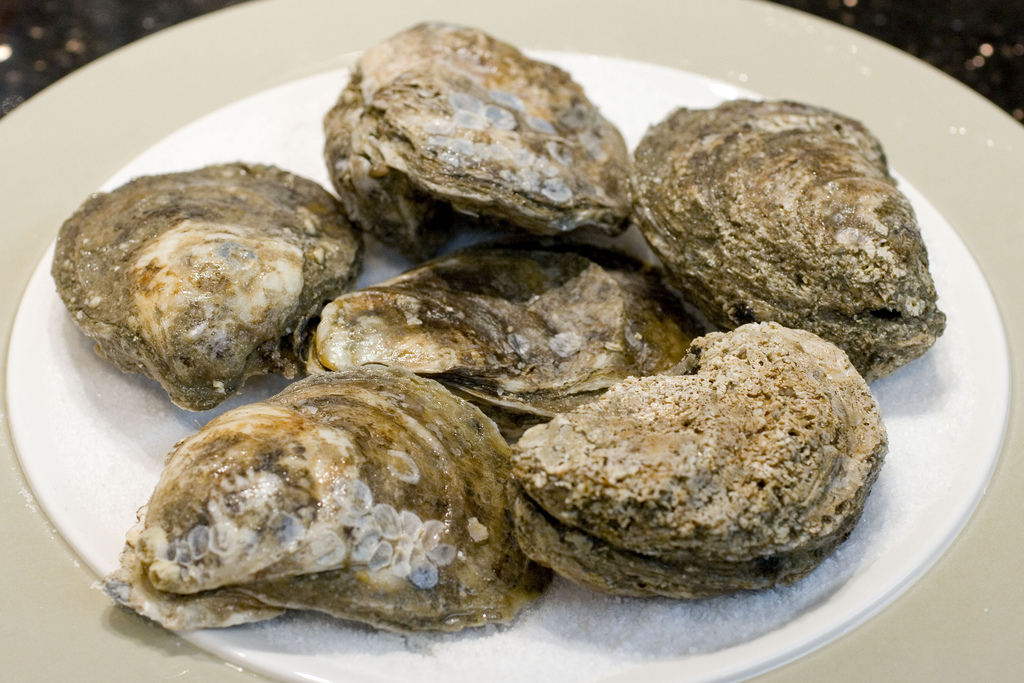
Virginia Oysters See Growth Over Last Decade

Earlier this month, Gov. Bob McDonnell toured Kellum Seafood Company’s oyster harvesting, shucking and packing facility in Weems, located in the Northern Neck along the Rappahannock River, to witness first-hand the strides made by Virginia’s oyster industry and to celebrate the industry’s growth in recent years, highlighted by a 28 percent leap in last year’s harvest. Over the past decade, the oyster harvest in Virginia has increased ten-fold, from 23,000 bushels in the 2001 oyster season to 250,000 bushels in the 2011 season. In that time, the dockside value of the oyster harvest increased from $575,000 to $8.75 million in 2011. Virginia continues to be the largest East Coast producer, and the nation’s third largest overall producer, of marine products.
 “Virginia’s oyster industry has made remarkable strides, and indications are this year’s harvest may be the best we’ve seen in the past quarter-century,’’ Governor McDonnell said. “Good management has allowed us to put our excellent oysters on dinner tables around the world, to create good jobs for our citizens and to bring new revenue into our state. And we’re on pace for even more growth in the oyster industry.  As oyster companies like Kellum Seafood continue to grow, they know they’ve got a friend in Richmond. Working with the General Assembly, we’re laser focused on putting in place policies that help job-creators like Tommy Kellum continue to expand their operations, and employ more Virginians in the process.” 

The Virginia Marine Resources Commission’s preliminary harvest reports indicate the 2012-13 oyster season harvest has increased another 28 percent, to more than 320,000 bushels, with a dockside value of $11.2 million, making it the largest oyster harvest in Virginia since 1987.
Kellum Seafood was founded three generations ago in a one-room oyster shucking house and has grown into an operation that grows, harvests, shucks, packs and ships oysters from water bottom the company leases from the state, as well as oysters caught from public oyster rocks by commercial watermen. Kellum Seafood’s plant has grown over the years to a 10,000 square foot facility complete with storage and on-site U.S. Department of Commerce inspections.
 “The oyster industry is growing and has a bright future,’’ said Tommy Kellum, current partner and vice-president of Kellum Seafood and the third generation of Kellums to manage the operation. “I’m so convinced of that that I’m expanding our operations and have recently purchased a new vessel to help accommodate the growth. Growth means jobs. The Governor and his Administration deserve a lot of credit.”
“Good fishery management has produced excellent results that are bearing fruit in the form of larger harvests, a growing industry and more jobs,” said Doug Domenech, Secretary of Natural Resources. “This is a win for the health of the Bay, for oyster-lovers and for our hard-pressed watermen in these difficult economic times.”
Thanks to a record $2 million appropriated in the state budget for oyster replenishment by Governor McDonnell and the Virginia General Assembly, VMRC mined fossil oyster shells this summer from the James River (augmented with available empty oyster shells from shucking houses such as Kellum Seafood) and planted roughly 1 billion individual empty oyster shells on public oyster grounds. It was enough to fill approximately 4,000 dump trucks.
Those empty shells will become homes for naturally occurring oyster larvae that attach to them during spawning and grow to form new adult oysters that will reach market size in roughly three years. The replenishment program provides significant ecological as well as economic benefits. A single adult oyster can purge up to 50 gallons of water a day. Oyster reefs provide important forage and refuge habitat for invertebrates, as well as juvenile crabs and finfish species.
 “While some of these oyster replenishment shells went onto our oyster sanctuaries, the majority went onto our new rotational oyster harvest areas, meaning they will be untouched for several years as they grow to adulthood and spawn a new generation of oysters before they can be harvested,” said Virginia Marine Resources Commissioner Jack Travelstead. “It is important they be harvested at that point because otherwise they are susceptible to two diseases, Dermo and MSX, which kill adult oysters. We don’t want to see these oysters wasted to disease.”
VMRC’s Dr. Jim Wesson estimates every $1 spent by the state to plant oyster shell yields $7 in economic benefits in the form of larger harvests, and increased jobs for oyster shucking, processing, packing and shipping houses.
Over the past five years of rotational harvests, the harvest off public oyster grounds has almost quadrupled, from 36,000 bushels in the 2008 oyster season to 137,000 bushels in 2012.  If oyster replenishment funding is continued at its current level, and environmental conditions remain unchanged, Wesson estimates the harvest from public oyster grounds could grow to 200,000 bushels in 2016 and that combined with anticipated increases in oyster aquaculture production, could push Virginia’s oyster harvest to 500,000 bushels in 2016 – which, if realized, would be a 56 percent increase from the preliminary 2012 harvest level.
“The significant gains in oyster aquaculture over the last few years have solidified the Commonwealth’s position in the global marketplace as a top producer of the highest quality oysters,’’ said Todd Haymore, Secretary of Agriculture and Forestry. “The Governor has promoted Virginia’s outstanding marine products, including our world-class oysters, on all of his domestic and international trade missions, resulting in new sales to key markets along the East Coast and to Asia and Europe. With fortified domestic marketing efforts and new Virginia agricultural trade offices now open in China and Great Britain and one to open soon in Canada, we expect more sales opportunities in the months ahead for our oyster producers and exporters.”
The Virginia seafood industry is one of the oldest industries in the United States and one of the Commonwealth’s largest. According to the Virginia Marine Products Board, the marketing arm of Virginia’s seafood industry, Virginia is the nation’s third largest producer of marine products, behind only Alaska and Louisiana, with total landings of almost 495 million pounds in 2011, the most recent year with full economic data. The dockside value from these landing to watermen alone was just under $192 million
Breaking News: Virginia Farm Bureau Federation AgPAC Andorses 88 Candidates for House Seats

Virginia Farm Bureau Federation AgPAC has announced its endorsement of 88 candidates for seats in the Virginia House of Delegates. The endorsements are based on recommendations of local committees of farmers. Endorsed were:

1st District – Terry Kilgore* (R)
2nd District – Mark Dudenhefer* (R)
3rd District – Will Morefield* (R)
4th District – Ben Chafin (R)
5th District – Israel O’Quinn* (R)
6th District – Jonathan McGrady (D)
7th District – Nick Rush* (R)
8th District – Greg Habeeb* (R)
9th District – Charles Poindexter* (R)
10th District – Randy Minchew* (R)
11th District – Onzlee Ware* (D)
12th District – Joseph Yost* (R)
14th District – Danny Marshall* (R)
15th District – Todd Gilbert* (R)
16th District – Les Adams (R)
17th District – Christopher Head* (R)
18th District – Michael Webert* (R)
19th District – Terry L Austin (R)
20th District – Dickie Bell* (R)
21st District – Ron Villanueva* (R)
22nd District – Kathy Byron* (R)
23rd District – Scott Garrett* (R)
24th District – Ben Cline* (R)
25th District – Steve Landes* (R)
26th District – Tony Wilt* (R)
27th District – Roxann Robinson* (R)
28th District – Bill Howell* (R)
30th District – Ed Scott* (R)
32nd District – Tag Greason* (R)
33rd District – Mary Daniel (D)
34th District – Barbara Comstock* (R)
35th District – Mark Keam* (D)
36th District – Ken Plum* (D)
37th District – David Bulova* (D)
40th District – Tim Hugo* (R)
41st District – Eileen Filler-Corn* (D)
42nd District – Dave Albo* (R)
43rd District – Mark Sickles* (D)
50th District – Jackson Miller* (R)
51st District – Rich Anderson* (R)
52nd District – Luke Torian* (D)
53rd District – Marcus Simon (D)
54th District – Bobby Orrock* (R)
55th District – Buddy Fowler (R)
56th District – Peter Farrell* (R)
57th District – David Toscano* (D)
58th District – Rob Bell* (R)
59th District – Matt Fariss* (R)
60th District – James Edmunds* (R)
61st District – Tommy Wright* (R)
62nd District – Riley Ingram* (R)
63rd District – Rosalyn Dance* (D)
64th District – Rick Morris* (R)
65th District – Lee Ware* (R)
66th District – Kirk Cox* (R)
67th District – Jim LeMunyon* (R)
68th District – Manoli Loupassi* (R)
69th District – Betsy Carr* (D)
70th District – Delores McQuinn*(D)
72nd District – Jimmie Massie* (R)
73rd District – John O’Bannon* (R)
74th District – Joe Morrissey* (D)
75th District – Roslyn Tyler* (D)
76th District – Chris Jones* (R)
77th District – Lionell Spruill, Sr* (D)
78th District – James A Leftwich, Jr. (R)
79th District – Johnny Joannou* (D)
80th District – Matthew James* (D)
81st District – Barry Knight* (R)
82nd District – Bill DeSteph (R)
83rd District – Chris Stolle*(R)
84th District – Glenn Davis (R)
85th District – Scott Taylor (R)
86th District – Tom Rust* (R)
87th District – John Bell (D)
88th District – Mark Cole* (R)
89th District – Daun Hester* (D)
90th District – Algie Howell* (D)
91st District – Gordon Helsel* (R)
92nd District – Jeion Ward* (D)
93rd District – Mike Watson* (R)
94th District – David Yancey* (R)
95th District – Mamye BaCote* (D)
96th District – Brenda Pogge* (R)
97th District – Chris Peace* (R)
98th District – Keith Hodges* (R)
99th District – Margaret Ransone* (R)
100th District – Lynwood Lewis* (D)

* indicates incumbent

“Each of these candidates has demonstrated a clear understanding of the needs and challenges farmers are facing and/or have proven their support through their favorable voting records while holding positions in the General Assembly,” said Wayne F. Pryor, chairman of VFBF AgPAC and president of Virginia Farm Bureau. “We believe these candidates will help agriculture and forestry maintain its vitality as the No. 1 industry in Virginia.”

The non-partisan VFBF AgPAC was created by Farm Bureau in 1999 and employs in-kind contributions to support candidates who can best support agriculture ad Farm Bureau issues.

Carolina Farm Credit Hires Former VFBF Governmental Relations Intern

Michael R. Morton, CEO of Carolina Farm Credit, is pleased to announce that Katie DuBreuil recently joined the Carolina Farm Credit team as a loan officer trainee in the Pilot Mountain service center.

DuBreuil is originally from Midlothian, VA and graduated from Virginia Tech University where she received bachelor’s and master’s degrees in agricultural economics. While at Virginia Tech, she worked as a graduate research & teaching assistant. She was also a summer intern for the Virginia Farm Bureau Federation’s Governmental Relations Department. She currently lives in Winston-Salem, NC and enjoys outdoor activities including hiking and shooting sports, traveling, and cooking. She is engaged to be married in October of this year.

DuBreuil’s role as a loan officer trainee consists of building strong relationships and providing value-added financial services to Carolina Farm Credit members.

To learn more about the wide array of loans and financial services available through Carolina Farm Credit, call the Pilot Mountain service center at 336-368-4761 or visit carolinafarmcredit.com.

Carolina Farm Credit is a farmer-owned cooperative providing short, intermediate, and long-term financing to full and part-time farmers and agricultural-related businesses and also provides financing for the construction and purchase of rural homes in 54 counties through 36 service centers. Other financial services available through Carolina Farm Credit are credit life and crop insurance, appraisal services, financial planning, and leasing programs.

Carolina Farm Credit serves over 8,800 members with loans outstanding totaling more than $1.3 billion. The association’s territory covers the western half of North Carolina, with service centers located in Albemarle, Asheboro, Asheville, Boone, Browns Summit, Burnsville, Carthage, Concord, Ellerbe, Graham, Hendersonville, Hillsborough, Jefferson, Lenoir, Lexington, Lincolnton, Marshall, Mocksville, Monroe, Murphy, Newton, Pilot Mountain, Roxboro, Rural Hall, Salisbury, Shelby, Siler City, Sparta, Spindale, Statesville, Taylorsville, Wadesboro, Waynesville, Wilkesboro, Yadkinville, and Yanceyville.

Carolina Farm Credit was recognized as a 2013 Best Employer in North Carolina. The list of the Best Employers in North Carolina was created by Business North Carolina, the Society for Human Resource Management (SHRM) – NC State Council and Best Companies Group. Carolina Farm Credit is the 5th Best Employer in North Carolina in the small to medium-sized company category.

Directors for Carolina Farm Credit are Joseph A. Lail, Chairman, Shelby; Mark A. Bray, Vice-Chairman, Lawsonville; John M. Barnard, Statesville; E. Bernard Beck, Seagrove; W. Rex Bell, Statesville; David M. Coltrane, Pleasant Garden; Susie J. Gambill, Sparta; W. Steve Love, Graham; Bobby J. “Bud” Matthews, East Bend; Clark M. Newlin, Haw River; Thomas E. Porter, Jr., Concord; Tony L. Ragan, Sanford; D. Kaleb Rathbone, Waynesville; Lewis E. Smith, Lincolnton; Vickie N. Smitherman, East Bend; L. Kim Starnes, Salisbury; Dr. Alton Thompson, Summerfield.

From the Field: Perseverance

From the Field is a bi-monthly column written by Mark Campbell, Farm Bureau Field Services Director for the Central District. He writes about Farm Bureau member benefits and County Farm Bureau activities.

Perseverance is defined as “continued effort to do or achieve something despite difficulties, failure, or opposition.”  Farm Bureau is thankful to have numerous volunteers and county Farm Bureaus that have the quality of perseverance. 

Perseverance in many cases is a key factor in farming and ranching.  Despite challenges, farmers and ranchers keep plowing forward with a hopeful heart and confidence in doing the right thing.  One example of perseverance that I want to share with you is from Fluvanna County. 
Fluvanna is a county just southeast of Charlottesville and has not had a vocational-agriculture class in the school system since the year 2000.  Residents say the class was mostly mechanical and wood trades with very little agriculture.  A FFA chapter hasn’t been present in decades.  While Fluvanna was lacking an agriculture program and FFA, counties adjacent to it, such as Louisa and Nelson, had extremely strong agriculture and FFA programs. Many of the residents wanted to see an agriculture class in Fluvanna schools again.
Fluvanna County Farm Bureau (FCFB) knew that things had to change, and it would be up to them to make it happen.  There had been a growing 4-H program, especially in the equine area.   
Discussions on how to implement an agriculture curriculum started in 2007.  In 2008, serious planning started.  Dr. Glenn Anderson, Agriculture Education Specialist for the Virginia Department of Education, met with the board of directors and informed them of the various agriculture curriculum tracks that were available and key people in the school system to meet. 
FCFB took every opportunity to lobby the school board and board of supervisors members for an agriculture program.  FCFB leveraged their lobbying efforts by having a $1,000 scholarship available to any high school student who planned to pursue a college degree in a college of agriculture.  Furthermore, FCFB assisted with funding a small hydroponics project that was actually part of a math business class. 
FCFB partnered with the extension agent and 4-H agent to further the cause.  The partnership hosted an “Agriculture Open House” at the middle school.  This open house had a rotation of classes that visited numerous stations that described what types of careers and opportunities fell under the broad title, agriculture.  The survey (conducted by school administration) response afterwards from the students revealed strong support for an agriculture class to be offered.
 FCFB had Virginia State FFA officers at one of their annual meetings to make the case for an agriculture class and FFA.  If you have heard a state FFA officer speak, you know what polished speakers they are.  FCFB made it a point to invite the key school staff, school board, and board of supervisors to hear the message.
This effort was not without challenges.  The message that FCFB was making seemed to often fall on deaf ears for the first few years.  Several reasons provided as to why an agriculture program was not realistic ranged from there being no interest to lack of funding.  There were times when it was appropriate to step back for a while, and take a break from it. 
FCFB persevered for six years and finally achieved success this year when a horticulture teacher was hired.  The class is available to grades 8-12 and current enrollment is 106 students.  A new large greenhouse is being constructed this fall. 
FCFB obviously plans to continue its support of this class now that it has been established.  Hopefully a FFA chapter will follow.
We can all feel overwhelmed at times with all that we have to do.  But I think the best strategy is to break it down in segments.  Little successes over time will lead to accomplishing that goal that seemed daunting at the start.
Until next time,

Mark

Breaking News: Virginia Farm Bureau Federation AgPAC endorses Cuccinelli, Northam, Obenshain

Virginia Farm Bureau Federation AgPAC has announced its endorsement of Ken Cuccinelli, the Republican candidate for governor; Ralph S. Northam, the Democratic candidate for lieutenant governor; and Mark D. Obenshain, the Republican candidate for attorney general.

“The individuals we endorsed have demonstrated their support for farmers through their leadership on specific issues or their favorable voting records while holding positions in the General Assembly,” said Wayne F. Pryor, VFBF president and chairman of the VFBF AgPAC board of trustees. “We believe we have endorsed three candidates who have helped farmers and will continue to help agriculture and forestry remain viable and remain Virginia’s largest industry.”

Pryor said Cuccinelli “has a proven track record of standing up for eminent domain reform” and for fair treatment of landowners in the takings process. “Without the leadership of Ken Cuccinelli, we would not have the eminent domain reform amendment to Virginia’s constitution,” approved by voters last fall.

He also praised Cuccinelli for calling foul when the U.S. Environmental Protection Agency attempted to overstep its statutory authority on water and air issues that affect farms.

“While farmers want clean water and air, they cannot survive if heavy-handed regulatory measures come to bear in the future from an overzealous federal agency. We appreciated Mr. Cuccinelli’s efforts as attorney general to question the EPA’s authority in trying to define water, itself, as a pollutant. While that case was not directly tied to agriculture, his actions served to call attention to the EPA overstepping its bounds.”

Pryor said Northam “has an excellent voting record on some of the key issues important to farmers. He supported the passage of the constitutional amendment on eminent domain reform. He grew up on the Eastern Shore with roots in the farming community, and we believe his experience on the Senate Agriculture,Conservation and Natural Resources Committee will serve as a useful background with regard to issues that have an impact on farmers.”

Obenshain, Pryor said, has also been a strong advocate for farmers on the Senate Agriculture, Conservation and Natural Resources Committee and has an agriculture-friendly voting record.

“He carried the constitutional amendment for eminent domain reform even in years when its passage failed, but he never gave up. He reached across the aisle to build bipartisan alliances to achieve its passage. He also recognizes the need to make sure the interests of landowners are protected. We believe that Mr. Obenshain, as Virginia’s next attorney general, will continue to make sure that EPA doesn’t try to bully Virginia into complying with job-killing regulatory measures that exceed its statutory authority.”

The nonpartisan VFBF AgPAC was created by Farm Bureau in 1999 and employs in-kind contributions to support candidates who can best support agriculture and Farm Bureau issues.

Virginia Tech Researchers Assist the State by Studying Effects of Pesticides on Honeybee Health

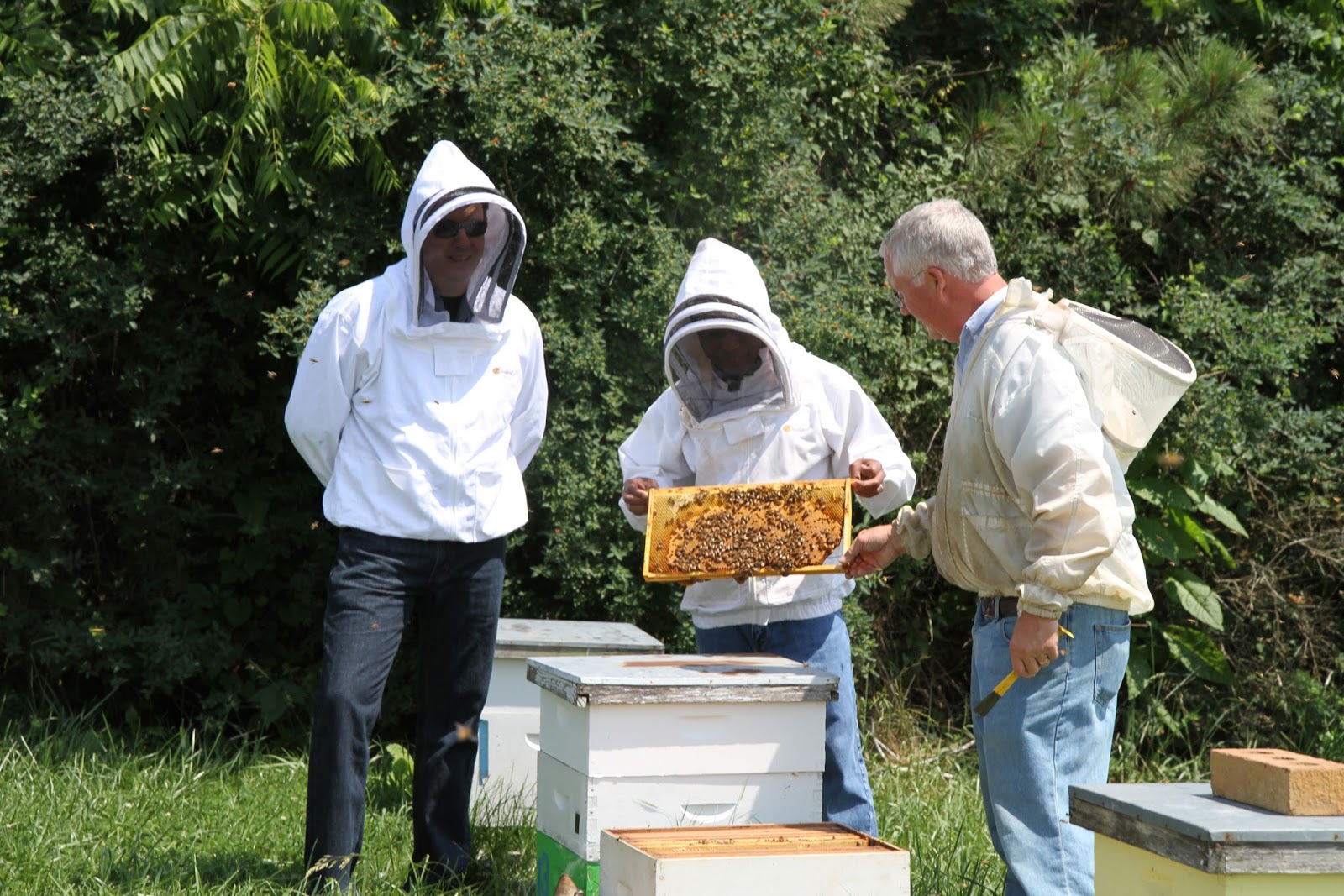
Troy Anderson, Carlyle Brewster, and Richard Fell monitor
honeybee hives at Virginia Tech’s Price’s Fork Research Center
Virginia Tech researchers are gathering valuable information about the impact of pesticide exposure on honey bee colony health in Virginia, helping both the apicultural and agricultural industries to reduce the loss of managed bee colonies.

Honey bees allow for the production of important crops such as apples, melons, and squash in the commonwealth of Virginia, but hives are collapsing at an approximate rate of 33 percent per year, according to the United StatesDepartment of Agriculture, and continued losses are expected to drive up food costs. Despite active research efforts, a fundamental explanation for bee colony losses remains unclear.

“There are knowledge gaps with respect to pesticide effects on bee colonies,” said Troy Anderson, an assistant professor of entomology in the College of Agriculture and LifeSciences and affiliated member of the Fralin Life Science Institute.  “This study will provide important information about the exposure of bee colonies to common-use pesticides and the health risks associated with these exposures.”

Funded by a $1.4 million grant from the Virginia Department of Agriculture and Consumer Services, Anderson is engaging in the five-year study with Richard Fell, professor emeritus of entomology and Carlyle Brewster, professor of entomology, in the College of Agriculture and Life Sciences. Funding for this grant is from pesticide fees collected by VDACS’ Office of Pesticide Services.  No taxpayer dollars are used.
“We are pleased to support this critical study,” said Matt Lohr, Virginia’s Commissioner of Agriculture and Consumer Services. “Our ability to protect honey bees and reinvigorate their numbers will rely heavily on the science-based results that we anticipate from this effort.”

Together, the team will employ Anderson’s toxicology background with Fell’s expertise in apiculture and Brewster’s talent in quantitative ecology.  They will seek out beekeeper participation in six agricultural regions of the state– Winchester, Virginia Beach, the Eastern Shore, Suffolk, Petersburg, and Blacksburg– and partner with Virginia Tech Agricultural Research and Extension Centers when possible.

“At each of the regions, we will examine various hive components such as wax, pollen, and the bees themselves to assess the levels of within-hive pesticide residues, and colony health and nutrition.  The multitude of data collected will then be analyzed using multivariate statistical methods to determine the extent to which bee colony health profiles are related to the pesticide residues in Virginia,” Brewster said.

Since the 1940’s, the number of hives in the United States has been halved from 5 million to 2.5 million, according to the United States Department of Agriculture.  Colony decline worsened in the 1980’s with the advent of pathogens and pests, and even more in the 1990’s, with the invasion of Varroa and tracheal mites.

“Beekeeper-applied miticides, or the pesticides used to treat these mites, are of particular interest in this study,” Anderson said.  “The study, however, will not be limited to miticides, but also will include several grower-applied pesticides.These data will not only improve our ability to predict favorable or unfavorable conditions for bee colony health, but will be used to provide useful management practices for beekeepers, growers, and pesticide applicators.”

My Busy Summer as a Governmental Relations Intern

Joseph Degreenia, a rising Junior at Virginia Tech, just wrapped up his final week as intern for the Governmental Relations Department, and he wanted to share his experiences this summer with you. Thanks for a great job this summer, Joseph! Good luck at Tech!
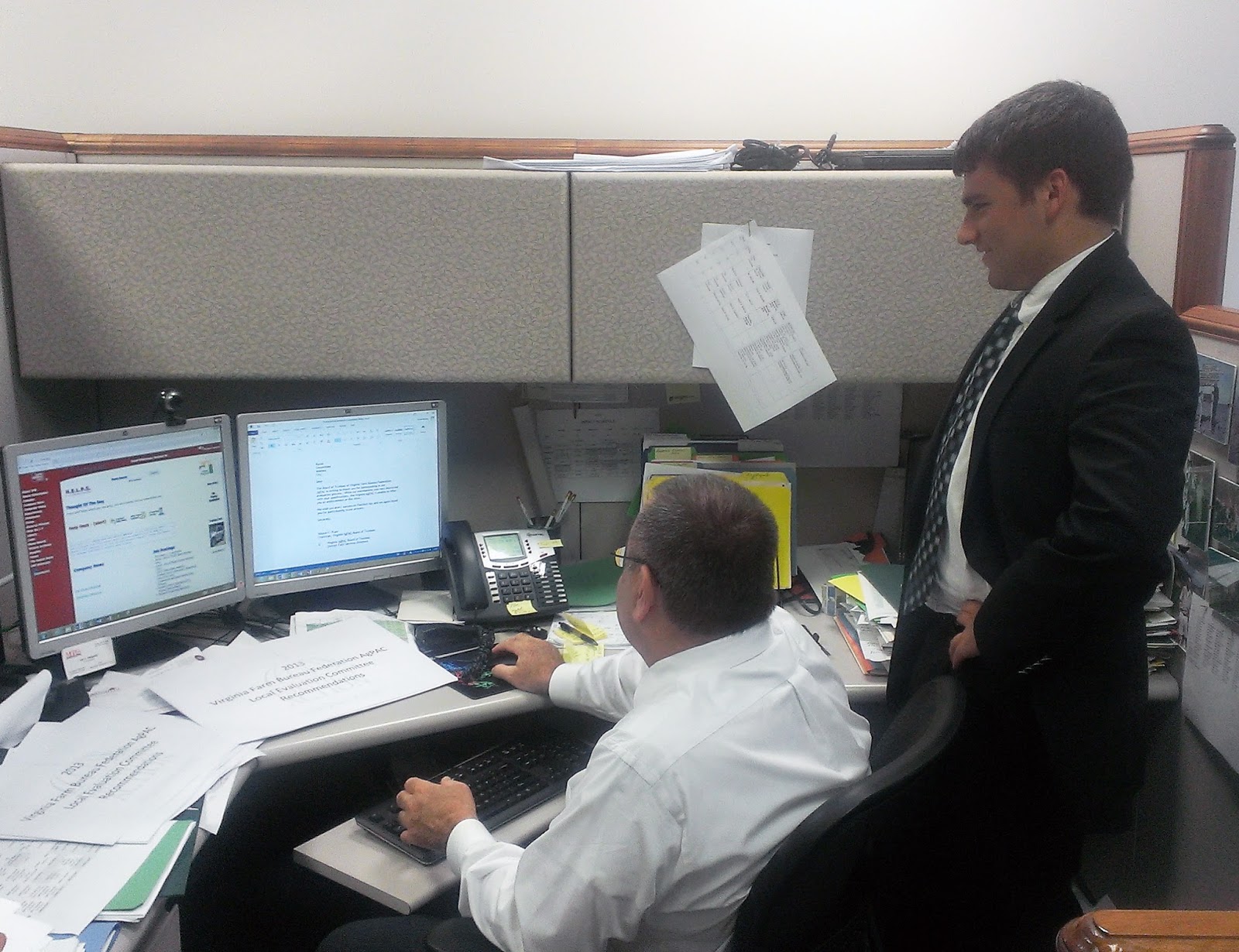
Andrew Smith and Joseph Degreenia (right) work on Virginia
Farm Bureau Federation AgPAC interviews
This summer I have had the opportunity to intern with the Virginia Farm Bureau Federation in the Governmental Relations Department.  It has been a very rewarding experience and has allowed me to be involved in one of the many behind-the-scenes factors that play a vital role in agriculture.
I grew up in a suburban area in Anne Arundel County, Maryland, and I joined 4-H when I was 9 years old. Being an active member in 4-H taught me valuable skills including public speaking, leadership and responsibility. It eventually led me to become the President of Maryland 4-H, and I traveled to Tanzania to help them with their 4-H program.
I knew that I wanted to pursue a career in agriculture, but I didn’t have a farm to go back to after college. So that’s what led me to Virginia Tech. I knew that there were many opportunities to explore there. After my first year I knew that I no longer had the desire to become a veterinarian, and with the help of the great advisors in the Dairy Science department, I decided to get a double major in Political Science. This opened up a whole new door of opportunities, and I discovered my interest in policy development.

This summer I was able to explore my interest in agricultural policy as I was able to attend a variety of events with the Farm Bureau lobbyists while focusing mainly on the Virginia Farm Bureau Federation AgPAC. I attended various policy and stakeholder meetings with the Farm Bureau team while having conversations with other industry leaders around the state and country. These meetings involved issues including MAP 21, Department of Environmental Quality funding, the Right to Farm, broadband coverage and many other hot topic issues in the Virginia agricultural industry.  
One of my favorite experiences was attending the Rural Jobs Council meeting with Vice President Martha Moore. It was very interesting to hear the reports and ideas on issues affecting rural Virginia. Afterwards we were invited to a reception at the Governor’s Mansion, and I had the opportunity to speak with Governor McDonnell about agricultural issues.
My main responsibility was working with the Virginia Farm Bureau Federation AgPAC. I was tasked with organizing interviews for potential endorsements with Farm Bureau members and candidates for the House of Delegates races across rural Virginia throughout the month of July. I wrapped these meetings up in the beginning of August with our interviews with urban races. One of the highlights of this internship was when I traveled to Northern Virginia to help interview candidates in some of those urban races. The AgPAC is very beneficial to farmers around Virginia because it allows farmers to ask questions that specifically affect agriculture.   
Andrew Smith and I also visited American Farm Bureau where we spoke with their staff about the importance of Agricultural Political Action Committees across the country. I also had the opportunity of meeting the American Farm Bureau President Bob Stallman and talked about my experiences this past summer. 
I was able to stay through the whole AgPAC process, and I attended the AgPAC board meeting. It was a great opportunity to hear the gubernatorial candidates again, as well as all of the other statewide candidates speak about agricultural issues.
The wit, humor and strong personalities from the entire governmental relations department at the Bureau made me feel welcome and at home and made working out of a cube not so bad after all. Wherever the future takes me after college, I know that I will never forget the skills and experiences that I had this past summer with the Virginia Farm Bureau. 

Virginia Farm Bureau Federation AgPAC Interviews Statewide Office Candidates

For the last two days, members of the Virginia Farm Bureau Federation AgPAC Board have been interviewing candidates for statewide offices at the West Creek office in Richmond.

On Monday, AgPAC Board members heard from Democratic candidate for Governor Terry McAuliffe and Republican candidate for Governor Ken Cuccinelli, as well as Republican candidate for Attorney General Mark Obenshain. On Tuesday, the Board interviewed Democratic candidate for Attorney General Mark Herring , Democratic candidate  for Lieutenant Governor Ralph Northam and Republican candidate for Lieutenant Governor E.W. Jackson.

Board members asked the candidates questions about their campaigns, as well as their stances on important issues affecting agriculture such as government regulations, transportation, water quality and rural development.

Members of the VFBF AgPAC Board have been elected by their peers and represent all areas of the state of Virginia.

In the previous weeks, County Farm Bureau Local Evaluation Committees have been interviewing candidates for the Virginia House of Delegates across the state. Their endorsement recommendations were discussed and voted on by the AgPAC board.

VFBF AgPAC endorsements for candidates running for statewide office will be announced on August 21. Endorsements for candidates running for House of Delegates seats will be announced in August 28.

Stay tuned to Plows and Politics for those lists of endorsements.

Breaking News: Public Meetings Announced On The Role Of The Soil And Water Conservation Districts

House Bill 2048 and Senate Bill 1279 of the 2013 General Assembly Session directed the Directors of the Departments of Environmental Quality (DEQ) and Conservation and Recreation (DCR); the Commissioner of Agriculture and Consumer Services (VDACS); members of the Senate Committee on Agriculture, Conservation and Natural Resources; and members of the House Committee on Agriculture, Chesapeake and Natural Resources, to convene public meetings throughout the Commonwealth to evaluate the role of Soil and Water Conservation Districts (Districts) in providing effective delivery of water quality services and technical assistance.

Six public meetings are being held from 6:30 pm until 9:00 p.m. in locations convenient to the Commonwealth’s six Soil and Water Conservation District Areas:

Area I – Augusta County Government Center, October 1;
Area II – Culpeper County Reva Fire and Rescue, October 28;
Area III – Henrico County Government Center, October 3;
Area IV – Emory and Henry College, October 24;
Area V – Chatham, Olde Dominion Agricultural Complex, October 30; and
Area VI – Chesapeake, Hampton Roads Planning District Offices, October 8.

Each meeting will include a roundtable discussion of the topics from Enactment Clause 12 of House Bill 2048 and Senate Bill 1279.  In addition to the Legislators, the roundtable will consist of representatives from the following areas:

  • DCR, DEQ and VDACS agency heads
  • One representative from each District in the area
  • The Virginia Association of Soil and Water Conservation District’s area chairperson
  • Representatives of agriculture
  • Representatives of environmental groups

AGENDA
  • Introduction of Roundtable Participants
  • Meeting Purpose
  • Meeting Process
  • Review of House Bill 2048 and Senate Bill 1279 and Actions to Date
  • Roundtable Discussion Topics
  • The role of soil and water conservation districts in providing effective delivery of water quality services and technical assistance
  • Implications of the 2013 Legislation
  • The extent of the role the districts should play in providing technical assistance for such programs as erosion and sediment control and stormwater management
  • The organizational location for district support that would provide the most effective and efficient delivery of district services
  • Public Comment

MEETING DIRECTIONS
All meetings are scheduled from 6:30 PM until 9:00 PM

Area I – October 1, 2013 – Augusta County Government Center Complex
South Board Room, 18 Government Center Lane, Verona, VA 24482
From the North Take Exit 227 on Interstate 81 Merge onto Laurel Hill Road Route 612 turn Left at the second light Turn left on to Route 11 then a left onto the Government Center Complex.  From the South take exit 225 off Interstate 81 turn left onto Woodrow Wilson Parkway Route 275, turn right at first light onto Route 11 and the second right into the Government Center Complex.

Area II – October 28, 2013 – Culpeper County Reva Volunteer Fire & Rescue
18230 Birmingham Road, Culpeper, VA 22701-6902
Reva Volunteer Fire and Rescue is located off of Route 29 halfway between Culpeper and Madison VA.  If traveling from the north or from Route 3 (Warrenton, Fredericksburg…): Take 29 South approximately 7 miles south of Culpeper VA.  Go past the Shell/7-11 station and several car dealers approximately 2.5 miles and RVFD will be located on the right.  If traveling from the south (Charlottesville): Follow 29 north approximately 10 miles north of Madison VA.  Go past the Reva Market about 1.5 miles and the RVFD will be on the left.

Area III – October 3, 2013 – Henrico County Human Services Board Room
8600 Dixon Powers Drive, Henrico, VA 23228.
From Interstate 64 take exit 185 Staples Mill Road West turn left on Parham Road and then left on Dixon Powers Road.  From Interstate 95 take Exit 83B onto Parham Road take Parham past Staples Mill and then turn left on Dixon Powers Drive.

Area IV – October 24, 2013 – Emory and Henry College
Board of Visitor’s Lounge, Van Dyke Center, 30461 Garnand Drive, Emory, VA 24327
Parking will be in the lot behind Hillman Hall (#13 on the map located adjacent to the Van Dyke Center which is #34 on the map). http://www.ehc.edu/about/emory-southwest-virginia/campus-map  From Interstate 81 take Exit 26 and follow the signs to the campus.

Area V – October 30, 2013 – Olde Dominion Agricultural Complex
19783 US Highway 29 South, Chatham, VA 24531

Area VI – October 8, 2013 – Chesapeake Hampton Roads Planning District Office
The Regional Building, 723 Woodlake Drive, Chesapeake, VA 23320
Take Interstate 64 to Exit 289A onto Greenbrier Parkway North then take a right onto Woodlake Drive.

Cuccinelli, McAuliffe Address Virginia Farming and Forestry at Forum

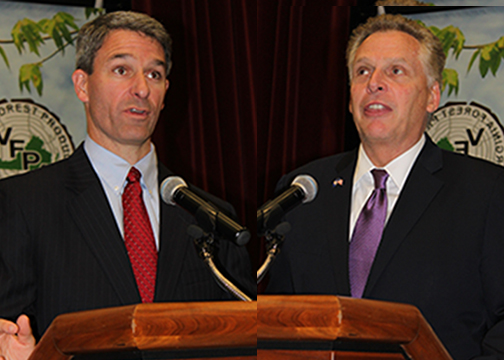
Cuccinelli (left) and McAuliffe (right)
Photos by Pam Wiley

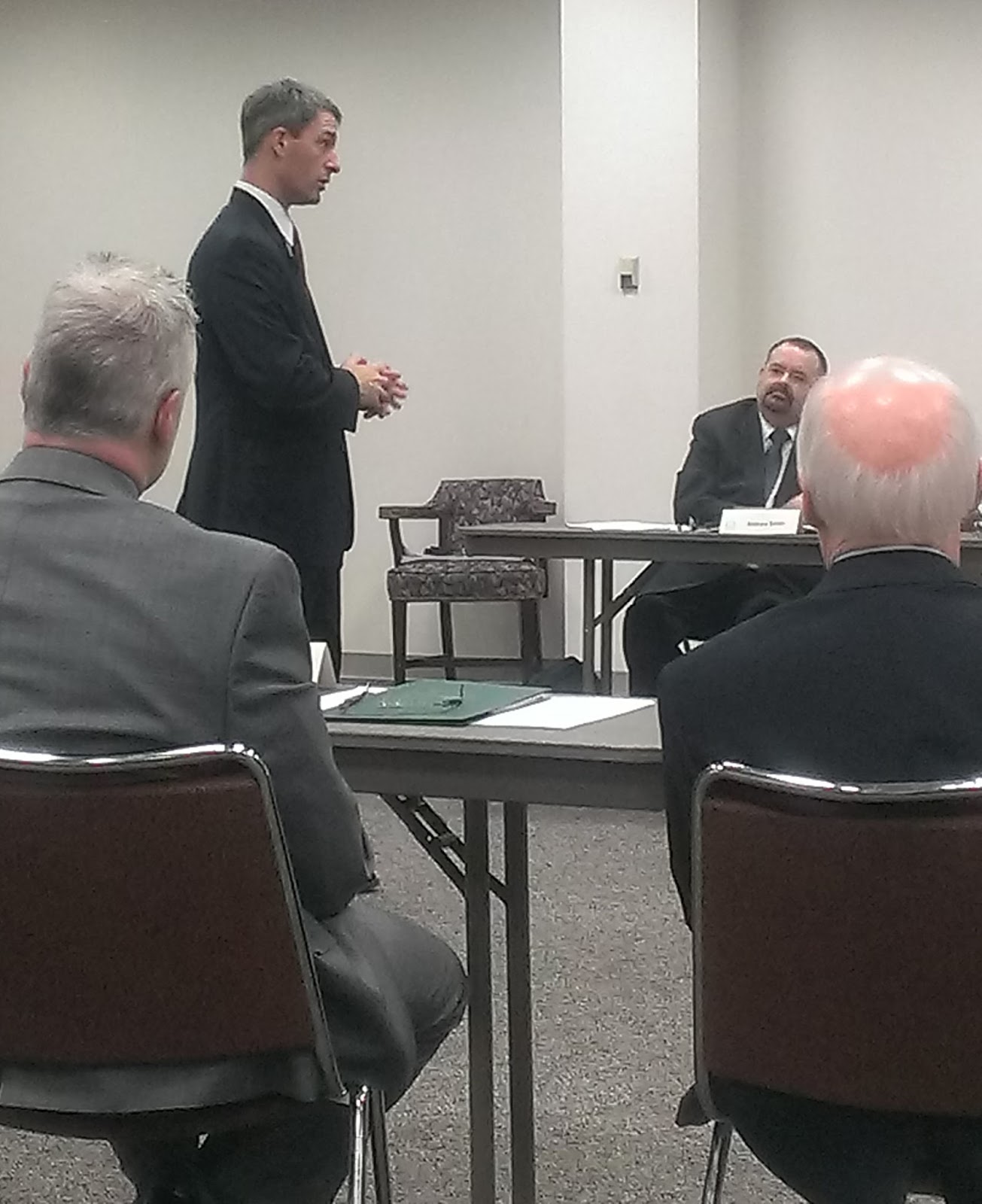
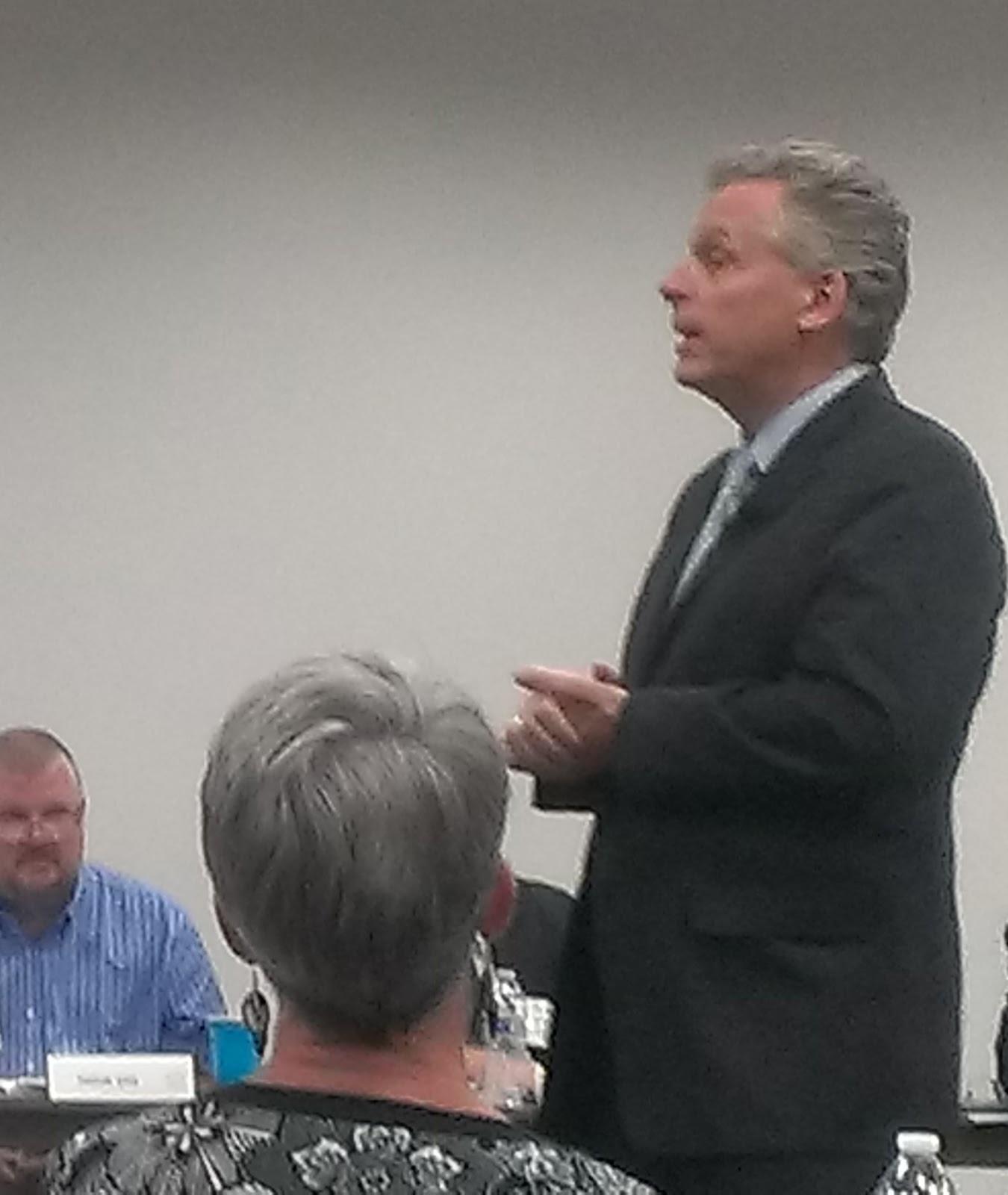
Gubernatorial candidates Ken Cuccinelli and Terry McAuliffe shared their thoughts on the future of farming and forestry in Virginia Aug. 2 at a forum at Wytheville Community College.

The event was sponsored by Virginia Farm Bureau Federation, the Virginia Agribusiness Council, the Virginia Forest Products Association and the Virginia Forestry Association and was open to those organizations’ members.

The candidates spoke separately, answering questions submitted by farmers and forestland owners.

McAuliffe said one of his major goals if elected will be to broaden markets for agricultural and forestry exports. While Virginia exports significant amounts of farm and forest products, “in some countries we are just scratching the surface,” he said.


McAuliffe said he would work toward $1 billion in annual farm and forestry exports to China and to make “as many trade missions as I can possibly get done” to market Virginia-grown products.

When asked for his thoughts on regulating farms to protect natural resources, McAuliffe said, “I want everybody to be at the table” for “a constant interaction between us as we move forward on regulations, and maybe on regulations we no longer need.”

Asked how he might lessen negative effects of the Patient Protection and Affordable Care Act on the state’s farms, McAuliffe noted that federal health care reform is now “the law of the land. We’ve got to work with it to find out what works for us” while ensuring that it does not hinder economic growth.

He said Virginia needs to take the federal Medicaid expansion rather than lose $26 billion it has paid into the system. “Why in green acres would we not want to bring that back? … I am not going to leave that money in Washington” to be spent on other states.

Cuccinelli questioned the affordability of the Affordable Care Act, calling it “an assault on the middle class.” If elected, “I will do everything I can to keep us unentangled with this new law as it unfolds,” he said.

As a state government, he said, “we have to obey the law of the land. We might not like it. It might be difficult. They’re making it more difficult.”

With regard to regulations proposed by the U.S. Environmental Protection Agency for Virginia farms and other businesses, Cuccinelli cited his track record for pushing back against EPA mandates and pledged to keep pushing back. He also said Virginia faces ongoing challenges to property rights, even after enactment of the constitutional amendment voters approved last fall.

The amendment’s opponents “want us all to say, ‘OK, we’re done!’” he said. “Well, we’re not done.”

The ability to take land using “quick take” procedures needs to be “reined in,” he said, and takings such as those by the Virginia Department of Transportation should be examined by state government “so we get consistency and what I expect to be better treatment of our citizens.”

Both candidates said they would ensure that 100 percent of state funds earmarked for transportation improvements would be spent on transportation.