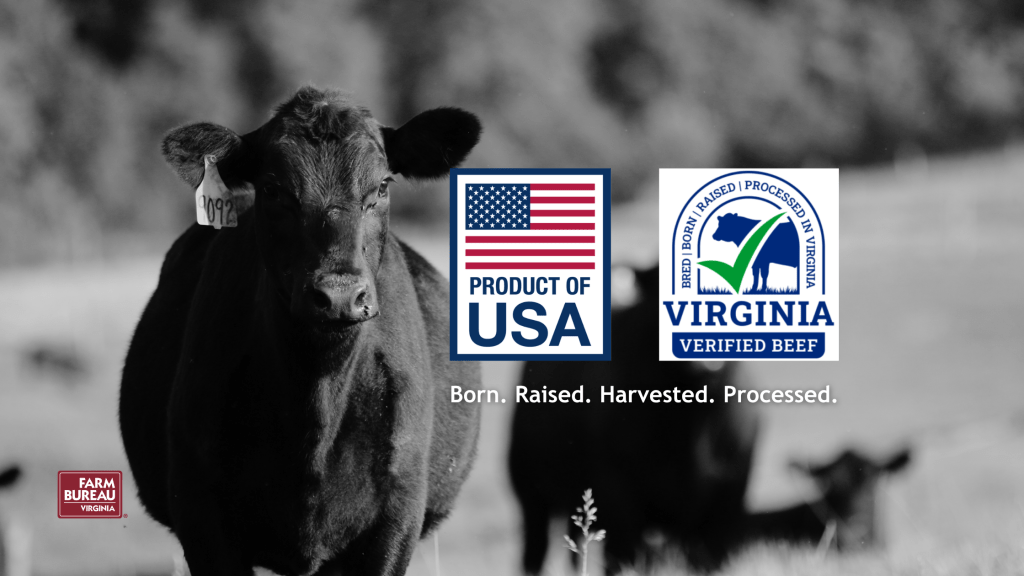
U.S. Secretary of Agriculture Brooke Rollins announced a national campaign to promote the updated “Product of USA” voluntary labeling standard for meat, poultry and egg products. The standard, which took effect Jan. 1, requires that animals be born, raised, harvested and processed in the United States for a product to carry the label.
Rollins said the change is designed to provide transparency for consumers and ensure that farmers committed to a fully domestic supply chain can compete fairly.
Administration officials noted that the update comes as the U.S. continues to lose family farms and faces a 75-year-low national cattle herd, even as consumer demand for beef has grown.
The updated definition ends the previous practice of allowing imported meat to qualify as domestic after minimal processing. Companies choosing to use the label must meet the fully U.S.-sourced requirement.
Virginia agriculture leaders say the shift aligns closely with state efforts to strengthen local beef production. The Virginia Verified Meat program, launched in 2025, certifies beef born, raised and processed within the commonwealth. Created through 2024 legislation, the program aims to support local producers, ensure truth in labeling, and increase consumer trust in Virginia-sourced meat. It also complements recent state legislation requiring lab grown or cell-cultivated proteins to be clearly labeled to prevent misleading marketing.
Jake Tabor, Virginia Farm Bureau legislative specialist for livestock issues, said the federal and state standards work hand in hand.
“Virginia’s livestock producers take pride in raising a high-quality product from start to finish, and both the ‘Product of USA’ and Virginia Verified Meat standards help ensure that commitment is recognized,” Tabor said. “Clear labeling gives Virginia farmers the fairness they deserve and gives consumers confidence that choosing local truly supports our communities.”
The announcement is part of USDA’s broader effort to strengthen domestic processing capacity and support American farmers.
The USDA will provide $12 billion in one-time bridge payments to American farmers facing market disruptions and elevated production costs.
What Farmers Need to Know
The Farmer Bridge Assistance (FBA) Program will distribute up to $11 billion to row crop producers of barley, chickpeas, corn, cotton, lentils, oats, peanuts, rice, soybeans, wheat, and other covered commodities. Payments are expected by February 28, 2026.
Action Required: Farmers must ensure their 2025 acreage reporting is accurate by 5 p.m. ET on December 19, 2025. Commodity-specific payment rates will be released by month’s end.
The remaining $1 billion is reserved for specialty crops and sugar, with details still under development.
Building on Historic Farm Support
This bridge program comes on top of over $30 billion in disaster and economic assistance already delivered in 2025, including:
$9.3 billion through the Emergency Commodity Assistance Program
$6 billion in supplemental disaster relief
$1.8 billion for specialty crop producers
These payments are designed to support farmers until the benefits of the One Big Beautiful Bill Act take effect in October 2026, which raises reference prices for major commodities by 10-21%.
Trade Wins and Market Access
The administration has secured trade agreements with more than 15 countries, opening new markets for American agricultural products:
Japan committed to $8 billion in agricultural purchases
China resumed large purchases of soybeans and sorghum
The EU agreed to purchase $750 billion in American energy while addressing barriers for pork and dairy
Thailand eliminated tariffs on 99% of U.S. goods, including most agricultural products
Additional Actions for Farmers
The Trump Administration has also:
Reduced H-2A farm labor costs, saving at least $2 billion initially
Provided nearly $1 billion in Section 32 commodity purchases for food assistance
Signed an executive order targeting price fixing and anti-competitive behavior in agricultural markets
Expanded crop insurance support, saving farmers over $400 million annually
Questions?
Producers can submit questions or request meetings by emailing farmerbridge@usda.gov.
Rural communities across Virginia are about to see a boost in veterinary availability for their livestock, poultry and horses. Seven veterinarians have been awarded grants totaling $890,000 to expand critical services that keep farms running and rural economies thriving.
Addressing a Critical Shortage
The shortage of large animal veterinarians isn’t just a Virginia problem—it’s a nationwide crisis affecting animal health, farm operations, food safety and agricultural economies from coast to coast, and Virginia is taking decisive action.
Through a newly launched partnership between the Virginia Department of Agriculture and Consumer Services (VDACS) and the Virginia Tobacco Region Revitalization Commission (TRRC), the commonwealth is making a strategic investment in the veterinary professionals who serve its agricultural backbone.
The Large Animal Veterinary Grant Program, which opened on July 1, 2025, attracted 43 applications from veterinarians across the state—clear evidence of both the demand for support and the commitment of practitioners to serve rural areas.
Making a Real Difference
VDACS awarded four grants of up to $110,000 each, while TRRC provided three grants of $150,000 to veterinarians serving Southern and Southwest Virginia. The funds will support everything from opening standalone clinics and haul-in facilities to purchasing equipment, hiring technicians and even paying down student loans.
“We are committed in the commonwealth to helping large animal veterinarians succeed, so they can continue providing such vital services to our farmers and rural communities,” said Dr. Charlie Broaddus, VDACS State Veterinarian.
The 2025 Grant Recipients
VDACS Large Animal Veterinary Grant Recipients:
Dr. Nathaniel Burke, Luray
Dr. James Cassell, Galax
Dr. Keagan Clevenger, Rockbridge Baths
Dr. Sherri Gard, Suffolk
TRRC Large Animal Veterinary Incentive Program Recipients:
Dr. Travis Gilmer, Scott County
Dr. Mary Tomlinson, Galax
Dr. Suzanne Newcombe, Gretna
Why This Matters
For farmers who depend on healthy livestock for their livelihoods, access to veterinary care isn’t a luxury—it’s essential. When animals get sick or injured, quick access to skilled veterinary care can mean the difference between a minor setback and a devastating loss.
TRRC Chairman Delegate Will Morefield emphasized the economic importance of this initiative: “Livestock, especially cattle, are the primary drivers of the agricultural economy of Southern and Southwest Virginia. This is a prime example of the Commission listening to our producers and the communities we serve and utilizing our unique flexibility to generate solutions that will make a real difference.”
A Collaborative Effort
The program reflects a truly collaborative approach to solving agricultural challenges. Recipients were selected by a diverse panel including representatives from TRRC, Virginia Farm Bureau, Virginia Board of Veterinary Medicine, Virginia Cooperative Extension, Virginia Academy of Food Animal Practitioners and the Virginia Veterinary Medical Association.
Virginia Farm Bureau President Scott Sink noted the organization’s role in bringing the program to life: “Farmers have long struggled with a shortage of large animal vets—and we’ve been working hard to change that. Partnering with Senator Travis Hackworth and Delegate Alfonso Lopez, we helped create a grant program to support these vital professionals.”
Looking Ahead
The grants will be distributed over multiple years, ensuring veterinarians can build sustainable practices and remain committed to their communities for the long term. This strategic approach recognizes that solving the rural veterinary shortage requires more than one-time funding—it requires creating conditions where practices can thrive.
As Virginia continues to support its agricultural sector, this investment in large animal veterinary services represents a crucial step toward ensuring farmers have the resources they need to keep their operations healthy and productive for generations to come.
Virginia’s small-scale farmers and local food producers have a new opportunity to strengthen their operations through the Governor’s Agriculture and Forestry Industries Development (AFID) Infrastructure Grant program. The fall application period opened on October 1 and runs through October 31, 2025, at 5 p.m.
Supporting Local Food Systems
Since its creation in 2021, the AFID Infrastructure Grant program has been a vital resource for communities looking to invest in their local agricultural infrastructure. Administered by the Virginia Department of Agriculture and Consumer Services (VDACS), the program focuses on supporting locally identified investments that help small farmers and food producers scale their businesses while benefiting the broader community.
What Projects Qualify?
To be eligible for funding, projects must directly support local food production and forestry while demonstrating clear community-wide benefits. The program prioritizes infrastructure investments in:
Food hubs (new and existing facilities)
Farmers markets
Commercial kitchens
Value-added processing facilities for meats, dairy, produce, and other Virginia-grown products
Packaging and processing infrastructure
Grant funds are intended primarily for capital expenditures, with a maximum award of $50,000 per project.
Who Can Apply?
Applications must come from a political subdivision of the Commonwealth, including:
Counties
Cities
Towns
Industrial and economic development authorities
Planning district commissions
However, localities are strongly encouraged to collaborate with small farmers, food producers, local food systems advocates, and other stakeholders interested in building robust local food and farming infrastructure. This collaborative approach ensures that funded projects truly meet the needs of the communities they serve.
Matching Requirements
This competitive grant program requires an equal cash match from the applying locality. Recognizing the challenges faced by some communities, the program offers reduced matching requirements for economically distressed localities, making the grants more accessible across Virginia.
Application Timeline
The AFID Infrastructure Grant program operates on a bi-annual cycle with two funding rounds each fiscal year:
Fall Round: Applications due October 31; awards announced by December 31
Spring Round: Awards announced by June 30
With the fall deadline rapidly approaching, interested localities should begin coordinating with local agricultural stakeholders now to develop strong applications that showcase community need and impact.
Why This Matters
Virginia’s agricultural sector continues to be a cornerstone of the state’s economy and rural communities. By investing in infrastructure that helps small producers access processing facilities, reach customers through farmers markets, and add value to their products, the AFID program strengthens the entire local food system. These investments create jobs, keep food dollars circulating in local economies, and ensure that Virginia-grown products can reach consumers more efficiently.
Get Started
For more information about the AFID Infrastructure Grant program, eligibility requirements, or the application process, contact:
Candidates for governor, lieutenant governor and attorney general have partnered with Virginia Farm Bureau Federation AgPAC, a nonpartisan political action committee, to present their stances on agricultural and forestry issues that align with Farm Bureau policy.
While endorsements will not be issued for individual candidates for the top spots in state leadership this year, farmers serving on the AgPAC board of trustees met with all six campaigns and briefed them on important agriculture and forestry issues. Candidates were then given the opportunity to present their agriculture and forestry platforms to the full AgPAC board of trustees.
In-kind contributions were offered to candidates who presented positions that help promote specific agriculture and forestry issues aligned with Farm Bureau policy.
Both gubernatorial candidates, Democrat Abigail Spanberger and Republican Lt. Gov. Winsome Earle-Sears, embraced the opportunity to share their ideas on issues important to farmers.
Spanberger’s top priorities included expanding access to markets for Virginia farmers, preserving working farm and forest lands, promoting rural economic development, ensuring farmers have access to labor, fully funding voluntary conservation programs and expanding agricultural education and support for Virginia’s land grant universities and Virginia Cooperative Extension programs.
“I worked with Virginia’s farmers to amplify their voices when I was in Congress by moving legislation that addressed their issues,” Spanberger said. “I was proud to receive awards from Farm Bureau and Virginia Cattlemen’s Association recognizing this work. I will do the same as governor and ensure that agriculture and forestry have a seat at the decision-making table.”
Earle-Sears emphasized her commitment to reducing taxes, supporting job creation, and preserving Virginia’s farmland and forestry through clean energy solutions like biomass. She voiced strong support for broadband expansion, and maintaining right-to-work and right-to-farm laws, while opposing increased pesticide regulations and minimum wage hikes. Earle-Sears also pledged to establish a governor’s office in Southwest Virginia to ensure accessibility and representation for rural communities. On environmental issues, she praised Virginia farmers for their efforts to protect the Chesapeake Bay, and called on neighboring states to uphold their responsibilities.
“I want you to know that I want to invest in you, but I think more importantly, I trust our farmers,” Earle-Sears said. “I trust our farmers and foresters, and our entire commonwealth benefits because of you. I will fight for your interests in Richmond. I will continue to fight for you. As governor, that is my promise.”
Four other statewide candidates agreed to meet with the AgPAC board—lieutenant governor candidates Democrat Sen. Ghazala Hashmi and Republican John Reid, and candidates for attorney general, Republican Attorney General Jason Miyares and Democrat Jay Jones.
“These candidates valued the opportunity to have meaningful conversations with farmers, exploring ways they might support agriculture through their roles if elected,” said Martha Moore, senior vice president of VFBF governmental relations. “We’re excited to assist these six statewide candidates in sharing their perspectives on key agriculture and forestry topics with farmers throughout Virginia. We believe that working together will bring attention to issues that matter in rural communities and help farmers make informed decisions ahead of the Nov. 4 election.”
Hashmi recognizes that agriculture and forestry are more than just industries; they are a way of life for many Virginians. Her vision centers on economic growth, workforce development and land stewardship, including strengthening the Virginia Agricultural Best Management program and promoting voluntary conservation practices to preserve Virginia’s working lands. She is committed to closing the broadband gap to ensure rural communities can thrive in the digital age and supports climate innovation through smart solar development on existing infrastructure. “I want to use this opportunity to elevate rural voices and build lasting support for the vital work happening in our agricultural and forestry communities,” Hashmi said.
Reid says he is committed to sustaining family farms and securing our food supply because a stronger agricultural foundation means a stronger Virginia. He supports increased funding for BMPs, empowering farmers to meet Virginia’s water quality goals while protecting our natural resources. Reid opposes reinstating the estate tax, recognizing the burden it places on landowners and the threat it poses to farm viability. He advocates for preserving farmland through strategic solar siting, and stands strong in defending Virginia’s right to farm—ensuring agriculture remains a cornerstone of Virginia’s economy and way of life.
Miyares reaffirmed his commitment to protecting Virginia’s right-to-work law, emphasizing its importance in attracting businesses and supporting the state’s workforce, including agribusiness. He pledged to oppose efforts that would hinder employment opportunities or burden farmers with unnecessary regulations, including those promoting animal rights. Miyares also voiced strong support for local authority in solar siting decisions, noting that wind and solar alone cannot meet Virginia’s energy needs over the next two decades. His focus remains on getting Virginia back to work and back to business—especially in vital sectors like agriculture.
Jones says he understands the economic challenges facing agriculture today and is committed to offering predictability and stability to support farmers and small business owners across the commonwealth. He believes that regulations play a vital role in protecting the environment and ensuring food safety. However, Jones advocates for science-based policies that are flexible, cost-effective, and adaptable to local conditions—so farmers can thrive without unnecessary burdens. Jones supports simplifying regulations to foster entrepreneurship and competitiveness in both national and global markets. He is especially focused on reducing barriers for beginning farmers, helping them build sustainable businesses and contribute to Virginia’s agricultural legacy.
The nonpartisan VFBF AgPAC was created in 1999 and employs in-kind contributions and endorsements to support candidates who can best support agriculture and Farm Bureau issues.
CattlePulse is a monthly update from Virginia Farm Bureau on the Virginia feeder cattle markets, the national trends that affect them and stories of cattle producers across the commonwealth.
In this month’s episode of CattlePulse, host Elijah Griles sits down with Dr. Josh Maples from Mississippi State University to unpack the July Cattle Inventory report and explore what it means for producers. With feeder cattle futures hitting all-time highs, Elijah and Dr. Maples discuss actionable strategies cow-calf producers can consider to manage price risk.
In this month’s episode of CattlePulse, host Elijah Griles unpacks the factors behind the recent futures contract dip, looks at how consumer demand is holding up to record high retail prices, and highlights another month of record high feeder calf prices.We want to hear from you!Have a question or a topic you'd like us to cover in a future episode?Email Elijah at elijah.griles@vafb.com.
CattlePulse is a monthly update from Virginia Farm Bureau on the Virginia feeder cattle markets, the national trends that affect them and stories of cattle producers across the commonwealth.
In this month’s episode, host Elijah Griles unpacks the factors fueling the feeder cattle futures rally. He also shares positive developments in the battle against the New World Screwworm fly. Plus, Franklin County cattle producer and meat processor Chase Scott shares his motivation to use the new Virginia Verified Beef label.
In this month’s episode of CattlePulse, host Elijah Griles unpacks the factors behind the recent futures contract dip, looks at how consumer demand is holding up to record high retail prices, and highlights another month of record high feeder calf prices.We want to hear from you!Have a question or a topic you'd like us to cover in a future episode?Email Elijah at elijah.griles@vafb.com.
Agricultural producers across the nation have a unique opportunity to shape how federal farm programs are delivered in their communities. The U.S. Department of Agriculture (USDA) Farm Service Agency (FSA) is now accepting nominations for farmers and ranchers to serve on local county committees, and the deadline is approaching fast.
Why County Committees Matter
FSA county committees aren’t just administrative bodies; they’re the backbone of local agricultural decision-making. These committees have real power to influence how disaster recovery, conservation, commodity support, and price support programs are implemented in your area. They also make decisions about county office employment and tackle other pressing agricultural issues that directly affect your operation.
With more than 7,700 dedicated agriculture community members currently serving nationwide, these committees represent the voice of local producers in federal program administration. It’s democracy in action at the grassroots level of American agriculture.
Who Can Serve?
The eligibility requirements are straightforward and designed to be inclusive:
You can be nominated if you:
Participate in or cooperate with a USDA program
Live in a Local Administrative Area (LAA) that’s up for election this year
Don’t worry if you’ve never received program benefits—being a “cooperating producer” simply means you’ve provided information about your farming or ranching operation to FSA. This broad definition ensures that producers at all levels of engagement can participate.
The Nomination Process Made Simple
Getting involved is easier than you might think. Here’s what you need to know:
Who Can Nominate:
You can nominate yourself
You can nominate other qualified producers
Qualifying organizations can also submit nominations
Key Requirements:
Complete and sign FSA Form 669A
Ensure the form is postmarked or received by your local FSA office by August 1, 2025
Be registered with your local FSA office
The USDA actively encourages all eligible producers to participate—whether that’s nominating candidates, voting in elections, or serving in office themselves.
Understanding Local Administrative Areas
Local Administrative Areas (LAAs) are the electoral districts for FSA committees. These can cover:
Single counties
Multi-county jurisdictions
Urban or suburban focused areas
Not every LAA holds elections each year, so your first step should be contacting your local FSA office to determine if your area is up for election in 2025. You can also use the geographic information system locator tool at fsa.usda.gov/elections to find your specific LAA.
Urban and Suburban Agriculture Gets a Voice
The FSA recognizes that agriculture isn’t limited to rural areas. Urban county committees specifically focus on promoting urban, indoor, and other emerging agricultural production practices. These committees serve 27 cities nationwide and work to:
Provide outreach to urban producers about USDA programs
Serve as advocates for urban agricultural communities
Assist in implementing programs that meet the unique needs of urban farming operations
Urban producers elect their own committee members, ensuring that the specific challenges and opportunities of urban agriculture are properly represented.
What Committee Service Involves
Serving on an FSA county committee is a significant commitment that offers real influence over agricultural policy implementation. Committee members serve three-year terms on panels that range from three to 11 members, depending on the size and needs of the area.
The role involves regular meetings, program oversight, and serving as a liaison between local producers and federal agricultural agencies. It’s an opportunity to directly impact how programs are administered in your community while gaining valuable insights into agricultural policy and program management.
Take Action Now
With the August 1 deadline approaching, interested producers should act quickly. Here’s your action plan:
Contact your local FSA office to confirm your LAA is holding elections this year
Register with FSA if you haven’t already
Obtain and complete FSA Form 669A
Submit your nomination before the August 1 deadline
Remember, election ballots will be mailed to eligible voters in November 2025, so the nomination period is your chance to ensure qualified candidates are on the ballot.
More Resources
For additional information about FSA county committee elections, nomination forms, and to access the LAA locator tool, visit fsa.usda.gov/elections. Urban agriculture information is also available at farmers.gov/urban.
Your local USDA Service Center can provide personalized guidance about the nomination process and answer questions about serving on county committees.
The Bottom Line
Agricultural producers have a voice in how federal farm programs are administered—but only if they choose to use it. Whether you’re interested in serving yourself or know someone who would make an excellent committee member, the nomination process is your opportunity to strengthen agricultural representation in your community.
Don’t let this chance pass by. Get involved, nominate qualified candidates, and help ensure that local agricultural voices are heard in federal program administration.
CattlePulse is a monthly update from Virginia Farm Bureau on the Virginia feeder cattle markets, the national trends that affect them and stories of cattle producers across the commonwealth.
In this month’s episode, host Elijah Griles breaks down the record-setting feeder cattle prices driven by tight national inventories and strong seasonal demand. He also discusses the impact of the New World screwworm fly on U.S. cattle imports and what it could mean for Virginia producers. Plus, Halifax County cow-calf producer Adam Davis shares how he’s using genetic data to improve herd performance.
In this month’s episode of CattlePulse, host Elijah Griles unpacks the factors behind the recent futures contract dip, looks at how consumer demand is holding up to record high retail prices, and highlights another month of record high feeder calf prices.We want to hear from you!Have a question or a topic you'd like us to cover in a future episode?Email Elijah at elijah.griles@vafb.com.
The following is a statement from Virginia Farm Bureau President Scott Sink, regarding the release of the Make America Healthy Again (MAHA) Commission initial assessment on May 22, 2025.
Virginia’s farmers share the White House’s vision for a healthier America, and we recognize that healthy meals start with healthy farms. However, we’re troubled by the MAHA Commission’s initial opinion-based findings and their potential impact on our farm families who have fed this nation for generations.
Our farmers don’t just grow food—they grow their legacies. They live on the land they farm, raise their children there, and work every day to pass healthy soil and thriving operations on to the next generation. Their livelihood depends on growing nutritious food sustainably. While the MAHA Commission questions some aspects of modern farming practices, farmers have the strongest incentive to protect both their land and their families’ health. They wouldn’t use tools or methods that jeopardize either their family’s safety or their farm’s future productivity.
As a farmer, I can confidently say that farmers share the goal of improving health outcomes in America. They’re dedicated to continuous improvement, guided by sound agricultural and livestock practices and technological advancements that keep our food supply safe, abundant and affordable.
Any policy changes must consider real-world consequences for food affordability and availability. Well-meaning, yet misguided, restrictions could reduce crop yields, drive up grocery costs and increase hunger in America—outcomes none of us want. Virginia’s farmers stand ready to be partners in building a healthier nation, but solutions must be practical and account for farming’s complexities. We need a seat at the table for discussions that include farmers’ voices and recognize that sustainable agriculture requires balancing environmental stewardship, economic viability and food security for all Americans.




 Plows and Politics