USDA Accepting Applications to Help Cover Costs of Organic Producers

The U.S. Department of Agriculture (USDA) will cover up to 75% of the costs associated with organic certification, up to $750 per category, through the Organic Certification Cost Share Program (OCCSP). Virginia Farm Service Agency (FSA) encourages organic agricultural producers and handlers to apply for OCCSP by Oct. 31, 2023, for expenses incurred from Oct. 1, 2022, through Sept. 30, 2023.  

As part of USDA’s broader effort to support organic producers and in response to stakeholder feedback, this year FSA increased the cost share to the maximum amount allowed by statute.  

“We’re taking steps to better support Virginia organic producers,” said Dr. Ronald M. Howell, Jr., State Executive Director for FSA in Virginia. “We’ve heard about this program’s value in helping Virginia organic producers and handlers obtain or renew their certifications under the National Organic Program, and I’m pleased that we’re able to increase and restore the cost share to the statutory limit this year. Organic certification costs have long been identified as a barrier to certification, and this assistance, at its full levels, will help Virginia organic producers participate in new markets while supporting and growing our local and regional food systems.”  

Cost Share for 2023 

The cost share provides financial assistance for organic certification, and producers and handlers are eligible to receive 75% of the costs, up to $750, for crops, wild crops, livestock, processing/handling and state organic program fees (California only).  

Virginia producers have until Oct. 31, 2023, to file applications, and FSA will make payments as applications are received.   

How to Apply 

To apply, Virginia producers and handlers should contact their local FSA office USDA Service Center. As part of completing the OCCSP application, producers and handlers will need to provide documentation of their organic certification and eligible expenses.   

Organic producers and handlers may also apply for OCCSP through participating state departments of agriculture. Additional details can be found on the OCCSP webpage.   

Opportunity for State Departments of Agriculture  

FSA is also accepting applications from state departments of agriculture to administer OCCSP. FSA will post a synopsis of the funding opportunity on grants.gov and will electronically mail the notice of funding opportunity to all eligible state departments of agriculture.   

If a state department of agriculture chooses to participate in OCCSP, both the state department of agriculture and FSA County Offices in that state will accept OCCSP applications and make payments to eligible certified operations. However, the producer or handler may only receive OCCSP assistance from either FSA or the participating state department of agriculture.   

Other USDA Organic Assistance  

USDA offers other assistance for organic producers, including the new Organic Transition Initiative (OTI), which includes direct farmer assistance for organic production and processing, conservation and crop insurance.    

For conservation, USDA’s Natural Resources Conservation Service (NRCS) is helping producers adopt the new organic management standard, which allows flexibility for producers to get the assistance and education they need such as attending workshops or requesting help from experts or mentors. It supports conservation practices required for organic certification and may provide foregone income reimbursement for dips in production during the transition period.   

USDA’s Risk Management Agency (RMA) reminds producers interested in the Transitional and Organic Grower Assistance Program, also part of OTI, to visit with their crop insurance agent for more information. Premium benefits for eligible policies will be automatically applied to the producer’s billing statement later this year.      

For producers that participated in the Transitional and Organic Grower Assistance Program, also part of OTI, premium benefits for eligible policies will be automatically applied to the producer’s billing statement later this year.       

USDA’s Risk Management Agency (RMA) also administers federal crop insurance options, including Whole Farm Revenue Protection and Micro Farm, which may be good options for organic producers.   

Also under OTI, is the USDA Agricultural Marketing Service (AMS) National Organic Program’s (NOP) Transition to Organic Partnership Program (TOPP). TOPP builds mentorship relationships between transitioning and existing organic farmers to provide technical assistance and wrap-around support in six U.S. regions.   

On May 10 USDA AMS announced the availability of approximately$75 million in grant funding for the Organic Market Development Grant (OMDG) program. OMDG will fund businesses transitioning to organic or initiating new organic production or processing and support new, improved and expanded markets for domestically produced organic products with a focus on processing capacity, market access, and product development.  
USDA Offers Assistance to Help Organic Dairy Producers Cover Increased Costs

The U.S. Department of Agriculture (USDA) announces assistance for dairy producers with the new Organic Dairy Marketing Assistance Program (ODMAP). ODMAP is established to help mitigate market volatility, higher input and transportation costs and unstable feed supply and prices that have created unique hardships in the organic dairy industry. Specifically, under the ODMAP, USDA’s Farm Service Agency (FSA) is making $104 million available to organic dairy operations to assist with projected marketing costs in 2023, calculated using their marketing costs in 2022.

“Organic dairy producers have faced significant and unique increases in their marketing costs, compounded by increases in feed and transportation costs and the limited availability of organic grain and forage commodities,” said FSA Administrator Zach Ducheneaux. “Without assistance, many organic dairies, particularly small organic dairies, will cease production, which not only impacts the domestic supply and consumption of organic milk but also the well-being of many rural communities across the country. This program will keep our small organic dairies in operation as they continue to weather a combination of challenges outside of their control.”

FSA will begin accepting applications for ODMAP on May 24, 2023. Eligible producers include certified organic dairy operations that produce milk from cows, goats and sheep.

Adam Warthesen, co-chair of the Organic Trade Association’s Organic Feedstuffs Relief Task Force, and Senior Director of Government and Industry Affairs for Organic Valley said: “With unprecedented organic feed costs and inflationary pressures over the last couple of years, resources like ODMAP are really going to matter as farmers plan for the rest of this year.”

Britt Lundgren, Senior Director of Sustainability and Government Affairs at Stonyfield, said: “The costs facing organic dairy today are uncommon and putting serious strain on operations. USDA is right to step in and offer support, and this is a good first step. The alternative is we lose family farmers. We look forward to working with USDA to cover more of the actual costs organic dairies are facing.”

Lia Sieler, Executive Director of Western Organic Dairy Producers Alliance, said: “We welcome the monetary resources allocated to dairy farmers through ODMAP with much anticipation. Input costs have been at an unprecedented high with no foreseeable changes and farmers are struggling to keep up with these high costs at their current pay price for the specialty products they produce. Farmers are struggling to continue producing a quality, safe and nutritious product with the current costs of doing business. We thank USDA with the help of many members of Congress for stepping in, hearing our voices and working diligently to get money pushed out as quick as possible to help alleviate some of this pain. Our work is not done, but this is a major win for our industry in a time of such uncertainty.”   

Chris Adamo, Vice President of Public Affairs and Regenerative Agriculture Policy with Danone North America, said: “Recent increases to cost of feed and overall inputs have significantly impacted organic dairy farms, and on behalf of Horizon Organic, we are grateful for USDA’s thoughtful work and strong support for the farms that supply our customers’ milk.” 

How ODMAP Works

FSA is providing financial assistance for a producer’s projected marketing costs in 2023 based on their 2022 costs. ODMAP provides a one-time cost-share payment based on marketing costs on pounds of organic milk marketed in the 2022 calendar year.

ODMAP provides financial assistance that will immediately support certified organic dairy operations during 2023 keeping organic dairy operations sustainable until markets return to more normal conditions. 

How to Apply

FSA is accepting applications from May 24 to July 24, 2023. To apply, producers should contact FSA at their local USDA Service Center. To complete the ODMAP application, producers must certify to pounds of 2022 milk production, show documentation of their organic certification, and submit a completed application form.

Organic dairy operations are required to provide their USDA certification of organic status confirming operation as an organic dairy in 2023 and 2022 along with the certification of 2022 milk production in hundredweight.  

ODMAP complements other assistance available to dairy producers, including Dairy Margin Coverage (DMC) and Supplemental DMC, with more than $300 million in benefits paid for the 2023 program year to date.  Learn more on the FSA Dairy Programs webpage.

USDA Offers Livestock Disaster Program Flexibilities; Responds to Needs Expressed by Producers Hard-Hit by Natural Disasters

EProgram Application Deadlines Extended to June 2 

USDA’s Farm Service Agency (FSA) has provided additional flexibilities and further enhanced disaster recovery assistance provided by the Emergency Assistance for Livestock Honeybees, and Farm-raised Fish Program (ELAP), Livestock Indemnity Program (LIP) and Livestock Forage Disaster Program (LFP) in response to needs expressed by livestock producers across the U.S. who have experienced significant feed, forage and animal losses from natural disasters. These livestock disaster program policy enhancements include an extended June 2, 2023, deadline to submit notices of loss and applications for payment for 2022 losses. The deadline extension and program flexibilities are available to eligible producers nationwide who incurred losses from a qualifying natural disaster event.  

LIP and ELAP reimburses producers for a portion of the value of livestock, poultry and other animals that died because of a qualifying natural disaster event or for loss of grazing acres, feed and forage. LFP provides benefits for grazing losses due to a qualifying drought or wildfire. For fire, losses must occur on federally managed lands. ELAP provides benefits for grazing losses not covered under LFP.        

New Program Applications for 2022  

FSA is accepting 2022 LIP notices of loss and applications for payment through June 2, 2023, for all covered livestock that may have been eligible in 2022.     

Producers who did not sign up for ELAP assistance for hauling livestock, forage and feedstuff hauling or other losses covered under ELAP in 2022 can also apply through June 2, 2023.     

FSA will accept LFP applications for only newly eligible covered livestock through June 2, 2023.    

All required supporting documentation must be received and on file in the county office by the established deadline.     

Revising 2022 Applications   

Producers who have a 2022 ELAP, LIP or LFP application on file with FSA as of the program deadline or were placed on an approved register, may revise their application with the newly updated eligible livestock no later than June 2, 2023.    

Filing a Notice of Loss for ELAP due to 2022 and 2023 Drought  

To support program access for counties that do not currently have a 365-day grazing season, FSA is waiving the 30-day timeframe for producers to submit a notice of loss for the 2023 ELAP program year due to qualifying drought in calendar years 2022 or 2023. Producers can now submit a notice of loss from the date the loss is apparent, as far back as Jan. 1, 2023, for 2022 eligible losses and 2023 eligible losses that occur before June 2, 2023.     

For counties that have a 365-day grazing season, producers must have a qualifying drought in the 2023 calendar year to be eligible for 2023 livestock, water and feed hauling in 2023.  

More Information  

Livestock producers must provide evidence that livestock death was due to an eligible adverse weather event or loss condition. In addition, livestock producers should bring supporting evidence, including documentation of the number and kind of livestock that died, photographs or video records to document the loss, purchase records, veterinarian records, production records and other similar documents. Owners who sold injured livestock for a reduced price because the livestock were injured due to an adverse weather event, must provide verifiable evidence of the reduced sale of the livestock. Producers can apply for ELAP, LFP and LIP benefits at their local FSA county office. For more information or to submit a notice of loss or an application for payment, please contact your local FSA office or visit farmers.gov/recover.

Friend of the Farm Chat: Del. Wendy Gooditis

After serving three terms in the Virginia House of Delegates, Del. Wendy Gooditis announced she will not seek another term in the 2023 elections. She has been a strong voice for Virginia’s agricultural industry, as she was assigned to the Agriculture, Chesapeake and Natural Resources Committee and at one time served as vice chair of the committee.

Redistricting eliminated House District 10, separating it into House Districts 29, 30 and 31. Gooditis resides in the new House District 31. As she moves forward, she remains dedicated to serving her rural community. She encourages her constituents to stay engaged in the political process and to continue working towards a better future for all Virginians. She will remain in office through the end of 2023.

Join us as we sit down with Del. Wendy Gooditis and talk about her favorite moments from her time in office and what she plans to do next.

Gov. Glenn Youngkin Signs Controlled Environment Agriculture Legislation

Gov. Glenn Youngkin signed HB 1563 and SB 1240, highlighting the Commonwealth’s continued commitment to Controlled Environment Agriculture (CEA). The bills expand the agricultural sales tax exemption to include items used to produce agricultural products for market in a CEA commercial facility. Following the signing at Virginia Tech’s Shenandoah Valley Agricultural Research and Extension Center in Raphine, Va., Youngkin announced that the “Great Indoors” Virginia symposium to address global food security through innovation is scheduled for September 25-26.

“Targeted investments and support for advanced training in cutting-edge agricultural technology training is vital in making Virginia the number one destination in the nation for controlled environment agriculture,” said Youngkin.“Innovation is critical to creating a resilient food system that prevents a rapidly growing world population from suffering food insecurity, while responding to consumer demand for healthier, more sustainable food options.

Under current law, CEA facilities may receive sales tax exemptions for some, but not all, of the purchases they make. The agricultural technology tax exemption legislation, supported by Sen. Mark D. Obenshain and Del. Hyland F. “Buddy” Fowler, Jr., expands the exemption to include tangible personal property items that are used in construction of a CEA facility.

The planned “Great Indoors” symposium will bring together leading innovators to explore CEA’s role in helping address global food safety and security concerns. The conference will bring senior leadership across the public and private sectors together to discuss how to scale new technologies to address food insecurities, while also addressing challenges often faced in outdoor farming, including extreme weather, labor costs and availability, soil erosion, water availability and pesticide resistance.

“Virginia is quickly becoming the destination of choice for CEA operations to locate and expand, due to the state’s strategic access to domestic consumer markets, plentiful and competitively priced resources, skilled workforce pipeline and the availability of public and private partnerships,” said Secretary of Agriculture and Forestry Matthew Lohr. “The Governor’s budget amendments seek to capitalize on these advantages and solidify Virginia’s position as the best state for CEA business in the nation.”

Youngkin’s 2023 budget amendments provide $1.250 million more in both FY2023 and FY2024 for agricultural technology grants or loans to advance the industry, assist in the development of agricultural products and improve infrastructure growth, productivity or efficiency. From the Governor’s Agriculture and Forestry Industries Development (AFID) program, $1 million is provided in FY2024 to fund agricultural technology research projects over the biennium.

Katelyn Jordan Joins Governmental Relations Team

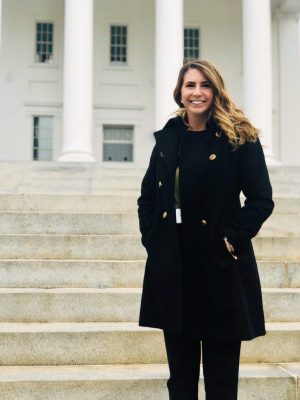
Katelyn Jordan is our newest legislative specialist on Virginia Farm Bureau’s Governmental Relations team. Her focus is on local affairs and local government authority issues, property rights and taxes. Prior to this position, she worked for three members of the Virginia General Assembly, the Office of the Lieutenant Governor and a Virginia state agency.

Katelyn is a first-generation college student and a 2019 Summa Cum Laude graduate from Randolph-Macon College. Holding a B.A. in Political Science, she also completed minors in Spanish and Communication Studies. Katelyn likes to say that she grew up “five minutes from the corn fields, five minutes from the beach” in Pungo, Virginia. She now resides in Richmond with her cat, Mr. Brightside. 

Small farm field days offer resources, funding to farmers statewide

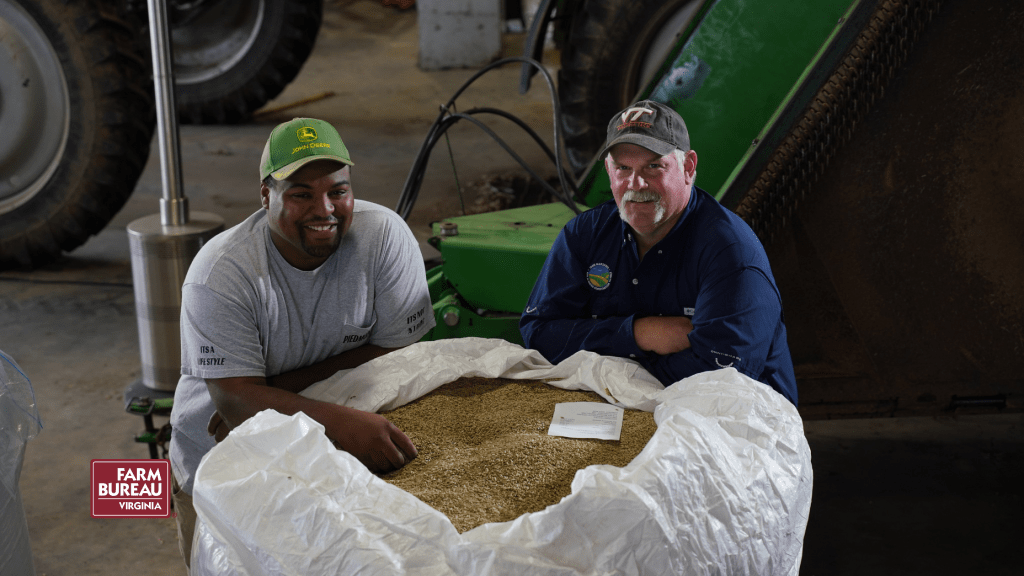
Pictured: farmer Joe Gray and conservation specialist Steven Jones. Photo courtesy of DCR.

Owners and operators of small farms throughout the state can discover ways to improve soil and animal health and gain information on major funding opportunities at four field days this month.  

The field days will take place in May on privately-owned small farms in Fauquier, Louisa, Franklin and Surry counties. These free events are sponsored by the Virginia State University Small Farm Outreach Program. 

Attendees will participate in farmer-led tours and demonstrations highlighting conservation best management practices such as nutrient management, cover crops, grazing-land management, continuous no-till and split nitrogen applications. These practices help reduce the cost of inputs and improve farm productivity while also safeguarding Virginia’s stream and river water quality.   

Specialists from the Virginia Department of Conservation and Recreation and Soil and Water Conservation Districts will be on hand to share information about programs that offer farmers free technical assistance and up to $300,000 per year in cost-share to implement best management practices on their farms. They will also highlight programs and resources available only to small farms. 

Farmers may register for one or more of the following at https://www.ext.vsu.edu/sfop-events

  • Saturday, May 13, from 9 a.m.–noon  
    Joe Gray’s Farm, Remington, Va. 
    For more information, contact Michael Carter Sr. at mcarter@vsu.edu. 
    Lunch will be served. 
  • Tuesday, May 16, from 9 a.m.–noon  
    Albert McGee’s Farm, Louisa, Va.  
    For more information, contact Roland Terrell at rterrell@vsu.edu. 
  • Wednesday, May 24, from noon–3 p.m.  
    Anthony and Tonja Martin’s Farm, Penhook, Va.  
    For more information, contact Clifford Somerville at csomerville@vsu.edu. 
    Lunch will be served.  
  • Thursday, May 25, from 10 a.m.–1 p.m. 
    Glenn Slade’s Farm, Surry, Va. 
    For more information, contact Derrick Cladd at dcladd@vsu.edu. 
    Lunch will be served.