
Robert Harper with Virginia Farm Bureau’s grain division provides this week’s market updates.
#merchandiserminute #grainfuture #virginiafarmbureau
Robert Harper with Virginia Farm Bureau’s grain division provides this week’s market updates.
#merchandiserminute #grainfuture #virginiafarmbureau
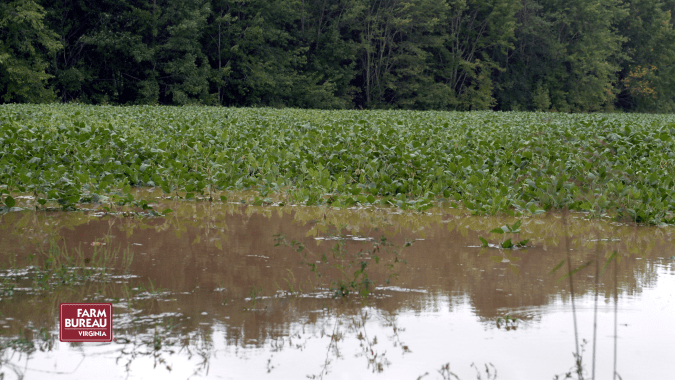
The Atlantic hurricane season extends from June 1 to November 30, with the peak occurring between mid-August and late October. The powerful winds and flooding rains of hurricanes can be disastrous for agricultural producers, and farmers can take precautions now to help protect their families, livestock and farm operations.
Tips to Protect You and Your Family
Livestock Preparedness Tips:
“Proper planning and taking precautions now could save thousands of dollars in property loss. I strongly encourage all agricultural producers to review these tips and take time now to prepare their farms and agribusinesses for hurricanes and other severe weather events,” said Joseph Guthrie, Commissioner of VDACS. “For more in-depth emergency preparation tips, please visit www.vaemergency.gov/threats/hurricanes.”
VDACS also encourages pesticide applicators, particularly those in Eastern Virginia, to secure their pesticide storage areas. Applicators in low-lying areas should attempt to elevate or move pesticides to locations that are less likely to flood. Pest control companies should consider the weather carefully when making any type of outdoor application and always read and follow the pesticide label.
Robert Harper with Virginia Farm Bureau’s grain division provides this week’s market updates.
#merchandiserminute #grainfuture #virginiafarmbureau

Below are several changes to wildlife regulations approved by the Board of Wildlife Resources that could impact Farm Bureau members. A complete list and additional details can be found here. These regulations go into effect August 1, 2023.

The General Assembly’s passage of HB 1806 and SB 1057 changed the implementation date for vehicles claiming a farm use exemption to obtain a formal placard from the Virginia Department of Motor Vehicles from July 1, 2023, to July 1, 2024. DMV has not implemented the new program yet.
The bill clarifies that the farm use exemption applies to all pickup and panel trucks, sport utility vehicles, trailers or semitrailers, and vehicles other than pickup and panel trucks, sport utility vehicles, trailers or semitrailers having a gross vehicle weight rating greater than 7,500 pounds. However, the only vehicles tasked with obtaining the placard are pickup trucks, panel trucks and sport utility vehicles. Trailers, semitrailers and vehicles over 7,500 pounds can continue operating as is under the farm use exemption without getting a new farm use placard.
Farmers are required to show they are in compliance with the law by July 1, 2024, and can obtain farm use placards from DMV, which will charge $15 for the placards. The tags will have an alphanumeric identification number, are nontransferable and must be displayed at all times.
The PDF document below for more detailed information. This page and the PDF will be updated as new information develops.

Virginia Tech’s culture of collaboration and innovation is just one of many strengths that attracted Mary Burrows, the new director of the Virginia Agricultural Experiment Station, to the university and to the position.
It also will be her focus as moves into the new role she started on July 10, she said.
“There is a culture of innovation and collaboration here at Virginia Tech that is very exciting,” said Burrows, who also serves as the associate dean for research in the College of Agriculture and Life Sciences. “My goal is to support this culture, encourage it and help it continue to thrive.”
Burrows comes to the university from Montana State University, where she spent 17 years as an Extension plant pathologist and the past three years as the associate director of Montana Agricultural Experiment Station and Research Development.
“Mary brings a wealth of research, Extension and administrative experience to Virginia Tech and the College of Agriculture and Life Sciences. We are excited to support her in her new role as the director of the Virginia Agricultural Experiment Station, our college’s research enterprise,” said Alan Grant, dean of the college.
During her time at Montana State, Burrows ran the university’s Extension Schutter Diagnostic Laboratory, a member of the National Plant Diagnostic Network, of which several Virginia Tech entities are also a member including the Plant Disease Clinic. The lab, Burrows said, had an estimated $1-3 million impact on the state each year.
As a plant virologist, one of her earliest projects was examining wheat viruses across the Great Plains. In 2006, she attended a National Plant Diagnostic conference, “and every diagnostician there was talking about wheat viruses in their state,” Burrows said.
“The survey I coordinated was the first demonstration of a newly described virus of wheat in all nine Great Plains states. The virus had only been identified in Kansas prior to the survey,” Burrows said. “Back in Montana, my expertise really came in handy as far as letting growers know how to diagnose and manage it.”
Burrows said she understands the importance of communication and collaboration among producers and other stakeholders. Building and maintaining those relationships will be one of her top priorities as director of the state’s experiment station.
“We have to make sure stakeholders know what impact we are having in their day-to-day operations,” she said. “I’m constantly beating the drum of how we are serving the needs or trying to serve the needs and getting feedback where it’s needed.”
Burrows, a native of Minnesota, earned her bachelor’s degree in biology from Minnesota State University-Morehead and her Ph.D. in plant pathology from the University Wisconsin-Madison. Her research interests include field crop diseases, wheat and pulse crops, fungi and viruses and epidemiology.
She comes to Virginia with her husband and two children, who enjoy the outdoors and regular trips to Colonial Williamsburg. She is excited about living in Virginia, “an agriculturally diverse state.”
“I’m really looking forward to meeting new people, helping out all the different organizations in Virginia, and making sure that our efforts helping to meet their needs,” Burrows said.
Robert Harper with Virginia Farm Bureau’s grain division provides this week’s market updates.
#merchandiserminute #grainfuture #virginiafarmbureau
Robert Harper with Virginia Farm Bureau’s grain division provides this week’s market updates.
#merchandiserminute #grainfuture #virginiafarmbureau
Robert Harper with Virginia Farm Bureau’s grain division provides this week’s market updates.
#merchandiserminute #grainfuture #virginiafarmbureau

One of the most rewarding opportunities at Virginia Farm Bureau Federation is the summer internship program. Not only do the students gain valuable experience, but the staff benefits from fresh perspectives and ideas brought by the interns.
Past interns have gone on to successful careers in various fields such as advocacy, association management, research and state government, which is a testament to the program’s effectiveness. Stefanie Taillon and Martha Moore, for example, started their journey as interns in the Virginia Farm Bureau’s Governmental Relations Department and are now play key staff roles in that same department.
This year we have two interns working with staff. Both have been doing a wonderful job and we want to share a little about them.

Raised on her family farm in New Market, Virginia, Haley Bennett’s earliest memories involve steering the Gator while sitting on her grandmother’s lap and checking the chicken houses for any black or speckled chicks among the masses of yellow.
She recently graduated from Virginia Tech with a degree in Political Science and two history minors. Haley has always appreciated the agriculture industry, but only when she left home did she gain an entirely new perspective and appreciation for agriculture policy. She served as an intern in Virginia Tech’s Hokies on the Hill program, where she discovered an entirely new side of agriculture. During her time in Washington, she learned the importance of policy and the effects it has downstream.
Through her internship with Farm Bureau this summer, she is working with the Government Relations Department on AgPAC where she is gaining a better understanding Virginia politics and the policy impacting agriculture.

Growing up in Chesterfield County, Virginia, Jacob Ver Beek’s surroundings were more suburban than rural. However, from a young age, he had a fascination with agriculture.
Jacob is currently a student at Virginia Tech where he is pursuing an Agricultural Business degree with a minor in Global Food Security. During his time as a Hokie, he has taken advantage of every opportunity to learn more about agriculture. One of the most rewarding experiences he’s had so far was an internship with the World Food Programme in Cambodia, where he worked create a commercialization strategy for fortified rice.
Jacob is especially excited to work close to his hometown this summer while having the opportunity to experience many different facets and departments at Virginia Farm Bureau. After he completes his undergraduate degree, he hopes to continue his education at Virginia Tech and pursue a masters in Agriculture and Applied Economics.
The Virginia Farm Bureau Federation’s summer internship program continues to provide an exceptional opportunity for students and staff alike. We can’t wait to see what amazing things Haley and Jacob will accomplish in the future!
 Plows and Politics