Farm Bureau hails Supreme Court Victory

88e9c-zippyd

AFBF President Zippy Duvall

A unanimous Supreme Court today ruled landowners may challenge the federal government whenever the Army Corps of Engineers tries improperly to regulate land with regulations designed to protect water.

Landowners have attempted many times to challenge Corps rulings known as jurisdictional determinations, but the government successfully argued that those determinations were not “final agency actions” and the lawsuits were dismissed. Now, when the Corps asserts jurisdiction over low spots that look more like land than water, it will have to do so with the knowledge that its jurisdictional determination can be tested in court. Continue reading

Statewide Initiative to Map Broadband Access in Virginia

Governor Terry McAuliffe has announced a new statewide initiative to better understand where Virginia has the largest gaps in broadband coverage. The Governor announced the initiative at a ceremony to sign House Bill 912, which clarifies and improves the process for installing communications infrastructure, benefiting rural communities. The new initiative, RUOnlineVA, provides a platform for Virginia residents and businesses to notify the Commonwealth whether or not they have access to broadband Internet connections.

RUOnlineVA is a key component of the Governor’s overall strategy to increase connectivity throughout the Commonwealth. House Bill 912 makes it easier to put telecommunications infrastructure in the rights-of-way for state-maintained roads. In addition to these components, the Governor’s budget includes $2.5 million for the Virginia Telecommunications Initiative, which provides funding for infrastructure expansion in unserved areas of the Commonwealth.

Continue reading

EPA, Army Corps of Engineers Violate Law, Oppress Farmers in California and Elsewhere, Farm Bureau Tells Congress

The Environmental Protection Agency and Army Corps of Engineers have violated their own regulations and effectively invented new ones in enforcing the Clean Water Act, the American Farm Bureau Federation said today.
Don Parrish, senior director of congressional relations at AFBF, told the Senate Subcommittee on Fisheries, Water and Wildlife that the Army Corps’ novel interpretations of environmental law are threatening the very livelihoods of ordinary, middle-class Americans who happen to farm for a living.

Continue reading

Farm Bureau Responds to Bay Journal Article

Last week, the Chesapeake Bay Journal published an article called, “Farm Bureau can choose to be a sore loser or part of the solution.” Below is Virginia Farm Bureau’s response:

It’s disappointing to read the Chesapeake Bay Foundation—Virginia‘s call for American Farm Bureau Federation to stop the rhetoric and be part of the solution. Implying that Farm Bureau is a sore loser and that farmers are lacking effort for a healthy Chesapeake Bay simply continues rhetoric; and is anti-farmer. If we all took the time to read the May issue of the Chesapeake Bay Journal you’d learn the following: Submerged Aquatic Vegetation is at 30 year high, crab populations are at 4 year high, oysters and shellfish are off slightly due to cold winter (not water quality). If you read further, Virginia leads the East Coast in oyster and clam production. These things would not be occurring if Farm Bureau members were not doing their part; and in many cases more than their fair share. It’s sad to hear that the recent Agriculture Census shows that the bay model was using data that overestimated the number of cattle in Virginia and therefore overstated their role in the condition of the bay. That’s not rhetoric.
The Clean Water Act, and the associated federal and state regulations, has been debated and litigated since it was passed decades ago. There is no doubt that will continue. CBF has done, and will likely do, its fair share to perpetuate that debate, litigation, and rhetoric. The advice provided in CBF’s commentary is one everyone should follow, stop the rhetoric and work to maintain a healthy Chesapeake Bay. We know the farmers are doing their part; are you?

Governor Vetoes Property Rights Bill

Unfortunately, the Governor just vetoed Senator Obenshain’s SB543 which VFBF supported. He had previously offered amendments to the General Assembly to weaken the bill, and those amendments were overwhelmingly rejected in the Senate by a bipartisan vote of 30-9.
Virginia Farm Bureau had sent a letter along with the Virginia Agribusiness Council and the National Federation of Independent Businesses asking him to sign the bill as passed. We are disappointed in the Governor’s decision and will work to protect private property rights in the 2017 Session. You can read the Governor’s press release here: https://governor.virginia.gov/newsroom/newsarticle?articleId=15335.

SB543 was introduced to better protect landowners and align with the language in the property rights constitutional amendment that passed in 2012. The legislation seeks to direct the court to reimburse a plaintiff for the costs of an inverse condemnation proceeding for “damaging” property if a judgment is entered for the plaintiff. Under current law, the court is directed to award compensation only for the “taking” of property. This would make sure that if your farm is damaged by the taking of a property next to you, you will be compensated fairly.

Since the constitutional amendment went into effect, utilities and special interests have tried to maintain that only certain protections for you as a landowner go into effect if your property is completely taken. Virginia law is clear that a jury may award you compensation if you can prove that an eminent domain project caused damage to your farm. SB543 was crucial as several large condemnation projects are set to get underway soon!
SB543 passed the House of Delegates and Senate unanimously.

Virginia Farm Bureau Grain Marketing Key Player in Supply Chain

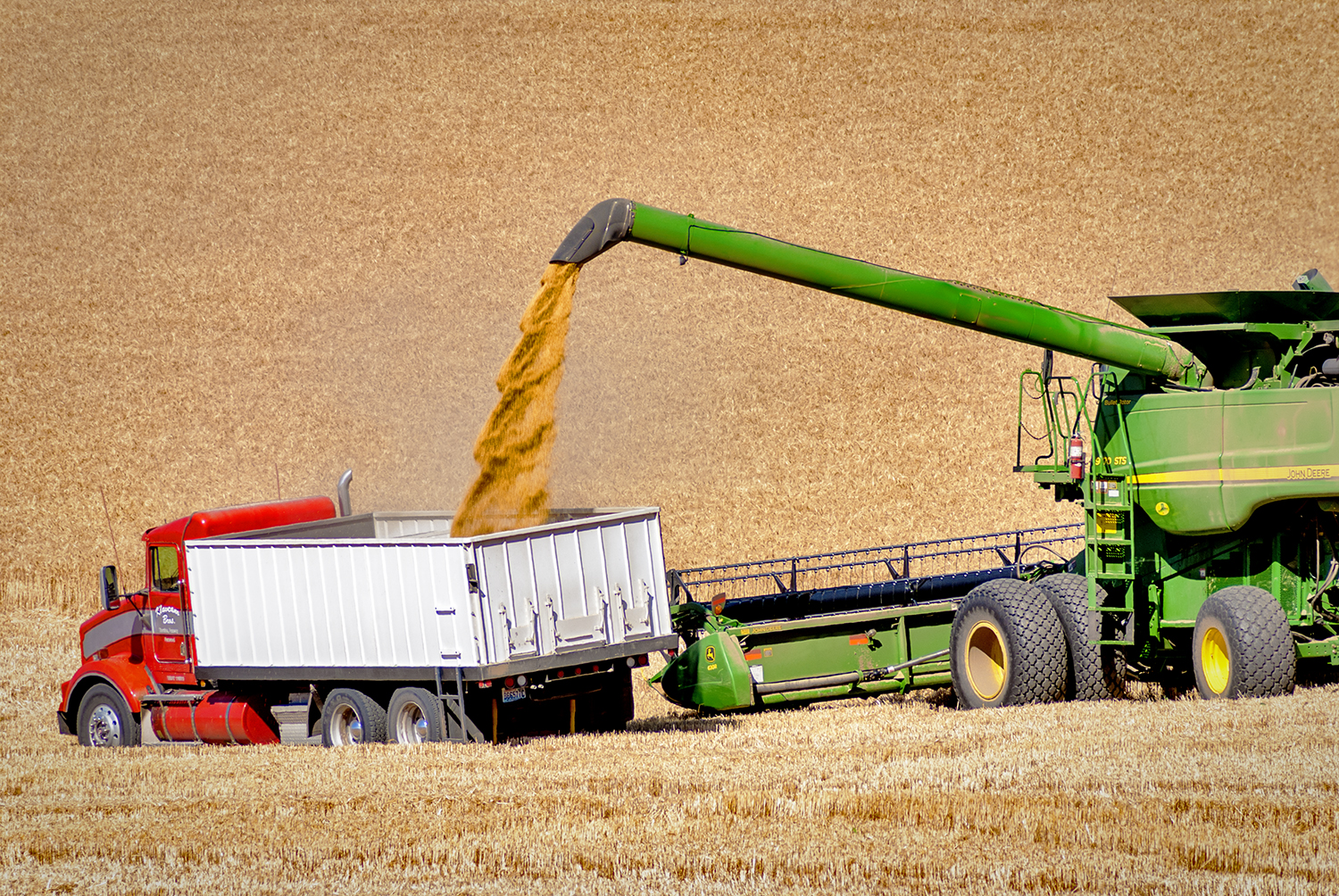
According to the U.S. Department of Agriculture, Virginia’s farmers produced more than half a billion bushels of grain and soybeans between 2006 and 2012. And the Virginia Farm Bureau Federation Grain Marketing Division moves millions of those bushels across the state annually.

An important part of the grain supply chain is farmers’ sale of those commodities. Profits are made through timely decisions on how and where to market crops, and the VFBF grain division helps with those sales. The program, which is approaching its 45th year, connects Virginia grain producers with buyers and markets.

“I work with about 17 buyers and dump trucks at 25 destinations to try and figure out what the best net price is,” explained Robert Harper, VFBF grain manager. “My job is to help farmers get the best prices for their grains.”

VFBF is one of only a few state Farm Bureaus that offer such a service to their members. Its grain division is a licensed grain dealer that Farm Bureau put in place in 1972 to help producer members buy and sell bulk loads of grains.

“Farmers in the late 1960s wanted access to more markets. They solicited $65,000 from 311 members in 22 counties to fund the first grain manager position at Farm Bureau,” explained Harper, who is the fifth grain manager. He works closely with a senior agriculture market analyst and accounting staff. Farm Bureau also offers its members access to a broker to hedge and to buy and sell options on their production.

When the division began, very few farmers had semi-trucks to move grain to destination markets. Farm Bureau gave them access to trucks and developed better basis prices—the difference between the futures market and the local cash price—by pooling bushels for members.

Harper, a former Virginia Cooperative Extension agent, has been selling grain for producers since 2014. He acts as a hub to connect producers with buyers and carriers.

“Some producers choose to have grain or beans picked up at the farm, and some choose to deliver themselves. Producers appreciate this flexibility,” he said.

Contact Harper at 804-290-1105.