Copenhaver Appointed New VDACS Commissioner

Brad Copenhaver has been appointed Commissioner of the Virginia Department of Agriculture and Consumer Services. He has served as Deputy Secretary of Agriculture and Forestry since May 2018, where he led the Northam Administration’s legislative efforts to legalize cannabis for adult use, regulate hemp-derived oils intended for human consumption, maintain federal produce safety compliance, and meet Virginia’s Chesapeake Bay cleanup commitments with regard to urban fertilizer application.

Brad grew up on his family’s beef cattle and burley tobacco farm in Washington County. After working on Capitol Hill as a legislative correspondent for Congressman H. Morgan Griffith, he was the Director of Government Affairs at the Virginia Agribusiness Council, where he worked closely with the General Assembly and Virginia congressional delegation on a variety of issues including animal welfare, food safety and labeling, the environment and water quality, and international trade. Brad was a Pamplin Scholar at Virginia Tech and graduated with degrees in political science and agricultural economics and completed his Master of Business Administration degree at the University of Washington. During his education career, Brad has served as a National Beef Ambassador, Virginia 4-H President, and treasurer of the UW Graduate and Professional Student Senate, and he spent summers working with the U.S. Department of Agriculture in Washington, D.C., the U.S. Meat Export Federation in Tokyo, and Bryant Christie, Inc., an agricultural exports consulting firm in Seattle.
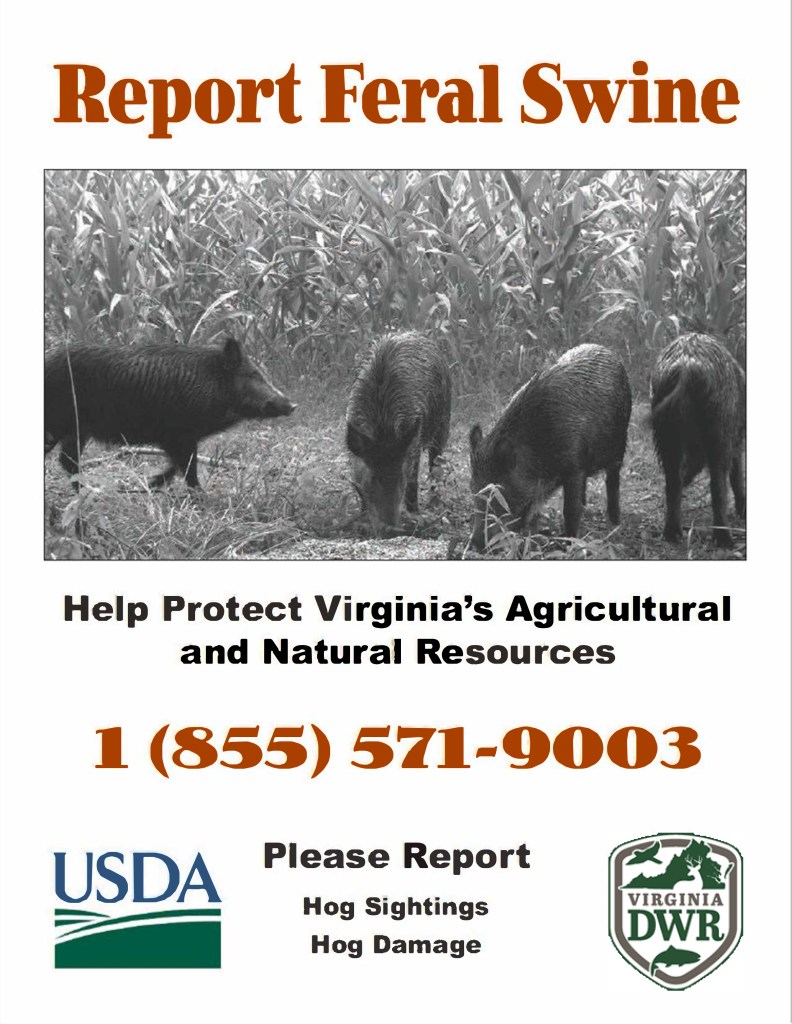
Farmers Encouraged to Report Feral Hog Sightings

As farmers know, feral hogs can be detrimental to crops, pastures, and infrastructure, as well as a serious risk for the spread of disease to livestock. Wildlife agencies, in cooperation with various stakeholders across the commonwealth, have managed to suppress the population in Virginia, but there is still work to be done to achieve eradication. Farmers who see feral hogs or experience hog damage are encouraged to contact the Wildlife Conflict Helpline at 1 (855-571-9003).

Virginia Farm Bureau members with questions or concerns can also contact Stefanie Taillon at 804-363-9505 or stefanie.taillon@vafb.com.

USDA Expands Aquaculture Disaster Assistance to Include Fish Raised for Food

In response to catastrophic aquaculture losses due to major winter storms that hit states along the U.S. Gulf Coast in February, the U.S. Department of Agriculture’s (USDA) Farm Service Agency (FSA) today announced a policy change that makes food fish and other aquatic species eligible for the Emergency Assistance for Livestock, Honey Bees and Farm-raised Fish Program (ELAP). Previously, only farm-raised game and bait fish were eligible for death loss ELAP benefits. Beginning June 1, eligible aquaculture producers can request ELAP assistance for 2021 losses. This policy change is for the 2021 and subsequent program years. 

ELAP provides financial assistance to eligible producers of livestock, honeybees and farm-raised fish for losses due to disease, certain adverse weather events or loss conditions, including blizzards and wildfires, as determined by the Secretary. 

To be eligible, losses must have occurred on or after Jan. 1, 2021. For farm-raised fish and other aquatic species death losses only that occurred prior to June 1, 2021, FSA is waiving the requirement to file a notice of loss within 30 calendar days of when the loss is apparent.  An aquaculture producer will still need to be able to provide contemporaneous records upon request to document the eligible loss event and demonstrate the beginning and ending inventory. The deadline to file an application for payment for the 2021 program year is Jan. 31, 2022. 

“We want producers of all kinds to know that we’re listening. Today’s announcement demonstrates that USDA is committed to helping the aquaculture industry recover from losses due to Winter Storm Uri and other disaster events,” said FSA Administrator Zach Ducheneaux.  “We are pleased to offer these policy flexibilities and related financial relief to impacted aquaculture producers; and we encourage them to contact their local FSA office for assistance.” 

USDA also announced today that it will purchase up to $159.4 million in domestically produced seafood, fruits, legumes, and nuts for distribution to a variety of domestic food assistance programs, including charitable institutions, under the authority of Section 32 of the Agricultural Adjustment Act. The bulk of today’s purchase includes American seafood—the largest single purchase of American seafood in the Department’s history. Combined, these actions will address disruptions in the food production and supply chains resulting from the COVID-19 pandemic. 

Takeaways From the 2021 Animal Agriculture Alliance Stakeholders Summit

Stefanie Taillon, Assistant Director

Virginia Farm Bureau is a member of the Animal Agriculture Alliance, a national organization dedicated to bridging the communication gap between farm and food communities. Each year, the Alliance hosts a Stakeholders Summit, which is a fantastic opportunity to interact with a wide variety of people involved in the livestock industry, from farmers to scientists to nutritionists, and learn about the latest developments in all things animal agriculture. For the past two years, the event has been virtual, but still informative and engaging. Here are some of my takeaways from the presentations and discussions at this year’s conference:

  1. Animal agriculture has learned a lot about communication over the years. Dr. Alison Van Eenennaam, an animal biotechnology and genomics expert from the University of California, Davis, shared that 37% of U.S. adults believe GMOs are safe to eat compared to 88% of scientists and reminded us that fears are difficult to address using logic and reason. While it’s frustrating to see some groups use the “FUD” tactic (Fear, Uncertainty, Doubt) against us, we as an industry can do better than that. Animal agriculture has a positive and compelling story to tell if we share it early, before the narrative is shaped for us, and in a creative manner. There’s not just “one” way to communicate information. To increase transparency for customers, Smithfield Foods created an ingredient glossary to explain what exactly those unknown ingredients on the back of the package are used for. Corteva Agriscience focuses on “putting agriculture’s voice in unexpected places”, such as partnering with the BBC on their Follow the Food series. Filament, an animal agriculture marketing company, goes to great lengths to make sure all the graphics they create accurately represent farming realities—even making sure a hay icon looks like alfalfa and not straw!
Continue reading

Faces of Virginia Farming: Featuring the Real Farm Moms of VA

Virginia Farm Bureau hosted the second episode of its new webinar series, “Faces of Virginia Farming” on May 6th.  Behind every piece of food and fiber is a person with a unique story, and Faces of Virginia Farming gives the public an opportunity to hear directly from these farmers and connect with the people who grow what they eat and wear.

Just in time for Mother’s Day, the episode featured an engaging group of women from across the state who are directly involved in all aspects of their farms, hold leadership positions on boards and community organizations, and work off-farm jobs–all while keeping their families straight!

Putting the “real” in Real Farm Moms were Shelley Butler Barlow of Cotton Plain Farms in Suffolk; Sarah Rudolph of Double R Farms in Wythe County; and Kari Sponaugle of Church Hill Produce in Highland County. They shared authentic and entertaining stories of life on the farm, misconceptions they face, and why they trust our food and fiber supply.

If you missed the episode, you can watch it here. To stay informed of future events, follow Virginia Farm Bureau Federation on Facebook or email facesofvafarming@vafb.com with questions.

Bill to Increase Carbon Market Participation for Farmers Reaches Senate

Legislation that would help farmers participate in carbon markets has been reintroduced to the U.S. Senate for consideration after clearing the Senate Committee on Agriculture, Nutrition and Forestry on April 22.

The Growing Climate Solutions Act would establish a certification program through the U.S. Department of Agriculture to eliminate barriers that have limited farmers’ involvement in carbon credit markets. The bill previously was introduced in 2020.

The Greenhouse Gas Technical Assistance Provider and Third-Party Verifier Certification Program would address previous issues relating to carbon markets, including a lack of reliable market information and access to qualified technical assistance providers and credit verifiers.

The certification program would ensure third-party assistance providers and credit verification services have agricultural expertise. It also would connect farmers with groups that would assist in monetizing sustainable land management practices.

Additionally, USDA would create a website to provide information for farmers interested in participating in carbon markets.

Continue reading

Know Your Limit When Hauling Products to Market

Andrew Smith, Associate Director

Planting season is well on its way, and you can just see the small grain growing. Before you know it, combines will be rolling in the fields. With that in mind, I thought it would be a good time to remind farmers to know their limit when hauling products to market.

It’s even more important to know what you can do, and where you can do it. I say this because the Virginia Department of Transportation is under guidance from the U.S. Department of Transportation to review and post weight limits on all bridges in the Commonwealth. So, you must pay attention to the bridges you cross to get from farm to market. Exemptions and allowances enjoyed by various industries do not allow you to violate weight limits on bridges. Some of the new postings have prompted discussions with agencies to find solutions to downgraded bridges until they can be improved or replaced.

Farmers enjoy several exemptions and allowances in a variety of areas of hauling agricultural products, but it’s important to have a good understanding of what they are and how they apply.

One of the best allowances we have is when you have your truck registered with the registered Farm Vehicle (F-tag) from the DMV. When you have this plate, you get an extra 5% allowance of weight. It’s one of the benefits of putting a registered farm plate on your vehicles. This is included in § 46.2-1128 of the Virginia Code.

Continue reading

Farmers Encouraged to Coordinate Emergency Plans with First Responders

National agriculture associations are urging farmers to engage with local first responders to prepare action plans for farm emergencies. Some of Virginia’s agriculturalists are already a step ahead.

The U.S. Poultry and Egg Association and other commodity groups recently released the first in a series of videos that will help farmers identify essential aspects of emergency action plans for their operations.

The initiative emphasizes the advantages of engaging with local emergency professionals—a measure one Hanover County farm family implemented in March. The farm hosted personnel from Henrico Technical Rescue Team who demonstrated grain bin extrication equipment provided by Virginia Farm Bureau Federation’s Farm Safety Advisory Committee.

Such coordination efforts allow responders to better understand the potential hazards they may face when responding to an on-farm emergency. They also give farmers insight into the accident response capabilities available within their communities.

Henrico County’s specialty unit is trained for unusual rescue situations like extrications or incidents involving confined spaces. The March trainings at Engel Family Farms in Hanover County were led by Lt. Charles Smith of Henrico Firehouse 1.

Continue reading