 Governor Ralph Northam today announced the recipients of fiscal year 2019 farmland preservation grants. Six localities have been awarded a total of $633,831 from the Virginia Department of Agriculture and Consumer Services’ (VDACS) Office of Farmland Preservation. The funds will be used to permanently preserve working farmland through local Purchase of Development Rights (PDR) programs. PDR programs compensate landowners who work with localities to preserve their land permanently by voluntarily securing a perpetual conservation easement.
VDACS has allocated funding to Albemarle, Clarke, Fauquier and Stafford counties as well as the cities of Chesapeake and Virginia Beach. These grant allocations bring the total allocation of state matching funds to $12.4 million since 2008, when PDR funds were first distributed.

 U.S. Secretary of Agriculture Sonny Perdue today announced that many Farm Service Agency (FSA) offices will reopen temporarily in the coming days to perform certain limited services for farmers and ranchers. The U.S. Department of Agriculture (USDA) has recalled about 2,500 FSA employees to open offices on Thursday, January 17 and Friday, January 18, in addition to Tuesday, January 22, during normal business hours. The offices will be closed for the federal Dr. Martin Luther King, Jr. holiday on Monday, January 21.
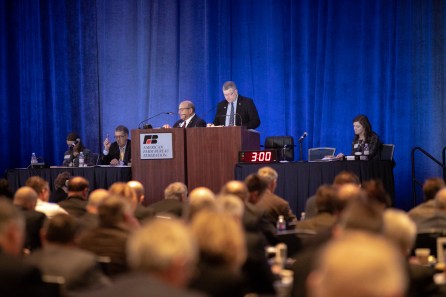 Farmer delegates to the American Farm Bureau Federation’s 100th Annual Convention today adopted policies to guide the organization’s work during its centennial year on key topics such as farm bill implementation, cell-cultured food products, trade, rural broadband access and rural mental health programs.
 American Farm Bureau Federation policy experts gave an overview of the issues expected to affect farmers and ranchers in 2019 in a workshop at the organization’s 100th Annual Convention.
 In front of a celebratory gathering of approximately 7,000 farmers and ranchers from across the nation, American Farm Bureau Federation President Zippy Duvall opened AFBF’s 100th Annual Convention by outlining a few of the organization’s many historic accomplishments – from leading the way on the nation’s first farm bill in the 1930s to helping develop the Food for Peace Program in the 1950s. As AFBF heads toward a new century of service to America’s farm and ranch families, Duvall said the organization will continue to be guided by the honorable principle that “farmers want to feed people.”
 The American Farm Bureau Federation presented awards to state Farm Bureaus at the organization’s 100th Annual Convention. The awards recognized excellence in implementation of outstanding member programs and membership achievement in 2018.
 Virginia farmers will help mark a milestone this month when they attend the 100th
  The U.S. Department of Agriculture (USDA) has announced an extension to the original deadline for Market Facilitation Program applications. Agricultural producers who are seeking payments through the program, which is a part of the trade mitigation initiative, will now have more time to submit their applications.
