The Virginia Department of Wildlife Resources (DWR) has launched its biennial regulation review process, offering citizens an opportunity to shape the Commonwealth’s wildlife management policies for 2025-2026. The department is specifically seeking public input on potential modifications to hunting, trapping and broader wildlife regulations.
This comprehensive review process follows a structured timeline: After collecting public suggestions, DWR staff will carefully evaluate all submissions and develop evidence-based recommendations. These recommendations will be presented to the DWR Board in Spring 2025, followed by an additional public comment period before final adoption.
Of particular interest, the Virginia Farm Bureau Federation’s Governmental Relations team will submit formal comments addressing wildlife depredation and governance issues, aligned with currently adopted organizational policies.
Stakeholders interested in submitting comments that support Virginia Farm Bureau Federation positions on wildlife management have until December 6 to participate in this important regulatory process.
American Farmland Trust and the Virginia Soil Health Coalition are collaborating to offer the Healthy Soils Grant Program. The program encourages producers and partners to pilot impactful ideas that innovatively fill gaps and address barriers to the adoption of soil health-building systems. This program aims to incentivize the adoption of practices and transformation of systems that go above and beyond current standards, supporting farmers, ideas, and expenses that are ineligible for other programs. Awards up to $30,000 for a single producer or $50,000 for a group of producers will be considered.
Applications for the 2024-2025 grant cycle are now open and will be accepted through November 15, 2024.
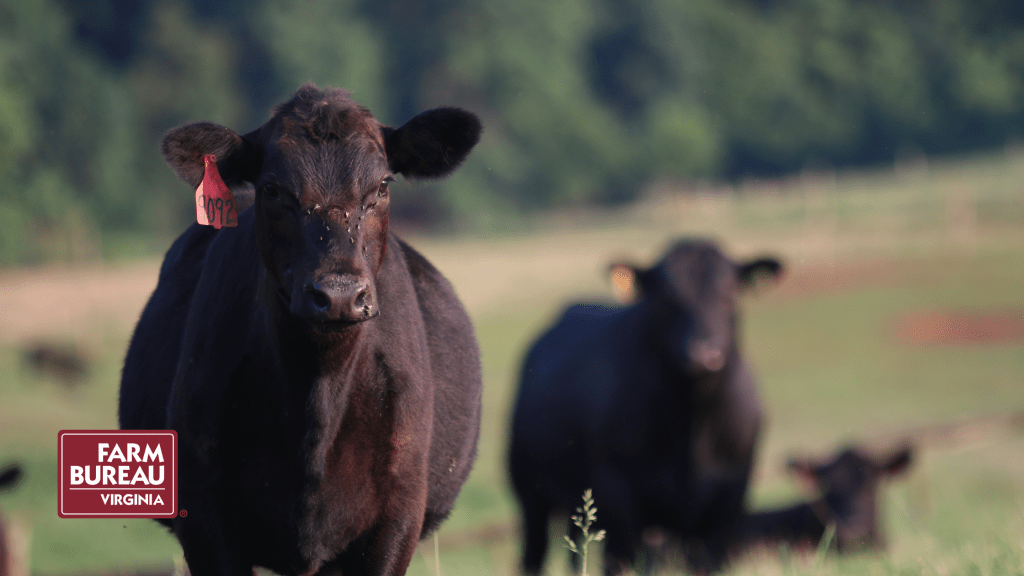
A new USDA- APHIS rule for animal disease traceability begins November 5 regarding what type of identification is used for transporting certain classes of cattle across state lines. This new rule covers the same classes of cattle that have been required to have some type of visual identification since 2013. Those classes of cattle are breeding cattle that are sexually intact over 18 months of age, all female dairy cattle of any age, male dairy cattle born after March 11, 2013; and all cattle used for rodeo, recreational events, showing or exhibitions.
The former “official identification” included metal ear tags, RFID tags, tattoos and, in some cases, brands. The new 2024 rule requires that the “official identification” be both visually and electronically readable. The only approved electronic identification will be an 840-RFID tag. Cattlemen can currently order the 840-RFID tags at no cost by contacting the Virginia Department of Agriculture and Consumer Services (VDACS) Office of Veterinary Services- Richard Odom at 804-692-0600 or richard.odom@vdacs.virginia.gov.
This rule does not apply to feeder cattle, cattle of any age going directly to slaughter or cattle being transported within the state and not crossing state lines. For example, if you sold bred heifers into another state or purchased bred heifers from another state, those heifers would have required some type of visual permanent identification. The change this year will require that the identification be visually and electronically readable, which will be the 840-RFID tag.
More detailed information and frequently asked questions can be found here:
Both American Farm Bureau and Virginia Farm Bureau have published responses to their respective candidate questionnaires on agriculture issues.
Presidential Candidate Questionnaire
For more than 40 years, American Farm Bureau has asked every presidential candidate to provide responses to issues likely to impact and affect farmers and ranchers and rural communities in the next four years. Both Vice President Kamala Harris and former President Donald Trump have provided their answers. We are sharing their unedited responses so you can read directly from the candidates on their policy positions and direction for our country. Click the button to view their positions.
While Virginia Farm Bureau Federation AgPAC issues endorsements in state races, it does not endorse congressional candidates during federal election years. Instead, Virginia Farm Bureau sends a questionnaire to all candidates with questions regarding federal agriculture issues. Click the button to view their responses.
Deadline to apply for a ballot to be mailed to you: October 25, 2024. Your request must be received by your local voter registration office by 5:00 p.m.
Voter registration offices open for early voting: Saturday, October 26, 2024.
Desi Fresh Foods, a leading U.S. producer of dahi, or South Asian yogurt, and lassi, a drinkable South Asian yogurt, will invest a significant amount of money to open a new manufacturing facility to Frederick County, Va. The new facility will create 56 new jobs and allow the company to significantly increase its current production while committing to source a significant amount of dairy ingredients from local Virginia farmers. The Commonwealth successfully competed with Delaware, New Jersey, Pennsylvania and West Virginia for the project.
“Virginia’s status as the top state for business enables opportunities like this, where we can bring in a leading food manufacturer that will support more routes to market for our dairy farmers while also strengthening the local economy and workforce,” said Gov. Glenn Youngkin. “The Commonwealth is committed to business development and the growth of our largest private industry – agriculture. Desi Fresh Foods will be an asset to the community of Frederick County and its local dairies.”
“Virginia dairy farmers’ high-quality products will be an asset to Desi Fresh Foods’ ability to continue being a leading manufacturer of South Asian dairy products,” said Secretary of Agriculture and Forestry Matthew Lohr. “We’re pleased Desi Fresh Foods recognized the benefits of relocating their facility to Virginia, and we are proud to support this project and its 56 new jobs with the Governor’s Agriculture and Forestry Industries Development Fund.”
“After an exhaustive search, we are thrilled to be opening our new facility in Northern Virginia,” said CEO of Desi Fresh Foods Larry LaPorta. “This move will not only allow us to streamline operations and increase production, but give us access to quality, essential ingredients that will help foster the growth of Desi Fresh Foods in the future and set us up for long-term success.”
“We appreciate Desi Fresh Foods’ decision to locate its operations in Frederick County, as well as its commitment to supporting Virginia dairies,” said chairman of the Frederick County Board of Supervisors Josh Ludwig. “Their presence enhances our local food economy, which encompasses farms, agribusinesses, suppliers, and our second-largest manufacturing sector—food manufacturing. We are excited about their future success in our community.”
“As a lifelong Virginia dairy farmer, I’m delighted Desi Fresh Foods is opening a new facility in Frederick County,” said Senator Timmy French. “The agricultural industry welcomes this opportunity and values the investment it brings to Virginia and the local economy.”
“We are so pleased to hear that Desi Fresh Foods is relocating to Frederick County,” said Delegate William D. Wiley. “This is exactly the type of industry that we are targeting and they will complement the existing dairy industry that we embrace.”
Founded in 2000, Desi Fresh Foods is a New York-based manufacturer of Indian-style spoonable and drinkable yogurt products that are distributed nationwide to retailers and food service customers. The company is the leading producer of dahi (a South Asian yogurt) and lassi (a drinkable South Asian yogurt) in the United States. Desi Fresh Foods’ product line includes whole milk, low-fat, fat-free, and organic yogurt and lower-fat paneer and lassi, sold through ethnic and mainstream retailers, and food service customers.
The Virginia Economic Development Partnership and the Virginia Department of Agriculture and Consumer Services worked with the Frederick County Economic Development Authority to secure the project for Virginia. Governor Youngkin approved a $150,000 grant from the Commonwealth’s Opportunity Fund and a $150,000 grant from the Governor’s Agriculture and Forestry Industries Development Fund to assist Frederick County with this project.
Support for Desi Fresh Foods’ job creation will be provided through the Virginia Talent Accelerator Program, a workforce initiative created by VEDP in collaboration with the Virginia Community College System and other higher education partners, with funding support from the Governor’s administration and the Virginia General Assembly. Launched in 2019, the program accelerates new facility start-ups through the direct delivery of recruitment and training services that are fully customized to a company’s unique products, processes, equipment, standards, and culture. All program services are provided at no cost to qualified new and expanding companies as an incentive for job creation.




 Plows and Politics