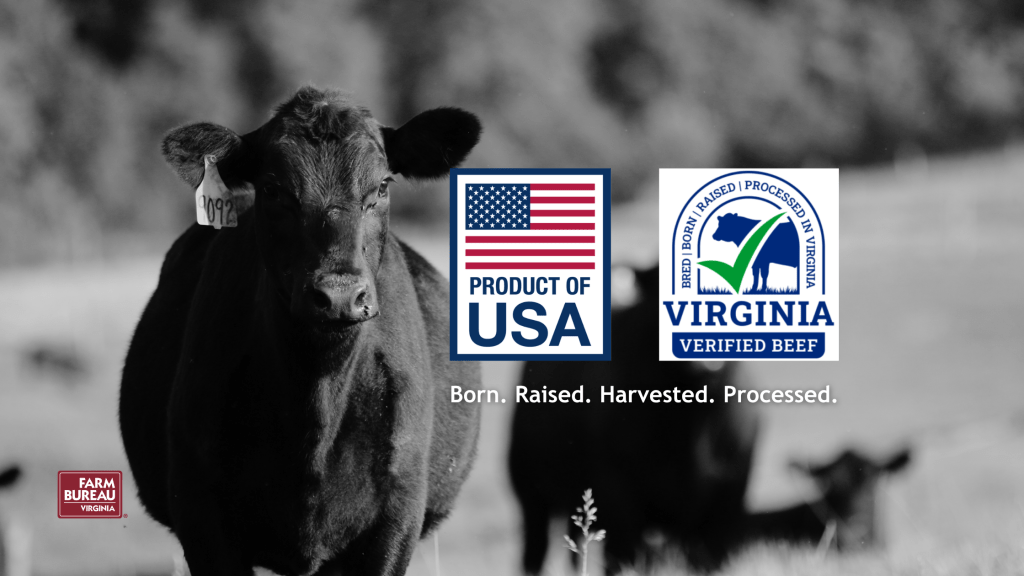
USDA launches campaign to promote strengthened ‘Product of USA’ label

U.S. Secretary of Agriculture Brooke Rollins announced a national campaign to promote the updated “Product of USA” voluntary labeling standard for meat, poultry and egg products. The standard, which took effect Jan. 1, requires that animals be born, raised, harvested and processed in the United States for a product to carry the label.

Rollins said the change is designed to provide transparency for consumers and ensure that farmers committed to a fully domestic supply chain can compete fairly.

Administration officials noted that the update comes as the U.S. continues to lose family farms and faces a 75-year-low national cattle herd, even as consumer demand for beef has grown.

The updated definition ends the previous practice of allowing imported meat to qualify as domestic after minimal processing. Companies choosing to use the label must meet the fully U.S.-sourced requirement.

Virginia agriculture leaders say the shift aligns closely with state efforts to strengthen local beef production. The Virginia Verified Meat program, launched in 2025, certifies beef born, raised and processed within the commonwealth. Created through 2024 legislation, the program aims to support local producers, ensure truth in labeling, and increase consumer trust in Virginia-sourced meat. It also complements recent state legislation requiring lab grown or cell-cultivated proteins to be clearly labeled to prevent misleading marketing.

Jake Tabor, Virginia Farm Bureau legislative specialist for livestock issues, said the federal and state standards work hand in hand.

“Virginia’s livestock producers take pride in raising a high-quality product from start to finish, and both the ‘Product of USA’ and Virginia Verified Meat standards help ensure that commitment is recognized,” Tabor said. “Clear labeling gives Virginia farmers the fairness they deserve and gives consumers confidence that choosing local truly supports our communities.”

The announcement is part of USDA’s broader effort to strengthen domestic processing capacity and support American farmers.

EPA Expands E15 Fuel Availability to Lower Costs at the Pump

The U.S. Environmental Protection Agency announced a temporary emergency fuel waiver that will allow nationwide sales of E15 gasoline and remove federal barriers to selling E10 fuel across the country. The action, taken in consultation with the Department of Energy and under authority of the Clean Air Act, is designed to strengthen the domestic fuel supply and provide Americans with relief at the pump ahead of the summer driving season.

Beginning May 1, 2026, EPA’s waiver will keep E15 — gasoline blended with 15% ethanol — available nationwide and prevent supply disruptions during peak travel months. Without this action, roughly half the country would be unable to sell E15 this summer. The waiver also temporarily removes enforcement of state “boutique fuel” requirements, allowing a consistent national fuel standard and improving distribution efficiency.

EPA Administrator Lee Zeldin said the move will increase fuel supply and consumer choice while maintaining environmental protections. Agriculture Secretary Brooke Rollins emphasized that year‑round access to E15 benefits both drivers and farmers by expanding markets for American‑grown biofuels and supporting domestic energy independence.

E15 is already offered at more than 3,000 gas stations nationwide and is often a lower‑cost option for consumers. By temporarily easing volatility and blending requirements for gasoline, EPA aims to reduce reliance on imported fuel, lower energy costs and reinforce America’s domestic energy supply.

The waiver will initially remain in effect through May 20, 2026, with EPA continuing to monitor fuel supply conditions and prepared to extend the action if necessary.

2026 General Assembly Update: Week 8

Session is wrapping up fast! With just one week to go, our team is hard at work advocating for full funding of AgBMP cost-share programs and supporting key partners like Virginia’s meat processors. As session winds down, we’re gearing up to hit the road for regional policy development meetings. We hope to see you there!